
Zoom R8 Multitrack Recorder Controller Review: The Ultimate All-in-One Portable Studio for Modern Creators
For many of us, the dream of making music often gets bogged down by the very tools meant to facilitate it. I remember sitting in my home studio, staring at a computer screen for six hours, more focused on troubleshooting latency issues and clicking through endless menus than actually playing my guitar. The “DAW fatigue” is real. We search for a way to capture inspiration the moment it strikes, without the barrier of a boot-up sequence or a software update. This is where a dedicated device like the Zoom R8 Multitrack Recorder Controller becomes more than just a piece of gear; it becomes a sanctuary for creativity. Whether you are a solo singer-songwriter needing to lay down tracks in a park or a podcaster requiring a reliable mobile interface, finding a tool that balances portability with professional-grade features is a common hurdle that can stall your artistic momentum if not addressed.
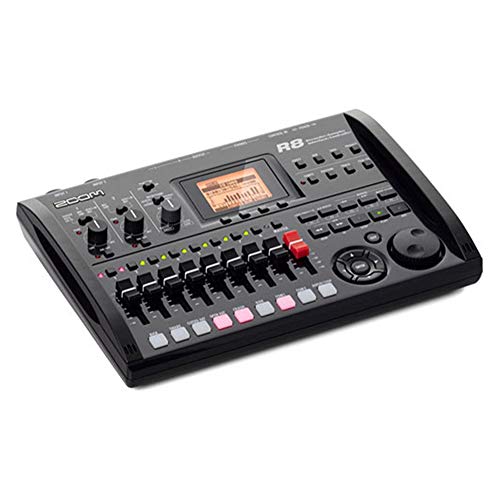
- Digital recorder with 16-track playback and 8-track simultaneous recording utilizing secure Digital (SD) memory
- 16/24-bit/44. 1kHz Linear PCM recording in WAV format
What to Consider Before Buying a Digital Multitrack Recorder
A Digital Multitrack Recorder is more than just an item; it’s a key solution for musicians, podcasters, and sound engineers who value a tactile, focused workflow. These devices allow you to bypass the distractions of a computer, providing physical faders and dedicated buttons that make the mixing process feel like an instrument in itself. By integrating recording, mixing, and often effects processing into a single unit, you eliminate the need for complex routing and multiple peripherals. For the traveling artist, it offers the freedom to record high-quality audio in environments where a laptop setup would be cumbersome or risky.
The ideal customer for this type of product is someone facing the limitations of a “fixed” studio and who craves a “pick up and go” solution without sacrificing sound quality. It’s perfect for songwriters who want to sketch out ideas quickly and for bands who need to record rehearsals with minimal setup. However, it might not be suitable for those who require 64 tracks of simultaneous recording or those who are deeply integrated into a high-end, multi-screen studio environment where a physical controller is secondary to software speed. In those cases, a dedicated high-end audio interface might be a more logical investment.
Before investing, consider these crucial points in detail:
- Dimensions & Space: Consider where you will be using the device most often. If you have a small desktop or plan to record in tight spaces like a tour bus, a compact footprint is essential. You want something that provides enough room for your fingers to move comfortably across the faders without taking up your entire workspace.
- Capacity/Performance: Look closely at how many tracks can be recorded simultaneously versus how many can be played back. For a solo artist, two-track simultaneous recording is usually enough, but a full band might need eight or more. Also, check the maximum SD card capacity to ensure you won’t run out of storage during a long session.
- Materials & Durability: Since these devices are often meant for travel, the build quality is paramount. While plastic chassis are common to keep weight down, the quality of the faders and the tactile response of the buttons will determine how long the device remains functional under heavy use.
- Ease of Use & Maintenance: A multitrack recorder should have an intuitive interface. If you have to consult the manual every time you want to arm a track, it will kill your creative flow. Look for devices with clear screens and a logical menu structure that allows for quick navigation.
Choosing the right recorder is about balancing your specific needs for portability against your requirements for track count and connectivity. While the Zoom R8 Multitrack Recorder Controller is an excellent choice, it’s always wise to see how it stacks up against the competition. For a broader look at all the top models, we highly recommend checking out our complete, in-depth guide:
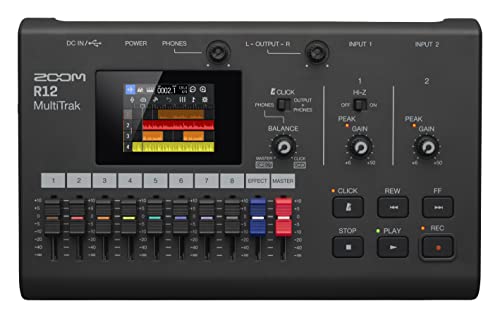
- EIGHT TRACKS WITH A TOUCHSCREEN – Records up to 8 tracks with two XLR/TRS inputs, a full-color LCD touchscreen, and DAW-style editing tools for cutting, copying, looping, and mixing without a...


- CAPTURE BIGGER PROJECTS WITH CONFIDENCE – Record music, interviews, podcasts, video audio, and live performances with a 4-track recorder that helps you capture more of the moment without worrying...
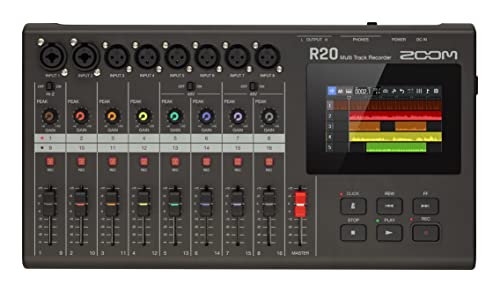
- RECORD WITHOUT A COMPUTER – DAW-style touchscreen interface lets you record, edit, and mix directly on the device with an intuitive, hands-on workflow
First Impressions and Key Features of the Zoom R8 Multitrack Recorder Controller
When I first unboxed the Zoom R8 Multitrack Recorder Controller, I was immediately struck by how lightweight it felt. Weighing in at just 1.23 kg, it feels almost like a toy until you actually power it up and feel the resistance in the faders. The silver finish gives it a professional aesthetic that fits well in any studio or field kit. Unlike its larger brother, the R24, the R8 is incredibly streamlined, making it the perfect companion for a laptop bag. Before you even plug in an external mic, you can see its full feature set and user reviews to understand the depth of engineering Zoom has packed into this small frame.
The layout is exceptionally logical. On the left, you have your two XLR/TRS combo inputs; in the center, the eight faders and the transport controls; and on the right, the jog wheel and menu navigation. One of the most impressive initial discoveries was the built-in stereo condenser microphones. They aren’t just an afterthought; they are surprisingly crisp and capable of capturing high-fidelity ambient sounds or acoustic guitar demos without any extra cables. Compared to older standalone recorders, the R8 bridges the gap between hardware and software by functioning as a 2-in/2-out audio interface and a DAW controller using Mackie Control emulation.
Key Benefits
- Highly portable and lightweight design (only 1.23 kg).
- Functions as a recorder, interface, controller, and sampler.
- Built-in stereo condenser microphones are excellent for quick ideas.
- Supports up to 32GB SDHC cards for massive recording sessions.
Limitations
- Only two simultaneous inputs might be limiting for full bands.
- The screen is functional but small compared to modern tablet displays.
Deep Dive: Performance Analysis of the Zoom R8 Multitrack Recorder Controller
Tactile Workflow and Standalone Recording Power
The primary reason anyone looks at the Zoom R8 Multitrack Recorder Controller is the standalone recording experience. In our testing, the 16-track playback capability allows for surprisingly complex arrangements. You can record two tracks simultaneously—perfect for a vocal and a guitar, or a stereo synth feed—and then overdub until you’ve reached the full 16-track limit. The workflow is incredibly “old school” in the best way possible. You press ‘Record,’ you play, and you move a physical fader to adjust the volume. There is zero latency when recording to the SD card, which is a massive advantage over many entry-level computer interfaces.
We found that the preamps are clean and provide enough gain for most dynamic microphones, though they really shine when used with sensitive condensers. The ability to record in 24-bit/44.1kHz WAV format means your files are professional grade and ready to be dragged into a DAW later for final mixing. However, many users—including myself—find that the onboard mixing tools are so robust that you can often finish a project entirely within the unit. The tactile nature of the faders makes “riding the gain” or performing a manual fade-out feel organic. You should check the latest price and availability to see how this hardware can simplify your creative process.
Versatility: More Than Just a Recorder
What truly elevates the Zoom R8 Multitrack Recorder Controller above its peers is its “Swiss Army Knife” utility. It isn’t just a recorder; it’s a 2-input/2-output USB audio interface. When I connected it to my MacBook, the DAW recognized it immediately. But the real magic happens when you switch it to “Control Surface” mode. Using the Mackie Control emulation, the R8’s physical faders and transport buttons (Play, Stop, Record) control the faders and transport in software like Cubase, Logic, or Ableton. This gives you a physical mixing desk experience for your digital projects.
Beyond that, the R8 includes a pad sampler and a rhythm machine. The eight pads can be used to trigger loops or one-shot samples, allowing you to build drum tracks or soundscapes on the fly. We were particularly impressed with the loop-based sequencer, which lets you trim audio files and assign them to pads for real-time performance. This level of integration is rare in a device at this price point. It’s a feature that really sets it apart from basic recorders that only offer linear tracking. Whether you are using it to control your software or as a standalone sampler, the versatility is unmatched in the portable market.
Onboard Effects and Guitar Mastering
For guitarists and vocalists, the internal processing power of the Zoom R8 Multitrack Recorder Controller is a massive boon. It comes loaded with over 140 studio-quality effects. These aren’t just basic reverbs; we’re talking about sophisticated guitar amp models, various distortion pedals, and even dedicated mastering effects designed to give your final mix that “polished” radio sound. I spent several hours testing the Hi-Z input with an electric guitar, and the emulations of classic tube amps were remarkably responsive to playing dynamics.
The vocal processors include compressors, de-essers, and pitch correction, which are essential for getting a demo to sound professional. What we liked most was the “Insert Effect” and “Send/Return Effect” architecture, which mirrors how high-end studio consoles operate. You can apply a specific effect to a single track or share a lush reverb across multiple tracks. This processing power is all internal, meaning you don’t need a single plugin to get a great sound. We recommend you explore the technical specs further to see the full list of available effects and how they can enhance your specific genre of music.
Portability and Power Flexibility
The “R” in R8 might as well stand for “Road-ready.” One of the most practical features we evaluated was the power options. The Zoom R8 Multitrack Recorder Controller can be powered by the included AC adapter, via USB bus power when connected to a computer, or—most importantly—by 4 AA batteries. On a fresh set of alkaline batteries, we were able to get nearly 5 hours of continuous recording time. This opens up possibilities that a laptop setup simply can’t match. Imagine recording a choir in a cathedral or capturing nature sounds in a remote forest without hunting for a power outlet.
The build, while light, is remarkably sturdy. The knobs have a nice “grip” to them, and the jog wheel is precise, making it easy to find a specific beat for an edit. Because it records directly to SDHC cards (up to 32GB), you don’t have to worry about spinning hard drives failing or being damaged by movement. This reliability makes it easy to secure yours today and start recording anywhere your inspiration takes you. It fits comfortably in a backpack, leaving plenty of room for cables and a microphone, making it the ultimate mobile studio for the traveling creator.
What Other Users Are Saying
The general consensus among the community is that the Zoom R8 Multitrack Recorder Controller is a reliable workhorse that punches far above its weight class. Many users highlight the “honesty” of the device—it does exactly what it says on the box without unnecessary fluff. One user noted, “I’ve used this for five years as my primary sketchpad, and it has never crashed or lost a file.” This sentiment is echoed by many who praise the stability of the SD card recording compared to the occasional glitches found in computer-based systems.
Positive reviews frequently mention the built-in microphones, with one musician stating they were “shocked at how good an acoustic guitar sounds just by placing the unit on a chair in front of me.” On the flip side, some negative feedback focuses on the “menu diving” required for advanced editing. As one user pointed out, “The screen is small, and if you want to do deep sample editing, it can be a bit tedious.” However, most agree that for the core tasks of recording and mixing, the physical controls more than make up for the small display. It’s a balanced piece of gear that rewards those who take the time to learn its deep feature set.
Comparing the Zoom R8 Multitrack Recorder Controller to the Competition
While the R8 is a phenomenal tool, different users have different needs. Let’s see how it compares to three other popular alternatives in the digital multitrack space.
1. Tascam DP-24SD 24-Track Digital Multi-Track Audio Recorder
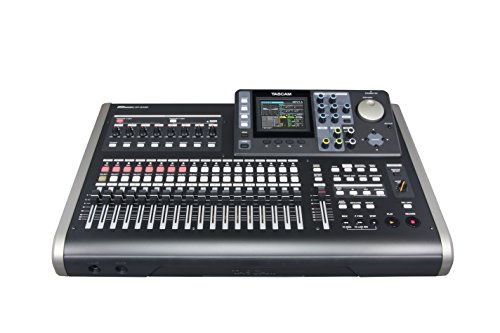
- Item Package Dimension: 23.97L x 17.49W x 7.49H inches
- Item Package Weight - 15.74 Pounds
If the R8 is the portable scout, the Tascam DP-24SD is the stationary general. The Tascam offers a significantly higher track count, with 24 tracks of playback and the ability to record 8 tracks simultaneously via its 8 XLR inputs. This makes it the superior choice for recording a full drum kit or a live band. However, it is much larger, heavier, and lacks the DAW controller and interface capabilities that make the Zoom R8 Multitrack Recorder Controller so versatile for modern hybrid studios. Choose the Tascam if you need sheer track numbers and don’t care about portability or computer integration.
2. Zoom H8 Digital Multitrack Recorder

- ONE RECORDER THAT ADAPTS TO YOUR WORKFLOW – The Zoom H8 is built for creators who switch between setups, with dedicated modes for field recording, music, and multi-person recording.
- TEN TRACKS FROM FOUR XLR INPUTS AND TWO COMBOS – Capture up to 10 individual tracks plus a stereo mix using 4 XLR inputs and 2 combo jacks for microphones, instruments, and more.
The Zoom H8 is more of a handheld field recorder on steroids. It features an innovative “App” based touchscreen interface and can record up to 12 tracks simultaneously with the right capsules. While it is more modern and features a color touchscreen, it lacks the physical faders that make the Zoom R8 Multitrack Recorder Controller so enjoyable to mix on. The H8 is better suited for podcasters and field recordists who need modular inputs, whereas the R8 is better for musicians who want a traditional “studio” feel in a portable package.
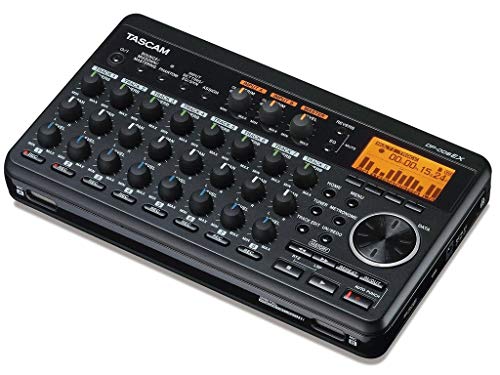
3. TASCAM DP-008EX 8-Track Digital Multitrack Recorder
- Item Package Dimension: 12.51L x 9.68W x 6.76H inches
- Item Package Weight - 2.44 Pounds
The TASCAM DP-008EX is perhaps the R8’s closest competitor in terms of size. It is even smaller and very focused on the “Pocketstudio” concept. It is incredibly simple to use and great for basic songwriting. However, it lacks the R8’s ability to act as a DAW controller and interface, and it doesn’t have the pad sampler or rhythm machine features. The DP-008EX is a great “entry-level” choice for those who want the simplest possible recording experience, but the R8 offers significantly more room to grow as a producer.
The Final Verdict: Is the Zoom R8 Multitrack Recorder Controller Right for You?
After putting it through its paces, the Zoom R8 Multitrack Recorder Controller stands out as one of the most intelligently designed pieces of audio gear in its price range. Its strength lies in its incredible versatility. Whether you use it as a standalone 16-track recorder for late-night inspiration, a tactile controller for your DAW, or a high-quality audio interface, it performs each role with professional competence. The built-in effects and microphones are the icing on the cake, providing a complete production environment that fits in a laptop sleeve.
While the two-input limit might be a dealbreaker for those recording full bands live, for the solo artist, podcaster, or mobile producer, it is nearly perfect. It solves the problem of “DAW fatigue” by providing a hands-on, focused experience that encourages playing over clicking. If you are looking to simplify your setup, increase your portability, and bring a tactile feel back to your music production, the ability to upgrade your recording setup with this unit is an investment you won’t regret. Take a moment to grab this versatile tool for your next project and experience the freedom of a studio that goes wherever you do.
Last update on 2026-09-15 / Affiliate links / Images from Amazon Product Advertising API