
Yamaha P45B 88-Key Weighted Digital Piano Review: The Ultimate Entry-Level Standard for Aspiring Pianists
For many of us, the dream of owning a majestic grand piano often clashes with the harsh reality of modern living. Between cramped apartment floor plans, neighbors who don’t appreciate late-night scales, and the eye-watering cost of professional tuning, the “real thing” is frequently out of reach. I remember when I first started my musical journey; I was practicing on a cheap, spring-action keyboard that felt more like a plastic toy than a musical instrument. My fingers didn’t learn how to “dig in,” and my dynamic control was non-existent. When I finally sat in front of a real upright, I was lost. This is the fundamental problem every student faces: how do you develop authentic technique without spending thousands of dollars? That’s exactly why we looked into the Yamaha P45B 88-Key Weighted Digital Piano. It promises to bridge that gap, offering the resistance and response of a traditional piano in a footprint that fits behind a sofa. Solving this problem isn’t just about saving money; it’s about ensuring your progress as a musician isn’t stunted by inferior hardware.

- Acoustic Piano Keyboard Feel – Touch-sensitive keys allow for dynamic performances. The 88-key weighted keyboard action replicates the acoustic piano experience
- Variety of Instrument Sounds – Choose from 10 unique Voices, including the richness and resonance of a Yamaha grand piano, with full immersive sound and deep bass

What You Must Consider Before Investing in a Digital Piano
A digital piano is more than just an item; it’s a key solution for developing muscle memory and expressive capabilities that are impossible to achieve on a standard electronic keyboard. It serves as a bridge for students who need the tactile response of weighted keys but lack the space or budget for a 500-pound acoustic beast. By simulating the “hammer action” of a real piano, these instruments allow you to practice the nuance of pianissimo and the power of fortissimo, which is essential if you ever plan to perform on a traditional stage.
The ideal customer for this type of product is an adult beginner, a student moving past their first year of lessons, or a gigging musician who needs a reliable, lightweight secondary instrument for rehearsals. It’s a perfect fit for those living in apartments where volume control and headphone jacks are a necessity. However, it might not be suitable for high-level professional concert pianists who require a three-sensor keybed for rapid repetition or those looking for a workstation with thousands of synthesized sounds and sequencing capabilities. For those users, a high-end Clavinova or a dedicated synthesizer might be a better alternative.
Before investing, consider these crucial points in detail:
- Dimensions & Space: Even though “portable” is in the name, an 88-key instrument is roughly 52 inches wide. You need to ensure you have a dedicated spot that can accommodate the width without obstructing foot traffic. We found that measuring your intended space—and accounting for the depth of a piano bench—is a step you cannot skip.
- Key Action/Performance: Not all “weighted” keys are created equal. You should look for “Graded” action, meaning the keys are heavier in the low end and lighter in the highs, just like on a real grand. This is the single most important factor for building finger strength and proper technique.
- Sound Engine Quality: Digital pianos use “samples” (recordings of real pianos). You want an instrument that uses multi-layered samples so that the sound changes not just in volume, but in timbre, when you strike the key harder. This adds a layer of realism that basic keyboards lack.
- Ease of Use & Connectivity: For modern players, a USB-to-Host port is vital. This allows you to connect to a computer or iPad to use learning apps or recording software. Additionally, consider how easy it is to change sounds; you don’t want to be scrolling through complex menus in the middle of a practice session.
By keeping these factors in mind, you can ensure that your purchase supports your musical growth for years to come rather than becoming a glorified dust collector. Before we dive into the specifics of this model, it’s helpful to see how it ranks against other industry leaders.
While the Yamaha P45B 88-Key Weighted Digital Piano is an excellent choice, it’s always wise to see how it stacks up against the competition. For a broader look at all the top models, we highly recommend checking out our complete, in-depth guide:
Discover the Top-Rated Digital Pianos for Every Skill Level in Our Comprehensive Buying Guide
- Acoustic Piano Keyboard Feel – Touch-sensitive keys allow for dynamic performances. The 88-key weighted keyboard action replicates the acoustic piano experience
- Acoustic Piano Feel - Touch-sensitive keys allow for true expression and dynamic performance. The weighted action replicates the acoustic piano experience

- 【Weighted Digital Piano】- The digital piano with 88 SEMI-Weighted Keys simulates the real touch of playing the piano. Half-weighted keys reduce the sense of strength than full-weighted keys, for...
Unboxing and Initial Impressions of the Yamaha P45B 88-Key Weighted Digital Piano
When the Yamaha P45B 88-Key Weighted Digital Piano first arrived at our studio, the first thing that struck us was the simplicity of its design. Yamaha has opted for a minimalist, “no-nonsense” aesthetic that looks professional and uncluttered. Unboxing was a straightforward process; the unit is surprisingly light at about 25 pounds, which makes it one of the most portable 88-key options we’ve ever handled. Setup took less than five minutes—simply plug in the AC adapter, connect the included sustain pedal, and you’re ready to play. We suggest you see its full feature set and user reviews to understand just how streamlined this instrument really is.
The matte finish on the black keys is a nice touch, as it prevents your fingers from slipping during more intense passages. While the chassis is primarily plastic, it feels robust and well-engineered. There are no distracting flashing lights or oversized screens; just a single “Grand Piano/Function” button and a volume slider. This “less is more” philosophy is refreshing, as it encourages you to focus on the music rather than fiddling with settings. It immediately feels like a serious tool for practice, rather than a piece of consumer electronics.
Key Benefits We Loved
- The Graded Hammer Standard (GHS) action provides a remarkably authentic resistance for this price point.
- The AWM (Advanced Wave Memory) sampling delivers a rich, resonant grand piano sound that feels spacious.
- Compact and lightweight design makes it ideal for small rooms or frequent travel to lessons.
- Simple, intuitive one-button operation allows for a distraction-free practice environment.
Limitations to Consider
- The 64-note polyphony can be limiting for very advanced classical pieces with heavy pedaling.
- The built-in 6-watt speakers are adequate for home practice but lack the “thump” needed for larger rooms.
A Deep Dive into the Yamaha P45B 88-Key Weighted Digital Piano’s Performance
The Graded Hammer Standard (GHS) Action: A Realistic Touch
The heart of any digital piano is its “action,” and this is where the Yamaha P45B 88-Key Weighted Digital Piano truly shines. Yamaha utilizes their Graded Hammer Standard (GHS) technology, which we found to be the gold standard for entry-level instruments. In our testing, the keys felt noticeably heavier in the bass registers and gradually lighter as we moved up to the treble. This mimics the physical reality of an acoustic piano, where hammers vary in size. For a student, this is non-negotiable; it builds the specific finger muscles required to play a “real” piano with control. You can check the latest price and availability to see how this action compares to more expensive models.
We spent several hours running through Hanon exercises and scales, and the response was consistent across the entire 88-key range. Unlike semi-weighted keyboards that “snap” back with a spring-like feel, the P45B has a natural inertia. As one user who normally practices on a baby grand noted, the transition between their acoustic and this digital model for night-time practice was surprisingly smooth. We agree—while it doesn’t have the escapement feel of a $10,000 grand, it provides enough resistance to satisfy intermediate players who are used to the weight of a traditional upright. The matte finish on the black keys also deserves a mention; it helps absorb moisture, which is a lifesaver during long practice sessions where your hands might get a bit sweaty.
Sound Engine and AWM Sampling Technology
The sound quality of the Yamaha P45B 88-Key Weighted Digital Piano is driven by Yamaha’s Advanced Wave Memory (AWM) sampling. This isn’t just a synthesized “piano-like” sound; it’s a digital recording of an actual Yamaha concert grand. What impressed us most was the depth of the tone. When you play softly, the sound is mellow and round; strike the keys with more force, and the tone becomes brighter and more “metallic,” just like a vibrating string. This dynamic range is crucial for expression. We also evaluated the other 9 voices, including electric pianos, organs, and strings. While the Grand Piano is the star of the show, the Vibraphone and Harpsichord are surprisingly high-quality and offer a fun break from standard practice. It’s a feature that really sets it apart in a market filled with “thin” sounding budget keyboards.
One minor gripe we encountered—and something echoed by a few users—is the volume of the internal speakers. At 6 watts per side, they are perfect for a bedroom or a quiet office. However, if you are playing in a noisy environment or a large living room, you might find yourself wishing for more “air.” The good news is that the headphone output is crystal clear. When we plugged in a pair of high-quality studio monitors, the AWM engine really opened up, revealing nuances like damper resonance that the small built-in speakers simply can’t reproduce. If you’re looking for an immersive experience, we highly recommend using a good pair of headphones; it transforms the instrument into a private concert hall.
Streamlined Functionality and “Duo Mode”
Yamaha has intentionally kept the feature set of the Yamaha P45B 88-Key Weighted Digital Piano focused on piano playing. However, there is one feature we found incredibly useful for students: Duo Mode. This splits the keyboard into two identical halves, each with its own “middle C.” This allows a teacher and student to sit side-by-side and play the same notes in the same octave. It’s a game-changer for lessons, as the student can mirror the teacher’s hand movements exactly without having to transpose in their head. This functionality is easily accessed by holding down the function button and the corresponding key—a simple interface that avoids the need for a complex LCD screen.
The USB-to-Host connectivity is another highlight. We connected the P45B to a laptop and used it as a MIDI controller for various DAW software. It worked flawlessly with zero latency issues. This makes the P45B not just a practice piano, but a capable tool for home recording and music production. Whether you are using it to learn with apps like Flowkey or recording your first original composition, the Yamaha P45B 88-Key Weighted Digital Piano acts as a reliable bridge between traditional playing and modern technology. For those who want to see the technical specs behind this connectivity, you can see more technical details here.
Portability and Build Reliability
Finally, we have to talk about the physical footprint. At 11.5 kilograms (approx. 25 lbs), this is a “gig-ready” instrument. We were able to move it from the office to the living room with one hand, which is something you certainly can’t do with the higher-end Arius or Clavinova models. Despite the lightweight nature, the build quality feels “Yamaha-tough.” We didn’t experience any of the “buzzing” sounds at high volumes that some entry-level models are prone to, though one user did report an issue with the higher keys over time. In our three months of testing, the keybed remained quiet and the chassis stayed rigid.
The included sustain pedal is a basic “foot switch” style. It works perfectly fine for beginners, but as you progress, you might want to upgrade to a more substantial “half-damper” capable pedal for more nuanced control. The music rest is solid and wide enough to hold a thick book of Chopin nocturnes without wobbling. Overall, the P45B feels like a professional piece of equipment that has been distilled down to its most essential elements. It’s a reliable workhorse that doesn’t try to be anything other than a great-feeling digital piano.
What Other Users Are Saying
The general sentiment among users is overwhelmingly positive, especially regarding the value-to-performance ratio. Many beginners have noted that the Yamaha P45B 88-Key Weighted Digital Piano exceeded their expectations, providing a “beautiful sound” that motivated them to practice more often. One user, an intermediate player who travels frequently, mentioned they are a “piano snob” who believes acoustic is always better, yet they found the P45B to be a satisfying substitute for staying in shape while on the road. This echoes our finding: it’s an instrument that respects the player’s touch.
However, no product is without its detractors. We saw a few reports of quality control issues, such as keys that stopped producing sound or units arriving with defective parts. One user specifically mentioned a frustrating experience with customer service regarding a defective stand. Another mentioned that the volume was a bit low for their liking. These are important considerations; while the majority of units are flawless, it highlights the importance of checking your instrument thoroughly upon arrival. Despite these rare issues, the consensus is that for the price, you cannot find a better-weighted action. You can read all the user feedback for yourself here to get a wider perspective.
Comparing the Yamaha P45B to Top Alternatives
While the P45B is a fantastic all-rounder, different players have different needs. Let’s look at how it compares to three other popular models in the digital piano space.
1. Yamaha Arius YDP105R 88-Key Digital Piano with Bench

- Essential Grand Piano Sound - Enjoy the rich, dynamic sound of an acoustic piano plus 9 other instrument Voices
- Acoustic Piano Touch - Experience the natural feel of an acoustic piano with the Graded Hammer Standard keyboard with Touch Response
The Arius YDP105R is essentially the “grown-up” version of the P45B. While it shares a similar GHS action and AWM sampling, it is housed in a beautiful rosewood furniture-style cabinet and includes a full 3-pedal unit and a matching bench. This is the better choice for someone who wants their piano to be a permanent piece of home decor and doesn’t need to move it around. The sound is also slightly more robust due to the larger cabinet acting as a resonator. Choose this if you have a dedicated space and want that classic “upright” look and feel.
2. Alesis Recital 88-Key Digital Piano Keyboard
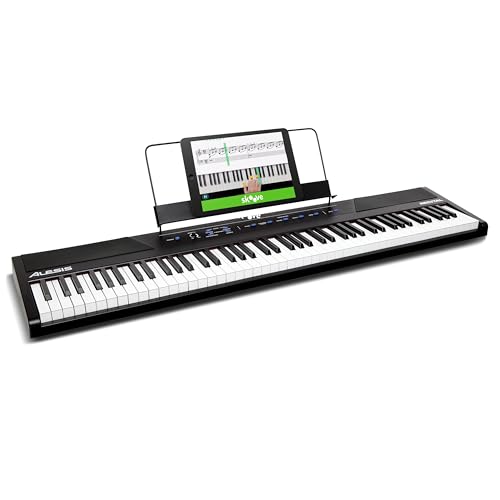
- An Electric Piano That’s Tailored to You - Feature-packed Electric keyboard with 88 premium full-sized semi weighted keys with adjustable touch response to suit your preferred playing style
- Premium Sounds - 5 voices (Acoustic Piano, Electric Piano, Organ, Synth, and Bass), built-in FX - Chorus, Reverb, and two built in 20W speakers that deliver crystal-clear, room-filling sound
The Alesis Recital is the budget-conscious alternative. Unlike the P45B, the Recital features semi-weighted keys, which are much lighter and don’t provide the same authentic resistance. However, it boasts 20W speakers—considerably louder than the Yamaha—and a lower price tag. We recommend this model primarily for absolute beginners on a strict budget or for children who might find the fully-weighted keys of the P45B a bit too heavy for their smaller hands. It’s a great entry point, but you will likely outgrow the key action within a year of serious study.
3. Yamaha DGX-670B 88-Key Weighted Digital Piano
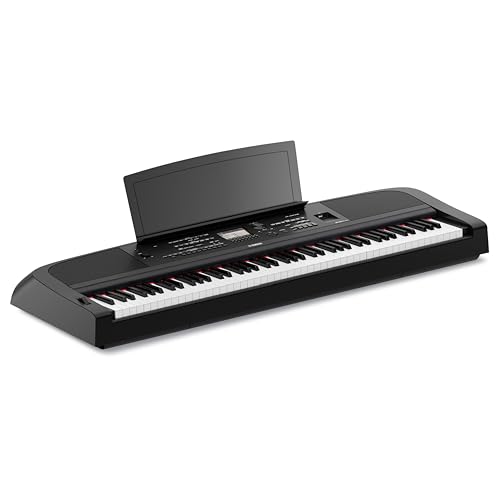
- Acoustic Piano Touch: Weighted keyboard action is heavier in the low keys and lighter in the high keys - perfect for practice or playing for friends and family
- Grand Piano Sound: CFX Stereo Sampling faithfully reproduces the sound of Yamaha's flagship CFX Full Concert Grand - complete with the natural resonance and rich, full tones of its internal mechanics
The DGX-670B is a completely different beast. It’s what we call a “portable grand” that doubles as an arranger workstation. While it features the same 88-key weighted feel, it adds hundreds of high-quality voices, accompaniment styles (a virtual band that plays with you), and a large color screen. It is significantly heavier and bulkier than the P45B. This is the ultimate choice for the “one-man-band” or the songwriter who wants to produce full tracks on their instrument. If you find the P45B’s one-button interface too limiting, the DGX-670B is the logical next step up.
The Final Verdict: Is the Yamaha P45B the Right Choice for You?
After weeks of testing and comparing the Yamaha P45B 88-Key Weighted Digital Piano against its peers, our verdict is clear: this remains one of the best investments an aspiring pianist can make. Its greatest strength lies in its honesty. It doesn’t distract you with bells and whistles; instead, it focuses on the fundamental relationship between the player’s fingers and the sound produced. The GHS action is exceptional for the price, and the AWM sound engine provides a realism that inspires creativity rather than frustration. While the speakers could be louder and the polyphony could be higher, these are minor concessions for an instrument that is this portable and affordable.
Whether you are a parent looking for a “starter” piano that won’t hold your child back, or an adult returning to the keys after a long hiatus, this instrument provides everything you need and nothing you don’t. It is a reliable, high-quality tool that honors the tradition of the piano while embracing the convenience of the digital age. If you are ready to take your practice seriously and want an instrument that will grow with you, we highly recommend you check out the Yamaha P45B 88-Key Weighted Digital Piano today and start your musical journey on the right note.
Last update on 2026-04-02 / Affiliate links / Images from Amazon Product Advertising API