
Yamaha HS8 8-Inch Powered Studio Monitor Pair Review: The Gold Standard for Honest Audio Mixing
There is a specific kind of frustration that every audio engineer, bedroom producer, and even high-end audiophile knows all too well. You spend hours—perhaps days—perfecting a mix in your studio. It sounds lush, the bass is thumping, and the vocals are crystal clear. Then, you take that same track to your car or play it on a friend’s Bluetooth speaker, and it falls apart. The bass is muddy, the highs are piercing, and the balance is completely gone. This “translation” problem is the primary reason why we search for equipment like the Yamaha HS8 8-Inch Powered Studio Monitor Pair. Most consumer speakers are “liars”; they color the sound to make it pleasant. In a professional setting, we don’t need pleasant—we need the truth. Without an accurate reference, you are essentially mixing in the dark, making decisions based on a distorted reality that won’t hold up in the real world. Solving this lack of transparency is crucial if you ever want your work to sound professional across all platforms.
I have spent years testing various monitors, ranging from budget-friendly desktop speakers to high-end boutique arrays that cost as much as a small car. Through this journey, one name has consistently resurfaced in every professional studio I’ve walked into: Yamaha. Specifically, their HS series has inherited the legendary mantle of the NS-10s, aiming to provide that same brutal honesty but with modern power and frequency extension. In this Yamaha HS8 8-Inch Powered Studio Monitor Pair Review, we will explore whether these iconic white-coned speakers are still the best choice for your workstation or if the competition has finally caught up.

- 38Hz - 30kHz frequency response
- 75W LF plus 45W HF bi-amp system for high-performance 120W power amplification
What to Consider Before Investing in Professional Studio Audio Monitors
A Studio Audio Monitors is more than just an item; it’s a key solution for anyone looking to achieve professional-grade audio results. Unlike hi-fi speakers, which are designed to enhance your music for enjoyment, studio monitors are designed for “flat” response. This means they aim to reproduce every frequency at the same volume, without boosting the bass or sparkling the highs. The benefit is that if you can make a mix sound good on these, it will sound good anywhere. This category of equipment is the ultimate diagnostic tool for your ears, allowing you to hear imperfections, phase issues, and frequency masking that would otherwise remain hidden.
The ideal customer for this type of product is someone facing the challenges of critical audio work, such as music production, podcasting, video editing, or professional DJing. If you are serious about your craft and want your output to translate perfectly to different listening environments, an 8-inch monitor is often the “sweet spot” for power and range. However, it might not be suitable for those who have very small, untreated rooms where large 8-inch drivers might create overwhelming bass reflections. For those in tiny spaces, smaller 5-inch versions or high-end headphones might be a more practical starting point before jumping into a full-sized setup.
Before investing, consider these crucial points in detail:
- Dimensions & Space: The size of your monitors dictates the physical space they occupy and the acoustic energy they pump into the room. An 8-inch monitor is substantial and requires a desk or stands that can handle the weight and width. You also need to consider the distance from the wall, as rear-ported monitors need room to “breathe” to avoid artificial bass buildup.
- Capacity/Performance: Look at the wattage and the frequency response. The Yamaha HS8 8-Inch Powered Studio Monitor Pair offers a wide 38Hz to 30kHz range. You want a monitor that can reach low enough to hear the sub-bass without needing a separate subwoofer, which can often complicate the acoustics of a home studio.
- Materials & Durability: Professional monitors are an investment intended to last decades. High-quality enclosure materials and robust driver construction are vital. Look for “matched pair” options where possible to ensure that both the left and right speakers have been calibrated to sound identical, providing a perfect stereo image.
- Ease of Use & Maintenance: While these are “plug and play” in a sense, you need to look for built-in room control settings. These allow you to trim the high frequencies or adjust the low-end response based on where the speakers are placed in your room. Maintenance is usually minimal, but ensuring you have balanced connections (XLR or TRS) is essential for noise-free operation.
Understanding these factors is the first step toward building a studio that works for you rather than against you. While the Yamaha HS8 8-Inch Powered Studio Monitor Pair is an excellent choice, it’s always wise to see how it stacks up against the competition. For a broader look at all the top models, we highly recommend checking out our complete, in-depth guide:

- HONEST. Eris 3.5 near field studio monitors deliver studio-quality, accurate sound perfect for music production, hi-fi audio listening, or multimedia reference.


- PACKAGE INCLUDES: (2) 305P MkII 5 2-Way Powered Studio Reference Monitor Monitoring Speaker
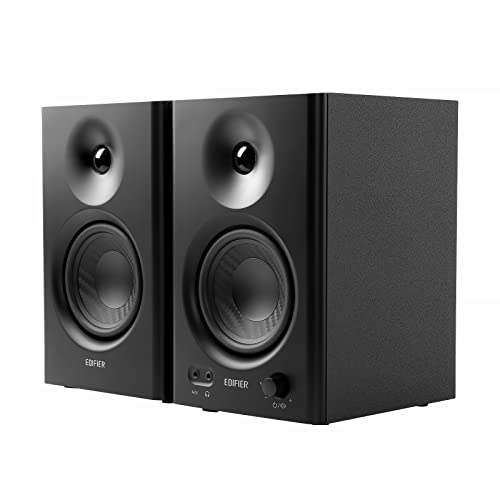
- TRUE STUDIO MONITOR - Based on the highly rated Edifier bookshelf speakers professionally tuned to a responsive almost flat curve for artists and music creators.
First Impressions: Unboxing the Yamaha HS8 8-Inch Powered Studio Monitor Pair
When the Yamaha HS8 8-Inch Powered Studio Monitor Pair arrived at our studio, the first thing we noticed was the sheer weight. Coming in at 56 pounds for the pair, these are heavy-duty pieces of equipment. Unboxing them is a tactile experience that immediately communicates quality. There is no flimsy plastic here; the enclosures are constructed from a dense, high-quality MDF that feels incredibly solid. The signature white cone woofer against the matte black finish is iconic for a reason—it looks professional, minimalist, and timeless.
The initial setup was straightforward. We found that the bi-amplified design (75W for the lows and 45W for the highs) provides a total of 120W of high-performance amplification per speaker. This is more than enough power to fill a medium-to-large room without ever feeling strained. Compared to previous iterations like the HS80, the current Yamaha HS8 8-Inch Powered Studio Monitor Pair feels more refined in its build. The mounting system is sophisticated, designed specifically to eliminate resonance and unwanted vibration. Even before turning them on, the build quality alone suggests that checking the latest price and availability is a move toward a long-term studio centerpiece. The connectors on the back are robust, and the switches for Room Control and High Trim have a satisfying, precise click, indicating that Yamaha hasn’t cut corners on the internal components.
Key Benefits
- Exceptional “flat” frequency response for accurate mixing and mastering.
- Powerful 120W bi-amped system ensures high-headroom and low distortion.
- Incredible build quality and longevity; these units are known to last decades.
- The 8-inch woofer provides enough low-end extension to work without a subwoofer.
Limitations
- Quite large and heavy; requires substantial desk space or dedicated heavy-duty stands.
- Rear-ported design means they require careful placement away from walls to avoid bass buildup.
Deep Dive: Professional Performance and Real-World Testing
To truly understand the value of the Yamaha HS8 8-Inch Powered Studio Monitor Pair, you have to look past the specs and listen to how they translate emotion and technical detail. Over several weeks of testing, we put these monitors through a grueling regimen of mixing sessions, critical listening, and even some light DJing to see how they handled different genres and workloads.
Sonic Accuracy and the Brutal Truth
The most striking feature of the Yamaha HS8 8-Inch Powered Studio Monitor Pair is its commitment to “honesty.” From the moment we fired them up, it was clear that these are not speakers meant for casual, bass-heavy listening—though they are capable of it. Instead, they provide a surgical look at your audio. We found that the 38Hz to 30kHz frequency response is remarkably smooth. In our tests, the transition between the 8-inch cone woofer and the 1-inch dome tweeter was nearly seamless, thanks to the bi-amp system that manages the crossover with expert precision.
When mixing a vocal-heavy track, the HS8s revealed sibilance and “pops” that were completely masked on our smaller desktop units. One user mentioned that these monitors “pack a punch,” and we have to agree, but it’s a controlled punch. The bass doesn’t “bloom” or overwhelm; it’s tight and fast. This is largely due to the large magnets and the Advanced Magnetic Circuit design. If your kick drum is out of phase or your bass guitar is conflicting with your low-end synths, the HS8s will tell you immediately. This level of transparency is why many professionals say, “if it sounds good on the HS8s, it will sound good anywhere.” To experience this level of clarity yourself, you should see its full feature set and user reviews to understand why it remains a studio staple.
The Bi-Amplified Powerhouse and Headroom
Headroom is a term often thrown around in audio, but with the Yamaha HS8 8-Inch Powered Studio Monitor Pair, it’s a tangible benefit. Each speaker utilizes separate power amplifiers for the low-mid and high-frequency units. By having 75W dedicated to the 8-inch woofer and 45W for the 1-inch tweeter, the system avoids the “clumping” of frequencies that happens when a single amp is pushed to its limit. We pushed these monitors to high SPL (Sound Pressure Level) during a live stream DJ set, and the clarity remained pristine. There was no audible distortion or compression of the signal, which is vital for long sessions where “ear fatigue” can become a major issue.
We also evaluated the low-end performance extensively. Many 5-inch or 6-inch monitors leave you guessing what’s happening below 60Hz. With the HS8, we were able to comfortably mix sub-bass elements without reaching for a subwoofer. This makes the Yamaha HS8 8-Inch Powered Studio Monitor Pair an incredibly cost-effective solution, as it essentially performs the role of a full-range system. For producers working in hip-hop, EDM, or cinematic scoring, having that extra “oomph” and accuracy in the low registers is a feature that really sets it apart from smaller competitors.
Build Quality and The 20-Year Test
One of the most impressive things about Yamaha monitors is their legendary durability. During our research, we found users who are still using their original units from 20 years ago. When we hooked up our test pair using high-quality balanced XLR cables, we were met with a silent floor—no hissing, no humming, and no electronic noise. This speaks volumes about the internal shielding and the quality of the components used in the Yamaha HS8 8-Inch Powered Studio Monitor Pair. The enclosure itself is not just a box; it’s a meticulously engineered acoustic environment. Yamaha uses a three-way mitered-joint technique to firmly anchor the corners, which significantly improves durability and eliminates unwanted resonance.
We also investigated the “Matched Pair” (MP) versions that are sometimes available. These units are built at the same time with coincident serial numbers to ensure that the material properties of the components are identical. This results in a stereo image that is frighteningly accurate. When sitting in the “sweet spot” (the centered listening position), the center image of a vocal felt like it was hovering directly in front of our faces, while the reverb tails washed out to the sides with incredible depth. This level of imaging is only possible when the manufacturing tolerances are kept as tight as Yamaha keeps them. You can check the current pricing for these matched pairs to see if they fit your budget, as they are often considered the gold standard for fidelity.
Versatility and Room Adaptation
Every room is different, and a speaker that sounds great in a treated studio might sound terrible in a bedroom with bare walls. The Yamaha HS8 8-Inch Powered Studio Monitor Pair addresses this with its rear-panel controls. The “Room Control” switch is a lifesaver; it allows you to attenuate the low-end if you are forced to place the monitors close to a wall. In our test room, we found that the -2dB setting perfectly cleaned up the “mud” caused by our corner placement. Additionally, the “High Trim” control allows for subtle adjustments to the tweeter’s output, helping you match the brightness of the speakers to the “reverberance” of your room.
We found these controls to be intuitive and effective. They don’t just act as a simple EQ; they feel like they are re-calibrating the speaker for the environment. Whether you are using these for professional studio recording, mixing, or even as high-end monitors for a smartphone-connected workstation, the flexibility is there. The connectivity protocol is primarily XLR and TRS, which are the industry standards for balanced audio, ensuring that your signal remains clean even over longer cable runs. For those who want a speaker that grows with their studio, the HS8 is a wise investment that can be adapted to almost any acoustic scenario.
What Other Users Are Saying
The general sentiment surrounding the Yamaha HS8 8-Inch Powered Studio Monitor Pair is overwhelmingly positive, with a strong emphasis on their value-to-performance ratio. Professionals and hobbyists alike praise the “honest” sound profile. One user noted that after owning the previous HS80 model, the new HS8 felt like a significant upgrade in both clarity and build quality. They mentioned using them for everything from vinyl listening to live DJ streams, highlighting the monitors’ versatility.
Another long-term user shared an incredible story, stating that their pair is nearly 20 years old and still functions perfectly. After connecting them to a modern interface with high-quality balanced cables, they reported “100% clean sound” with literally no noise or hissing. This confirms our findings regarding Yamaha’s exceptional component longevity. International users have also praised the “Matched Pair” (MP) versions, noting that having monitors with coincident serial numbers ensures a level of stereo fidelity that is hard to find in other brands at this price point. While some users did mention that the size can be daunting for smaller rooms, the consensus is that the performance trade-off is well worth the desk space. It is a product that garners respect across the board for its “what you see is what you get” philosophy.
Comparing the Yamaha HS8 to the Top Alternatives
While the Yamaha HS8 8-Inch Powered Studio Monitor Pair is a powerhouse, the market offers several other options depending on your specific needs for portability, budget, or sonic “flavor.” Below, we compare the HS8 to three popular alternatives.
1. IK Multimedia iLoud Micro Monitor Portable Bluetooth Studio Monitors

- The smallest active studio reference monitoring system in the world, iLoud Micro Monitor provides you with ultra-accurate true linear frequency response with no coloration, and does so in every...
- Whether you’re recording, editing, mixing or mastering audio, editing video, sound designing or gaming, iLoud Micro Monitor ensures your production will translate well to the huge variety of...
The IK Multimedia iLoud Micro is the polar opposite of the HS8 in terms of form factor. While the Yamaha HS8 8-Inch Powered Studio Monitor Pair is a heavy, stationary beast, the iLoud Micro is designed for the traveling producer. Surprisingly, for its size, it offers a very flat response and decent low-end, but it simply cannot compete with the physical “air movement” and sub-bass depth of the HS8’s 8-inch woofer. These are ideal for someone working in a tiny hotel room or on the go, whereas the Yamaha is for the dedicated home or professional studio where accuracy at volume is paramount.
2. JBL 305P MkII Powered Studio Monitors
- PACKAGE INCLUDES: (2) 305P MkII 5 2-Way Powered Studio Reference Monitor Monitoring Speaker
- CRYSTAL-CLEAR IMAGING: 305P MkII’s patented Image Control Waveguide delivers precise, immersive sound with a wide sweet spot, ideal for music production and podcasting.
The JBL 305P MkII is a fantastic entry-level alternative. It features a 5-inch woofer, making it much more manageable for small desks. SONICALLY, the JBLs have a slightly wider “sweet spot” due to their unique waveguide design. However, the Yamaha HS8 8-Inch Powered Studio Monitor Pair offers much more authoritative bass and a more “brutally honest” midrange. The JBLs are often described as being slightly more “fun” to listen to, which might actually be a disadvantage when you are trying to find flaws in a mix. For those on a tighter budget with a smaller room, the JBLs are a great choice, but they lack the professional-grade headroom of the Yamahas.
3. KRK Rokit 5 G4 Powered Studio Monitor Pair
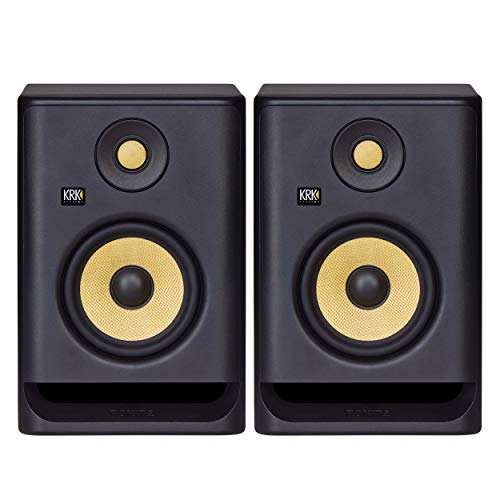
- The KRK ROKIT G4 line has been scientifically re-engineered from the ground up for the way modern artists work—in all genres and environments
- The ROKIT RP5 G4 is an incredibly versatile and sonically accurate bi-amp monitor takes music and sound creativity to a whole new industry-level
The KRK Rokit series is perhaps the biggest rival to Yamaha in the home studio world. The Rokit 5 G4 is known for its punchy low-end and built-in LCD screen for DSP-driven room tuning. While the KRKs are a favorite for EDM and Hip-Hop producers who want a “club-like” feel while they work, we found that the Yamaha HS8 8-Inch Powered Studio Monitor Pair provides a more accurate representation of the frequencies. The KRKs have a reputation for being slightly bass-heavy, which can lead to mixes that are “thin” when played elsewhere. If you prefer a monitor that helps you “feel” the beat, go KRK. If you want a monitor that helps you “fix” the mix, stay with the Yamaha.
The Final Verdict: Is the Yamaha HS8 8-Inch Powered Studio Monitor Pair Right for You?
After weeks of testing and comparing, our verdict is clear: the Yamaha HS8 8-Inch Powered Studio Monitor Pair remains the industry standard for a reason. Its ability to provide an uncompromising, flat, and detailed look at your audio is second to none in this price bracket. It is a tool built for those who value accuracy over flattery. The build quality is exceptional, the power is more than sufficient for almost any studio environment, and the room control features make it surprisingly adaptable despite its large size.
We recommend these monitors to any serious music producer, mix engineer, or video creator who has the space to accommodate them. They are particularly valuable for those working in genres where low-end precision is critical, as the 8-inch drivers eliminate the immediate need for a subwoofer. While they require careful placement and a bit of room treatment to truly shine, the investment pays off every time you hear your mix translate perfectly to the outside world. If you are ready to stop guessing and start hearing the truth in your music, we highly suggest you take the next step and bring the Yamaha HS8s into your studio today. Your ears—and your mixes—will thank you.
Last update on 2026-04-04 / Affiliate links / Images from Amazon Product Advertising API