
Walrus Audio Mako MKII ACS1 Amp Cab Simulator Review: The New Gold Standard for Compact Pedalboard Rigs?
As a session guitarist who has spent the better part of two decades lugging a vintage AC30 up and down narrow club stairs, I know the physical toll of great tone. We all want that visceral, air-moving response of a 12-inch speaker and the harmonic saturation of glowing glass, but the reality of modern touring often demands a “silent stage” or a direct-to-PA solution. For years, the trade-off was stark: you either carried the heavy iron or you settled for sterile, thin digital emulations that felt like playing through a wet cardboard box. I’ve spent countless hours trying to make digital rigs feel “alive,” often failing to find that elusive “bloom” that happens when a guitar interacts with a real transformer. That is exactly why I was so eager to dive into this Walrus Audio Mako MKII ACS1 Amp Cab Simulator Review. We are living in a golden age of modeling, and the MKII promises to bridge the gap between “digital convenience” and “analog soul.” If you’ve been searching for a way to leave the heavy head at home without sacrificing your signature sound, you’ll want to see its full feature set and user reviews to see how far this technology has come.
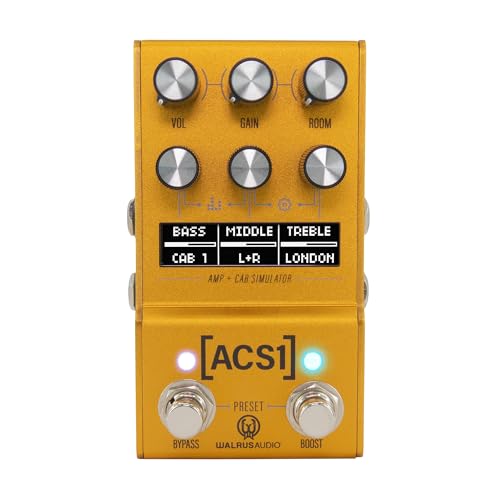
- Has three different types of reverb effects
- Includes six IRs custom-engineered by David Hislop and Kenyon Reed at Tone Factor and six by Justin York of York Audio

What to Consider Before Investing in Electric Guitar Amplifier Cabinets and Simulators
An Electric Guitar Amplifier Cabinet is more than just a box with a speaker; it’s the final filter that shapes your entire musical identity. Whether you are buying a physical cabinet or a high-end simulator like the Walrus Audio Mako MKII ACS1 Amp Cab Simulator, you are essentially choosing the “voice” of your instrument. A great simulator provides the solution to the problems of inconsistent room acoustics, microphone placement headaches, and the sheer volume required to get a tube amp into its “sweet spot.” By moving to a simulator, you gain total control over your signal chain, ensuring your audience hears exactly what you hear in your monitors every single night.
The ideal customer for this type of product is the gigging professional who needs a reliable, consistent direct signal, the home studio producer who can’t crank a 50-watt stack at 2 AM, and the pedalboard enthusiast who wants a “fly-rig” that fits in a backpack. While it might not be suitable for the absolute purist who refuses to play without the physical push of a 4×12 cabinet behind them, or those who prefer a “one-knob” simplicity without the depth of IR loading, for everyone else, it’s a game-changer. If you find yourself constantly fighting with sound engineers over stage volume, this is your exit ramp.
Before investing, consider these crucial points in detail:
- Dimensions & Space: In a physical world, a cabinet takes up massive real estate in your van and on stage. In the digital world, the “space” is your pedalboard footprint. Look for a device that offers stereo functionality without requiring a massive enclosure. The MKII ACS1 manages to cram a dual-amp rig into a standard-sized pedal, which is a feat of engineering that saves both your back and your board space.
- Capacity & Performance: This refers to the processing power and the quality of the Impulse Responses (IRs). You want a unit that can handle high-resolution IRs (24-bit/48kHz) to ensure the nuances of the speaker’s movement are captured. Higher performance means lower latency, which is critical for that “immediate” feel when your pick hits the string.
- Materials & Durability: For a pedal, this means a rugged aluminum chassis and high-quality switches. Since this will be the “heart” of your rig, it needs to withstand years of being stepped on. Look for top-mounted or well-protected jacks to prevent cable strain during tight stage setups.
- Ease of Use & Maintenance: While digital units don’t need tube replacements, they do need firmware updates. A good simulator should have an intuitive interface—knobs for the things you change often (EQ, Gain) and easy-to-navigate menus for the “set and forget” features like noise gates and MIDI channels.
Choosing the right hub for your tone is a journey, and while the Walrus Audio Mako MKII ACS1 Amp Cab Simulator is a top-tier contender, it’s always helpful to see how it compares to other solutions in the market.
While the Walrus Audio Mako MKII ACS1 Amp Cab Simulator is an excellent choice, it’s always wise to see how it stacks up against the competition. For a broader look at all the top models, we highly recommend checking out our complete, in-depth guide:
- Celestion Vintage 30: The Celestion V30 sound has been captured on thousands of recordings from a diverse range of notable players, including Slash, Steve Stevens, and Peter Frampton.

- 1,000 Watt Class-D Power Amp

- Massive Power for Modeler Rigs - This high-output guitar cabinet delivers 750W of peak power (325W RMS) and 130dB-SPL to ensure your modeled tones cut through any mix, from rehearsal rooms to outdoor...
First Impressions: Unboxing the Walrus Audio Mako MKII ACS1 Amp Cab Simulator
When I first pulled the Walrus Audio Mako MKII ACS1 Amp Cab Simulator out of its box, the first thing that struck me was the weight and the finish. Walrus Audio has a reputation for aesthetic excellence, and the MKII in its sleek enclosure feels like a premium piece of studio gear rather than just another stompbox. It’s remarkably compact for what it claims to do. Compared to the previous version, the MKII feels more “pro”—the knobs have a satisfying resistance, and the addition of the small OLED screen for navigation is a massive upgrade over the “blink-code” LED systems of yesteryear. It’s worth checking the latest price and availability to see why this has become a mainstay on professional boards so quickly.
Setting it up was surprisingly plug-and-play. I ran my stereo delays into the inputs and the stereo outs directly into my interface. Within thirty seconds, I had a rich, bell-like “Fullerton” (Fender-style) tone filling my headphones. It doesn’t feel like a toy; it feels like a high-end rack unit shrunk down by a shrink ray. We found that the initial learning curve mentioned by some users is actually quite shallow if you’ve ever used an amp—the knobs do exactly what you expect them to do.
Key Benefits We Discovered
- Incredible tonal variety with 6 distinct, world-class amp models.
- Stunning IR library featuring industry leaders York Audio and Tone Factor.
- True stereo versatility allowing for “dual-mono” mixed amp setups.
- High-quality built-in reverbs (Room, Hall, Spring) that add instant “air” to the sound.
Drawbacks to Consider
- The price point is on the higher end of the pedal market.
- Lack of a dedicated physical effects loop (though stereo ins/outs mitigate this).
Deep Dive: Performance Analysis of the Walrus Audio Mako MKII ACS1 Amp Cab Simulator
The Tonal Palette: Six Amps, Infinite Possibilities
The core of the Walrus Audio Mako MKII ACS1 Amp Cab Simulator experience lies in its six amp models. We spent dozens of hours A/B testing these against both the original MKI and real-world counterparts. The “Fullerton” (Tweed) and “California” (Blackface) models are standout achievements. In the MKII, Walrus has refined the gain stages to be more reactive. When you roll back the volume on your guitar, the “Fullerton” cleans up with that specific “glassy” chirp that we usually only find in hand-wired boutique amps. This is a feature that really sets it apart from cheaper modelers that tend to get “fizzy” when the gain is lowered.
Moving into the British territory, the “London” (Marshall) and “Dartford” (Vox) models capture the midrange “growl” and “chime” respectively. What impressed us most was the “Super” and “Frontier” models, which provide higher-gain and modern clean options that weren’t as refined in previous iterations. We found that the MKII handles high-gain pedals at the input significantly better than the MKI; it doesn’t “choke” or compress in an unflattering way when hit with a heavy fuzz. This confirms what many users have said about it being “all you really need” for a direct rig. The feel under the fingers is “spongy” and interactive, which is the holy grail for digital modeling.
The IR Engine: Professional Speaker Emulation
An amp model is only as good as the cabinet it’s paired with, and Walrus spared no expense here. By partnering with York Audio and Tone Factor, they have included IRs that are widely considered the gold standard in the industry. During our testing, we swapped through the 12 onboard IRs and found that each one completely transforms the character of the chosen amp. For instance, pairing the “London” amp with a York Audio 4×12 IR gave us that thumping low-end resonance that makes you forget you’re playing through a pedal.
The ability to load your own custom IRs via the Walrus web app is a crucial benefit for the tone-chaser. We found the interface for loading IRs to be stable and fast. If you have a favorite cabinet that you’ve mic’d yourself, being able to carry that sound in this small box is a massive logistical advantage. The “voodoo” mentioned by users is really just high-quality convolution processing, but the result is a sound that feels three-dimensional. When you use the “Room” control to add a bit of space, the sound moves from “mic’d amp in a closet” to “amp in a world-class studio,” making the Walrus Audio Mako MKII ACS1 Amp Cab Simulator a professional choice for both stage and studio.
The Stereo Workflow and Dual-Amp Capability
One of the most powerful features we evaluated is the ability to run two different amp/cab combinations in stereo. You can have a “Dartford” (Vox) on the left and a “Fullerton” (Fender) on the right. This creates a massive, wide soundstage that sounds like a professional multi-tracked studio recording in real-time. We found that this feature is where the ACS1 MKII truly crushes the competition in its size class. Most pedals this size are mono or offer a simple stereo pass-through, but the ACS1 is a true dual-processor unit.
The onboard presets (up to three accessible via the switches, and many more via MIDI) allow you to jump from a small, boxy mono combo for a verse to a massive, dual-stack stereo roar for a chorus. In a live setting, this is invaluable. We tested the MIDI integration with a standard controller and found it responsive and glitch-free. For the player who uses MIDI to sync their delays and drives, the ACS1 fits perfectly into that ecosystem, allowing for total rig automation with a single tap. It’s this level of sophistication that justifies the “pricey” tag—you aren’t just buying a pedal; you’re buying a redundant, professional-grade amplifier system.
Advanced EQ and Navigation: The MKII Evolution
The transition from the MKI to the MKII brought about a fundamental shift in how you interact with your tone. The addition of the navigation menu for Presence, Resonance, and the Noise Gate is a masterstroke. In our testing, being able to fine-tune the “Resonance” allowed us to match the pedal’s response to different playback systems, whether we were using high-end studio monitors or a budget PA system. The noise gate is particularly effective; it’s subtle enough to not cut off your notes’ decay but strong enough to kill the hum of single-coil pickups in a high-gain setting.
The built-in reverb engine—now featuring Room, Hall, and Spring—adds that final layer of polish. We found the “Spring” reverb to be surprisingly authentic, capturing that slightly “boingy” and metallic drip found in vintage Fender amps. This means for many gigs, you could truly just bring a drive pedal, the ACS1, and your guitar and sound like a million bucks. The interface remains tactile with its knobs, but the menu-diving for deeper settings is logical and fast, which is why users keep giving this pedal high marks for its “plug and play” nature despite its complexity.
What Other Users Are Saying
The general consensus among the guitar community is one of high praise, often bordering on disbelief at how much “amp” is packed into such a small enclosure. One user, a veteran tone-chaser of 35 years, noted that the ACS1 might just be the end of their quest for the perfect crunch and clarity, frequently using it direct-to-DAW for professional work. This aligns perfectly with our findings: the “feel” of the device is its strongest selling point. Another user highlighted the “amazing” sound when plugged straight into a PA, noting that the absence of an effects loop wasn’t a dealbreaker because the pedal handles front-end effects so gracefully.
However, it’s important to stay balanced. We did find one report of a unit arriving DOA (dead on arrival). While Walrus Audio’s limited lifetime warranty and customer service are excellent (the user was promised a replacement within days), it’s a reminder that even high-end electronics can have rare manufacturing hiccups. The most common “complaint” is the price, but as one user aptly put it, “to my ear, it’s worth the cost.” When you consider it replaces three or four high-end tube amps and a dozen cabinets, the value proposition becomes much clearer.
Comparing the Walrus Audio Mako MKII ACS1 Amp Cab Simulator to the Competition
1. VOX AP2-CAB Amplug V2 Cab Amp Simulator
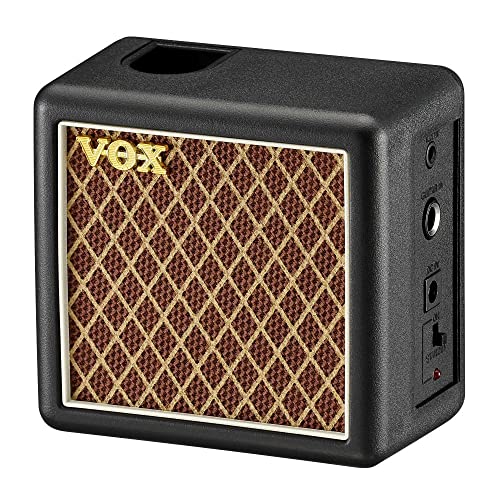
- Compact Guitar Processor
- With amPlug 2, the analog circuit has been significantly improved and each model now offers three modes
The Vox Amplug V2 is at the opposite end of the spectrum compared to the Walrus Audio Mako MKII ACS1 Amp Cab Simulator. While the Walrus is a professional-grade studio and stage tool, the Vox is a battery-powered practice solution. It’s fantastic for jamming in a hotel room or on the couch, but it lacks the IR loading, stereo imaging, and high-fidelity processing of the ACS1. If you are a beginner on a strict budget just looking for a way to hear your guitar through headphones, the Vox is a great choice. However, for anyone performing or recording, the Walrus is the vastly superior instrument.
2. Peavey Large Rubber Feet

- Packaged in sets of four, with Phillips screws
- Large rubber feet are 1 1/4 inch in diameter, 3/4 inch tall
While technically in the “parts” category for amplifier cabinets, these Peavey rubber feet represent the “old way” of doing things—maintaining heavy, physical cabinets. If you are sticking with your traditional 4×12 and just need some replacement parts for stability, these are industry standard. But if you’re tired of needing those rubber feet to keep your 80-pound cabinet from vibrating across the stage, it might be time to upgrade to the digital portability of the ACS1. One is a maintenance item; the other is a tonal revolution.
3. Orange PPC108 20W 1×8″ Speaker Cabinet
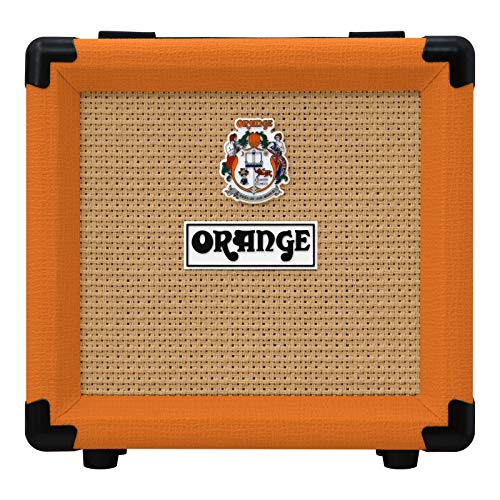
- Cloth Grill
- Compact Closed Back Cab
The Orange PPC108 is a great “real” micro-cab for practice. It provides that authentic Orange midrange punch and the physical movement of air that some players crave. However, it is limited to one sound (Orange) and one speaker size (8-inch). The Walrus Audio Mako MKII ACS1 Amp Cab Simulator can emulate a 4×12 Orange stack, a 2×12 Vox, or a 1×12 Fender—and do it in stereo. The Orange cab is a fun accessory for a Micro Terror head, but the ACS1 is a comprehensive tonal workstation that offers infinitely more versatility for the serious musician.
The Final Verdict: Is the Walrus Audio Mako MKII ACS1 Amp Cab Simulator the Right Move?
After extensive testing, it’s clear that the Walrus Audio Mako MKII ACS1 Amp Cab Simulator is more than just a minor update; it’s a significant leap forward in “amp-in-a-box” technology. Its greatest strengths lie in its incredible IR library, its true stereo dual-amp architecture, and its remarkably “tube-like” feel. While the price might give some pause, the sheer quality of the tones—from shimmering cleans to classic British crunch—makes it a sound investment for any guitarist looking to modernize their rig without losing their identity. We recommend it most highly to gigging professionals and studio rats who demand consistency and high-fidelity tone.
If you are ready to stop fighting with heavy gear and start enjoying consistent, world-class tone at every show and session, we highly recommend you grab this pedal here to complete your rig. It’s a professional tool that delivers on every promise, making it one of the most essential additions to any modern pedalboard.
Last update on 2026-10-24 / Affiliate links / Images from Amazon Product Advertising API