
Valeton TAR-20G Guitar Amp Head Review: The Ultimate Budget-Friendly Pedal Platform for Desktop and Stage
Every guitarist has been there: you have a collection of pedals that you absolutely love, but your massive tube stack is just too much for a midnight practice session or a small coffee shop gig. We often find ourselves searching for that “Goldilocks” solution—an amplifier that is small enough to fit on a desk, powerful enough to drive a cabinet, and transparent enough to let our pedals do the talking. The struggle is finding something that doesn’t rely on digital modeling, which can often feel sterile or overly complicated when all you want is a pure analog signal path.
Searching for a compact head usually leads to two extremes: overpriced boutique mini-heads or cheap digital units that claim to “model” every classic amp ever made but master none of them. When we first came across the Valeton TAR-20G Guitar Amp Head, we were skeptical. Could a device weighing less than two pounds really provide 20 watts of genuine analog power? Solving this portability problem is crucial for the modern musician who oscillates between a home studio, a rehearsal space, and small live venues. Without a reliable, lightweight solution, you’re stuck lugging 50-pound combos or compromising your tone with subpar digital simulations. We took this little powerhouse into our studio to see if it truly lives up to the hype as a legitimate pedal platform.
An Electric Guitar Amplifier Head is more than just an item; it’s a key solution for guitarists who want modularity and control over their sound. Unlike a combo amp, which houses the electronics and the speaker in one box, a head allows you to pair your “brain” with different “bodies” (speaker cabinets). This versatility is essential for achieving specific tonal characteristics. For instance, pairing a 20W head with a 1×12 cabinet for home use and a 4×12 for a larger stage can completely transform your projection and low-end response. Before you check the latest price and availability of any mini-head, you must understand your primary use case.
The ideal customer for this type of product is someone facing space constraints or travel requirements, such as a session player, a home recorder, or a touring musician looking for a reliable backup. It is a fantastic choice for those who have spent years building a pedalboard and want an amp that serves as a “clean slate.” However, it might not be suitable for those who require the massive headroom of a 100-watt tube amp for high-volume clean playing in a metal band with a loud drummer, or for those who prefer the all-in-one convenience of a modeling amp with built-in digital effects and Bluetooth connectivity.
Before investing, consider these crucial points in detail:
- Dimensions & Space: Consider where the amp will live. A desktop amp needs a small footprint and shouldn’t generate excessive heat. Look for units that can fit into a gig bag pocket or sit comfortably next to a computer monitor without cluttering your workspace.
- Capacity/Performance: Wattage isn’t just about volume; it’s about “headroom.” A 20W solid-state amp is plenty for home practice and small gigs, but you need to ensure it can handle being pushed. Check if it can drive both 8-ohm and 16-ohm cabinets to ensure compatibility with various gear.
- Materials & Durability: Since mini-heads are designed for travel, the enclosure material is vital. While plastic can be light, metal chassis are generally preferred for road-worthiness. Pay attention to the quality of the jacks and knobs, as these are the most common points of failure on budget equipment.
- Ease of Use & Maintenance: One of the biggest draws of solid-state technology is the lack of maintenance. Unlike tube amps, you don’t have to worry about biasing or replacing expensive glass bottles. Look for a straightforward interface where the EQ actually makes a tangible difference to the tone.
By keeping these factors in mind, you can ensure that your next purchase integrates seamlessly into your workflow. While the Valeton TAR-20G Guitar Amp Head is an excellent choice, it’s always wise to see how it stacks up against the competition. For a broader look at all the top models, we highly recommend checking out our complete, in-depth guide:
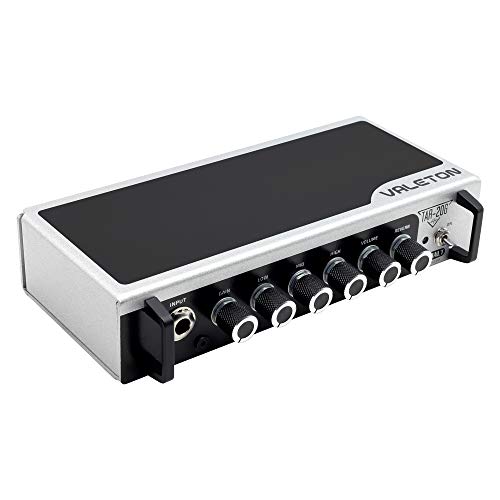
- Pure Analog Preamp Design with Super Wide Tonal Range from the Pristine Chime to Classic British Crunch, to Roaring Hi-Gain
- Max. 20W Pure Solid State Output Power sounds and responses like Vacuum Tubes Amp with Rich and Harmonic Tone
First Impressions: Unboxing the Valeton TAR-20G Guitar Amp Head
When the Valeton TAR-20G Guitar Amp Head arrived at our studio, our first thought was, “Is there actually an amp in this box?” At just 816 grams (roughly 1.8 lbs), it is incredibly light. Upon opening the package, we were greeted by a sleek, black unit that feels surprisingly dense for its size. The “Asphalt” aesthetic is modern and professional, avoiding the toy-like appearance that plagues some other micro-amps. The front panel layout is intuitive, featuring Gain, Volume, and a 3-band EQ, along with a dedicated Reverb knob.
Initial setup took less than two minutes. We connected it to an 8-ohm 1×12 cabinet, plugged in a Stratocaster, and flipped the switch. There is a noticeable “thump” when you power it on—a common quirk in small solid-state circuits—but once it’s on, it’s ready to go. Unlike tube amps that require a warm-up period, the Valeton TAR-20G Guitar Amp Head provides immediate gratification. We were particularly impressed by the tactile feel of the knobs; they have a nice resistance that suggests quality internal components. You can see its full feature set and user reviews to understand why this unit is gaining such a following in the guitar community.
Key Benefits
- Extremely lightweight and portable (fits in a gig bag)
- Pure analog preamp design for a natural, non-digital response
- Built-in Cab Sim on the headphone out for silent recording/practice
- Integrated FX Loop which is rare at this price point and size
Limitations
- Noticeable “pop” or “thump” when powering the unit on
- Can become slightly “hissy” when the volume is pushed beyond 50%
- Channel Switching & Independent Control: The BanTamp XL series features a dedicated footswitch for channel switching and six knobs. This allows you to independently control both the CLEAN and...

A Deep Dive into the Valeton TAR-20G Guitar Amp Head’s Performance
To truly understand what the Valeton TAR-20G Guitar Amp Head is capable of, we put it through a series of rigorous tests involving different guitars, pedals, and speaker configurations. This isn’t just a “bedroom amp”; it’s a tool that can adapt to various musical environments if you know how to dial it in.
The Analog Preamp: Tone Shaping and Responsiveness
In a world saturated with digital modeling, the “Pure Analog” claim of the Valeton TAR-20G Guitar Amp Head is its strongest selling point. We found that the preamp behaves much more like a traditional amplifier than a software-based emulator. When we dialed back the gain and pushed the volume, we were met with a sparkling, glassy clean tone that served as a perfect canvas. The 3-band EQ (Bass, Middle, Treble) is exceptionally responsive. On many budget amps, these knobs feel like they barely change the frequency, but here, every micro-adjustment is audible. We were able to pull thick, jazz-style warm tones out of a bridge humbucker by rolling back the treble and boosting the mids, and conversely, we could get that “spanky” country twang by scooping the mids.
The gain stage is equally impressive. While it won’t replace a dedicated high-gain metal head on its own, it provides a very musical “crunch” that reminds us of a hot-rodded British amp. As we increased the gain, the compression felt natural rather than forced. One user we spoke with mentioned they were wary of solid-state “modeling” claims, but were pleasantly surprised by how this unit actually *responds* like an amp. We confirmed this; the way it reacts to your guitar’s volume knob is a testament to its analog heritage. If you want to explore the sonic possibilities of the analog preamp, you’ll find it handles everything from bluesy breakup to aggressive hard rock with ease.
The FX Loop: A Game Changer for Pedal Enthusiasts
Perhaps the most surprising feature on an amp of this size and price is the inclusion of a fully functional FX Loop. For those who use time-based effects like delay and reverb, placing them *after* the preamp stage is vital for maintaining clarity, especially when using the amp’s onboard gain. We tested the Valeton TAR-20G Guitar Amp Head by running a high-end reverb pedal and a digital delay through the loop while cranking the gain on the front panel. The result was pristine. The effects didn’t get “mushed” into the distortion, which is a common problem with amps that lack an FX loop.
We also experimented with using the FX Loop’s “Return” as a power-amp input. By plugging a dedicated preamp pedal directly into the Return, we bypassed the Valeton’s internal preamp entirely. This effectively turned the unit into a 20W power amp. While some users have noted that the volume can be lower when using it this way, we found that with a high-output preamp pedal, it was more than sufficient for home use. This versatility makes it an incredible pedal platform solution for desktop setups where you might want to swap between different preamp “flavors” while using the same power section and speaker cabinet.
Studio and Practice Versatility: Cab Sim and Silent Play
For many of us, the “Headphone Out” on an amp is usually an afterthought—a fizzy, thin-sounding mess that we only use when we absolutely have to. However, the Valeton TAR-20G Guitar Amp Head includes a built-in Cabinet Simulator. We plugged the “Phones” jack directly into our studio audio interface to see how it handled direct recording. While it won’t beat a multi-thousand dollar IR loader, it is shockingly usable. The Cab Sim rounds off the harsh high frequencies you’d normally get from a direct signal, giving it the “air” and “thump” of a mic’d-up speaker. This makes it an invaluable tool for late-night songwriting sessions where you need a great tone without waking the neighbors.
Additionally, the Aux In allows you to jam along to backing tracks from your phone or computer. We spent hours practicing along to drum loops, and the mix between the guitar and the external audio was well-balanced. One point to note is that the headphone jack is 3.5mm, located on the back. While some users might prefer a 1/4″ jack on the front, the current placement keeps the front panel clean and uncluttered. For those looking for a portable studio and practice companion, this feature alone justifies the investment.
Reliability and Real-World Usage: The “Gig Bag” Amp
After using the Valeton TAR-20G Guitar Amp Head for several weeks, we can confidently speak to its “road-worthiness.” Despite its plastic and metal hybrid construction, it feels rugged. We threw it into a backpack with cables and pedals, and it emerged unscathed. It is compatible with 8 and 16-ohm speakers, and we even tested it with a high-sensitivity 12-inch speaker. In that configuration, it was “run you out of the room” loud. It’s important to note that the efficiency of your speaker will dictate how much volume you get out of these 20 watts. Paired with a high-sensitivity Eminence or Celestion speaker, this amp could easily handle a small coffee shop gig or a rehearsal with a quiet drummer.
We did encounter the “hiss” that some users mentioned when the volume and gain are both past the 12 o’clock position. However, in a real-world scenario, you rarely need to max out both. By balancing the gain and volume effectively, the noise floor remains perfectly acceptable for live use. There was also a report of an Aux jack failing for one user, but in our experience, the build quality seemed solid. Just like any compact gear, treating the jacks with a bit of care will ensure a long life. For anyone needing a backup that sets a new standard for portability, it’s hard to beat this form factor.
What Other Users Are Saying
The general consensus among the guitar community regarding the Valeton TAR-20G Guitar Amp Head is overwhelmingly positive, especially considering its price point. Many users have expressed surprise at the sheer volume and “tube-like” feel of the analog preamp. One owner noted, “The clean channel is super clear… a great pedal platform,” which aligns perfectly with our findings. Another seasoned player compared it to their much more expensive Egnater head, stating that the pristine tones were nearly on par.
On the flip side, some users have pointed out specific quirks. One common critique is the “loud thump” upon powering up, which can be startling if you’ve already turned your cab on. Another user mentioned that while it’s plenty loud for practice, it might struggle to “cut through” a loud drummer in a metal setting without being mic’d up. These critiques are relevant because they define the boundaries of the product: it is a stellar practice, recording, and small-gig tool, but it isn’t a replacement for a 100W stadium stack. However, the recurring theme is that for the money, the performance is “just wow.”
Comparing the Valeton TAR-20G Guitar Amp Head to the Competition
While we are fans of the Valeton, the mini-head market is competitive. Let’s see how it compares to three other popular options.
1. Orange Micro Dark Terror Mini Amp Head

- Power: 20Watt (hybrid)
- Tube: one 12AX7 (preamp)
The Orange Micro Dark is a hybrid beast, featuring a 12AX7 tube in the preamp and a solid-state power section. If you are looking specifically for high-gain, saturated metal tones out of the box, the Micro Dark has more aggressive teeth than the Valeton. However, the Micro Dark lacks the 3-band EQ of the Valeton TAR-20G Guitar Amp Head, opting instead for a single “Shape” knob. Those who want fine-tuned control over their mids and bass will likely prefer the Valeton, whereas “plug and play” rockers will love the Orange.
2. JOYO Zombie-II Mini Tube Guitar Amp
- Channel Switching & Independent Control: The BanTamp XL series features a dedicated footswitch for channel switching and six knobs. This allows you to independently control both the CLEAN and...
- Versatile High-Gain Platform & Clean Pedal Foundation: The ZOMBIE-II excels at lower gain settings and responds brilliantly to your favorite overdrive pedals, letting you push into higher gain with...
The JOYO Zombie-II is another hybrid head, specifically voiced for the “Mesa Boogie” high-gain sound. It features two channels and Bluetooth connectivity, which the Valeton lacks. If you need a dedicated distortion channel and want to stream backing tracks wirelessly to your cab, the JOYO is a strong contender. However, it is slightly larger and heavier than the Valeton. The Valeton TAR-20G Guitar Amp Head wins on pure portability and serves as a more “neutral” pedal platform for those who don’t want their amp’s built-in distortion to define their sound.
3. Orange Micro Terror 20W Guitar Amp Head

- Power: 20 watt (hybrid)
- Tube: 1 12AX7 tube preamp with solid state power amp
The original Micro Terror is a classic of the genre. It offers a very similar wattage to the Valeton and a hybrid tube/solid-state design. It provides that classic “Orange” mid-range honk that many players crave. However, it lacks an FX Loop, which for many pedalboard users is a dealbreaker. The inclusion of the FX Loop on the Valeton TAR-20G Guitar Amp Head gives it a significant edge for players who rely on delay, reverb, or modulation pedals and want to maintain maximum signal integrity.
The Final Verdict: Is the Valeton TAR-20G Guitar Amp Head Right for You?
After extensive testing, the Valeton TAR-20G Guitar Amp Head has proven itself to be much more than a novelty. Its standout strengths are its pure analog preamp, its highly responsive 3-band EQ, and the inclusion of an FX Loop—a rarity at this size. It excels as a “pedal platform,” providing a clean, honest foundation for your favorite stompboxes to shine. While it has minor quirks like the power-on thump and some noise at extreme settings, these are easily managed within a standard workflow.
We recommend this amp head to anyone who needs a portable practice solution, a desktop amp for home recording, or a reliable backup for live gigs. If you are a high-gain metal player looking for “in-the-box” distortion, you might prefer one of the hybrid alternatives mentioned above, but for everyone else, the Valeton offers incredible value. It is truly the “little amp that could,” delivering professional features in a package that fits in the palm of your hand. If you’re ready to simplify your setup without sacrificing your tone, we suggest you pick up the Valeton TAR-20G and experience its analog power for yourself.
Last update on 2026-09-17 / Affiliate links / Images from Amazon Product Advertising API