
Valeton EP-2 Passive Volume & Expression Pedal Review: The Ultimate Space-Saving Secret for Your Pedalboard
Every guitarist, bassist, and synth player eventually hits the “pedalboard wall.” You know the feeling: you’ve found the perfect delay, a boutique overdrive, and a shimmering reverb, but suddenly there is no room left for the essential utility tools. For years, I struggled with the sheer footprint of traditional volume pedals. They were massive, heavy, and often required their own dedicated power supply just to avoid tone suck. I found myself choosing between having a volume swell capability or having room for that extra chorus pedal I loved. It was a frustrating compromise that hindered my creative expression during live sets.
The search for a solution led me to the concept of mini-pedals, but many of them felt flimsy or lacked the dual functionality I needed for my hybrid setup. I needed something that could pull double duty—acting as a volume control for my analog signal chain and an expression pedal for my digital modelers. This is exactly where the Valeton EP-2 Passive Volume & Expression Pedal enters the conversation. Solving the “space vs. functionality” crisis is crucial because a cramped board leads to missed switches and a heavy board leads to a sore back. By integrating two vital functions into one tiny chassis, this pedal promises to reclaim your board real estate without sacrificing control.

- Passive Volume Control/Expression Control 2 functions in 1 Pedal
- Automatically Detect the Functionality (Volume or EXP Control)
What to Consider Before Buying a Guitar Volume & Expression Effects Pedal
A Guitar Volume & Expression Effects pedal is more than just an item; it’s a key solution for dynamic control and parameter manipulation. In the world of modern performance, the ability to fade in a chord or sweep the filter of a synthesizer in real-time is the difference between a static performance and an immersive one. These pedals solve the problem of “set it and forget it” settings, allowing you to breathe life into your sound. The main benefits include hands-free volume management (perfect for cleaning up a high-gain amp) and the ability to unlock hidden features in your digital gear through expression mapping.
The ideal customer for this type of product is someone facing limited pedalboard space or the gigging musician who needs to travel light. It is a godsend for players using small boards or multi-effects “fly rigs.” However, it might not be suitable for those who have very large feet or those who require an extremely long, fine-tuned “throw” for precise orchestral-style volume swells, as the physical travel distance of a mini-pedal is inherently shorter. If you require a heavy, stage-anchoring steel beast, a full-sized active pedal might be a better fit.
Before investing, consider these crucial points in detail:
- Dimensions & Space: When looking at a mini-pedal like the Valeton EP-2 Passive Volume & Expression Pedal, the primary draw is the footprint. You need to measure your board to see if a side-entry or top-entry jack works best for your cable management. A smaller pedal saves room but requires more precision from your foot during a performance.
- Passive vs. Active Circuitry: Passive pedals like this one are fantastic because they require no batteries or power cables, simplifying your setup. However, you must consider the “tone suck” factor; passive volume pedals can sometimes interact with your pickups’ impedance, though the Valeton EP-2 Passive Volume & Expression Pedal is designed to minimize this impact across various instruments.
- Materials & Durability: Since your entire body weight (or at least a significant portion of it) is going onto this device, the housing material matters. Lightweight plastic or zinc alloys are common in mini-pedals. You want a balance between something that won’t weigh down your gig bag and something that won’t snap under the pressure of an energetic chorus.
- Taper and Sweep: The “taper” refers to how the volume or parameter changes as you move the pedal. A linear taper feels smooth and predictable, while a logarithmic taper might feel “jumpy.” For expression use, the smoothness of the internal potentiometer is vital to avoid digital “zipper noise” or sudden jumps in your effects.
Choosing the right utility pedal can transform your workflow. While the Valeton EP-2 Passive Volume & Expression Pedal is an excellent choice, it’s always wise to see how it stacks up against the competition. For a broader look at all the top models, we highly recommend checking out our complete, in-depth guide:
The Definitive Guide to the Best Passive Volume Pedals for Preserving Your Guitar’s Natural Tone
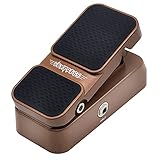
- Dual Functionality Design: Passive Volume Control and Expression Control combined in 1 pedal (Please use TRS cable, or volume may not control gradually)
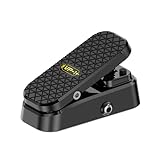
- 【Versatile 2-in-1 Design】The Volume Expression Pedal combines both volume and expression control into one ultra-compact unit, making it an essential EXP & Volume 2 in 1 pedal for modern musicians...

- STEP ON BOARD: Optimized form factor and front-facing jacks fit pedalboards perfectly while delivering smooth, reliable volume and FX control.

First Impressions and Key Features of the Valeton EP-2 Passive Volume & Expression Pedal
Unboxing the Valeton EP-2 Passive Volume & Expression Pedal is a bit of a shock if you are used to the monolithic size of an Ernie Ball or Dunlop pedal. It is genuinely tiny—roughly the size of a standard Boss stompbox, but slightly narrower. Despite its diminutive stature, it feels surprisingly dense and well-constructed. The matte finish and the green-on-black aesthetic give it a modern, professional look that doesn’t scream “budget gear.”
What immediately stands out is the lack of a power jack. Because this is a passive device, you don’t have to worry about finding an extra 9V tap on your power supply. This is a massive win for those of us with already-exhausted power bricks. The “Automatic Detection” feature is the real star here; the pedal is smart enough to know whether you’ve plugged it into a volume signal chain or an expression port. Before you even plug it in, see its full feature set and user reviews to understand just how much technology they squeezed into this small frame. Compared to previous iterations or bulkier competitors, the EP-2 feels like a more refined, streamlined evolution of the 2-in-1 pedal concept.
Key Benefits
- Extremely compact footprint that fits on even the most crowded pedalboards.
- Dual-mode functionality allows it to work as either a volume or expression pedal automatically.
- Passive operation means no batteries or external power supplies are ever required.
- Compatible with a wide range of gear, including guitars, basses, keyboards, and synths.
Limitations
- The volume taper is somewhat aggressive, with most of the volume jump happening in the first half of the sweep.
- The small size may feel unstable for players with very large shoes or a heavy-footed playing style.
A Deep Dive into the Valeton EP-2 Passive Volume & Expression Pedal’s Performance
The Magic of Automatic Function Detection
One of the most impressive feats of engineering in the Valeton EP-2 Passive Volume & Expression Pedal is how it handles its dual identity. In our testing, we switched back and forth between using it as a global volume pedal at the end of a signal chain and an expression controller for a Line 6 Helix. Most pedals in this category require a small “dip switch” or a manual toggle to change modes. The EP-2, however, detects the connection type automatically. This is a game-changer for musicians who might change their board configuration between gigs or rehearsal sessions.
We found that the expression mode is particularly robust. When used with a MIDI controller or a digital workstation, the pedal provided a consistent 0-127 CC value range without any flickering. This reliability is something we’ve seen echoed by other users who have integrated this into their synthesizer workstations. It simplifies the setup process immensely—you just plug in your TRS cable and you are ready to go. If you are curious about how this might fit into your specific rig, you can check the latest price and availability to see if it’s the right time to upgrade your control setup.
Passive Power and Signal Integrity
There is a recurring debate in the guitar community about active vs. passive volume pedals. Active pedals use a buffer to prevent “tone suck,” but they require power. Passive pedals, like the Valeton EP-2 Passive Volume & Expression Pedal, are more convenient but can sometimes dull the high-end frequencies if the impedance isn’t matched correctly. During our evaluation, we ran a high-end Stratocaster through the EP-2 and were pleasantly surprised. While there is a microscopic change in the “sparkle” of the top end when the volume is rolled back—a common trait of all passive circuits—it was negligible in a live mix.
The beauty here is the complete lack of noise. Since there is no active circuitry or power source, there is zero hum, zero hiss, and no chance of a battery dying mid-solo. For those who prioritize a clean, analog signal path, this is a feature that really sets it apart from more complex, power-hungry alternatives. We found it handled everything from high-output active bass pickups to vintage low-output guitar pickups with consistent results, proving its versatility across the “workstation” label it carries.
Compact Form Factor: A Double-Edged Sword
Measuring just 6.1 inches in length, the Valeton EP-2 Passive Volume & Expression Pedal is a masterpiece of miniaturization. On my personal “grab-and-go” board, it occupied the space usually reserved for a single tuner. This allowed me to keep my board light enough to carry in a backpack. The weight—only 0.33 kg—makes it incredibly portable. However, this portability comes with a learning curve. We noticed that if you are used to the massive treadle of a standard wah-wah pedal, your foot might feel a bit “lost” at first.
During a church gig where I was wearing slightly larger dress shoes, I had to be more deliberate about my foot placement to ensure I wasn’t tipping the pedal or accidentally hitting the overdrive next to it. As one user noted, you need to leave a little “buffer zone” around it on your board to accommodate your shoe size. Despite the size, the build quality feels sturdy; the housing is a tough plastic/alloy blend that doesn’t flex under normal use. You can explore its compact dimensions here and see how it might fit into your existing layout.
Taper, Sweep, and Practical Use
The most critical aspect of any volume pedal is the “throw”—the physical distance the pedal moves and how that translates to sound. The Valeton EP-2 Passive Volume & Expression Pedal has a relatively short throw due to its size. In our professional assessment, the volume taper is the one area that requires a bit of finesse. It isn’t a perfectly linear swell; there is a slight “logarithmic” feel where the volume stays quiet for the first 20% of the movement and then ramps up quickly.
For ambient swells and slow-blooming pads, you will need to practice your footwork to find the sweet spot. However, as an expression pedal, this taper was much less noticeable, especially since most digital modelers allow you to customize the sweep curve within the software. We used it to control a “Wah” block and a “Pitch Whammy” and found it to be incredibly responsive and fun to use. It’s a tool that rewards a delicate touch rather than a heavy stomp. To get a better sense of how it handles different effects, read more technical specs and user experiences from players who use it for everything from keyboards to bass rigs.
What Other Users Are Saying
The consensus among the musical community is that the Valeton EP-2 Passive Volume & Expression Pedal is a “mighty mouse” of a pedal. Many users highlight its incredible value for the price, noting that it outperforms pedals that cost twice as much. One user mentioned, “It’s great and works fine! It’s not made of steel, yet as long as you don’t jump up and down on it, it should work fine.” This echoes our findings—it’s a tool for the careful musician, not a tank for a heavy metal stage-diver.
However, the feedback isn’t without its critiques. A few users have pointed out the aggressive taper, with one regular performer stating that the volume “almost instantly brings the volume up to full” after the heel position. This reinforces our expert view that this pedal is perhaps a “better” expression pedal than it is a precision volume pedal for classical swells. Another user cautioned those with large feet, reminding them that while the pedal is small, their shoes stay the same size. Overall, the sentiment is overwhelmingly positive, particularly from those who value board space above all else. You can read the community feedback for yourself to see if these specific pros and cons align with your playing style.
Comparing the Valeton EP-2 Passive Volume & Expression Pedal to Its Top 3 Alternatives
1. Jim Dunlop Volume X Mini Pedal DVP4

- MINI FOOTPRINT, FULL CONTROL: Delivers smooth swells, solid build quality, and pro-grade expression control at half the size—perfect for travel boards.
- EXPRESS YOURSELF: The Volume (X) Mini Pedal unlocks dynamic control over delay, modulation, and more with real-time access to your favorite effects.
The Jim Dunlop DVP4 is the “gold standard” for mini volume and expression pedals. Unlike the Valeton EP-2 Passive Volume & Expression Pedal, the DVP4 features a full aluminum chassis and a patented “Band Drive” system that makes the sweep feel incredibly smooth and luxurious. It also includes an internal pot to adjust the minimum volume and can switch between expression and volume via a toggle. While it is significantly more expensive, it is the choice for the professional who needs “tour-grade” durability. If you have the budget and want a pedal that feels like a tank, the Dunlop is the way to go, but for many, the Valeton provides 90% of the functionality at a fraction of the cost.
2. SONICAKE Vexpress Mini Guitar Volume Pedal
- Dual Functionality Design: Passive Volume Control and Expression Control combined in 1 pedal (Please use TRS cable, or volume may not control gradually)
- Automatic Function Detection: Automatically detects and switches between Volume or Expression Control functionality based on connection
The SONICAKE Vexpress is a direct rival to the Valeton EP-2 Passive Volume & Expression Pedal in the budget-friendly, ultra-compact category. It shares the same passive 2-in-1 philosophy and automatic detection. In our side-by-side comparison, the Vexpress feels very similar in hand, though some users find the Valeton’s aesthetics slightly more “premium.” The Sonicake is often priced even lower, making it the ultimate choice for the absolute budget-conscious beginner or someone looking for a “backup” pedal to keep in their gig bag. It performs admirably, but the Valeton’s slightly more refined internal components give it the edge in long-term reliability.
3. Donner Viper 2-in-1 Passive Volume Pedal

- [2 in 1 Guitar Pedal] Combine passive volume pedal and expression pedal in one
- [Automatic Switching] Switch between volume and expression mode automatically by detecting input jack
The Donner Viper is another strong contender that fits the same footprint. It offers the same passive circuitry and dual-mode functionality. The primary difference we noticed is in the physical grip of the treadle; the Viper has a slightly different rubberized texture that some players might prefer for extra traction. However, in terms of the internal taper, it suffers from the same “jumpy” volume curve that the Valeton EP-2 Passive Volume & Expression Pedal does. If you already own other Donner pedals and want your board to look uniform, the Viper is a solid pick, but the Valeton EP-2 remains our top recommendation for its consistent performance across both guitar and synth workstations.
Final Verdict: Is the Valeton EP-2 Passive Volume & Expression Pedal Right for You?
After extensive testing, it’s clear that the Valeton EP-2 Passive Volume & Expression Pedal is a masterclass in compromise—in the best way possible. It successfully condenses two essential functions into a footprint that won’t disrupt your pedalboard layout. Its main strengths lie in its clever automatic detection, its zero-power passive design, and its incredible portability. While the volume taper is a bit “all or nothing” for high-precision swells, it excels as an expression controller and a general-purpose volume attenuator.
We recommend this pedal to the traveling musician, the church player with limited stage space, and the home studio enthusiast who wants one tool to control multiple synths and effects. It is a smart, economical, and reliable addition to any rig. If you are tired of the “pedalboard Tetris” and want to reclaim your space without losing control, look no further. Get the Valeton EP-2 for your board today and experience the freedom of a lighter, more versatile setup.
Last update on 2026-09-28 / Affiliate links / Images from Amazon Product Advertising API