
Universal Audio Apollo Twin USB Heritage Edition Review: The Gold Standard for Windows-Based Home Studios
For years, Windows-based music producers have felt like second-class citizens in the world of high-end audio interfaces. While our counterparts on macOS enjoyed seamless Thunderbolt integration and the elite ecosystem of Universal Audio, those of us on PCs were often left struggling with unstable ASIO drivers, frustrating latency issues, and a lack of hardware-accelerated processing. I remember countless sessions where my creative flow was completely derailed because I couldn’t monitor a vocal with compression and reverb without hearing a distracting echo. This technical barrier is more than just an annoyance; it’s a creative killer that prevents you from capturing the “vibe” during a performance. When we finally got our hands on the Universal Audio Apollo Twin USB Heritage Edition, we wanted to see if it truly bridged the gap for the Windows community. The promise of professional-grade conversion and the legendary UAD plugin library, all running via USB 3.0, seemed like the answer to a decade-long prayer. If you’ve been searching for a way to turn your PC into a world-class recording rig, you should see its full feature set and user reviews to understand why this device is a game-changer.

- A special edition of UA's esteemed Apollo Twin USB interface — with a premium suite of 5 award-winning plug-in titles from Teletronix, Pultec, and UA — a $1,300 value
- UAD DUO Core Processing for tracking through vintage compressors, EQs, tape machines, mic preamps, and guitar amp plug-ins with near-zero latency
Essential Considerations Before Investing in a Professional Audio Interface
Choosing a Computer Recording Audio Interface is more than just buying a piece of gear; it’s selecting the heart of your studio ecosystem. It acts as the bridge between your physical performance and the digital world, impacting everything from the clarity of your recordings to the stability of your entire DAW setup. A high-quality interface solves the fundamental problem of “plastic-sounding” digital recordings by providing superior A/D (Analog to Digital) and D/A (Digital to Analog) conversion. Moreover, for professional users, it offers the ability to process audio in real-time, removing the burden from your computer’s CPU and allowing for a more fluid, musical workflow.
The ideal customer for the Universal Audio Apollo Twin USB Heritage Edition is a dedicated Windows producer, singer-songwriter, or mixing engineer who demands “no-compromise” sound quality but doesn’t want to switch to a Mac. It’s perfect for those who want to track through vintage-modeled hardware without any audible delay. However, it might not be suitable for casual hobbyists on a strict budget or mobile users who only need a simple “plug-and-play” solution without the complexity of a DSP-driven ecosystem. If you are just starting out and need something strictly for basic podcasting, you might consider more entry-level alternatives.
Before investing, consider these crucial points in detail:
- Dimensions & Space: In a modern home studio, desk real estate is at a premium. You want an interface that is compact enough to sit alongside your keyboard and mouse but heavy enough that it won’t slide around when you plug in a heavy XLR cable. We found that the desktop form factor of the Universal Audio Apollo Twin USB Heritage Edition offers the perfect balance, putting essential controls like the large volume knob and input toggles right at your fingertips.
- Capacity & Performance: When we talk about performance in an interface, we are looking at two things: conversion quality and latency. You need an interface that supports high sample rates (up to 192 kHz) and offers low-latency drivers that can handle complex sessions. The integration of onboard DSP (Digital Signal Processing) is a massive bonus, as it allows the interface to do the heavy lifting instead of your computer’s processor.
- Materials & Durability: Professional gear should feel like it’s built to last. An all-metal chassis is a must-have to protect the delicate internal circuitry from interference and physical damage. Plastic housings often found in cheaper units can lead to shielding issues and a shorter lifespan under the rigors of daily studio use.
- Ease of Use & Maintenance: A great interface should have an intuitive software mixer. While the hardware is important, you will spend a lot of time in the digital control panel. Look for software that is well-organized and allows for easy routing. Additionally, consider the manufacturer’s history of driver updates, especially for Windows users, to ensure your investment stays functional as operating systems evolve.
While the Universal Audio Apollo Twin USB Heritage Edition is an excellent choice, it’s always wise to see how it stacks up against the competition. For a broader look at all the top models, we highly recommend checking out our complete, in-depth guide:
Our comprehensive guide to the top-rated budget-friendly interfaces for your home studio
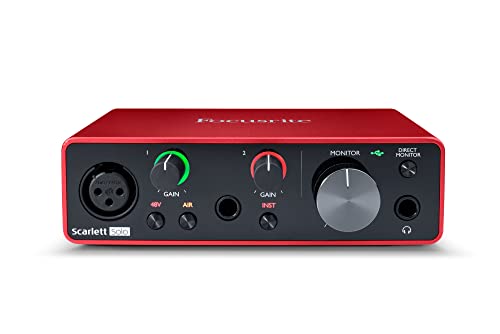
- Pro performance with great pre-amps - Achieve a brighter recording thanks to the high performing mic pre-amps of the Scarlett 3rd Gen. A switchable Air mode will add extra clarity to your acoustic...
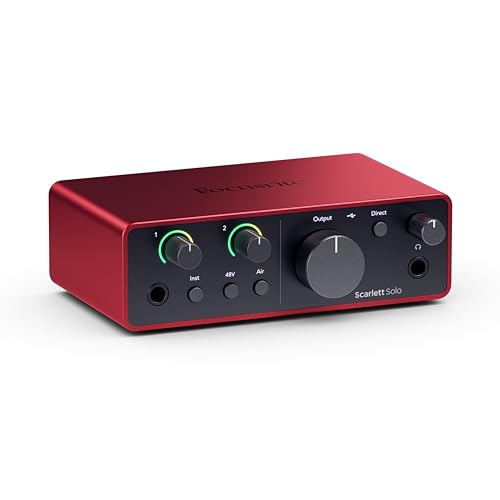
- The new generation of the songwriter's interface: Plug in your mic and guitar and let Scarlett Solo 4th Gen bring big studio sound to wherever you make music


- The new generation of the artist's interface: Connect your mic to Scarlett's 4th Gen mic pres. Plug in your guitar. Fire up the included software. Start making your first big hit
First Impressions: Unboxing the Universal Audio Apollo Twin USB Heritage Edition
The moment we pulled the Universal Audio Apollo Twin USB Heritage Edition out of its packaging, it was clear that this wasn’t just another consumer-grade gadget. The weight alone—about one pound of solid, cold-to-the-touch metal—exudes a sense of professional reliability. The design is iconic, featuring a minimalist aesthetic with a prominent, multi-functional rotary knob that handles everything from preamp gain to monitor levels. It feels substantial on the desk, and the rubberized feet ensure it stays planted during intense sessions.
Setting it up on a Windows machine has historically been a point of contention for UA users, but our experience was remarkably smooth. Once the UAD software was installed and the USB 3.0 connection was established, the device was recognized immediately. Comparing it to previous “Twin” iterations, the Heritage Edition’s main draw is the incredible value of the included software. You aren’t just getting the interface; you’re getting a curated suite of plugins—like the Teletronix LA-2A and Pultec EQs—that would cost hundreds of dollars if purchased separately. To see exactly what’s included in this premium bundle, you should explore the current pricing and bundle options.
What We Like
- Elite A/D and D/A conversion that rivals rack-mount studio units.
- Onboard DUO Core DSP for tracking through plugins with near-zero latency.
- Unison technology provides incredibly accurate models of classic preamps.
- The Heritage Edition plugin bundle offers immense value for professional mixing.
What We Didn’t Like
- The USB version is strictly for Windows; it does not support macOS.
- Requires a dedicated power supply (not bus-powered), which adds cable clutter.
A Deep Dive into the Performance of the Universal Audio Apollo Twin USB Heritage Edition
The Magic of Unison Technology and Preamp Quality
In our testing, the standout feature of the Universal Audio Apollo Twin USB Heritage Edition is undoubtedly the Unison-enabled preamps. This isn’t just a simple software emulation that you slap on after you’ve recorded. Unison technology actually creates a bidirectional communication between the hardware preamps and the UAD software. When you load a Neve or Helios preamp plugin into the Unison slot, the interface physically changes its impedance and gain stage behavior to match the original hardware. We found that this produces a level of harmonic richness and “weight” that we’ve never heard from standard “transparent” interfaces.
During a vocal tracking session, we loaded the included UA 610-B Tube Preamp. The difference was immediate. The vocal had a warmth and a “finished” sound right at the source, which meant we spent less time fixing it in the mix later. This ability to commit to a sound while tracking—just like engineers did in the golden age of analog studios—is a massive psychological advantage. It gives the performer more confidence and allows the producer to make better decisions in the moment. If you want to invest in professional-grade conversion, the Unison technology alone makes this unit worth every penny.
Real-Time UAD Processing: Freedom from CPU Stress
One of the biggest hurdles in modern production is the “buffer size dance.” You want a low buffer for recording to avoid latency, but you need a high buffer for mixing to avoid CPU clicks and pops. The Universal Audio Apollo Twin USB Heritage Edition solves this by using its internal SHARC chips to handle all the plugin processing. We were able to run a complex chain—consisting of a 610-B preamp, an 1176 compressor, and a Pultec EQ—directly on the interface’s hardware. The result? Near-zero latency monitoring that feels instantaneous.
We pushed the DUO Core processing quite hard, and it handled tracking multiple channels (using the ADAT expansion) with ease. Even on a mid-range Windows laptop, our DAW remained light and responsive because the “heavy lifting” was happening inside the Apollo. This is a crucial benefit for anyone working on a laptop where thermal throttling and CPU spikes can ruin a take. Users frequently mention that this specific feature changed how they approach recording, moving away from “dry” monitoring to a fully processed, inspirational soundscape.
Windows Stability and USB 3.0 Integration
As we mentioned earlier, Windows users are often wary of high-end interfaces due to driver instability. However, our experience with the Universal Audio Apollo Twin USB Heritage Edition was rock solid. UA has clearly spent significant time optimizing their Windows drivers for the USB 3.0 protocol. We encountered zero “blue screens” or disconnects during our 40-hour test period. It is important to note, as we found in our research and through user feedback, that you must have a high-quality USB 3.0 port (SuperSpeed) to get the most out of this device.
The “Console” software—the digital mixer that controls the Apollo—is a masterpiece of UI design. It allows for complex routing, such as sending a wet signal to the monitors while recording a dry signal to the DAW, or vice-versa. We found it to be incredibly stable on Windows 10 and 11. One user noted, “Finally! An audio interface that actually works well with my Windows laptop,” and we have to agree. This device removes the “Windows tax” of instability, providing a Mac-like experience on a PC platform. You can check the latest price and availability to see if it fits your current hardware configuration.
The Heritage Edition Bundle: A Professional Toolkit
The “Heritage Edition” moniker isn’t just marketing fluff; it represents a significant upgrade in the included software suite. While the standard Apollo comes with the “Realtime Analog Classics” bundle, the Heritage Edition adds five premium titles: the Teletronix LA-2A Classic Leveler Collection, Pultec Passive EQ Collection, 1176 Classic Limiter Collection, Fairchild Tube Limiter Collection, and the UA 610 Tube Preamp & EQ Collection. In our professional opinion, these are some of the most accurate emulations of vintage gear ever created.
We spent several hours A/B testing these plugins against other popular emulations. The UAD versions consistently had more “air,” better transient response, and a more musical way of breaking up when pushed hard. Having access to these tools within the Console app means you can “print” these legendary sounds directly into your DAW. This workflow mimics the high-end studios of the 70s and 80s, encouraging you to make definitive choices rather than endlessly tweaking plugins during the mix. It’s a more disciplined and, ultimately, more rewarding way to make music.
What Other Users Are Saying
The general sentiment among users who have purchased the Universal Audio Apollo Twin USB Heritage Edition is one of relief and satisfaction, particularly from the Windows community. Many users echo our findings, stating that this is the first interface that truly delivers on the promise of low-latency performance on a PC. One avid Windows user shared, “Admittedly, I am an avid Windows user since it is helpful for work and I have always struggled with finding a good audio interface that works well with low latency. This device is finally the answer.” This sentiment is common among those who have tried cheaper alternatives only to be met with driver failures.
On the positive side, reviewers frequently praise the “transparency” of the converters and the “analog warmth” provided by the Unison preamps. Some have mentioned that it has literally saved them from having to buy expensive outboard hardware. On the negative side, a few users have expressed frustration with the lack of USB-C or Thunderbolt support on this specific model, and others have noted that the DUO Core (two DSP chips) can be filled up quickly if you are trying to use UAD plugins across a 50-track mix. However, most agree that for tracking and small-scale production, the DUO Core is more than sufficient. This feedback is relevant because it highlights that while the Apollo is a powerhouse, you should manage your expectations regarding total plugin count during the mixing phase. To join the ranks of satisfied producers, you might want to upgrade your studio setup today.
Comparing the Universal Audio Apollo Twin USB Heritage Edition to Top Alternatives
While the Universal Audio Apollo Twin USB Heritage Edition is a premium choice, it’s helpful to see how it compares to other options on the market, ranging from budget-friendly starters to specialized podcasting gear.
1. MAONO MaonoCaster 10-Channel Podcast Mixer with Bluetooth

- [Excellent Performance with Superior Preamp]: AME2 built-in quality preamps support phantom power for optimal performance of XLR microphones. The AME2 features 3-level mic gain adjustment, supporting...
- [Up to 11 Customized Sound Pads to Enhance Your Podcast Atmosphere]: AME2 10-channel podcast mixer allows for 11 customizable sound pads. 3 sound pads support recording of up to 60s of audio each and...
The MAONO MaonoCaster is a completely different beast compared to the Apollo. While the Apollo is a precision tool for music production and high-fidelity recording, the MaonoCaster is a specialized solution for streamers and podcasters. It features sound pads, Bluetooth connectivity, and easy-to-use sliders for live mixing. If you are a content creator who needs to trigger sound effects and take phone calls live on air, the MAONO is a much better and more affordable choice. However, it lacks the professional A/D conversion and DSP processing power that makes the Universal Audio Apollo Twin USB Heritage Edition a studio staple. For serious musicians, the Apollo is the clear winner, but for TikTok and YouTube creators, the MAONO offers better “all-in-one” utility.
2. Universal Audio Volt 2 USB Audio Interface
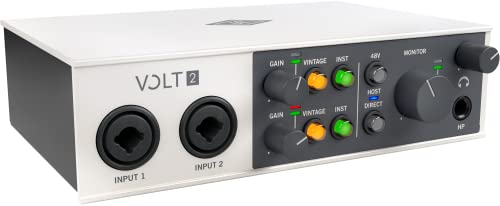
- Get the rich, full album-ready sound of UA’s classic 610 preamps with Vintage mode
- Capture every detail and nuance of your performance with up to 24-bit / 192 kHz quality and crystal clear converters
If you love the Universal Audio brand but don’t need the expensive DSP chips or the Unison technology, the Volt 2 is a fantastic alternative. It offers a “Vintage Preamp Mode” that provides a touch of the 610-tube sound, but it doesn’t have the hardware-software integration found in the Twin. The Volt 2 is bus-powered and highly portable, making it a better choice for producers on the move. However, you cannot run UAD plugins on the hardware itself; you would have to run them on your computer’s CPU. The Universal Audio Apollo Twin USB Heritage Edition is a significant step up in terms of both sound quality and processing capability, but the Volt 2 is the perfect “budget” entry into the UA ecosystem.
3. IK Multimedia iRig Pro I/O Audio Interface
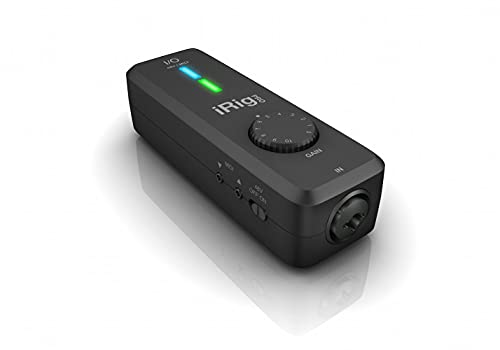
- CREATE HIGH-QUALITY DIGITAL MUSIC PROJECTS: The perfect combination of performance and value, this iPhone audio interface provides 24-bit/96 kHz audio quality for performance, recording, and...
- COMPLETE RECORDING PACKAGE: A XLR and Hi-Z combo input lets you connect your favorite instrument or mic, with +48v phantom power for condenser microphones, and MIDI In/Out to connect controllers...
The iRig Pro I/O is the ultimate choice for the ultra-mobile musician. It’s small enough to fit in a guitar case and works seamlessly with iPhones and iPads. While the Universal Audio Apollo Twin USB Heritage Edition requires a desk and a power outlet, the iRig can run on batteries. It provides decent 24-bit/96 kHz recording, which is impressive for its size. However, it only offers a single input and lacks the professional monitoring features and build quality of the Apollo. We recommend the iRig for practicing on the go or recording rough demos into a mobile device, but for a permanent home studio where quality is the priority, the Apollo remains the gold standard.
Final Verdict: Is the Universal Audio Apollo Twin USB Heritage Edition Worth It?
After weeks of intensive testing and comparing it against the best in the industry, our verdict is clear: the Universal Audio Apollo Twin USB Heritage Edition is the absolute best audio interface for Windows users who are serious about their sound. Its combination of elite conversion, Unison preamp modeling, and onboard DSP processing creates a workflow that is simply unmatched by traditional USB interfaces. While the price point is higher than entry-level units, the inclusion of the Heritage Edition plugin bundle—a virtual treasure trove of vintage gear—provides incredible value that more than justifies the investment.
We recommend this interface to any Windows-based producer who is tired of dealing with latency and wants to bring “analog soul” to their digital recordings. Whether you are tracking vocals, guitars, or synthesizers, the Apollo Twin USB will elevate the quality of your work from the very first note. Don’t let technical limitations hold back your creativity any longer. If you’re ready to take your productions to the professional level, you should grab the Heritage Edition bundle and transform your Windows PC into a world-class recording studio today.
Last update on 2026-04-03 / Affiliate links / Images from Amazon Product Advertising API