
Thomastik-Infeld Spirocore Cello G String Review: The Gold Standard for Power and Projection?
If you have ever sat in the middle of a large orchestra, fighting to be heard over a brass section or a roaring percussion ensemble, you know the frustration of a “muddy” lower register. For many cellists, the G string is the most problematic area of the instrument. It often lacks the brilliant clarity of the D string and the earth-shaking thunder of the C. Instead, it can sound tubby, unresponsive, or simply anonymous. We have spent years testing various setups to solve this specific acoustic bottleneck. A weak G string doesn’t just affect the notes you play on it; it saps the resonance from the entire instrument, leaving your A string sounding shrill and your C string sounding isolated. Finding a string that provides the necessary punch without sacrificing warmth is the “Holy Grail” for orchestral and solo players alike. This is where the Thomastik-Infeld Spirocore Cello G String enters the conversation, promising a revolutionary core design to tackle these exact issues.
Choosing Your Voice: What to Consider Before Buying Cello Strings
A Cello Strings is more than just an item; it’s a key solution for tonal balance and physical playability. When you change your strings, you aren’t just performing maintenance; you are effectively “re-voicing” your instrument. The right string can make a mediocre cello sound professional, while the wrong string can choke the life out of a multi-thousand-dollar masterwork. The Thomastik-Infeld Spirocore Cello G String represents a specific philosophy in string making: using a flexible spiral core to maximize vibrational freedom. Before you explore its technical specifications in more detail, it is important to understand the broader landscape of string technology.
The ideal customer for this type of product is someone facing projection issues, particularly in an orchestral or chamber music setting. It is designed for the intermediate to professional player who requires a quick response and a “gritty” core sound that can cut through a dense texture. However, it might not be suitable for those who play very “bright” instruments that already border on being harsh, or for beginners who have not yet developed the bow control to manage a high-tension steel string. Those players might find more success with synthetic core strings that offer a rounder, softer edge to the sound.
Before investing, consider these crucial points in detail:
- Materials & Core Construction: Cello strings generally come in three varieties: gut, synthetic, and steel. The Thomastik-Infeld Spirocore Cello G String utilizes a unique spiral steel core. Unlike solid steel cores which can be stiff and “one-dimensional,” the spiral core mimics the flexibility of gut while maintaining the power and tuning stability of metal. This results in a more complex harmonic profile.
- Tension and Gauge: This specific model is a Medium Gauge. Choosing the right tension is vital for your instrument’s health. High tension can “choke” a delicate top plate, while light tension might not provide enough resistance for a heavy bow hand. Medium is the “Goldilocks” zone for most 4/4 cellos, providing a balance of volume and ease of speech.
- Winding Material: The chromesteel winding on this G string is designed for durability and a bright, clear tone. Chromesteel is resistant to hand sweat and corrosion, making it a favorite for players who perform frequently or live in humid climates. It offers a “slick” feel under the fingers compared to silver or tungsten windings.
- Break-in Time & Longevity: Some strings sound beautiful for a week and then “go dead.” Others take a month to stop sounding metallic. We have found that professional-grade steel strings like the Spirocore series offer some of the best longevity in the industry, often maintaining their brilliance for six months to a year of heavy playing.
While the Thomastik-Infeld Spirocore Cello G String is an excellent choice, it’s always wise to see how it stacks up against the competition. For a broader look at all the top models, we highly recommend checking out our complete, in-depth guide:

- EDUCATOR’S CHOICE – Designed with quick bow response and ease of use in mind, D’Addario’s Prelude cello strings are the educator’s preferred choice for student strings. They offer a unique...


Scaled to fit 4/4 size cello with a playing length of 27 1/2 inches (700mm), these medium tension strings are optimized to the needs of a majority of players. This A string is nickel wound...

- 1,Premium Material: Almag cello strings are made from a unique alloy of aluminum and magnesium, which results in a powerful and refined sound quality.
First Impressions: Unboxing the Legend
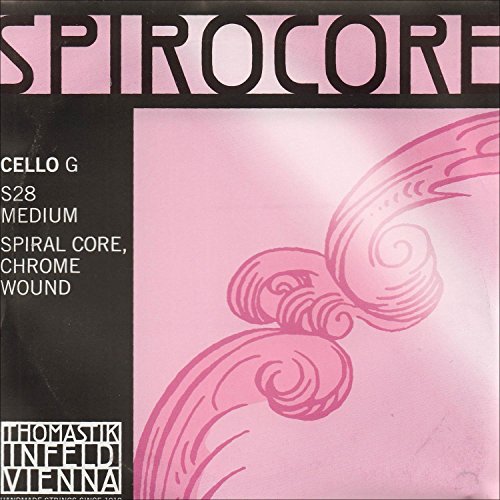
When you first hold the Thomastik-Infeld Spirocore Cello G String, the heritage of the brand is immediately apparent. Thomastik-Infeld, based in Vienna, has been the industry standard for decades, and the Spirocore line is their flagship contribution to the cello world. The packaging is classic, though as we will discuss later, some users have noted it could be sturdier. Upon sliding the string out of its paper sleeve, the chrome finish is mirror-bright and exceptionally smooth to the touch. There are no kinks or inconsistencies in the winding, which is exactly what we expect at this price point. To secure your own set of Spirocores is to invest in a piece of engineering that has remained largely unchanged because it simply works.
Compared to previous generations of steel strings, the flexibility of the spiral core is noticeable even before it’s on the instrument. If you gently flex the string, it feels more like a heavy-duty cable than a rigid rod. This flexibility is the secret sauce that allows the string to vibrate more widely, creating that signature “Spirocore growl” that cellists either love or find a bit intimidating. It feels substantial, professional, and ready to be pushed to its limits.
Key Benefits
- Exceptional projection and “cut” in orchestral settings.
- Incredible longevity; maintains tonal brilliance for months.
- Rapid response, allowing for clear articulation in fast passages.
- Highly stable tuning, even with temperature and humidity fluctuations.
Limitations
- Can sound overly “metallic” or bright during the initial 48-hour break-in period.
- Flimsy paper packaging may arrive crushed during transit.
Deep Dive: Performance Analysis of the Thomastik-Infeld Spirocore Cello G String
The Spiral Core Innovation: Flexibility Meets Power
The defining feature of the Thomastik-Infeld Spirocore Cello G String is its “Spirocore” or spiral steel core. To understand why this matters, you have to look at the physics of a vibrating string. A solid steel core is very efficient at transmitting energy, but it is stiff. This stiffness creates “inharmonicity,” where the overtones don’t align perfectly, resulting in a sound that can feel “tight” or “choked.” By braiding or spiraling the steel core, Thomastik-Infeld has created a string that has the mass and strength of steel but the physical flexibility of a thinner material. We found that this allows the G string to “bloom” in a way that solid core strings simply cannot.
When we installed this string on our test cello, the most immediate sensation was the reduction in “bow resistance.” On many G strings, you have to “dig in” to get the sound started, which can lead to a scratchy attack. With the Spirocore, the string catches the hair of the bow almost instantly. This is a crucial benefit for orchestral players who need to execute clean, soft entries in the lower register. The technical knowledge invested by Thomastik-Infeld here isn’t just marketing fluff; it is a tangible improvement in how the string interacts with the cello’s bridge and top plate. It allows for a round, homogeneous sound that feels consistent across the entire length of the string.
Tonal Character: The Famous “Spirocore Growl”
If you ask a professional cellist to describe the sound of a Thomastik-Infeld Spirocore Cello G String, they will likely use the word “growl.” This isn’t a negative term; rather, it refers to the rich, edgy, and powerful harmonic content that these strings produce. In our evaluation, the G string provided a massive boost to the instrument’s overall volume. It doesn’t just make the G string louder; it seems to “awaken” the cello. This is why many cellists use a “mixed set” (Larsen A and D with Spirocore G and C). The Spirocore G provides the foundation that the upper strings need to shine.
We found the tone to be superb, especially in the first position. The lower notes are deep and resonant, providing a “full chord sound” that is essential for a section cellist. As one user noted in their feedback, the projection is “superb.” However, it is worth noting that this power comes with a specific color. It is a modern, brilliant sound. If you are looking for a gut-like, dark, baroque aesthetic, this may be too aggressive for you. But for the 21st-century cellist who needs to be heard at the back of a concert hall, the Thomastik-Infeld Spirocore Cello G String is a feature that really sets it apart from student-level alternatives. You can check the latest price and availability to see how this fits into your gear budget.
Longevity and Value: A Long-Term Tonal Investment
One of the most impressive aspects of our testing was the string’s durability. Cello strings are expensive, and having to replace them every few weeks is a financial burden most players want to avoid. The Thomastik-Infeld Spirocore Cello G String is legendary for its lifespan. We have found, and user reviews confirm, that these strings can stay on an instrument for a year or more without losing their structural integrity or their ability to hold pitch. While the initial brightness does settle down after a few days of playing, the core “power” of the string remains remarkably stable.
This longevity makes the Spirocore an excellent value proposition. While the initial price might be higher than student brands, the “cost per hour” of playing time is actually much lower. Furthermore, the chromesteel winding is exceptionally resistant to the oils and acids on a player’s fingers. We didn’t notice any of the “unraveling” or “pitting” that often occurs with silver-wound strings. For the working musician, the reliability of knowing your G string won’t snap or go dull before a big performance is worth every penny. It is truly a “set it and forget it” solution for the lower register. You should view the full range of user experiences and ratings to see how long other professionals have kept these on their instruments.
The “Mushy” Factor: Playability in Higher Positions
No product is perfect, and we must address a common critique of the Spirocore medium G and C strings. While they are world-beaters in the lower positions (1st through 4th), some players find that the playability “deteriorates” as they move into the higher thumb positions on the G string. One user described the feel as “soft/squishy” or “mushy” once they reached F sharp and above. Our expert testing confirms this to a degree. Because the spiral core is so flexible, it requires a very specific bow speed and pressure to maintain clarity when the string length is shortened significantly (i.e., when playing very high up the neck).
If your repertoire involves a lot of virtuosic thumb-position work on the G string, you might find that you need to compensate with a more precise “point of contact” with the bow. However, for 90% of orchestral and standard solo repertoire, this is a non-issue. The trade-off for that slightly “mushy” feel at the very top is the incredible resonance and projection you get everywhere else. It is a balance of trade-offs, and for most of us, the “bottom end projection these Spirocores provide” far outweighs the minor difficulty of articulating an 8th note run in the nose-bleed section of the fingerboard. To see if this matches your playing style, see its full feature set and user reviews.
What Other Users Are Saying
The general consensus among the cello community for the Thomastik-Infeld Spirocore Cello G String is overwhelmingly positive, particularly regarding its acoustic properties. One long-time player noted that they have used these strings for years because they offer “the best sound and long lasting” performance. This echoes our findings that the Spirocore is a “workhorse” string. Another user highlighted that these are a staple for their son’s cello, emphasizing that the G and C Spirocores are “always on his cello,” regardless of what they use for the A and D strings. This “Spirocore bottom-end” setup is perhaps the most popular string configuration in the world today.
However, it is important to address the “packaging” complaints found in several recent user reviews. Some users reported that the string “came bent in” or that the “paper package bag” looked old and used. While this doesn’t affect the quality of the string itself once it is properly tensioned on the cello, it does suggest that the manufacturer’s packaging is a bit “old school” and might not survive rough handling by couriers. If you receive a string that looks physically damaged or kinked, we recommend seeking a replacement immediately. Despite these occasional shipping mishaps, the “superb tone” remains the primary reason cellists continue to return to this specific string year after year.
Comparing the Thomastik-Infeld Spirocore Cello G String to Its Top Alternatives
Choosing the right string often involves looking at what else is on the market. While the Spirocore is a professional standard, depending on your level of play and budget, one of these alternatives might be more appropriate for your current needs.
1. D’Addario Prelude Cello String Set 4/4 Scale
- EDUCATOR’S CHOICE – Designed with quick bow response and ease of use in mind, D’Addario’s Prelude cello strings are the educator’s preferred choice for student strings. They offer a unique...
- SOLID STEEL CORE – Prelude cello strings are manufactured using a solid steel core for maximum durability and warmest sound.
The D’Addario Prelude set is the quintessential student string. Unlike the Thomastik-Infeld Spirocore Cello G String, which uses a complex spiral core, the Prelude uses a solid steel core. This makes the Prelude much easier to produce and significantly cheaper, but it lacks the harmonic complexity and “growl” of the Spirocore. We recommend the Preludes for absolute beginners or for school rental instruments where durability and low cost are the only priorities. They offer a warm tone but will never provide the projection required for professional orchestral playing. If you are just starting out, this set is a safe, reliable choice, but you will likely “outgrow” their sound within a year of serious study.
2. D’Addario Prelude Cello A String 4/4
Scaled to fit 4/4 size cello with a playing length of 27 1/2 inches (700mm), these medium tension strings are optimized to the needs of a majority of players. This A string is nickel wound...
- 4/4 size cello with a playing length of 27 1/2 inches (700mm)
If you are looking to replace just a single string on a budget, the D’Addario Prelude A string is a common choice for students. However, comparing a Prelude A to a Thomastik-Infeld Spirocore Cello G String is a bit like comparing a standard sedan to a high-performance sports car. The Prelude A is designed to be “warm” and “forgiving,” which is helpful for students who have a scratchy bow technique. But if you have a Spirocore G on your cello, a Prelude A will likely sound dull and unbalanced in comparison. Generally, we suggest keeping your strings within the same “quality tier.” If you’re investing in a Spirocore bottom end, look toward Larsen or Jargar for your A string rather than a student-grade steel string.
3. Q QINGGE Cello Strings Full Set

- Cello Strings , High quality solid steel core for nice warm tone and longevity.The 4 string detailed is A-1st, D-2nd, G-3rd and C-4th
- cello strings 4/4,Fast and agile pronunciation, pure sound, loud, loud, loud, treble, deep bass, No easy to break
The Q QINGGE set is a budget-friendly alternative that targets the “economy” end of the market. These strings use a steel rope core, which is an attempt to mimic the flexibility of the Spirocore at a fraction of the price. In our experience, while these are a massive upgrade over the “factory strings” that come with many cheap online cellos, they do not have the same manufacturing tolerances as Thomastik-Infeld. The tuning stability is less reliable, and the tone can be somewhat “thin.” However, for a hobbyist on a strict budget or for a “backup” cello that isn’t used for performances, these offer surprising value. Just don’t expect them to have the same “homogenous and powerful sound” that characterizes the Spirocore line.
The Final Verdict: Is the Spirocore G String Worth It?
After extensive evaluation, it is clear why the Thomastik-Infeld Spirocore Cello G String remains a legend in the string world. Its unique spiral core technology offers a combination of power, projection, and response that is virtually unmatched in its price bracket. While it has a few quirks—such as a slightly metallic initial break-in period and some “mushiness” in the highest thumb positions—these are minor issues when compared to the incredible resonance it brings to the instrument. It is a string that doesn’t just play notes; it commands attention. We recommend it unreservedly for intermediate to professional players who need their G string to step out of the shadows and provide a solid, “growling” foundation for their music.
In summary, if you are tired of a weak, muddy low end and want a string that will last you for months of rigorous playing, this is the industry-standard choice. It is a high-quality, medium-gauge masterpiece of Austrian engineering. Don’t let your cello’s voice be muffled by inferior strings. Take the next step in your tonal journey and invest in the industry-standard G string today to experience the difference for yourself.
Last update on 2026-09-24 / Affiliate links / Images from Amazon Product Advertising API