
Thomastik-Infeld Dominant Violin Set Medium Tension Review: The Legendary Gold Standard for Modern Violinists
I remember clearly the first time I felt truly frustrated with my violin. It wasn’t the bow, and it wasn’t my technique—well, at least not entirely. My instrument, a decent mid-range workshop model, sounded thin, nasal, and remarkably “metallic.” No matter how much I practiced my vibrato or adjusted my bow pressure, the sound lacked that woody, soulful resonance we associate with professional recordings. I was at a crossroads: do I spend thousands on a new instrument, or is there a simpler fix? This is the exact moment most players find themselves searching for the Thomastik-Infeld Dominant Violin Set Medium Tension. We look for strings because we realize that the interface between the player and the wood is the vibration of the wire itself. Choosing the wrong strings can make a $5,000 violin sound like a tin can, while the right set can breathe life into an average fiddle. The complication of staying with subpar strings is more than just bad tone; it’s the discouragement that comes when your hard work doesn’t result in a beautiful sound. That is why finding a reliable, professional-grade set is crucial for any advancing student or performing artist.

- Highly flexible, multi-strand nylon core
- For artists who feel uncomfortable with steel strings
What to Consider Before Buying Violin Strings: A Comprehensive Buyer’s Guide
A set of violin strings is more than just an item; it’s a key solution for tonal correction, playability, and instrument projection. When you decide to upgrade, you aren’t just buying wire; you are choosing the “engine” of your violin’s sound. The right strings can tame a harsh instrument or brighten a dull one, effectively acting as a customizable EQ for your violin. Without a quality set, a player might struggle with “wolf tones,” unstable tuning, or a lack of dynamic range, which can be incredibly demoralizing during practice and performance.
The ideal customer for this type of product is someone facing the limitations of basic steel strings—usually students moving into intermediate repertoire or professionals who need a reliable, “neutral” baseline. The Thomastik-Infeld Dominant Violin Set Medium Tension is perfect for those who want the warmth of gut strings without the constant tuning headaches. However, it might not be suitable for those who strictly prefer the piercing brightness and high tension of solid steel cores, or those playing in extremely humid, outdoor environments where specialized coated strings might be preferred. If you are looking for a very specific, dark “old-world” sound, you might consider pure gut, but for 90% of players, a synthetic core is the superior choice.
Before investing, consider these crucial points in detail:
- Core Material & Technology: The core is the heart of the string. Traditional gut is warm but unstable. Steel is stable but often harsh. Synthetic cores, like the multi-strand Perlon used in the Thomastik-Infeld Dominant Violin Set Medium Tension, aim to offer the best of both worlds: the complex overtones of gut with the pitch stability of steel.
- Tension Levels: Strings usually come in Soft (Weich), Medium (Mittel), and Heavy (Stark). Medium tension is the industry standard for a reason—it provides enough resistance for a powerful bow stroke without putting excessive structural stress on the violin’s top plate and neck.
- Winding Materials: The metals wrapped around the core (Aluminum, Silver, Chrome, or Gold) significantly affect the “color” of the sound. Aluminum is generally bright and responsive, while silver (often used on G strings) provides a deeper, richer resonance. Understanding this mix helps in achieving a balanced sound across all four strings.
- Longevity vs. Break-in Time: Some strings sound amazing for a week and then “die.” Others take a month to stretch. You want a string that settles quickly—within two to three days—and maintains its tonal brilliance for several months of daily playing.
In our experience, balancing these factors is what leads to a satisfying playing experience. Now, let’s see how these considerations manifest in one of the most famous string sets in history.
While the Thomastik-Infeld Dominant Violin Set Medium Tension is an excellent choice, it’s always wise to see how it stacks up against the competition. For a broader look at all the top models, we highly recommend checking out our complete, in-depth guide:
Check out our comprehensive guide to finding the best affordable strings for your instrument.
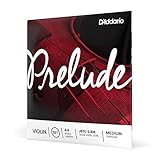
- EDUCATOR’S CHOICE – Designed with quick bow response and ease of use in mind, our violin strings are a unique blend of warm tone, affordability and durability making them ideal for both new and...


- Nice Sound Quality: the violin strings are are made of steel core with reliable material plated ball end, delivering warm and balanced tone; It meets the performance needs of beginners to intermediate...
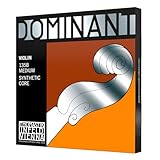
- THE STANDARD – Professional musicians worldwide choose Dominant violin strings for their clear, rich, well-balanced tone, and easy playability. Most teachers prefer Dominant over bright-sounding...
First Impressions and Key Features: Unboxing the “Industry Standard”
When you first hold the packaging of the Thomastik-Infeld Dominant Violin Set Medium Tension, there is an immediate sense of heritage. The iconic yellow and purple branding has remained largely unchanged for decades, signaling a product that doesn’t need to rely on flashy modern graphics to prove its worth. Upon unboxing, the strings are neatly coiled, with the distinct color-coded silking at the peg and tailpiece ends (purple for Dominants). We found that the strings feel remarkably supple right out of the envelope—this is the “highly flexible, multi-strand nylon core” at work. Unlike stiff steel strings that feel like unyielding wire, these have a “soft” tactile quality that suggests they will be easy on the fingers.
Comparing these to market leaders, the Thomastik-Infeld Dominant Violin Set Medium Tension often serves as the “neutral” benchmark. While other brands might aim for extreme “brilliance” or extreme “warmth,” Dominants aim for a balanced, gut-like complexity. To ensure you are getting the genuine article for your next performance, we recommend you see its full feature set and user reviews to understand why this specific 135B set remains the most popular choice globally.
Key Benefits We Discovered
- Exceptional tonal complexity that closely mimics traditional gut strings without the instability.
- Highly flexible Perlon core that reduces left-hand fatigue during long practice sessions.
- Remarkable versatility; they sound good on almost any violin, from student models to fine antiques.
- Quick settling time, reaching pitch stability much faster than natural gut alternatives.
Limitations to Consider
- The E string can sometimes be “whistly” or metallic compared to the warmth of the lower strings.
- Initial “metallic” edge that takes about 48 to 72 hours of playing to mellow out.
A Deep Dive into Performance: Why the Thomastik-Infeld Dominant Set Rules the Stage
Tonal Architecture: The Perlon Core Advantage
The defining characteristic of the Thomastik-Infeld Dominant Violin Set Medium Tension is its multi-strand synthetic core, often referred to by the trade name “Perlon.” In our testing, this core is what creates the “magic.” When you draw the bow across the string, the vibration isn’t just a simple sine wave; it’s a complex series of overtones. We found that the Dominants offer a richness that steel strings simply cannot replicate. The sound is round, full, and carries a certain “fizz” or texture that helps the violin project in a large room. This is the “comparable in sound to gut” promise mentioned in the technical specs, and it holds up under scrutiny.
We’ve observed that on many “average” violins, these strings act like a professional filter. They smooth out the harsh high frequencies and bolster the weak lower mids. This is why many teachers recommend them for students whose instruments sound a bit “cheap.” One user mentioned that their $500 fiddle “sounded like a $10 violin” until they swapped to these strings, and we can confirm this transformative effect. If you want to experience this tonal shift yourself, you should check the latest price and availability for this specific medium tension set.
Playability and Left-Hand Comfort
For many players, the physical sensation of the string is just as important as the sound. The 135B set is designed for “artists who feel uncomfortable with steel strings,” and the difference is palpable. Because the Perlon core is so flexible, the string has more “give” when you press it down against the fingerboard. This lower perceived tension (even though it’s a “Medium” set) makes shifting and executing fast vibrato significantly easier. We found that after three hours of rigorous orchestral rehearsal, our left-hand fingertips felt much less stressed than they do with high-tension chrome or steel sets.
This flexibility also translates to bow response. The Thomastik-Infeld Dominant Violin Set Medium Tension is incredibly responsive to nuances in bow speed and pressure. You can pull a delicate pianissimo or a crushing fortissimo with equal confidence. We noticed that the articulation—the “pop” at the start of a note—is clear without being percussive. This is a critical benefit for intermediate students learning complex strokes like spiccato or sautillé, where the string’s elasticity plays a major role in the bow’s bounce.
Stability, Durability, and the “Break-In” Period
One common complaint with high-end violin strings is that they are temperamental. Natural gut strings can go out of tune if someone breathes too heavily near them. In contrast, we found the Thomastik-Infeld Dominant Violin Set Medium Tension to be impressively “set and forget” once they have stretched. During our evaluation, the strings required frequent tuning for the first 24 hours—which is standard—but by day three, they held their pitch through temperature changes and intense playing. This reliability is why they are the “standard” for students who may not have the ear yet to tune every five minutes.
Regarding durability, these strings are built to last. The silver-wound G string and aluminum-wound A and D strings are resistant to the acidity of finger sweat, provided they are wiped down after use. We found that even with an hour of daily use, as one parent of three violinists confirmed, these strings hold their tonal integrity for months. They don’t go “false” (where the string vibrates unevenly) nearly as quickly as cheaper alternatives. To see why so many professionals keep a spare set of these in their case, take a closer look at the technical specifications and user feedback here.
The 135B Configuration: Balancing the E String
The “135B” set is a specific configuration that includes a plain steel E string with a ball end. In the world of violinists, the “Dominant E” is a topic of much debate. Some find it a bit bright or “whistly.” However, in our expert opinion, the plain steel E provides a necessary brilliance that cuts through the warmth of the synthetic A, D, and G. It provides a “sparkle” at the top end of the instrument’s range. If you find your violin is naturally very bright, you might eventually swap just the E for a gold-plated version, but as a balanced set, the 135B works remarkably well for the majority of instruments.
We noticed that the transition between the A and E strings—often a point of “tonal “break” in cheaper sets—is smooth here. The aluminum winding on the A string is crafted to provide a bridge between the silver G/D and the plain steel E. This holistic design is why the Thomastik-Infeld Dominant Violin Set Medium Tension is often called the most “well-rounded” set on the market. It doesn’t try to be the loudest or the darkest; it just tries to be the most “correct.” You can explore the full component list of this set to see exactly what materials are used for each string.
What Other Users Are Saying
The general consensus among the violin community is overwhelmingly positive, cementing the Thomastik-Infeld Dominant Violin Set Medium Tension as the “standard” for a reason. Most users report a dramatic improvement in sound quality, especially when upgrading from stock strings. One teacher noted that their student’s $500 violin transformed from sounding like a toy to a real instrument. Another long-time user mentioned that their daughters, who practice at least an hour a day, have relied on these strings for years because they “hold up very well.”
However, the feedback isn’t without its nuances. Some users noted that the strings can be “a little stubborn to put on,” specifically mentioning the D string’s interaction with certain fine tuners. Others pointed out that during the initial “stretch-in” phase, they can go out of tune more than steel strings. A small minority felt the sound wasn’t as warm as they expected, which usually happens if the strings haven’t been played in for the requisite 48 hours. Overall, the sentiment is that for the price, the “beautiful tone” and “playability” are well worth the investment, making them a “must-try” for any serious player.
Comparing the Thomastik-Infeld Dominant Violin Set Medium Tension to Top Alternatives
1. Thomastik-Infeld Dominant Violin Strings 4/4 Set
- THE STANDARD – Professional musicians worldwide choose Dominant violin strings for their clear, rich, well-balanced tone, and easy playability. Most teachers prefer Dominant over bright-sounding...
- EASY TO PLAY – Dominants are comfortable under your fingers and respond quickly to the bow, making them an easy-to-play set for beginners and professionals alike. This set is available in 4/4 full...
This is a very similar sibling to our main product, often differentiated by the specific E-string variant. While the 135B we are reviewing is the standard medium tension set, this variation often focuses on the “Steel E Ball” version specifically designed for corrosion resistance. If you live in a very humid environment or have particularly acidic sweat that eats through strings, this slightly more robust E-string version might be a better fit. However, for general tonal balance and the “classic” Dominant feel, the 135B remains our top recommendation for the average player.
2. D’Addario J56 Pro-Arte Nylon Violin Strings Medium
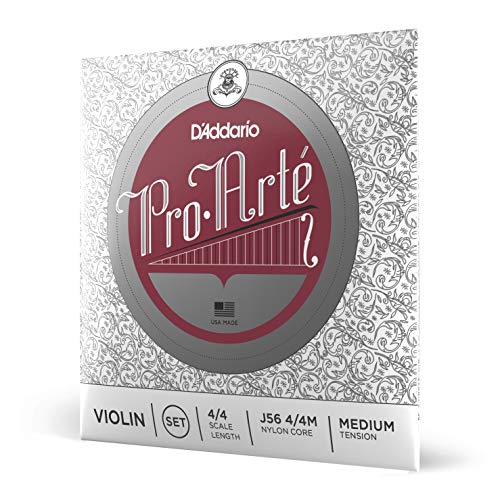
Sized to fit 4/4 scale violin with a playing length of 13 inches (328mm), these medium tension strings are optimized to the needs of a majority of players.
Pro-Arte synthetic core violin...
- 4/4 scale violin with a playing length of 13 inches (328mm)
The Pro-Arte series is D’Addario’s answer to the Dominant. They use a similar synthetic core and are known for having a very “warm” and “dark” sound. In our experience, these are even less “metallic” than Dominants out of the box, making them a great choice for violins that are naturally shrill or overly bright. However, they lack the “zing” and projection that the Thomastik-Infeld Dominant Violin Set Medium Tension provides. If you are a student on a strict budget, these are a fantastic entry into synthetic strings, but they don’t quite match the professional complexity of Thomastik-Infeld.
3. D’Addario Helicore 4/4 Size Violin Strings Medium Tension Set
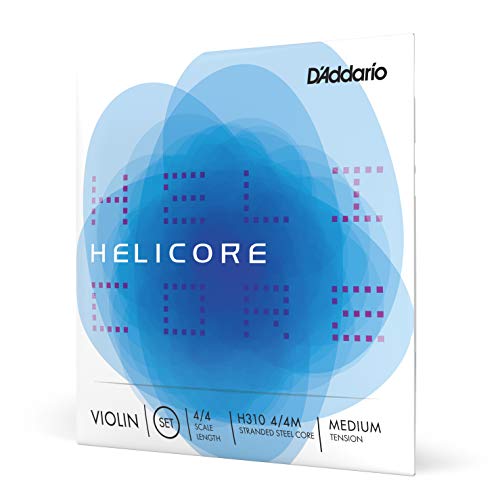
- VERSATILE STRINGS – Designed for optimum playability, D’Addario’s Helicore violin strings are one of the most versatile stranded-steel core strings available. Helicore strings suit many playing...
- STRANDED STEEL CORE – Helicore violin strings are crafted with a multi-stranded steel core, giving them great playability and a clear, warm tone. Smaller string diameter provides quick bow response...
Helicore strings are a completely different animal. They use a multi-strand steel core rather than synthetic. This makes them incredibly stable and gives them a very fast, clear response. They are the favorite of fiddlers, jazz violinists, and electric violin players who need “punch” and clarity. However, for classical music, they lack the “bloom” and gut-like overtones of the Dominants. If you find the Dominants too “mushy” or if you play primarily folk and pop, the Helicores are the better alternative. But for a traditional violin sound, Dominants win every time.
The Final Verdict: Is the Thomastik-Infeld Dominant Set Worth It?
After decades on the market, the Thomastik-Infeld Dominant Violin Set Medium Tension remains the undisputed king of synthetic violin strings. Its ability to mimic the warmth and complexity of gut while providing the stability and ease of modern materials is unmatched at this price point. We’ve seen it transform student instruments and hold its own on professional stages. While the E string might be bright for some, and the initial break-in period requires a little patience, the results are undeniably professional. It is the safest, most reliable investment a violinist can make to improve their tone without buying a new instrument.
If you are tired of a thin, metallic sound and want a string that feels as good as it sounds, this is the set for you. Whether you are a parent buying for a student or an adult returning to the instrument after years away, the difference these strings make is truly “amazing,” as one user put it. Don’t settle for subpar tone that holds back your progress. We highly recommend that you grab a set of Thomastik-Infeld Dominant 135B strings today and hear your violin’s true potential for the first time.
Last update on 2026-09-26 / Affiliate links / Images from Amazon Product Advertising API