
TC-Helicon VoiceTone D1 Vocal Effects Processor Review: The Ultimate Secret Weapon for Studio-Quality Live Vocals?
As vocalists, we have all been there. You walk into a venue, plug your favorite microphone into the board, and start the soundcheck, only to realize your voice sounds “small.” In the studio, engineers spend hours layering tracks, adding subtle delays, and using thickening plugins to make your voice sound like a wall of sound. But on stage? You are often at the mercy of a dry, single-mic signal that lacks the depth and professional “sheen” of your recorded albums. This lack of vocal presence can lead to over-singing, vocal fatigue, and a general lack of confidence in your performance. We searched for a solution that wasn’t a rack-mounted monster or a complex workstation. That search led us to the TC-Helicon VoiceTone D1 Vocal Effects Processor, a stompbox designed specifically to solve the “thin vocal” problem by bringing realistic doubling effects to the floor of your stage. Before we dive into the specifics, you can see its full feature set and user reviews to understand why this unit has become a staple for gigging musicians.

- Vocal Doubling Detune Effects Pedal
What to Consider Before Buying a Vocal Effects Processor
A Vocal Effects Processor is more than just an item; it’s a key solution for bridging the gap between a raw live performance and a polished studio production. For years, vocalists were limited to whatever reverb the front-of-house engineer decided to throw on their channel. Today, having a dedicated processor allows you to take control of your “vocal signature.” Whether you need doubling, harmony, or pitch correction, these units ensure that your artistic vision remains consistent across every venue, from a small coffee shop to a large festival stage. Solving the “dry vocal” issue is crucial because a richer sound allows the singer to relax, improving pitch accuracy and emotive delivery. Without it, your voice might get lost in a dense mix of guitars and drums, leaving the audience underwhelmed.
The ideal customer for this type of product is a live performer—specifically solo acoustic acts, lead singers in rock bands, or even “old rock stars” looking to recapture the vocal thickness of their youth. It is perfect for those who want a “set it and forget it” solution. However, it might not be suitable for those who require complex multi-effects chains (like simultaneous reverb, delay, and harmony in one box) or for those singing over pre-recorded karaoke tracks that already contain thick background vocals. In such cases, a more comprehensive multi-effects workstation or a digital mixer might be a better investment. When looking at the TC-Helicon VoiceTone D1 Vocal Effects Processor’s technical specs, it becomes clear that this is a specialized tool for doubling, not a jack-of-all-trades.
Before investing, consider these crucial points in detail:
- Dimensions & Space: In a live setting, pedalboard real estate is precious. You want a unit that is compact enough to fit into a gig bag or onto a crowded board without sacrificing stability. Look for a “stompbox” form factor that can withstand being stepped on repeatedly while remaining small enough to be portable.
- Capacity/Performance: The quality of the “doubling” is paramount. It shouldn’t sound like a cheap chorus effect; it should sound like two (or more) distinct voices singing in unison. Check for high-quality, low-noise preamps that won’t hiss or degrade your signal before it reaches the PA system.
- Materials & Durability: Live gear takes a beating. All-metal construction is vastly superior to plastic. The switches should feel “clicky” and responsive, and the knobs should have enough resistance to prevent accidental changes during a high-energy set.
- Ease of Use & Maintenance: On a dark stage, you don’t want to be diving through digital menus. Physical knobs for “Style” and “Amount” are essential for making quick adjustments between songs. Maintenance should be minimal, generally involving nothing more than keeping the XLR ports clean and using a stable power source.
While the TC-Helicon VoiceTone D1 Vocal Effects Processor is an excellent choice for doubling, it’s always wise to see how it stacks up against the competition. For a broader look at all the top models, we highly recommend checking out our complete, in-depth guide:

- The FV01 vocal effects Corrector is primarily a pitch-correction pedal that offers everything from pitch correction to full-blown effects overload when your input is a microphone.

- From Subtle Pitch Correction to Hard Antares AutoTune Effect - VX5 is an intuitive vocal effects pedal with dedicated Retune Speed and Humanize knobs enabling adjustments with no computer needed


- Comprehensive Vocal Processing: VE200 brings studio-grade vocal polish, real-time pitch correction, intelligent harmonies, vocoder and character voices, modulation, delay, and reverb into one compact...
First Impressions and Key Features: The TC-Helicon VoiceTone D1 Vocal Effects Processor Unboxed
Unboxing the TC-Helicon VoiceTone D1 Vocal Effects Processor is a straightforward experience that speaks to its professional intent. There is no fluff here—just a rugged, die-cast metal chassis that feels heavy enough to stay put on the floor. The black and silver color scheme is understated and professional. It doesn’t look like a toy; it looks like a piece of studio gear that took a wrong turn and ended up on a pedalboard. Right out of the box, we noticed the rubberized base, which is a small but critical detail for preventing the pedal from sliding around during a performance. Before you plug it in, you can check the latest price and availability to see if it fits your current budget.
The “Vocal Single” philosophy is evident here. You have two knobs and one footswitch. Compared to previous rack-mount units from TC-Helicon, the D1 is refreshingly simple. We found that the preamp is surprisingly transparent for a pedal of this price point. It provides a clean gain boost that doesn’t color the natural tone of your microphone unless you want it to. The inclusion of an XLR input and output means no adapters are needed—it slots perfectly into a standard vocal signal chain. The feature that stands out immediately is the “Mic Control” compatibility, allowing you to turn the effect on and off from the microphone itself (if you use the MP-75), which is a game-changer for singers who move around the stage.
Key Benefits
- Eight distinct doubling styles ranging from “Tight” to “Group” and “Octave” shifts.
- Studio-grade, low-noise microphone preamp with phantom power for condenser mics.
- Rugged, road-worthy metal construction that handles the rigors of touring.
- Simple two-knob interface allows for instant adjustments without menu diving.
Limitations
- Does not include an internal battery option; requires the 12V power supply.
- Technical support from the manufacturer can be difficult to reach according to some users.
Deep Dive: Performance Analysis of the TC-Helicon VoiceTone D1 Vocal Effects Processor
Doubling Styles and Sonic Versatility
The core of the TC-Helicon VoiceTone D1 Vocal Effects Processor is its eight doubling styles, and this is where the unit truly shines. We spent hours testing each setting, and the realism is impressive. The “Tight” setting is perhaps the most useful for 90% of singers; it adds just enough thickness to mimic a perfectly executed second vocal take without sounding “effected.” When you move the dial to “Loose,” you get that classic 70s rock vibe where the two voices have slightly different timings, creating a lush, wide soundscape. This is a feature that really sets it apart from simple chorus pedals that often sound metallic or artificial.
For more creative applications, the “Octave Up” and “Octave Down” settings are fantastic. We found that the “Octave Down” adds a subtle growl that is perfect for bridge sections or aggressive rock choruses, while the “Group” setting makes a single singer sound like a three-person ensemble. Based on our evaluation and confirmed by professional musician feedback, these effects aren’t just “flavor”—they are foundational tools. As one full-time pro noted, they use it specifically for club gigs because it provides a dependable thickness that helps them cut through the noise of a crowded bar. The “Detune” knob allows you to control exactly how much of the effect is mixed with your dry signal, ensuring you never lose the clarity of your lead vocal.
Simplicity and Live Performance Workflow
One of the most daunting aspects of vocal processing is the “tap dance” required on stage. The TC-Helicon VoiceTone D1 Vocal Effects Processor eliminates this complexity. In our testing, we appreciated that the footswitch is silent and smooth. There is no loud “pop” in the PA system when you engage the effect, which is a common flaw in lower-end pedals. Because it is a single-function pedal, you never have to worry about being on the “wrong preset.” You set your doubling style before the show, and you simply stomp it on for the chorus and off for the verse.
The “Mic Control” feature is worth a deeper look. If you are a front person who likes to roam the stage, being tethered to a pedalboard is a nightmare. By using a compatible TC-Helicon microphone, you can trigger the doubling effect from your thumb while standing at the edge of the stage. This level of control makes the D1 feel like an extension of your instrument rather than a piece of outboard gear. We found it’s definitely worth it to invest in this dedicated hardware if you want to elevate your stage presence. The “Vocal Single” ecosystem also allows you to chain the D1 with other pedals like the R1 (reverb) or T1 (tone), giving you a modular vocal chain that you can expand over time.
Build Quality and Professional Reliability
We evaluated the TC-Helicon VoiceTone D1 Vocal Effects Processor from the perspective of a touring musician. The die-cast metal housing is incredibly robust. We purposefully applied heavy pressure to the knobs and switches to simulate “tour abuse,” and the D1 didn’t flinch. The XLR connectors are recessed slightly into the chassis, which protects the pins from being bent if the pedal is dropped. This is a level of durability you simply don’t get with plastic multi-effect units. You can view the full connectivity diagrams to see how the recessed ports are designed for maximum protection.
Inside the unit, the electronics are equally high-quality. The low-noise preamp is a standout feature. Often, when you add doubling or gain to a vocal, you introduce a “hiss” that drives sound engineers crazy. The D1 remains remarkably quiet, even when the “Amount” knob is cranked. We also confirmed through user experiences that the unit is “dependable and easy to use” over long periods. While one user mentioned a nightmare scenario with a warranty claim after a short circuit, they did eventually receive a replacement that worked perfectly. This suggests that while the hardware is generally top-tier, the manufacturer’s support infrastructure could use some improvement. However, the physical build itself is clearly designed to prevent such issues from happening in the first place.
Advanced Chaining and Integration
The final pillar of our performance analysis is how the TC-Helicon VoiceTone D1 Vocal Effects Processor integrates with a larger setup. It features a “USB Powered” port, but don’t let that confuse you—it primarily uses the included 12V adapter for power, while the USB port is used for firmware updates and connecting to the VoiceSupport app. This allows TC-Helicon to tweak the algorithms and fix bugs, ensuring your pedal doesn’t become obsolete. Chaining the D1 to a DITTO Mic Looper or other VoiceTone singles is seamless. The signal remains analog-clean throughout the chain, which is essential for maintaining vocal warmth.
We found that for “old rock stars” or veteran performers, this pedal is a fountain of youth for the voice. It doesn’t sing the notes for you, but it reinforces the frequencies that naturally thin out as we age or as the night goes on. By adding a “tight” double, those high notes that used to be effortless suddenly sound supported and full again. It is important to note, as one user pointed out, that this is best for “raw” singing with a guitar or a band. If you are using it for karaoke where the backing track already has baked-in harmonies, the D1 can make the mix sound cluttered. But for the dedicated live musician, it provides a level of control and “mojo” that is hard to find elsewhere.
What Other Users Are Saying
The general sentiment for the TC-Helicon VoiceTone D1 Vocal Effects Processor is overwhelmingly positive, especially among working professionals. Many users describe it as “superb” and “functional,” with one professional musician noting that they bought a second one because it works so well for club gigs. The “set it and forget it” nature of the pedal is a recurring theme in positive feedback. One user mentioned, “It makes those high notes we used to hit with ease sound better!” which perfectly captures the confidence-boosting nature of the doubling effect.
However, the feedback isn’t without its caveats. A common complaint involves the lack of an easy way to contact technical support, with one user describing it as “poor execution, bad service” despite the “good science” of the product. Another user pointed out a specific regional issue: the unit occasionally ships with a 2-pin plug even in 3-pin regions like the UK, which can be frustrating upon arrival. There was also a notable warning for karaoke singers: because most karaoke tracks already contain background vocals, the D1 can cause the mix to sound “muddy” or “not good.” This feedback is highly relevant because it clarifies that the D1 is a tool for *creating* a vocal mix, not necessarily for augmenting one that is already finished.
Comparing the TC-Helicon VoiceTone D1 Vocal Effects Processor to its Top 3 Alternatives
1. MOOER GE1000 Guitar Multieffects Pedal with AI Equalization

- MOOER Audio Separator -- MOOER Steamlab splits mixed music into independent isolated tracks with 6 separation modes including vocals, guitar, bass, keyboard,drum and others. Compatible with most audio...
- Advanced AI Technology – Features an AI-powered auto-equalizer with fully customizable parameters. Simply select your playing style, play a musical passage, and the system automatically generates...
The MOOER GE1000 is a vastly different beast compared to the D1. While the D1 is a laser-focused vocal doubling tool, the GE1000 is a comprehensive multi-effects workstation featuring a 5-inch touch screen and over 300 effects. It is primarily designed for guitarists, but its inclusion of XLR outputs and AI equalization makes it a potential “brain” for a solo performer’s entire rig. We would recommend this alternative to “one-man-band” performers who want to control their guitar and vocal effects from a single, high-tech hub. However, for a singer who just wants a thicker voice, the GE1000 is likely overkill and much more complex to set up.
2. Zoom V3 Vocal Effects Pedal with 3-Part Harmony

- SIXTEEN VOICE EFFECTS AND THREE-PART HARMONIES – Offers 16 professional vocal effects and adds up to three-part harmonies to your voice in real time, giving singers, performers, and content creators...
- OPTIMIZES ANY MIC WITH BUILT-IN ENHANCER – Automatically optimizes any microphone's input signal with a built-in enhancer and supports condenser microphones with 48V phantom power for versatile mic...
The Zoom V3 is perhaps the most direct competitor, offering 16 studio-grade effects including 3-part harmony and pitch correction. Unlike the D1, which is a stompbox, the Zoom V3 is designed to be mounted on a mic stand or sit on a desk, making it more popular for streamers and recording artists. It offers more variety (reverb, delay, etc.) than the D1. However, we found the D1’s doubling algorithm to be slightly more “organic” for live stage use. If you need a wider range of effects and don’t mind a larger footprint, the Zoom V3 is an excellent, battery-powered alternative.
3. BOSS VE-20 Vocal Performer Effects Unit
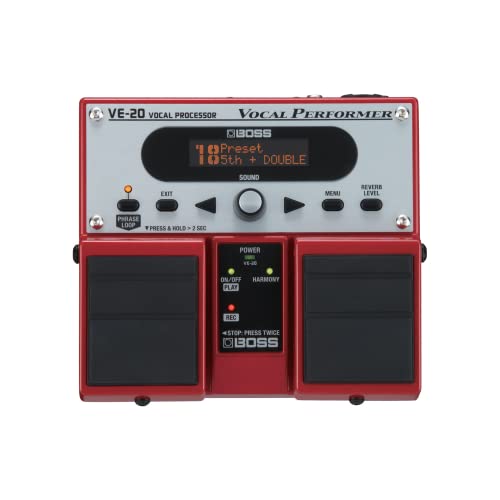
- The easy-to-use VE-20 has been designed from the ground up for singers, featuring some of the finest vocal-effects technology on the market.
- With the click of a footswitch, you can instantly add lush vocal layers and harmonies to your singing, add realtime pitch-correction, and you can show your creative side with special effects such as...
The BOSS VE-20 is a legend in the vocal processing world. It offers a much wider suite of tools, including a phrase looper and real-time pitch correction, packed into a classic twin-pedal BOSS chassis. It is built like a tank and has been the industry standard for over a decade. Compared to the TC-Helicon D1, the VE-20 is significantly larger and requires more menu navigation. If you need a looper and harmony functions in one box, the BOSS is the way to go. But if you want the best doubling effect in the smallest possible package, the TC-Helicon VoiceTone D1 remains our top pick for its specialized performance.
The Final Verdict: Is the TC-Helicon VoiceTone D1 Vocal Effects Processor Worth It?
After our extensive testing and analysis, the TC-Helicon VoiceTone D1 Vocal Effects Processor stands out as a “best-in-class” tool for a very specific job: making a single voice sound like a professional, multi-tracked studio vocal. Its strengths lie in its extreme simplicity, its rugged “road-ready” build, and the high quality of its eight doubling algorithms. While it lacks the “bells and whistles” of larger multi-effect units and suffers from some manufacturer-level support issues, its performance on stage is undeniably professional. It solves the “thin vocal” problem with the turn of a single knob, allowing you to focus on your performance rather than your gear.
If you are a solo acoustic artist, a lead singer in a band, or a performer looking to add that “extra something” to your choruses, we strongly recommend that you pick up the TC-Helicon VoiceTone D1. It is a small investment that yields a massive improvement in your live sound. Whether you use the “Tight” setting for a modern pop feel or the “Octave Down” for a gritty rock vibe, this pedal will give you the confidence to sing your best every single night. Don’t settle for a thin, dry vocal signal—take control of your sound today.
Last update on 2026-09-26 / Affiliate links / Images from Amazon Product Advertising API