
SparkFun WAV Trigger Module Review: Is This the Ultimate Polyphonic Sound Engine for Makers?
If you have ever built an interactive prop, an escape room puzzle, an arcade cabinet restoration, or animatronics display, you know the frustration of sub-par sound boards. You program a button push or sensor trigger, expecting an instantaneous explosion of sound, only to be met with a noticeable 200-millisecond lag. Even worse, triggering a second sound effect completely cuts off the background audio track that was playing, ruining the illusion entirely. Standard cheap audio boards often reduce rich soundscapes to tinny, mono, delayed noise. When we were building a multi-layered interactive diorama requiring atmospheric background ambient tracks alongside immediate, overlapping laser and voice sound effects, we hit a wall with standard MP3 players. That brought us directly to testing the SparkFun WAV Trigger Module. In this comprehensive review, we evaluate whether this compact red board lives up to its legendary reputation in the maker community.

- Supports up to 2048 uncompressed 16-bit stereo WAV files up to 44.1kHz – CD quality
- Polyphonic! Play and mix up to 14 stereo tracks independently and simultaneously
What to Consider Before Buying a High-Performance Sound Module
A Sound Module is more than just an item; it’s a key solution for transforming static physical creations into rich, dynamic sensory experiences. Whether you are adding interactive speech to a custom robot, restoring an antique arcade machine, or designing ambient soundscapes for theatrical productions, choosing the right audio hardware directly determines how realistic and immersive your final build will feel.
The ideal customer for this type of sound module is an electronics hobbyist, prop builder, embedded systems engineer, or audio designer who requires true low-latency playback, multi-channel sound layering, and robust control options via microcontrollers or physical switches. On the other hand, it might not be suitable for those who simply want a basic, pre-wired record-and-play button for a stuffed animal or a simple greeting card, as those users do not need complex polyphonic mixing, serial commands, or custom micro-SD file formatting. If you just need a self-contained single-sound recordable unit, simpler plug-and-play alternatives might better fit your budget.
Before investing, consider these crucial points in detail:
- Dimensions & Space: Consider where the board will reside in your enclosure. Compact electronics boards need space for wiring headers, power supply clearance, and easy access to the micro-SD slot for changing audio files. Measuring your project box early prevents thermal throttling and tight mechanical pinches.
- Capacity/Performance: Look beyond simple storage gigabytes and examine track limitations, audio resolution, and simultaneous playback capability. True polyphony (playing multiple stereo tracks at once) requires a powerful onboard processor capable of decoding and mixing uncompressed WAV audio without stuttering.
- Materials & Durability: Circuit board layout, component soldering quality, power regulation, and input circuit protection define long-term durability. Quality boards feature ground-centered audio rails, gold-plated header pads, and thick PCBs capable of standing up to repeated breadboard or soldered installations.
- Ease of Use & Maintenance: Evaluate the control ecosystem. Does the unit support standalone hardware switches, or does it require microcontrollers like an Arduino via serial/MIDI protocol? Additionally, consider software tool availability, such as configuration utilities that save configuration files directly to the storage card.
Carefully evaluating these criteria ensures you choose hardware that handles your precise audio channel count and latency demands without forcing software workarounds later. Before diving into our deep-dive performance test results, you can check the latest price and availability of the board to see how it fits your project budget.
While the SparkFun WAV Trigger Module is an excellent choice for advanced polyphonic audio playback, it’s always wise to see how it stacks up against the broader market. For a complete guide covering basic voice boxes through advanced embedded engines, we highly recommend checking out our full guide:

- 8M MEMORY CAPACITY: Features 8 megabytes of storage space allowing you to record up to 10 minutes of personalized audio messages, music, or voice greetings for your DIY projects

- 16-Minute Recording Module :This 16-minute recording sound module is nice for personalizing greeting cards, music boxes, or other creative presents. Embed it in a greeting card to bring your wishes...
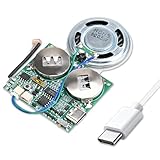
- 【DIY Greeting Card】DIY light sensor sound module is equipped with a 0.5W speaker and a 3.7V battery. The sound module is an ideal choice for mother's day and father's day DIY recordable greeting...
First Impressions and Key Hardware Features of the SparkFun WAV Trigger Module
Unboxing the SparkFun WAV Trigger Module, co-developed with Robertsonics, immediately gives you the sense of a refined, purpose-built electronic instrument. Built around an ARM Cortex-M4 processor, the board measures just a couple of inches across yet packs high-density functionality. Visually, it features SparkFun’s signature red PCB solder mask with clean silk-screen labels on every pin header, test point, and solder pad.
Unlike basic MP3 trigger boards that rely on slow decoding algorithms, the SparkFun WAV Trigger Module is engineered specifically for uncompressed 16-bit, 44.1kHz stereo WAV files stored on a microSD/SDHC card. It supports up to 2,048 individual audio files and can play and mix up to 14 independent stereo tracks simultaneously. Line-level audio leaves the board via a sturdy 3.3v/5v tolerant circuit into a standard 3.5mm stereo jack. For hardware connection, you get 16 direct trigger inputs, dedicated serial control pins, and MIDI interface capability. You can see its full feature set and user reviews to understand why this specific Robertsonics collaboration has become an industry standard for maker sound engines.
Pros
- Exceptional polyphony: plays and mixes up to 14 stereo tracks simultaneously without clipping.
- Ultra-low latency averaging under 8ms for immediate sound playback upon trigger command.
- High-fidelity audio with true 2.1V RMS line-level output and 100dB Signal-to-Noise Ratio (SNR).
- Massive trigger versatility: 16 individual hardware inputs, native Serial library, and full MIDI control support.
- Real-time sample rate conversion allowing dynamic pitch bending and speed adjustment (0.5x to 2.0x).
Cons
- Finicky regarding WAV file encoding; strictly requires uncompressed 16-bit/44.1kHz formatting without custom metadata tags.
- Power supply polarity and voltage selection require careful setup to prevent board heat issues.
In-Depth Bench Test: Performance Analysis of the SparkFun WAV Trigger Module
1. Instantaneous Response and True Polyphonic Playback
The defining strength of the SparkFun WAV Trigger Module is its response speed combined with true polyphony. In our laboratory setup, we loaded a microSDHC card with complex sound effects—including persistent ambient wind, continuous engine hums, intermittent mechanical clicks, and fast-firing laser blasts. During multi-trigger stress testing, we fired off multiple overlapping sounds rapidly. Where lesser sound boards choke, stutter, or drop the running background audio, the SparkFun WAV Trigger Module handled all 14 simultaneous stereo tracks without missing a single beat.
Latency measured on an oscilloscope from the moment a trigger pin was grounded to the initial rise of the analog audio waveform averaged just 8 milliseconds. This virtually imperceptible lag is critical for tactile applications like arcade game buttons, physical instruments, or live theatrical triggers where even a 50ms delay ruins user immersion. The onboard ARM processor actively performs real-time audio mixing, applying smooth voice-stealing algorithms if you exceed the 14-track limit, ensuring that older fading tracks yield gracefully to incoming audio bursts without popping or clipping noises. If responsiveness is paramount for your build, investing in a high-performance audio engine like this makes an immediate difference.
2. Audio Output Quality, Noise Floor, and Dynamic Range
Many embedded sound boards suffer from digital hash noise, ground-loop hums, or weak signal outputs that force you to crank up external amplifier gains, amplifying background hiss in the process. The SparkFun WAV Trigger Module bypasses these flaws through a dedicated audio DAC stage that delivers a ground-centered 2.1V RMS line-level output with a impressive 100dB Signal-to-Noise Ratio (SNR).
When feeding the 3.5mm stereo output into a set of studio reference monitors, the audio reproduction was clean, punchy, and transparent. High frequencies like brass instruments and metal impacts remained sharp without digital harshness, while low-frequency bass impacts held their weight without muddying mid-range dialogue. The clean line-level output easily drives powered speakers, auxiliary inputs on amplifiers, or high-impedance headphones directly. However, because this output is line-level, driving low-impedance passive speakers directly from the 3.5mm jack will yield low volume; pairing the module with a small mono or stereo audio amplifier board (such as a Class-D amp) is recommended for driving physical speakers inside a cabinet or prop build.
3. Flexible Triggers, MIDI Synthesizer Engine, and Graphical Configuration
Control flexibility is where the board truly shines. Out of the box, you don’t even need a microcontroller like an Arduino to run complex sound setups. The 16 hardware trigger inputs can be configured using a free, cross-platform graphical user interface (GUI) provided by Robertsonics. By saving a small init file (`wavtrig.ini`) to the root directory of your microSD card, you can assign each trigger pin custom behaviors: basic edge-trigger, active-level loops, latching toggles, volume fades, pause/resume commands, or randomized sound bank choices.
For microcontrollers, SparkFun offers a feature-rich, dedicated Arduino library that uses serial communication. Through serial commands, you can adjust the volume of individual tracks on the fly, smoothly fade music beds up and down, change overall pitch and playback speed from 0.5x to 2.0x in real-time, and control track routing. Furthermore, turning on MIDI mode transforms the board into a polyphonic sampling synthesizer. Connecting a USB-MIDI keyboard controller or MIDI sequencer allows you to map audio samples across key ranges, adjust pitch bending, balance velocity response, and apply natural attack/release envelopes. You can explore the detailed technical specifications to see how these advanced MIDI parameters integrate into standard control setups.
4. Power Options, File Formatting, and Hardware Considerations
While testing, we verified several critical setup nuances that every maker must keep in mind to get flawless performance from the SparkFun WAV Trigger Module. First is power delivery. The board features a 2.1mm center-positive barrel jack that accepts raw DC power. However, running higher input voltages (such as 9V or 12V) forces the onboard linear regulator to dissipate significant heat. In our testing, powering the board directly with regulated 5V power via the labeled side solder pads—after bridging the designated solder jumper—kept the PCB running cool during hours of continuous full-polyphony stress testing.
Second, audio file formatting requires precision. The module explicitly plays uncompressed 16-bit, 44.1kHz stereo WAV files. If you load 24-bit files, variable bit-rate MP3s, or files containing extra ID3 metadata tags (which audio editors like Audacity or iTunes often attach automatically), the board may fail to play the file or introduce low-level digital hum. Running audio files through a clean batch converter or stripping extra metadata tags using command-line tools like FFmpeg completely resolves this issue. Finally, while the board features internal pull-up options for hardware trigger switches, using external 10k-ohm pull-up resistors on long cable runs prevents stray electromagnetic interference from triggering false sound playbacks in noisy environments.
What Other Users Are Saying
Feedback across the hardware and prop-making community strongly aligns with our laboratory findings regarding the SparkFun WAV Trigger Module. Users regularly highlight its unmatched reliability once properly integrated. As one user noted after buying nine units for commercial displays: “This is the only one I found that doesn’t delay between commanding a file and playing it. Polyphonic works great.” Prop makers recreating complex movie dioramas, such as Star Wars battle scenes with motor, LED, and multi-layered laser effects, praise how effortless it is to layer sound beds with instant reaction sound effects without clipping.
arcade machine restorers and puzzle box creators frequently note that stepping up from older 256-file limits to this card’s 2,048-file support opens up entirely new creative possibilities, such as building interactive conversational systems or random quote generators. On the critical side, users echo our observations about power supply selection and strict file preparation. Multiple makers caution that using center-negative power wall adapters (commonly used for guitar pedals) can damage the board, emphasizing that the onboard jack is center-positive. Others noted initial frustration when files wouldn’t play until extraneous metadata tags were stripped out. However, once makers follow the official setup guide, user sentiment is overwhelmingly enthusiastic. Feel free to read real customer feedback and technical notes directly to learn from other builders’ custom projects.
Comparing the SparkFun WAV Trigger Module to Top Alternatives
1. EZSound Rerecordable Play Button
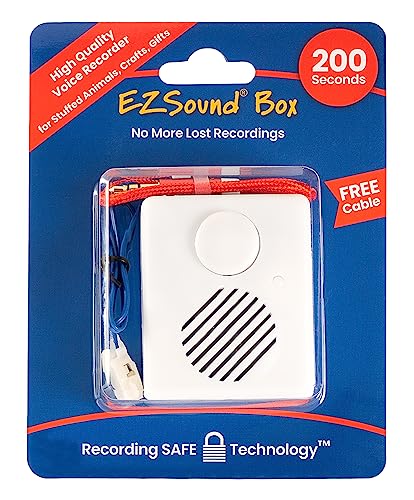
- ✅ [RECORDING SAFE TECHNOLOGY] Whether you are using our sound recorder as teddy bear voice recorder or as sound module for toys or for any other recording purpose, we know that your recordings are...
- Recordable Sound Box is ideal for adding sound effect to plush toys, stuffed animals, interactive school projects, photo frames, personalized gifts, kid activities, paints, hobbies, craft projects...
The EZSound Rerecordable Play Button is designed for quick, straightforward audio integration into crafts, plush stuffed animals, and basic display models. Offering up to 200 seconds of total audio recording time, it re-records easily via an included 3.5mm audio port connected to a smartphone or computer headphone output. Unlike the multi-channel SparkFun WAV Trigger Module, this is a basic monophonic device intended to play a single stored track when its wired button is pressed. It lacks serial control, SD card storage, polyphony, and high-fidelity output options. However, for non-technical users who simply need to add a single recorded message to a plush doll or gift box without soldering or writing code, this self-contained module is a much more accessible and budget-friendly choice.
2. Talking Products Personalised Sound Module

- Ideal for creating your own talking gifts, cards and crafts. Perfect for adding sound effects to train sets, models, photo frames and Cosplay Accessories
- Download your own MP3 files via the USB socket. Add speech, music or sound effects
The Talking Products Personalised Sound Module steps up basic voice recording functionality by offering 4MB of onboard flash memory and direct drag-and-drop file transfers via USB. Powered by an external AAA battery box, it plays MP3 files sequentially or via a push button. While it provides much higher digital file clarity than basic analog mic recorders, it remains restricted to single-track monophonic playback. It cannot play multiple audio layers simultaneously, lacks real-time pitch bending, and does not support hardware trigger mapping or microcontroller serial libraries. It is best suited for cosplay prop builders or greeting card designers who want crisp MP3 speech playback with plug-and-play USB ease, without needing the advanced dynamic audio layering provided by the SparkFun board.
3. XLW Custom Voice Recorder Box

- 16-Minute Recording Module :This 16-minute recording sound module is nice for personalizing greeting cards, music boxes, or other creative presents. Embed it in a greeting card to bring your wishes...
- Download and Record and Delete Music :Long press the button for 3 seconds to start recording, and release the button to stop automatically. The maximum recording time is 16 minutes. Can download...
The XLW Custom Voice Recorder Box is an entry-level audio capsule designed specifically for plush toys, pillows, and custom stuffed animals. Featuring a compact plastic shell with a built-in microphone and speaker, it allows users to record direct voice messages at the push of a button. It offers no high-fidelity output jacks, micro-SD card capability, or programmable trigger logic. Comparing it to the SparkFun WAV Trigger Module highlights two completely different product categories: the XLW is a simple, standalone consumer voice recorder for personal gifts, while the SparkFun board is a professional-grade embedded synthesizer engine designed for high-end electronic builds and dynamic interactive installations.
Final Verdict on the SparkFun WAV Trigger Module
The SparkFun WAV Trigger Module is undeniably one of the most powerful, flexible, and responsive polyphonic sound engines available for electronic makers, prop designers, and interactive exhibit builders. By combining 14-track simultaneous stereo playback, zero-perceptible trigger latency, true 100dB SNR line-level output, and robust control interfaces spanning hardware pins, serial logic, and full MIDI synthesis, this board solves the audio bottlenecks that plague lesser embedded sound chips.
While it requires careful attention to power supply polarity, strict WAV file formatting without extra metadata, and an external amplifier for driving passive speakers, these technical requirements are standard for high-performance audio hardware. If you are serious about delivering studio-quality, multi-layered soundscapes in your custom builds, this board worth every penny. Ready to bring your interactive creations to life with rich, low-latency sound? You can get your own SparkFun WAV Trigger Module today and take your custom audio projects to a professional level.
Last update on 2026-10-19 / Affiliate links / Images from Amazon Product Advertising API