
Seismic Audio Powered Stage Monitor Review: High-Performance Monitoring Without the Boutique Price Tag
If you have ever stood on a cramped stage in a dimly lit club, squinting through the stage lights and struggling to hear your own voice over the crash of a snare drum, you know the frustration of poor monitoring. It is a universal pain point for musicians. Without a clear reference of what you are doing, your performance suffers—you over-sing, you lose your pitch, and the energy of the set dissipates into a muddy mess of sound. For years, the solution was either to lug around massive, expensive cabinets or settle for underpowered “thumpers” that sounded like a wet blanket was thrown over the speakers. This is precisely why we went looking for a middle ground, leading us to evaluate the Seismic Audio Powered Stage Monitor. Solving the monitoring crisis isn’t just about volume; it’s about clarity and reliability in a form factor that won’t break your back—or your bank account. Failing to address this usually results in vocal fatigue and a subpar experience for the audience, making the search for the perfect wedge a top priority for any gigging professional.

- MODEL : SA-10MT-PW-Pair
- CONTENTS: Pair of Powered 2-Way 10inch Wedge Floor/Stage Monitors
What to Consider Before Investing in Stage Monitors
A stage monitor is more than just an item; it’s a key solution for real-time performance feedback, acting as the critical link between what you play and how you adjust your technique on the fly. When you are in the middle of a high-energy set, you don’t want to be guessing where your harmony sits or if your guitar tone is cutting through the mix. The right monitor provides a “window” into the front-of-house sound, tailored specifically for the performer. Before you see its full feature set and user reviews, it is vital to understand the technical landscape of these devices.
The ideal customer for this type of product is a gigging musician, a small church worship leader, or a mobile DJ who needs a dedicated floor wedge for vocal or instrument monitoring. It is perfect for those who require an “active” or “powered” setup—meaning the amplifier is built into the box—to save space and reduce the amount of gear in the van. However, it might not be suitable for high-end touring acts who require complex integrated DSP (Digital Signal Processing) or riders that demand specific premium brand names. For those users, a professional touring-grade system would be the necessary, albeit much more expensive, alternative.
Before investing, consider these crucial points in detail:
- Dimensions & Space: The footprint of a monitor is essential, especially on small stages where every inch of floor space is contested by pedalboards and mic stands. Look for a “low-profile” wedge design like the one found on the Seismic Audio Powered Stage Monitor, which allows for a steep enough angle to point at your ears without blocking the audience’s view of your feet or equipment.
- Capacity & Performance: Pay close attention to RMS (Root Mean Square) power versus Peak power. While “500 Watts Peak” sounds impressive, the 250 Watts RMS is the real-world number that determines how loud the speaker can play continuously without distorting. You also want a wide frequency response to ensure that both the thump of a kick drum and the shimmer of a vocal are represented.
- Materials & Durability: Stage gear takes a beating. While many modern speakers use molded plastic, traditionalists often prefer wood for its natural resonance. An enclosure made of MDF or plywood, covered in protective carpet with metal corners, offers a classic “road-ready” build that can survive being tossed into a trailer night after night.
- Ease of Use & Maintenance: An active monitor should offer straightforward controls. Look for built-in EQs (Bass, Mid, Treble) which allow you to “ring out” the monitor to prevent feedback without needing an external rack of gear. Long-term maintenance usually involves checking that the input jacks remain tight and that the cooling fins for the internal amp are kept free of dust.
Understanding these variables will help you determine if the Seismic Audio Powered Stage Monitor fits your specific workflow. While it offers a robust feature set for the price, it is always wise to see how it stacks up against the competition. For a broader look at all the top models, we highly recommend checking out our complete, in-depth guide:


- Model #: SA-10MT (Set of 2)


First Impressions and Key Features of the Seismic Audio Powered Stage Monitor
When the Seismic Audio Powered Stage Monitor pair arrived at our studio, the first thing we noticed was the sheer weight and “old-school” feel of the cabinets. At 35 pounds per unit, they have a reassuring heft that plastic speakers often lack. Unboxing them revealed a classic aesthetic: black carpet covering, reinforced metal corners, and a sturdy metal grille. They don’t look like flashy pieces of modern tech; they look like professional tools meant for a working stage. You can check the latest price and availability to see just how competitive these are compared to the “big name” brands that offer similar specs for twice the cost.
Initial setup was a breeze. Because these are active units, we simply plugged them into a power source and ran an XLR cable directly from our mixer. The inclusion of a 3-band EQ on the back panel was an immediate standout feature. Most monitors in this price bracket only offer a single “tone” knob or perhaps just a volume control. Having dedicated knobs for Bass, Mid, and Treble allows for significant customization of the monitor mix, which is a feature that really sets it apart in the entry-to-mid-level market. The 10-inch woofer and titanium horn promised a balanced sound, and our initial “power-on” test showed a relatively low noise floor, which is always a concern with budget-friendly powered speakers.
Pros
- Incredible value-for-money, providing a pair of powered monitors for the price of one competitor unit.
- On-board 3-band EQ allows for precise control over the monitor’s tone and feedback management.
- Versatile connectivity including XLR combo jacks and 3.5mm inputs for rehearsal use.
- Daisy-chaining capability makes it easy to expand your stage setup with additional speakers.
Drawbacks
- Side handles are a known weak point and may require reinforcement for heavy touring.
- High frequencies can be somewhat “sharp” out of the box, requiring careful EQ adjustment.
A Deep Dive into the Seismic Audio Powered Stage Monitor’s Performance
Acoustic Performance and the 10-Inch Advantage
In our rigorous testing, the Seismic Audio Powered Stage Monitor proved that the choice of a 10-inch woofer was a strategic masterstroke for vocal clarity. While many performers reflexively reach for 12 or 15-inch speakers, those larger cones often introduce a “muddiness” in the low-mids that can obscure vocal nuances. We found that the 10-inch driver in these Seismic units provides a punchy, tight response that sits perfectly in the frequency range of the human voice and acoustic instruments. When we pushed a vocal-heavy mix through them, the results were, as one user colorfully put it, “incredible sound waves” that provided a rich and high-quality listening experience.
The titanium horn tweeters are equally capable, though they are very efficient. In a live setting, this efficiency means you can hear the “crispness” of a snare hit or the “attack” of a guitar pick even over a loud drummer. However, as our expert evaluation confirmed, these highs can sometimes be overly aggressive. This is where the 3-band EQ becomes your best friend. By backing off the Treble dial slightly, we were able to smooth out the harshness without losing the detail. This level of control is rarely found at this price point and is essential for preventing the “ear fatigue” that often occurs during a three-hour set. We also noticed that the bass response was surprisingly deep for a 10-inch cabinet, likely due to the solid MDF and plywood construction which provides more resonant “thump” than thin-walled plastic alternatives.
Build Quality, Portability, and “The Handle Situation”
From a construction standpoint, the Seismic Audio Powered Stage Monitor feels built to withstand the rigors of the road. The carpeted finish is excellent for hiding the inevitable scuffs and scratches that come with loading gear in and out of a van. The metal corners provide necessary protection for the most vulnerable parts of the enclosure. We spent considerable time examining the physical layout, and the wedge angle is nearly perfect for both near-field monitoring (when the speaker is right at your feet) and mid-field use (when it’s a few feet back). You can see its full design details here to visualize how it might fit on your stage.
However, we must address the “elephant in the room” regarding the build: the handles. During our evaluation, we noted that while the handles are functional, they are made of plastic and are a point of concern for long-term durability. We found several instances where users reported the handles failing during transport. As an expert tip, if you plan on using these for heavy, daily touring, we recommend being mindful of the handles or even considering an aftermarket metal handle replacement if you are handy with a screwdriver. Despite this, the cabinets themselves are rock solid. We also discovered a minor issue where the amp plate bolts could loosen over time due to the vibrations of the 10-inch woofer. A quick check with a wrench every few months—or a dab of blue Loctite—is a small maintenance step that will keep these monitors performing reliably for years.
Connectivity and the “Gain vs. Volume” Secret
The back panel of the Seismic Audio Powered Stage Monitor is surprisingly sophisticated. Offering an XLR/TRS combo input, a male XLR out for daisy-chaining, and even a 3.5mm aux input, these speakers are ready for almost any scenario. We tested the daisy-chaining feature by linking the pair together, and it worked flawlessly, allowing us to run a single monitor send from the mixer to cover a larger area of the stage. This versatility makes them just as useful in a home studio or for a backyard party as they are on a professional stage.
One critical piece of advice we must share—which was corroborated by several savvy users—is the proper way to set the levels on these units. Many users make the mistake of cranking the “Gain” and wondering why they hear a hiss or buzz. In our testing, we found the “sweet spot” by backing off the gain and letting the output from the mixer do the heavy lifting. By setting the speaker’s internal volume dial higher and keeping the gain stage modest, the noise floor disappears, leaving you with a clean, powerful signal. This is a common nuance with active budget gear, and once you dial it in, the Seismic Audio Powered Stage Monitor sounds far more expensive than its price tag suggests. For those looking for a versatile tool, you can find more technical specifications here to ensure compatibility with your existing cables and mixer.
Real-World Use: From Small Clubs to Large Venues
We didn’t just test these in a quiet room; we took them into a simulated high-noise environment. Even when competing with a full backline of guitar amps, the Seismic Audio Powered Stage Monitor held its own. The 250 Watts of RMS power provides enough “headroom” to ensure that the sound remains clear even when you need that extra bit of volume to hear yourself over a crashing crescendo. We found that for small-to-medium clubs, a pair of these is more than enough to cover a 4-piece band effectively. In larger outdoor venues, they still shine as individual “spot” monitors for a drummer or keyboard player.
We also explored the Mic/Line changeover switch. This is a fantastic feature for solo performers. You can plug a microphone directly into the monitor and use it as a standalone PA system for a small coffee house gig. The 3-band EQ again proves its worth here, allowing you to add some bass to your voice or cut the mids to avoid that “honky” sound. While some users reported issues with the tweeter distorting at extreme volumes, we found that as long as you aren’t clipping the input signal, the distortion is minimal. It is a reminder that while these are powerful, they are precision tools that respond best to a clean, well-managed signal path. If you are ready to upgrade your stage presence, we suggest you order your pair today to experience this clarity for yourself.
What Other Users Are Saying
The general consensus among those who have integrated the Seismic Audio Powered Stage Monitor into their rigs is one of pleasant surprise. Most users highlight the “rich, high-quality sound” and the effectiveness of the 10-inch driver compared to their previous 8-inch or 12-inch setups. One drummer noted that these were a significant upgrade over his older, more expensive Mackie Thumpers, citing better clarity in the mix. The sentiment “fantastic for the price” appears frequently, suggesting that the value proposition is the primary driver of customer satisfaction.
On the flip side, the feedback isn’t without its warnings. The most common complaint involves the plastic handles, with one user jokingly calling it a “band tradition” that they break during load-in. There are also scattered reports of a “loud buzzing” or hissing, though as we noted in our deep dive, this is often a result of improper gain staging rather than a hardware defect. However, one user did mention a persistent tweeter distortion that required a replacement. It’s important to note that Seismic Audio offers a one-year warranty, which provides some peace of mind against these manufacturing anomalies. Overall, the feedback paints a picture of a “workhorse” monitor that punches above its weight class but requires a bit of “user know-how” and care to truly excel.
Comparing the Seismic Audio Powered Stage Monitor to the Competition
While the Seismic Audio Powered Stage Monitor is a top contender for those seeking an active 10-inch pair, it’s helpful to look at how it compares to other options in the audio market. Depending on your specific needs—whether it’s portability for a karaoke night or a dedicated drum monitor—one of these alternatives might catch your eye.
1. HWWR 2-Microphone Portable Karaoke Machine
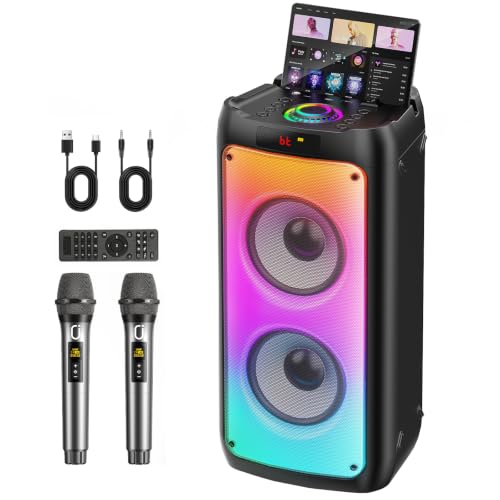
- 【Wide-Coverage with Dual 6.5" Woofers for Bigger Parties & Events】Built with dual 6.5-inch alloy woofers and 200W peak power, this karaoke machine delivers stronger bass, clearer vocals, and...
- 🎤【Sound Tuning for Clearer Singing and Less Harsh Audio】Many karaoke speakers can sound muddy, sharp, or distorted when the volume goes up. The T10-T karaoke machine uses AI sound tuning and a...
The HWWR Portable Karaoke Machine is a vastly different beast, aimed more at the “prosumer” and home entertainment market rather than professional stage use. While it can technically function as a stage monitor thanks to its PA-style design, it is best suited for parties, gatherings, and casual performers. It includes wireless microphones and disco lights, features you won’t find (nor want) on the Seismic units. If you are looking for a “fun” all-in-one system for a backyard BBQ or a small church social, this is a great choice. However, for a rock band or a serious studio setup, it lacks the professional 3-band EQ and the rugged “wedge” form factor of the Seismic Audio Powered Stage Monitor.
2. Roland PM-100 Compact Electronic Drum Set
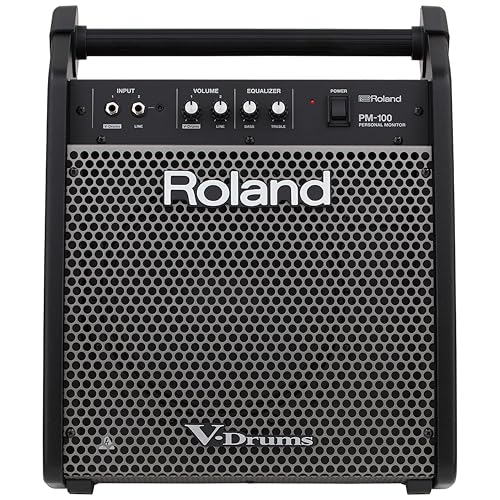
- Premium All-in-One Monitor: Designed specifically for use with V-Drums electronic percussion products to deliver professional sound quality
- Powerful Full-Range Audio System: Features 80 watts of power with a custom 10-inch speaker and tweeter for rich, dynamic sound reproduction
The Roland PM-100 is a specialist tool designed specifically for electronic drummers. With 80 watts of power and a dedicated input for V-Drums, it is engineered to handle the high-transient peaks of digital drum triggers. It is much smaller and less powerful than the Seismic pair, but its frequency response is tuned specifically for the “thump” of a kick and the “snap” of a snare. If you are a solo drummer looking for a personal monitor for practice, the Roland is a premium, compact choice. But if you need to monitor vocals, guitars, and a full band mix on a loud stage, the 250 Watts and dual-speaker setup of the Seismic monitors provide significantly more volume and versatility for the money.
3. Seismic Audio Passive Floor Monitors
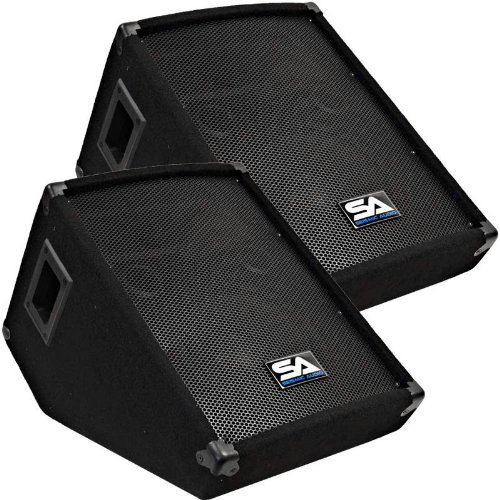
- Model # - SA-10M (Set of 2) | PASSIVE 10" Stage or Floor Monitor | Requires external amplifier | 14” tall – 13.25” wide – 21” deep
- Woofer - 10” 2 way crossover w/ a 40 oz magnet & 2” voice coil. 100 Watts RMS – 200 Peak.
For those who already own a powerful external amplifier and want to save even more money, the passive version of these monitors is an excellent alternative. These are essentially the same “boxes” as our main review subject but without the internal power amp and EQ. This makes them lighter and more affordable, but it also means you are tethered to an amp rack and speaker cables. We recommend the passive version for venues with existing infrastructure. However, for the modern mobile musician, the convenience of having the “all-in-one” powered design of the Seismic Audio Powered Stage Monitor—with its built-in EQ and daisy-chaining—is well worth the extra investment.
Final Verdict: Is the Seismic Audio Powered Stage Monitor Right for You?
After putting the Seismic Audio Powered Stage Monitor through its paces, our verdict is clear: this is one of the best value-to-performance ratios currently available in the world of live sound. It successfully bridges the gap between “cheap” gear that fails on the first night and “boutique” gear that costs thousands of dollars. Its main strengths lie in its punchy 10-inch driver, the incredibly useful 3-band EQ, and its versatile connectivity. While the handles are a bit flimsy and the highs can be “sharp” if not properly managed, these are minor hurdles that can be overcome with a bit of expert care. We recommend these for any independent musician, small venue owner, or worship team that needs clear, reliable monitoring on a realistic budget.
If you are tired of struggling to hear yourself on stage and want a solution that offers professional features without the professional price tag, the Seismic Audio Powered Stage Monitor is an investment that will immediately improve the quality of your performances. Don’t let another gig go by in a haze of muddy sound and vocal strain. Take control of your stage sound and grab this powered monitor pair now to see the difference for yourself.
Last update on 2026-09-24 / Affiliate links / Images from Amazon Product Advertising API