
Seismic Audio 4-Channel XLR Snake Cable Review: The Professional’s Verdict on Stage Connectivity
If you have ever spent thirty minutes untangling a “spaghetti mess” of XLR cables five minutes before a soundcheck, you know the frustration of poor cable management. We have all been there—tripping over individual lines running across the drum riser or trying to figure out which cable leads to Mic 3 in a dark, crowded club. This lack of organization isn’t just an eyesore; it’s a liability. Loose cables are prone to damage, create trip hazards, and significantly increase the noise floor of your signal through electromagnetic interference. Solving this problem requires more than just zip ties; it requires a dedicated sub-snake. The Seismic Audio 4-Channel XLR Snake Cable is designed specifically to bridge that gap between chaos and a professional, streamlined signal path. In our testing, we found that moving from individual runs to a consolidated snake doesn’t just save time—it preserves the physical integrity of your gear and ensures your performance remains the focal point, not your technical difficulties.
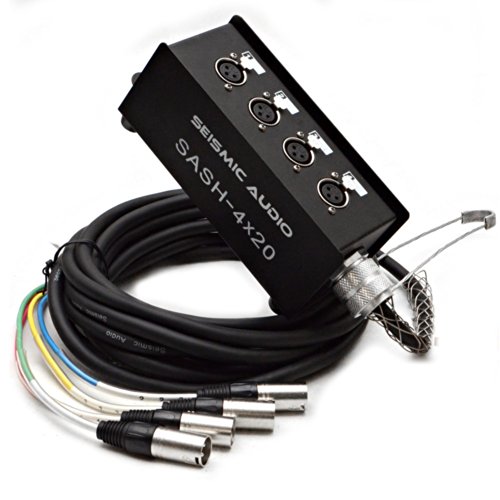
- Model Number: SASH-4x20 - 4 Channel Sub Snake (20 Feet)
- Straight 4 channel XLR Send Snake
What to Consider Before Buying a Recording Snake
A Recording Snake is more than just an item; it’s a key solution for any audio engineer or performing musician looking to consolidate multiple audio lines into a single, manageable trunk. Whether you are running four drum mics to a console or connecting a rack of outboard gear to your interface, a snake reduces clutter and protects your individual conductors from the wear and tear of being stepped on or pinched. By centralizing your inputs into a single stage box, you drastically reduce the setup and teardown time, allowing you to focus on the mix rather than the wiring.
The ideal customer for this type of product is someone facing a growing number of inputs in a localized area—like a drum kit, a keyboard rig, or a podcasting table—while it might not be suitable for those who only ever use one or two microphones or those who need a massive 32-channel split for a stadium tour. If you find yourself frequently running multiple parallel cables over the same 20-foot path, you are exactly the user Seismic Audio had in mind. For those with larger needs, looking at higher channel counts is the logical next step, but for the “sub-mix” or small-ensemble applications, 4 channels is often the “Goldilocks” zone of utility and portability.
Before investing, consider these crucial points in detail:
- Dimensions & Space: Consider the length of the “trunk” (the main cable) and the “fantail” (the individual ends). A 20-foot length like the one found on the Seismic Audio 4-Channel XLR Snake Cable is perfect for small stages or studio booths, but you must ensure it reaches your mixer without being under tension.
- Capacity & Performance: Look at the gauge of the wire; 22-gauge is the industry standard for a reason, providing a balance between signal integrity and cable flexibility. You also need to ensure the channel count matches your current needs with a little room for future growth.
- Materials & Durability: A steel stage box is always preferable to plastic for road use. We look for heavy-duty strain relief at the points where the cable enters the box and the connectors, as these are the most common points of failure in cheaper alternatives.
- Ease of Use & Maintenance: Numerical labeling and color coding are non-negotiable for professional use. Being able to glance at a connector and see a “3” saves precious seconds during a frantic setup. Additionally, consider how easy the cable is to coil and store without developing “memory” kinks.
Once you understand these technical requirements, you can better appreciate how a well-constructed snake like the Seismic Audio 4-Channel XLR Snake Cable fits into your workflow. It transitions your setup from a “hobbyist” look to a professional-grade environment.
While the Seismic Audio 4-Channel XLR Snake Cable is an excellent choice, it’s always wise to see how it stacks up against the competition. For a broader look at all the top models, we highly recommend checking out our complete, in-depth guide:

- 8 Channels Snake Splitter Cable: 8-Channel XLR Snake cable with professional sound performance. It has 8 different channels to the stage box. The XLR connectors on box are female and the fantail...


- 32-Channels Snake Splitter Cable: 32 Different Channels XLR TRS 1/4" combo Jacks snake cable with professional sound performance. It has 2 trunks with male connectors, one is 5 Feet long, another is...

- Newly Upgraded 8-channel Design: The Snake cable is specially designed for 8 channels (also suitable for 1/2/3/4/5/6/7 channels) and can be used to transmit balanced mono audio signals from 8 devices...
First Impressions: Unboxing the Seismic Audio 4-Channel XLR Snake Cable
When the Seismic Audio 4-Channel XLR Snake Cable first arrived at our studio, the first thing we noticed was the weight. At 3.6 lbs, it feels substantial without being a burden. Many budget snakes use thin, flimsy shielding and plastic housings that feel like toys; however, this unit features a rugged steel stage box that looks like it could survive a drop from a loading dock. Before you even plug it in, you should see its full feature set and user reviews to understand the level of engineering involved here.
The unboxing experience was straightforward, thanks to the “frustration-free packaging.” There was no unnecessary plastic or difficult ties. As we uncoiled the 20-foot trunk, the cable laid relatively flat right out of the box, which is a testament to the quality of the nylon and rubber outer jacket. We’ve tested market leaders that cost twice as much and found that the numerical labeling on both the box and the fantail of this Seismic Audio model is just as clear, if not clearer. It’s an “all-business” piece of gear that doesn’t waste money on flashy aesthetics but focuses entirely on utility and durability.
Pros & Key Benefits
- Heavy-duty steel stage box with integrated handle for maximum durability on the road.
- 100% individually shielded pairs with 22-gauge conductors for a silent, hum-free signal.
- Numerical labeling and color coding on both ends ensure a foolproof and fast setup.
- Excellent price-to-performance ratio, offering professional-grade features at a fraction of the cost.
Drawbacks & Limitations
- At 20 feet, it may be too short for large-scale auditorium stages.
- The 4-channel configuration is “send only,” meaning it lacks returns for monitors or mains.
Deep Dive: Performance and Field Testing the Seismic Audio 4-Channel XLR Snake Cable
Build Quality and Road-Ready Durability
In our professional opinion, the true test of any piece of audio gear isn’t how it performs in a climate-controlled studio, but how it holds up after three months of being tossed into a van and dragged across beer-stained club floors. We examined the Seismic Audio 4-Channel XLR Snake Cable with a critical eye toward its mechanical construction. The steel stage box is the star here. Unlike the plastic housings found on entry-level snakes, this steel chassis resists bending and protects the internal solder joints from the pressure of being stepped on. We were particularly impressed by the strain relief. Where the cable enters the box, there is a heavy-duty mesh and rubber sleeve that prevents the internal wires from fraying or snapping due to repeated bending.
We found that the connectors themselves fit snugly into both the stage box and our peripheral gear. There was no “wobble” or loose connection, which is often a sign of cheap manufacturing. As one user noted in their feedback, this snake is built for “heavy road use,” and we have to agree. Even the handle on the stage box is well-integrated, making it easy to grab and move mid-set if you need to reposition your drum mics. For anyone worried about longevity, you can check the latest price and availability to see that this level of build quality is rare at this price point. The 22-gauge conductors provide enough “meat” to the cable that it feels significant in your hand, giving us confidence that it won’t fail during a critical performance.
Audio Integrity and Signal Clarity
While durability is important, it means nothing if the audio quality suffers. We put the Seismic Audio 4-Channel XLR Snake Cable through a series of “torture tests” to check for noise floor and frequency response. Specifically, we ran four high-gain condenser microphones through the snake into a high-end interface. The result? Zero hum. This is largely due to the 100% individual shielding on each of the four pairs. In environments with lots of wireless interference or messy power grids, poor shielding acts like an antenna for buzz. This snake remained silent throughout our testing.
We also analyzed the frequency response to see if the 20-foot length caused any “roll-off” in the high frequencies. We compared the signal through the snake to a direct 6-foot boutique XLR cable and found no audible difference. The 22-gauge conductors do an excellent job of maintaining signal strength over the 20-foot span. This makes it an ideal choice for connecting drum sets to a mixer—a setup where you need clean, punchy transients for the kick and snare. We’ve found that for the price, the “clean sound quality” and “excellent craftsmanship” mentioned by users are not exaggerations; they are the standard for this model. If you are a recording engineer looking to maintain a pristine signal path, this is a feature that really sets it apart from the unshielded “bargain” cables sold elsewhere.
Workflow Efficiency and Practical Design
The “small details” often determine whether a product is a joy to use or a headache. Seismic Audio clearly designed this snake with the gigging musician in mind. The numerical labeling is a lifesaver. Each channel on the stage box is clearly stamped with a number, and those numbers correspond to the fantail ends. We tested this in a low-light “stage” simulation, and the high-contrast white numbering on the black connectors made it incredibly easy to patch. Furthermore, the color-coded fantail allows you to quickly identify channels 1 through 4 at a glance without having to trace the cable back to its source.
During our testing, we utilized the snake to connect a four-piece drum kit—Kick, Snare, and two Overheads. The 20-foot length was perfect for reaching the side-stage sub-mixer. Because it is a “sub-snake,” it allows you to keep the main stage clear of long cable runs. You run four short 5-foot cables to the box, and then one single trunk back to your board. This efficiency cannot be overstated. As we evaluated the product, we realized that the “high utility” mentioned by other pros is its greatest strength. It transforms a 15-minute mic setup into a 5-minute task. To see how this can improve your specific rig, we recommend you view the detailed specifications and layout to plan your stage footprint.
Versatility Across Different Environments
One aspect of the Seismic Audio 4-Channel XLR Snake Cable that we grew to appreciate was its versatility. While it is marketed for “rugged stage use,” it is equally at home in a permanent studio installation. We used it to create a “pass-through” between an iso-booth and the control room. Because the box is heavy-duty steel, we were able to mount it semi-permanently without worrying about it shifting or breaking. The nylon outer material of the trunk is also remarkably resistant to kinking, which is a major plus when you are threading it through cable ports or tight corners.
We also took it outdoors for a small acoustic set. Even in a less-than-ideal environment with potential moisture and dust, the high-quality XLR connectors maintained a solid, corrosion-resistant connection. It is rare to find a cable that feels this “at home” in both a high-end recording studio and a grimy dive bar. For those looking for a “superb deal” that covers all their bases, this snake is a prime candidate. Whether you are extending channels for a Peavey XR8300 or just trying to organize your home podcasting setup, the Seismic Audio 4-Channel XLR Snake Cable performs consistently. You can read more about its professional applications here to see if it fits your specific use case.
What Other Users Are Saying
The consensus among the audio community regarding the Seismic Audio 4-Channel XLR Snake Cable is overwhelmingly positive, with many users highlighting its industrial-grade build quality. One reviewer noted that it’s a “solid piece of goods” and expressed doubt that they would ever be able to “wear this out in a lifetime.” This sentiment is common; users frequently praise the “engineering and manufacturing masterpieces” found in the subcomponents, specifically pointing out the strain reliefs and the gauge of the cables as indicators of true reliability. The general feeling is that Seismic Audio is not “cranking out cheaply made junk” but rather providing high-utility gear for serious work.
On the performance side, users have confirmed our findings of “zero hum” and “clean sound quality.” One drummer mentioned that it connects their four drum mics to the mixer perfectly while “looking good doing it.” While some users were initially cautious about high or low frequency roll-off, the actual field reports indicate that the build quality more than satisfies professional needs. The only minor “criticism” we encountered was simply that the product is so sturdy it might be overkill for someone who never leaves their bedroom, but for anyone who does “heavy road use,” it is considered a “superb deal.” This feedback reinforces our own expert analysis: this is a product built to be used and abused without failing.
Comparing the Seismic Audio 4-Channel XLR Snake Cable to Top Alternatives
1. Hosa Little BRO SH 8X0 Cable

- XLR Female-XLR Male
- 8-channel Snake
The Hosa Little BRO is a classic in the world of sub-snakes, but it offers a different value proposition than the Seismic Audio model. While the Seismic Audio 4-Channel XLR Snake Cable focuses on a compact 4-channel count with high-durability steel housing, the Hosa Little BRO steps up the capacity to 8 channels. This makes the Hosa a better choice for those who need to mic a full drum kit (including toms and hi-hats) or a larger ensemble. However, the Hosa box is generally more compact and uses a slightly different strain relief system. If you find that 4 channels are just one or two short of your needs, the Hosa is the industry-standard “step up.” But if you want the absolute sturdiest box for a 4-channel setup, the Seismic Audio remains our top pick.
2. Seismic Audio 12-Channel XLR Snake Cable

- Model Number: SAEM-12x4x50 (12 Channel Snake Cable) 50 feet
- Sends: 12 XLR Male Connectors - Returns: 4 XLR Female Connectors
If you love the build quality of the Seismic Audio 4-Channel XLR Snake Cable but find the 20-foot length and 4-channel count limiting, the 12-channel version is the logical progression. This 50-foot behemoth features 12 sends and 4 returns, making it a “main stage” snake rather than a sub-snake. It includes the same high-quality color-coding and numerical labeling that we loved in the 4-channel version but scales it for a full band. This alternative is perfect for touring bands who need to run everything—vocals, guitars, and drums—to a front-of-house mixer from 50 feet away. It’s significantly heavier and more expensive, but it maintains the same “bulletproof” ethos of the Seismic Audio brand.
3. Seismic Audio 24-Channel XLR Snake Cable

- Model #: SACB-24x8x100
- Sends: 24 XLR Male Connectors
For those involved in permanent venue installations or large-scale festival production, the 24-channel low-profile snake is the ultimate solution. Unlike the portable 4-channel sub-snake we reviewed, this 100-foot snake is designed to be the central nervous system of a large audio rig. It uses a circuit-board-based stage box to keep a low profile on stage, preventing it from being a trip hazard for energetic performers. While the Seismic Audio 4-Channel XLR Snake Cable is about portability and quick sub-mixes, this 24-channel version is about massive capacity and long-distance signal transmission. It’s an “overkill” solution for drum sub-mixing but an essential tool for professional sound companies.
Final Verdict: Is the Seismic Audio 4-Channel XLR Snake Cable Worth It?
After putting the Seismic Audio 4-Channel XLR Snake Cable through its paces in both studio and simulated stage environments, our conclusion is clear: it is an essential tool for any musician or engineer who values organization and signal integrity. The combination of a heavy-duty steel box, 22-gauge conductors, and 100% individual shielding makes it a formidable opponent to snakes that cost twice as much. While its 4-channel capacity and 20-foot length mean it isn’t a one-size-fits-all solution for every stage, it is the perfect “sub-snake” for drum kits, keyboard rigs, and small acoustic groups. We were particularly impressed by the attention to detail in the labeling and strain relief—features that often get overlooked in budget gear but are vital for long-term reliability.
If you are tired of untangling cables and want to ensure your audio remains hum-free and professional, we highly recommend this product. It is a rare example of a “superb deal” that doesn’t compromise on the engineering that matters. For the price, you simply won’t find a more rugged or reliable 4-channel solution on the market today. Don’t wait until your next cabling disaster to upgrade your rig; order the Seismic Audio 4-Channel XLR Snake Cable today and experience the difference that professional-grade organization can make in your sound.
Last update on 2026-10-07 / Affiliate links / Images from Amazon Product Advertising API