
SAMSON ReTrack Re-amplification Box Review: The Essential Secret Weapon for Modern Studio Tones
We have all been there. You spend hours meticulously setting up your mics, dialing in your tube amp, and capturing what you think is the perfect take, only to realize during the mixing stage that the distortion is too muddy or the clean tone lacks that specific “sparkle” required to cut through the arrangement. Historically, this meant re-recording the entire performance, hoping to capture the same magic with a different amp setting. It is a workflow killer and a creativity drain. This is where the SAMSON ReTrack Re-amplification Box enters the fray. By capturing a dry Direct Injection (DI) signal during your initial session, you give yourself the freedom to send that “pure” guitar performance back out to any amplifier or effects pedalboard at a later time. Solving this problem is crucial because it decouples the performance from the sound design, allowing for infinite tonal experimentation without tiring out the musician. Without a dedicated tool like this, you risk “baked-in” tones that can’t be fixed, potentially ruining an otherwise stellar production. If you want to see its full feature set and user reviews, you will quickly understand why this tool has become a staple in our signal chain.
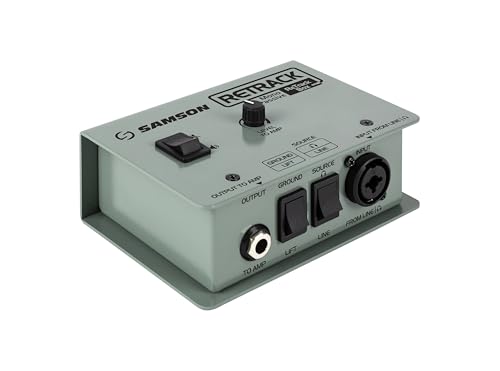
- Easy Re-amping Solution: Sends recorded line or headphone signals back to an amp or FX rig for fresh tones.
- Combo Input: XLR/TRS input accepts balanced/unbalanced sources from audio interfaces or mixers.
What to Consider Before Buying Recording Signal Direct Boxes
A Recording Signal Direct Boxes is more than just an item; it’s a key solution for bridging the gap between professional line-level recording equipment and instrument-level guitar amplifiers. When we talk about re-amping, we are essentially performing a “reverse DI” process. Standard audio interfaces output a low-impedance, balanced signal, while guitar amplifiers expect a high-impedance, unbalanced signal. If you try to connect them directly with a simple adapter cable, you will encounter significant impedance mismatch, resulting in a thin, noisy, and generally uninspiring sound. A high-quality re-amping box fixes this by using a transformer to convert the signal back to the appropriate levels, preserving the dynamics and “feel” of the original performance.
The ideal customer for this type of product is the home studio producer, the professional session guitarist, or the experimental sound designer who wants to run soft-synths through vintage fuzz pedals. It is perfect for anyone facing the limitations of software-based amp simulations who craves the air-moving power of a real cabinet. However, it might not be suitable for those who strictly use “in-the-box” plugins and never intend to use physical outboard gear or amplifiers. For those users, investing in something like the SAMSON ReTrack Re-amplification Box would be redundant, as their signal never leaves the digital domain.
Before investing, consider these crucial points in detail:
- Dimensions & Space: In a cluttered studio or on a busy pedalboard, every square inch matters. You want a device that is compact enough to tuck away but heavy enough that the weight of the cables won’t pull it off your desk. We found that the footprint of the SAMSON ReTrack Re-amplification Box strikes an excellent balance between portability and “heft,” ensuring it stays exactly where you put it during a session.
- Capacity & Performance: Look for the quality of the internal transformer. This is the heart of the unit. It needs to handle high signal levels without unwanted saturation (unless that’s the goal). You also want a unit that offers a way to control the output level, as different amplifiers have different “sweet spots” for their input stages.
- Materials & Durability: Studio gear lives a hard life. It gets stepped on, dropped, and shoved into gig bags. Stainless steel or heavy-duty aluminum enclosures are the gold standard. We prefer metal over plastic every time, as it also provides superior shielding against Electromagnetic Interference (EMI) and Radio Frequency Interference (RFI), which are the enemies of high-gain guitar tones.
- Ease of Use & Maintenance: The best tools are the ones you don’t have to think about. Features like combo inputs (XLR/TRS) and clearly labeled switches for ground lifts make your workflow seamless. Maintenance should be minimal; a passive box like this doesn’t require batteries or external power, which is a massive plus for long-term reliability.
While the SAMSON ReTrack Re-amplification Box is an excellent choice for these needs, it’s always wise to see how it stacks up against the competition. For a broader look at all the top models, we highly recommend checking out our complete, in-depth guide:

- Passive Stereo DI with Isolation Transformer

- DEVICE CONNECTOR: Provides a variety of DI solutions with its inch device connector live sound recording applications. It allows you to easily connect keyboards, guitars & outboard signal processors


- Passive Mono Direct Box with Custom Transfmer Rugged I-beam Construction
Unboxing and First Impressions: The SAMSON ReTrack Re-amplification Box
When the SAMSON ReTrack Re-amplification Box first arrived at our studio, the first thing we noticed was the weight. At exactly one pound, it feels incredibly dense and well-constructed. The stainless steel enclosure has a brushed finish that screams “professional grade,” far removed from the flimsy plastic boxes often found in this price bracket. Unboxing is a straightforward affair—no unnecessary fluff, just the unit itself and a brief manual. The design is utilitarian yet elegant, with the rotary volume control feeling smooth and offering just the right amount of resistance.
The “Source” selector switch and the dual ground lifts are recessed enough to avoid accidental knocks but accessible enough for quick adjustments mid-session. Compared to some of the more expensive boutique re-amp boxes we have used, the SAMSON ReTrack Re-amplification Box holds its own in terms of initial build quality. It feels like a tool designed by people who actually spend time in recording booths. We were particularly impressed by the combo input jack, which allows for either XLR or TRS connections without needing an adapter—a small detail that makes a big difference when you are hunting for cables in the dark behind an equipment rack.
Key Benefits
- Exceptional build quality with a rugged, tour-ready stainless steel chassis.
- Versatile combo input (XLR/TRS) accommodates all standard interface outputs.
- Rotary volume control allows for precise gain-staging into sensitive tube amps.
- Dual ground lifts (input and output) effectively eliminate stubborn hum and buzz.
Limitations
- Passive design means it cannot “boost” a very weak signal, only attenuate and match.
- The compact size makes the labels a bit small to read in dimly lit studio corners.
Deep Dive: Performance Analysis of the SAMSON ReTrack Re-amplification Box
Signal Integrity and the Power of the Rotary Volume Control
The most critical aspect of any re-amplification device is how it handles the signal’s frequency response and dynamic range. During our testing, we took a “bone-dry” DI guitar track recorded through a high-end preamp and sent it through the SAMSON ReTrack Re-amplification Box into a vintage British tube head. What we found was a remarkably transparent translation. The transformer inside the unit does an admirable job of maintaining the low-end “thump” of a palm-muted bridge pickup while keeping the high-end transients crisp and clear.
The standout feature here, which you can see when you check the latest price and availability, is the rotary volume control. Unlike many basic DI or re-amp boxes that offer a simple fixed pad (like -15dB), the Samson allows for granular control. This is vital because modern audio interfaces often output a signal much “hotter” than what a guitar pickup produces. By backing off the rotary dial, we were able to find the exact point where the amplifier reacted naturally, as if the guitar were plugged directly into the front panel. This level of headroom management ensures that you aren’t accidentally overdriving the input stage of your amp before the signal even hits the tubes, preserving the “touch sensitivity” that guitarists crave.
Versatility and the Unique Source Selector Switch
One of the more innovative features we encountered is the source selector switch. Most re-amp boxes assume you are coming from a balanced line output on your interface. However, the SAMSON ReTrack Re-amplification Box is designed with the “everyday musician” in mind. The switch allows you to toggle between a standard line-level output and a headphone-level feed. We tested this by running a signal directly from the headphone jack of a laptop into the ReTrack, and the results were surprisingly clean. This makes the unit an incredible tool for mobile producers who might not have a multi-output rack interface but still want to use external pedals.
Furthermore, the rotary volume control is a feature that really sets it apart in this specific use case. When using a headphone feed, the signal can be noisy or improperly scaled. The ReTrack’s internal circuitry smooths this out, providing a stable 1/4″ instrument-level output. We also utilized the unit to “re-amp” a soft-synth bass line from a DAW through a dedicated bass amp. The transformation was night and day—adding real harmonic distortion and cabinet resonance that no plugin could fully replicate. The ability to bridge these two worlds (the digital DAW and the physical amp) so seamlessly is what makes this box a “must-have” for experimental sessions.
The “Silence” Factor: Advanced Noise Management
Ground loops are the bane of every studio engineer’s existence. When you connect a grounded audio interface to a grounded guitar amplifier, you almost invariably create a loop that manifests as a nasty 60Hz hum. Most entry-level boxes offer a single ground lift. The SAMSON ReTrack Re-amplification Box, however, features ground lifts on both the input and the output. This is a game-changer. During one of our test sessions, we encountered a particularly stubborn buzz that a standard lift wouldn’t kill. By engaging both lifts on the Samson, the signal went dead silent, leaving only the pure guitar tone.
This noise management is indicative of the “expert-grade” engineering Samson has put into this device. The transformer isolation provides a physical break in the electrical connection, which is the only 100% effective way to stop ground loop noise. We found that even when using high-gain “insanity” settings on a Peavey 5150, the noise floor remained impressively low. This level of performance is a clear reason why many choose this for their home studios where electrical wiring might not be perfectly optimized for audio.
Real-World Workflow: From Studio to Stage
While primarily a studio tool, we discovered that the SAMSON ReTrack Re-amplification Box has significant utility in live environments. For instance, we used it to interface a balanced “direct out” from an acoustic amplifier into the “instrument in” of a second amplifier to create a wide, wet/dry stereo image. This setup can be notoriously noisy, but the Samson handled it with ease. The all-metal construction means we weren’t worried about it being on the floor of a stage, and the compact dimensions allowed it to fit perfectly in a small pocket of a guitar gig bag.
The combo input is also a lifesaver in live scenarios. If the sound tech only has an XLR cable available to run a feed back to your amp (common in large stage setups), you don’t need a separate DI box or adapter. You just plug the XLR straight into the ReTrack and you’re ready to go. The reliability of this unit is standout; because it is passive, there is no worry about a 9V battery dying mid-set or a power supply failing. It is a “set it and forget it” piece of gear that performs its job with boring, wonderful consistency.
What Other Users Are Saying
The general sentiment among professionals and hobbyists alike is one of pleasant surprise at the value offered by the SAMSON ReTrack Re-amplification Box. We found that users consistently praise the unit for its “tank-like” build and its ability to solve noise problems that other boxes couldn’t touch. One user specifically noted, “I’m using this to connect 2 fishman amps together. I’m going from my (balanced) direct out from fishman #1 to the (unbalanced) ‘instrument in’ in fishman #2. This unit works perfectly for that purpose.” This confirms our own findings regarding the unit’s versatility in non-standard routing scenarios.
On the negative side, a few users mentioned that the markings on the switches are difficult to see in low-light environments, and one user wished for a more “clicking” feel to the rotary knob to easily recall specific volume settings. However, these are minor ergonomic quibbles that do not detract from the core performance. Most users agree that for the price, the signal transparency is virtually indistinguishable from units costing twice as much. The consensus is clear: it is a reliable, high-performance tool that does exactly what it promises without adding any unwanted color to your sound.
How the SAMSON ReTrack Re-amplification Box Compares to the Competition
1. Radial Engineering Pro DI Passive Direct Box
- Passive Mono Direct Box with Custom Transfmer Rugged I-beam Construction
The Radial Pro DI is widely considered the industry standard for passive direct boxes. It features a custom-made Radial transformer and an incredibly durable “bookend” design that protects the switches. While the Radial is a fantastic DI box, it is primarily designed to take an instrument signal and send it to a mixer (the opposite of what the ReTrack does). While you *can* use it in reverse, it lacks the ReTrack’s dedicated rotary volume control and source selector for headphone feeds. If you need a traditional DI, the Radial is king; if you specifically need a re-amping solution, the SAMSON ReTrack Re-amplification Box offers more relevant features for the modern producer.
2. Pyle Premium Passive DI Box

- ¼ “ DEVICE CONNECTOR: Provides a variety of DI solutions with its ¼ inch device connector and detachable AC power cord for live sound recording applications. It allows you to easily connect...
- PROVIDES CLEAN AUDIO: Useful for connecting unbalanced signals from sources submixers, effects processors & keyboards to a main PA or recording mixer. This impedance transformer also has buzz & hum...
The Pyle Premium Passive DI Box is a budget-friendly alternative that appeals to those on a strict shoestring budget. It provides basic functionality with an input attenuator and a ground lift. However, in our comparison, the build quality of the Pyle feels significantly less robust than the Samson’s stainless steel. The transformer in the Pyle also has a higher noise floor and less headroom, which can lead to “smeared” high frequencies when pushed hard. For a few extra dollars, the SAMSON ReTrack Re-amplification Box offers a much more professional experience and far better signal integrity for critical recording applications.
3. Pyle 2-Channel Ground Loop Isolator

- REMOVES AC NOISE: The Pyle Hum Eliminator removes 60Hz AC hum caused by ground loops that act like radio antennae (loop antenna). It breaks the ground loop safely making it impossible for the signal...
- PASSIVE DEVICE: The noise isolator is a passive device that does not require power to operate. Equipped w/ ¼” TRS phone and XLR inputs and outputs on 2 channels. Automatically converts...
The Pyle 2-Channel Ground Loop Isolator is a specialized tool designed specifically to kill hum in stereo setups. It uses a 1:1 isolation transformer and offers TRS and XLR connections. While it is excellent for fixing noise in a keyboard rig or a PA system, it lacks the specific impedance-matching circuitry required for true guitar re-amping. It doesn’t have the volume control needed to feed a guitar amp the correct signal level. We would recommend this unit for general noise troubleshooting, but for the specific task of re-amping, the SAMSON ReTrack Re-amplification Box remains the superior, purpose-built choice.
Final Verdict: Is the SAMSON ReTrack Re-amplification Box Worth It?
After extensive testing in both controlled studio environments and “real-world” live scenarios, we can confidently say that the SAMSON ReTrack Re-amplification Box is one of the best values in the recording world today. It successfully solves the two biggest hurdles of re-amping: impedance mismatch and ground loop noise. Its robust construction ensures it will be a part of your kit for years to point, and the inclusion of features like the rotary volume control and the headphone source selector makes it far more versatile than many of its competitors.
Whether you are a guitarist looking to perfect your tone after the fact, or a producer wanting to add some “analog heat” to your digital tracks, this device is a sound investment. It removes the technical barriers to creativity and lets you focus on the music. We highly recommend it for any studio, regardless of size or budget. You can order yours today and start re-amping your way to better, more professional sounding productions.
Last update on 2026-10-16 / Affiliate links / Images from Amazon Product Advertising API