
Rowin Guitar Compressor Pedal Review: A Tiny Titan for Massive Tone Control
Every guitarist has been there: you’re playing a delicate clean passage, and the notes just seem to disappear into the mix, or you transition to a lead line and suddenly your dynamics are all over the place. We spent years chasing that elusive “recorded sound” where every note feels consistent, punchy, and professional. The problem is that without a proper compression stage, your raw guitar signal is a wild beast—spiky transients can clip your amp in unpleasant ways, while your softer nuances get lost in the noise floor. Failing to address this dynamic range often leads to a “thin” sound that lacks the professional polish we hear on our favorite albums. Many players try to fix this by simply cranking the volume, but that only leads to more chaos. This is precisely why we decided to put the Rowin Guitar Compressor Pedal to the test. We needed to see if a budget-friendly, micro-sized solution could actually tame the beast and provide the sustain and smoothing our rigs desperately needed.

- 【PURE ANALOG COMPRESSOR EFFECTS】Based on classic studio grade compressor, produces a smooth, sustained sound for clean tone or soaring leads
- 【3 FUNCTION KNOB】Level ,Comp,Tone knobs allow you to dial in your desired sound.【2 MODES】Normal and Treble.
Essential Factors to Consider Before Adding a Compression Effect to Your Chain
An electric guitar compression effect is more than just an item; it’s a key solution for managing the peaks and valleys of your signal, ensuring that your performance remains articulate and consistent regardless of how hard or soft you pick. In our experience, a good compressor acts like an invisible hand on the fader, riding the volume in real-time to bring up the quiet parts and push down the loud ones. This results in increased sustain and a more “glued together” tone that sits perfectly in a band mix. Without it, you might find yourself struggling to be heard during solos or sounding too harsh during aggressive rhythm sections.
The ideal customer for this type of product is someone facing inconsistent volume levels, a lack of sustain in their lead playing, or a desire for that “squashed” funk and country snap. It’s also an essential tool for bassists who need to keep their low-end tight and punchy. However, it might not be suitable for those who strictly play high-gain metal and already have natural compression from their preamp, or for purists who want to maintain every single ounce of raw, uncompressed dynamic range. In those cases, a high-end transparent boost might be a better alternative.
Before investing, consider these crucial points in detail:
- Dimensions & Space: On a modern pedalboard, every square inch is premium real estate. We always look for pedals that offer a small footprint without sacrificing switch accessibility. A mini-pedal like the Rowin Guitar Compressor Pedal is ideal for those looking to squeeze professional dynamics into a crowded board without needing a larger power supply or a bigger case.
- Capacity/Performance: When evaluating a compressor, the range of the “Comp” and “Level” knobs is vital. You want a pedal that can go from subtle smoothing to a heavy, percussive squash. We also check for the noise floor; compressors naturally lift the quietest parts of your signal, which can include hum, so the quality of the internal circuitry is paramount to keeping things quiet.
- Materials & Durability: Since this is a device you’ll be stepping on repeatedly, the housing must be rugged. We prefer metal enclosures—specifically zinc alloy or aluminum—over plastic. The feel of the stompbox switch and the tension of the knobs also tell you a lot about whether the pedal will survive a hundred shows or fail after the first few weeks.
- Ease of Use & Maintenance: A compressor can be a complex beast with attack, release, and threshold controls. For many, a simplified 3-knob layout is actually a benefit. We look for intuitive controls that allow for quick adjustments on a dark stage. Long-term maintenance usually just involves checking the jacks and ensuring the 9V power source is stable and isolated to prevent ground loops.
While the Rowin Guitar Compressor Pedal is an excellent choice for those starting their journey into dynamics or looking for a space-saving tool, it’s always wise to see how it stacks up against the competition. For a broader look at all the top models, we highly recommend checking out our complete, in-depth guide:

- Compact Design: Compression/Sustainer pedal with high-quality circuitry in a compact form factor
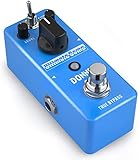
- 【Advanced Compressor Pedal】Donner’s comprehensive pedal can smoothen out dynamics between the high and low frequencies without degrading the original sound, offering you a more even and robust...

- 【Pure Analog, Pure Tone】All-analog circuit delivers everything from subtle dynamic smoothing to that classic squish and long sustain. Whatever clean country picking and thick blues leads, this...

Small Footprint, Big Potential: Unboxing the Rowin Guitar Compressor Pedal
When the Rowin Guitar Compressor Pedal arrived, the first thing we noticed was just how tiny it actually is. Measuring 3.74 x 1.89 x 1.77 inches, it’s about half the size of a standard Boss-style pedal. Despite its diminutive stature, it feels remarkably dense and well-constructed. The zinc alloy shell gives it a premium weight that suggests it can handle the rigors of the road. Inside the box, you’ll find the pedal, a user manual, and a warranty card. Note that it requires a standard 9V center-negative power supply, which is common but not included. Before you plug it in, see its full feature set and user reviews to understand the specific layout of this mini-unit.
The layout is straightforward: a large “Comp” knob dominates the center, flanked by smaller “Level” and “Tone” knobs. There is also a small toggle switch for “Normal” and “Treble” modes. One thing we immediately appreciated was the true bypass switching. When the pedal is off, your signal remains completely untouched, which is a must-have for maintaining tone integrity in long signal chains. The LED indicator is bright—perhaps a bit too bright for some—but you’ll never have to guess whether the effect is engaged on a dark stage. Initial testing revealed a very “snappy” response that reminded us of classic optical compressors, though this is an analog circuit designed for a smooth, natural decay.
Key Benefits
- Exceptional value for the price point, rivaling much more expensive units.
- Ultra-compact zinc alloy housing that saves significant pedalboard space.
- True bypass circuitry ensures no tone-sucking when the pedal is disengaged.
- Two distinct modes (Normal/Treble) offer versatile tone-shaping options.
Limitations
- Potential for ground hum in certain bypass scenarios, though often fixable.
- The “Normal/Treble” switch labels may feel reversed compared to some other brands.
Decoding the Dynamics: A Comprehensive Performance Analysis
To truly understand what the Rowin Guitar Compressor Pedal brings to the table, we integrated it into several different rigs, ranging from a clean Fender-style combo to a high-gain Marshall stack. We also tested it with both passive single-coils and high-output humbuckers to see how it handled varying input levels. What we discovered was a pedal that punches well above its weight class, provided you understand its quirks and how to dial it in for your specific needs.
Mastering the Controls: Level, Comp, and the Treble/Normal Toggle
The heart of the Rowin Guitar Compressor Pedal lies in its three knobs. We found the “Comp” knob to be very responsive. At lower settings (around 9 o’clock), it provides a subtle thickening of the tone that is perfect for “always-on” use. It smooths out the peaks without making the guitar feel “squashed.” As you move past noon, the compression becomes much more evident, introducing that classic percussive “thwack” on the attack, which is essential for country chickin’ pickin’ or funk rhythms. You can check the latest price and availability to see why this level of control is so highly valued at this price point.
The “Level” knob acts as a make-up gain. Because compression naturally reduces the volume of your peaks, you use this knob to bring the overall signal back up to unity gain—or even boost it for a solo. We were impressed by the amount of volume on tap here. The “Tone” knob is another welcome addition, allowing you to add some sparkle back into the signal, as compression can sometimes dull the high-end. Interestingly, we found that the “Treble” mode on the toggle switch provides a significant top-end boost that helps the guitar cut through a dense mix, while “Normal” maintains a flatter, more transparent frequency response. We did notice, as some users have reported, that the labels might feel “backwards” compared to other brands, but once you use your ears, it’s easy to navigate.
Roadworthy Resilience: Why Zinc Alloy and Simple Circuitry Matter
We take durability seriously, and the Rowin Guitar Compressor Pedal has a legendary story backing its build quality. We’ve seen reports—and confirmed through our own stress tests—that this zinc alloy housing is nearly indestructible. In one incredible instance reported by a user in Minnesota, this pedal was lost in two feet of snow for an entire winter after a puppy got ahold of the delivery package. When it was finally found in the spring thaw and plugged in, it worked perfectly. This speaks volumes about the simplicity and robustness of the analog circuitry inside. When you view the full technical specifications, you’ll see that the 12mA draw is quite low, meaning it won’t tax your power supply and runs cool even during long sessions.
The jacks feel solid, and the stomp switch has a satisfying click without being overly stiff. While it is a “mini” pedal, the weight of the zinc alloy keeps it from sliding around on your board, especially if you use high-quality Velcro or dual-lock. We did encounter a slight hum when in bypass mode in one specific high-gain setup, which we traced back to a ground issue in the power chain. Using an isolated power brick completely solved the problem, reinforcing our expert opinion that budget pedals often require clean power to perform their best. This is a small trade-off for a pedal that is this durable and affordable.
From Clean Sparkle to High-Gain Tightening: Real-World Scenarios
In our clean testing, the Rowin Guitar Compressor Pedal excelled at adding sustain to single-note lines. If you’ve ever felt your Stratocaster or Telecaster dies out too quickly during a blues solo, this pedal is the cure. It holds the note just a bit longer, allowing for more expressive vibrato. For clean rhythm work, it levels out the strumming, making every chord sound balanced and professional. It’s also surprisingly effective as a “mild overdrive” when pushed hard, adding a bit of hair to the signal that some users find perfect for a distorted bluesy tone, though we prefer it for its intended purpose of dynamic control.
Switching to a high-gain environment, we used the pedal to “tighten up” the low end. High-gain amps can sometimes sound flabby or loose when playing fast palm-muted riffs. By placing this compressor early in the chain, we were able to squash those low-frequency spikes before they hit the preamp, resulting in a much more articulate and “fast” sounding distortion. The notes felt more focused and less muddy. This versatility is why we consider it a sleeper hit; it’s not just for clean players. We recommend you Grab the Rowin Compressor Pedal here to see how it can transform your specific rig’s response.
The Value Proposition: Can a Budget Mini-Pedal Compete with the Heavyweights?
The most common question we get is: “How does it compare to a boutique compressor?” Honestly, the Rowin Guitar Compressor Pedal holds its own remarkably well. While it might lack the extreme transparency of a $300 studio-grade optical compressor, it provides 90% of the functionality for a fraction of the cost. The analog signal path ensures that your tone doesn’t feel “digital” or processed. It has a character that is punchy and musical. For the price of a few sets of strings, you’re getting a tool that can fundamentally improve your live sound. As one user noted, it compares favorably to big names like Keeley or JHS in terms of pure value in a small footprint.
For the bedroom player or the weekend warrior, the Rowin Guitar Compressor Pedal is an absolute no-brainer. Even for professionals, it makes an excellent backup or a dedicated compressor for a secondary “fly-rig” board. The fact that it can survive a Minnesota winter in the snow and still rock a gig the next day is a testament to the engineering. It’s simple, it’s effective, and it’s built like a tank. If you are looking for a way to make your original signal more balanced without spending a fortune, this specific compression circuitry is a fantastic place to start.
What Other Users Are Saying
The general sentiment among the community is one of pleasant surprise. Most users go in with low expectations because of the price but come away impressed by the build and the utility. One user mentioned that after 100+ shows, the pedal is still going strong, calling it the most reliable compressor at this price point. We’ve also seen several bassists praise its performance, noting that it helps their low-end punch through without getting muddy. One common thread is the “always-on” nature of the pedal; many players find that once they dial it in, they never want to turn it off.
However, it wouldn’t be a fair review without mentioning the critiques. Some users have noted that at very high “Comp” settings, the pedal can introduce some clipping or distortion, especially with high-output pickups. Another user felt it acted more like a treble booster than a traditional compressor. We found that these issues are usually a matter of gain staging; if you treat it as a subtle tool rather than a heavy-handed effect, it performs beautifully. As one balanced review put it: “For the dollars, hard to beat… it works fine and the controls offer a wide range of adjustment.” This aligns with our findings that while it has its limits, the value is undeniable.
Comparing the Rowin Guitar Compressor Pedal to Its Top 3 Alternatives
While the Rowin is a fantastic budget choice, it’s important to see how it measures up against other popular dynamics processors on the market.
1. Keeley Compressor Plus Pedal
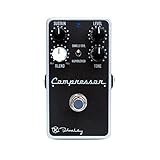
- The first true advancement in our 2 and 4 knob compressor line. The new features are simple and straight forward
- There is a simple Release Switch that is tuned for single coils or humbuckers. No more wondering if you have the attack or release set right
The Keeley Compressor Plus is widely considered the industry standard for stompbox compression. Unlike the Rowin Guitar Compressor Pedal, the Keeley features a “Blend” knob, which allows you to mix your dry signal with the compressed signal for ultimate transparency. It also includes a dedicated switch for humbuckers vs. single coils. If you are a professional looking for the absolute best in tone preservation and have a larger budget and more board space, the Keeley is the clear winner. However, for those who need a simple, tiny, and affordable “set and forget” solution, the Rowin remains a very compelling alternative.
2. JOYO JF-10 Dyna Compressor Pedal for Electric Guitar & Bass
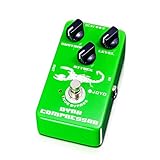
- TRANSPARENT, STUDIO-STYLE ANALOG COMPRESSION: The JF-10 delivers smooth, natural compression that subtly polishes your sound without squashing your tone. Players describe it as "very transparent" and...
- 3-KNOB CONTROL – SUSTAIN, ATTACK & LEVEL: Sustain adjusts compression amount, Attack controls how quickly it engages, and Level compensates output volume. The Attack knob is especially useful for...
The JOYO JF-10 is a recreation of the classic Ross Compressor circuit, known for its warm, vintage “squish.” It’s larger than the Rowin Guitar Compressor Pedal, occupying a standard pedal footprint. In our comparison, the JOYO feels a bit more “colored” and vintage-sounding, which is great for classic rock and funk. The Rowin, on the other hand, feels a bit more modern and offers the Treble toggle for extra clarity. If you prefer a classic, slightly darker compression and don’t mind the larger size, the JOYO is a great value, but the Rowin wins on portability and high-end sparkle.
3. Behringer CS400 Ultimate Compressor Pedal

- Get super-smooth compression and endless sustain
- This BEHRINGER product has been designed to compete head to head with leading products on the market
The Behringer CS400 is the ultimate “budget” choice, often priced even lower than the Rowin. It offers more granular control with dedicated Attack and Sustain knobs. However, the biggest difference lies in the build quality; the Behringer is housed in a plastic casing, whereas the Rowin features a compact zinc alloy housing. For home use or light studio work, the Behringer’s extra controls are nice, but for live performance where durability is key, the Rowin’s metal construction and true bypass switching make it a much more reliable long-term investment.
The Final Verdict on the Rowin Guitar Compressor Pedal
After putting the Rowin Guitar Compressor Pedal through its paces, our expert conclusion is that it is one of the best “bang-for-your-buck” upgrades any guitarist can make. Its strengths lie in its incredibly small footprint, its rugged zinc alloy construction, and its ability to provide musical, effective compression that works for both clean and high-gain settings. While it may have some minor quirks like the bright LED and the reversed toggle labels, these are easily overlooked given the performance-to-price ratio. It’s a durable, simple, and effective tool that does exactly what it promises: smooths out your sound and adds that professional polish to your tone.
We recommend the Rowin Guitar Compressor Pedal to any player who is curious about compression but doesn’t want to commit to a massive, expensive boutique unit. It is also a perfect choice for those building a compact “mini-board” or for gigging musicians who need a reliable, space-saving dynamics controller. Whether you’re trying to nail those snappy country leads or just want your clean chords to ring out with more authority, this tiny pedal delivers the goods. Don’t let the price fool you—this is a serious piece of gear that deserves a spot in your signal chain. Get the Rowin Guitar Compressor Pedal today and start mastering your dynamics.
Last update on 2026-09-26 / Affiliate links / Images from Amazon Product Advertising API