
Roland FP-30X 88-Note Digital Piano Review: The Ultimate Balance of Portability and Professional Performance
For many of us, the dream is a nine-foot concert grand piano sitting in a sun-drenched parlor. However, for the modern musician, the reality is often much different. We deal with cramped apartments, the need for silent practice at 2 AM, and the logistical nightmare of moving a heavy instrument for a weekend gig. The problem isn’t just finding a piano; it’s finding a piano that doesn’t compromise the soul of the music for the sake of convenience. Many entry-level keyboards feel like toys, with “clicky” plastic keys and tinny speakers that suck the inspiration right out of a practice session. If you are serious about your development as a pianist, settling for a subpar action or a generic sound engine can actually hinder your technique and ear training. This is where the Roland FP-30X 88-Note Digital Piano enters the conversation, promising to bridge the gap between portable convenience and high-end acoustic realism. We spent weeks putting this unit through its paces to see if it truly lives up to the legendary Roland reputation.

- Balancing affordability with superior performance, the FP-30X is the sweet spot of Roland’s FP-X series.
- This slim and stylish portable piano builds on the entry-level FP-10 with an enhanced sound engine, more powerful onboard speakers, and increased polyphony.

What to Consider Before Buying a Digital Piano
A digital piano is more than just an item; it’s a key solution for students, hobbyists, and professional performers who need the response of an acoustic instrument without the maintenance and footprint of a traditional piano. Unlike a standard “keyboard,” a digital piano focuses primarily on the piano-playing experience—meaning the weight of the keys and the quality of the piano samples are the most critical factors. Choosing the right one can mean the difference between an instrument you’ll cherish for a decade and one that ends up collecting dust because it feels “off.”
The ideal customer for this type of product is someone facing space constraints but unwilling to sacrifice the 88-key range, or an adult learner returning to the craft who wants an instrument that feels familiar to the acoustic pianos of their youth. It is also perfect for gigging musicians who need a reliable, lightweight board that can still drive a professional sound system. However, it might not be suitable for those who require thousands of synthesizer leads or complex workstation capabilities, as the Roland FP-30X 88-Note Digital Piano is focused on being a piano first and foremost. For those who want a permanent furniture piece that never moves, a dedicated console piano might be a better fit, but for everyone else, portability is a massive plus.
Before investing, consider these crucial points in detail:
- Dimensions & Space: Even though “slim” is in the name, an 88-note keyboard has a fixed width of about 51 inches. Ensure you have a dedicated spot or a sturdy stand that can accommodate this width. The depth is where you save space, as these units are often less than half the depth of a traditional upright.
- Key Action/Performance: Look for “weighted” or “hammer-action” keys. Not all weighted keys are equal; some use simple springs, while others, like the Roland PHA-4, use actual physical hammers to simulate the leverage and resistance of an acoustic piano. This is vital for building finger strength and dynamic control.
- Sound Engine & Polyphony: Polyphony refers to how many notes can ring out at once. For complex classical pieces or using sustain pedals heavily, you want a higher polyphony count (the FP-30X offers 256) to prevent notes from cutting off abruptly.
- Connectivity & Future-Proofing: In the modern era, having Bluetooth MIDI and Audio is a game-changer. It allows you to play along with songs from your phone or connect to learning apps without a mess of wires, making the learning process much more engaging.
While the Roland FP-30X 88-Note Digital Piano is an excellent choice, it’s always wise to see how it stacks up against the competition. For a broader look at all the top models, we highly recommend checking out our complete, in-depth guide:

- Acoustic Piano Keyboard Feel – Touch-sensitive keys allow for dynamic performances. The 88-key weighted keyboard action replicates the acoustic piano experience
- Acoustic Piano Feel - Touch-sensitive keys allow for true expression and dynamic performance. The weighted action replicates the acoustic piano experience

- 【Weighted Digital Piano】- The digital piano with 88 SEMI-Weighted Keys simulates the real touch of playing the piano. Half-weighted keys reduce the sense of strength than full-weighted keys, for...
Unboxing and First Impressions: A Sleek Powerhouse
When the Roland FP-30X 88-Note Digital Piano arrived at our studio, the first thing we noticed was the weight. At nearly 33 pounds, it’s “solid” rather than “light.” As one user correctly pointed out, the box is bulky, and you’ll likely want a second pair of hands to move it into your practice space. Once unboxed, the design is striking in its minimalism. The black matte finish looks professional, and the “Ivory-Feel” keys have a subtle texture that prevents your fingers from slipping during fast passages—a common complaint with the glossy plastic keys found on cheaper competitors.
The layout is deceptively simple. Roland has moved many of the deeper functions to “key combinations,” where you hold a button and press a specific piano key to change settings. While this keeps the top panel clean and stylish, it does introduce a slight learning curve, as some users have noted. However, once you see its full feature set and user reviews, you realize that this minimalist approach allows you to focus on the music rather than a distracting LCD screen. The built-in 22-watt speakers are housed underneath, which we found provides a surprisingly immersive stereo field when the piano is placed on a standard desk or a dedicated stand.
Key Benefits
- Industry-leading PHA-4 Standard keyboard with authentic hammer action and escapement.
- SuperNATURAL Piano sound engine provides rich, organic tonal variations.
- High 256-note polyphony ensures no dropped notes during complex performances.
- Bluetooth Audio and MIDI support for seamless integration with the Roland Piano App.
Limitations
- The button interface requires memorizing key combinations or using the app for deep settings.
- The included DP-2 sustain pedal is a basic “footswitch” style; serious players will want to upgrade to a damper pedal.
Deep Dive: Putting the Roland FP-30X 88-Note Digital Piano to the Test
The PHA-4 Keyboard: A Masterclass in Tactile Response
The heart of any digital piano is the action, and the Roland FP-30X 88-Note Digital Piano features the PHA-4 Standard keyboard. We found this to be one of the most realistic actions in this price bracket. Unlike many “semi-weighted” keyboards that feel spongy, the PHA-4 uses actual weights and a pivot system that mimics the feel of a grand piano. There is even a feature called “escapement,” which provides that slight “click” or notch feel when you press a key slowly—just like the hammers on a real acoustic instrument.
In our testing, the “Ivory Feel” texture on the white keys was a standout feature. It absorbs moisture from your fingertips, which is incredibly helpful during long practice sessions or under hot stage lights. We compared the touch to several acoustic pianos and found it to be roughly 70% comparable to a high-end baby grand, which is a remarkable feat for a portable digital unit. If you’re looking to check the latest price and availability, you’ll find that this action alone justifies the investment for serious students who need to develop proper finger technique.
SuperNATURAL Sound Engine: Beyond Simple Sampling
While many digital pianos simply play back a recorded note (sampling), the Roland FP-30X 88-Note Digital Piano uses Roland’s SuperNATURAL technology. This engine models the behavior of the entire piano, meaning the sound changes based on how hard you hit the key and how the strings would vibrate in relation to one another. We found the piano tones to be incredibly rich, with a natural decay that doesn’t sound “looped” or artificial. The bass notes have a satisfying growl, while the upper register is crisp without being piercing.
We also explored the “Onboard Sounds,” which include a variety of electric pianos, organs, and strings. While the primary concert grand is the star of the show, the electric pianos have a wonderful vintage character that works perfectly for jazz or pop. The 22-watt speaker system is a significant upgrade from the previous FP-30 model, offering enough volume to fill a medium-sized living room without distortion. When we plugged in high-quality headphones, the 3D Ambience feature made it feel as though the sound was coming from the room around us, rather than directly into our ears—a feature that significantly reduces ear fatigue during late-night sessions.
Modern Connectivity: Bluetooth and the Roland Piano App
One of the biggest advantages of the Roland FP-30X 88-Note Digital Piano is its integration with modern technology. We tested the Bluetooth Audio feature, which allowed us to stream backing tracks from a smartphone directly through the piano’s speakers. This turns the piano into a high-quality stereo system and makes practicing along with your favorite songs an absolute blast. More importantly, the Bluetooth MIDI allows the piano to talk to the Roland Piano App (formerly Piano Every Day).
Because the physical interface on the piano is so minimalist, the app becomes your “command center.” Through the app, we were able to select sounds, adjust the “Piano Designer” settings (like lid height and string resonance), and even access digital sheet music and rhythm accompaniments. We found this to be a feature that really sets it apart from older or more traditional digital pianos. It transforms a solitary practice session into a guided, interactive experience that is especially helpful for beginners who need visual feedback.
Design, Portability, and Daily Usability
At 51 inches wide and only 11 inches deep, the Roland FP-30X 88-Note Digital Piano is the definition of “slim and stylish.” We were able to fit it onto a standard office desk for testing, but it truly shines when paired with the optional KSC-70 stand. Roland also included a dedicated “Desktop” setting that optimizes the internal EQ to ensure the sound doesn’t become muddy when the piano is placed on a flat surface—a thoughtful detail we really appreciated. While it is heavy enough to feel substantial, it remains portable enough for one person to move between rooms or take to a rehearsal.
The build quality is exactly what we’ve come to expect from Roland: rugged and dependable. We didn’t encounter any issues with key noise or “grease” problems that some users reported on very early iterations of previous models. The inputs on the back are well-labeled and include dual headphone jacks on the front, allowing a teacher and student to listen simultaneously. This level of practical design makes the FP-30X a “workhorse” instrument that can handle the rigors of daily use by multiple family members or the demands of a traveling musician.
What Other Users Are Saying
The general sentiment among users is overwhelmingly positive, with many praising the Roland FP-30X 88-Note Digital Piano for its “acoustic-like” feel. One user, who is returning to the piano as an adult, noted, “This piano is wonderful. It feels like the acoustic pianos I’ve played. I absolutely love the Bluetooth capabilities.” Another reviewer highlighted the sound quality, stating it was “much better than the built-in sound” of other major competitors in the same price range, even comparing the touch favorably to their home baby grand.
However, no product is without its critics. A few users mentioned the “odd” controls, noting that they require a bit of a learning curve since they are labeled “easy” but actually involve multi-button shortcuts. We also saw one report of a quality control issue where 11 keys arrived non-functional; while this appears to be a rare occurrence given the thousands of units sold, it highlights the importance of checking your unit upon arrival. Most users agree that for the price, the combination of the PHA-4 action and the SuperNATURAL sound engine is hard to beat. You can read more user experiences to see how it fits into different musical setups.
Comparing the Roland FP-30X to Top Alternatives
While the Roland is a top-tier choice, the digital piano market is crowded. Here is how the Roland FP-30X 88-Note Digital Piano stacks up against three other popular options.
1. Donner DDP-80 88-Key Weighted Digital Piano

- 88 Key Full-Weighted Digital Piano - The 88 key heavy hammer action keyboard simulates the acoustic piano, accurately captures the strength of your fingers and gives you a grand piano touch. It’s a...
- Powerful Sound Source - The Advanced French DREAM sound source is adopted, bringing you a realistic auditory experience. 128 max polyphony and the triple pedal will help you express your feelings...
The Donner DDP-80 is a vastly different beast. While the Roland focuses on portability and modern tech, the DDP-80 is designed as a piece of “mid-century modern” furniture. It features a beautiful wood-grain finish and built-in legs, making it look like a piece of art in your living room. However, in terms of performance, the Roland FP-30X 88-Note Digital Piano wins on action and sound engine complexity. The Donner is great for someone who wants a stylish, “set it and forget it” piano for a home with a specific aesthetic, but the Roland is the superior choice for serious learners or performers who need advanced connectivity and a more sophisticated hammer action.
2. Yamaha DGX-670B 88-Key Weighted Digital Piano
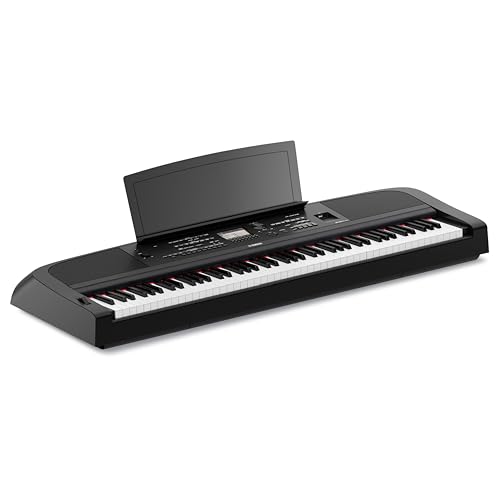
- Acoustic Piano Touch: Weighted keyboard action is heavier in the low keys and lighter in the high keys - perfect for practice or playing for friends and family
- Grand Piano Sound: CFX Stereo Sampling faithfully reproduces the sound of Yamaha's flagship CFX Full Concert Grand - complete with the natural resonance and rich, full tones of its internal mechanics
The Yamaha DGX-670B is more of a “portable grand/arranger” hybrid. It features a large color screen and hundreds of voices, styles, and recording features that the Roland lacks. However, it is also much larger and heavier, making it less “portable” than the FP-30X. If you want a full “one-man-band” experience with backings and complex recording capabilities, the Yamaha is a fantastic tool. But if your goal is a focused, high-quality piano experience with a slim profile, the Roland FP-30X 88-Note Digital Piano offers a more authentic “piano-first” feel and a much smaller footprint.
3. Donner DDP-300 88-Key Digital Piano

- 【88 Weighted Key Digital Piano】Experience the authentic touch of an acoustic piano from a digital piano. With bass keys that feel heavier and treble keys that are lighter, the DDP-300 electric...
- 【High-Quality Sound Selection】Savor 10 HD timbres from top grand pianos & 128 polyphony for intricate melodies. MIDI output empowers creativity. Metal pedals elevate live performances
The Donner DDP-300 is a console-style piano that comes with a full furniture stand and a three-pedal unit included. It’s aimed squarely at the beginner market looking for a “traditional” look at a lower price point. While the DDP-300 offers great value, it cannot compete with the Roland’s SuperNATURAL sound engine or the refined PHA-4 keybed. The Roland’s Bluetooth-enabled capabilities and superior speaker system make it a better long-term investment. If you have the budget, we recommend the Roland FP-30X 88-Note Digital Piano for its higher ceiling of performance and better resale value.
Final Verdict: Is the Roland FP-30X the Right Piano for You?
After weeks of testing, it’s clear that the Roland FP-30X 88-Note Digital Piano is one of the best values in the digital piano world today. It successfully balances the three pillars of a great instrument: authentic touch, inspiring sound, and modern convenience. While the interface is a bit minimalist for some, the integration with the Roland Piano App solves nearly all usability hurdles. Its 256-note polyphony and 22-watt speakers ensure that you won’t outgrow the instrument as your skills progress from a beginner to an intermediate or even advanced level.
Whether you are a student looking for your first “real” piano, an adult hobbyist with limited space, or a pro who needs a reliable gigging board, the FP-30X delivers. It feels like an instrument, not a gadget, and that is the highest praise we can give a digital piano. If you are ready to take your playing to the next level with an instrument that responds to your every nuance, we highly suggest you invest in your musical future here. The Roland FP-30X 88-Note Digital Piano isn’t just a purchase; it’s a partner in your musical journey.
Last update on 2026-03-31 / Affiliate links / Images from Amazon Product Advertising API