
Roland Electronic Drum Pad PDX-12 Review: Does It Actually Feel Like a Real Snare?
If you have ever spent hours behind a standard electronic drum kit, you know the specific frustration we often face: the “basketball” effect. Most entry-to-mid-level kits come with 8-inch or 10-inch pads that feel cramped and unnaturally bouncy. For years, I struggled with the transition between my acoustic kit and my electronic practice rig. My muscle memory would fail me; I’d go for a rim shot and hit plastic, or I’d try to execute a subtle ghost note and find the trigger response either too hot or completely dead. This disconnect isn’t just annoying—it actually hampers your development as a drummer. Without a realistic surface, you aren’t practicing your craft; you’re just playing a video game with sticks. That is why finding a pad like the Roland Electronic Drum Pad PDX-12 is so critical. It promises to bridge that gap, providing the physical real estate and the tactile response required for genuine expression.

- Large 12-inch pad ideal to develop your stick work
- 2-ply mesh pad head is tension adjustable for natural rebound, resistance and stick-feel
Choosing the Right Electronic Drum Pad: A Comprehensive Buyer’s Guide
A Electronic Drum Pads is more than just an item; it’s a key solution for drummers who need to practice in silence without sacrificing the technical nuances of their playing. In the modern drumming landscape, the pad is the interface between your physical movement and the digital sound. If that interface is poor, the sound will feel disconnected. We have found that a high-quality pad can rejuvenate an old drum module, making a decade-old brain feel brand new simply because the triggering is more accurate and the “stick-feel” is more authentic. The main benefit here is the preservation of technique—specifically your ability to play dynamically across the entire surface of the drum.
The ideal customer for this type of product is someone facing the limitations of a “budget” kit or an intermediate player looking to upgrade their snare to a full 12-inch diameter. It is perfect for those who want to use a standard snare stand and maintain a natural playing posture. However, it might not be suitable for those who are strictly looking for a portable, tabletop “all-in-one” solution. If you don’t already own a drum rack or a snare stand, or if you are looking for a standalone unit with built-in sounds, you might consider different percussion controllers instead of a dedicated trigger pad.
Before investing, consider these crucial points in detail:
- Dimensions & Space: When choosing a pad, diameter is king. A 12-inch pad like the Roland Electronic Drum Pad PDX-12 allows for a much wider range of motion. We’ve found that smaller pads force your elbows inward, which can lead to shoulder tension over long sessions. Always ensure your current mounting hardware or snare stand can accommodate the specific dimensions of a 12-inch shell.
- Capacity/Performance: Look for dual-triggering capabilities. A pad should be able to distinguish between a head hit and a rim shot independently. This is vital for playing styles that rely on cross-sticks or aggressive rim accents. Furthermore, the ability to adjust the tension of the mesh head is a feature that separates professional gear from toys.
- Materials & Durability: Mesh is widely considered superior to rubber for both noise reduction and feel. However, not all mesh is created equal. Multi-ply mesh (like the 2-ply design found here) offers better resistance and prevents the “trampoline” effect where the stick bounces back too fast. It also tends to last much longer under heavy hitting.
- Ease of Use & Maintenance: Consider the height of the hoop. A hoop that is too high will cause you to accidentally trigger rim sounds, while one that is too low feels unnatural. Maintenance usually involves occasionally tightening the tension rods with a standard drum key—much like an acoustic drum—to ensure the triggers remain sensitive across the entire surface.
Once you understand these variables, it becomes much easier to see why specific models stand out in a crowded market. Transitioning from a basic setup to a specialized pad can be the single most impactful upgrade you make to your studio.
While the Roland Electronic Drum Pad PDX-12 is an excellent choice, it’s always wise to see how it stacks up against the competition. For a broader look at all the top models, we highly recommend checking out our complete, in-depth guide:
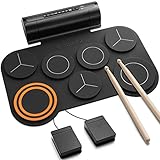
- [Fun Drum Pad Machine] DED-20 electronic drum pad 's high-quality sound source sample is taken from a real drum source, faithfully reproducing the acoustic drum's sound. 7 drum sets(1 SNARE, 1 CRASH...

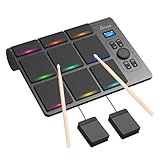
- 【Versatile Tabletop Drum Kit】The Portable Electronic Drum Kit features 9 Velocity-Sensitive Pads with LED light, hi-hat and kick bass drum pedal controller to reproduce full drum set sound with...

- Expand Your Performance - Add any sound sample to your drum or percussion setup via standard SD card
Unboxing the Roland Electronic Drum Pad PDX-12: First Impressions
When we first pulled the Roland Electronic Drum Pad PDX-12 out of the box, the first thing that struck us was the weight. At nearly 7 pounds, it feels substantial—not like a piece of hollow plastic. The 12-inch diameter is immediately impressive; it looks like a real snare drum. Roland has opted for a “low-height hoop,” which is a subtle but genius design choice. On many older V-Drums, the rubber rim was quite high, forcing you to change your stick angle just to avoid hitting the rim. With this model, the angle feels almost identical to my 14-inch acoustic snare. Assembly was a breeze; it features a standard trigger output jack and fits onto any traditional snare stand or a 10.5mm tom holder. You can see its full feature set and user reviews to understand just how versatile this mounting system really is compared to the proprietary clamps found on cheaper kits.
Key Benefits
- Authentic 12-inch size allows for natural stick work and posture.
- 2-ply mesh head provides adjustable tension for a realistic rebound.
- Dual-triggering system detects head and rim shots independently.
- Low-profile hoop design mimics the feel of an acoustic snare.
Limitations
- Does not include a mounting arm or stand in the box.
- Higher price point than basic 8-inch rubber pads.
Deep Dive into the Roland Electronic Drum Pad PDX-12 Performance
The 12-Inch Form Factor: Why Size Matters for Your Muscle Memory
We cannot overstate how much of a difference the 12-inch diameter makes. Most intermediate kits ship with 8-inch or 10-inch pads. While these are functional, they force a very “tight” playing style. When we swapped our old snare for the Roland Electronic Drum Pad PDX-12, our entire body posture relaxed. Because the hitting surface is larger, you don’t have to be as “surgical” with your aim, which allows you to focus on the groove rather than worrying about missing the trigger zone. This size also makes it much easier to perform “cross-sticking”—placing the tip of the stick on the mesh while clicking the rim with the shaft. On smaller pads, your hand often gets in the way of the trigger, but here, there is plenty of room to move. For anyone serious about their technique, we recommend you check the latest price and availability of this 12-inch model, as it truly changes how you approach the kit.
Furthermore, the larger surface area helps in distributing the wear and tear on the mesh head. We found that the Roland Electronic Drum Pad PDX-12 handles heat and friction better than smaller pads because you aren’t hitting the exact same square millimeter every single time. This contributes to the long-term durability that the brand is known for. In our testing, we also noticed that the larger frame provides a more stable platform, reducing the “wobble” that sometimes occurs when you bury the stick into a smaller, lighter pad during a heavy backbeat.
Dual-Ply Mesh and Tension Control: Dialing in Your Rebound
The 2-ply mesh head on the Roland Electronic Drum Pad PDX-12 is where the “magic” happens. Unlike single-ply mesh which can feel thin and flimsy, or rubber which is too jarring, this 2-ply material has a certain “give” followed by a firm snap. The best part? It is fully tension-adjustable using a standard drum key. I personally prefer a slightly looser snare for a “fat” feel, and I was able to achieve that easily. Conversely, if you are a gospel or marching drummer who needs a lightning-fast rebound, you can crank the tension up. This level of customization is a feature that really sets it apart from the fixed-tension pads found on budget sets. We found that the mesh also does a fantastic job of absorbing the “clack” sound of the stick, making it one of the quietest pads in its size class—perfect for apartment living.
We also checked how the tensioning affected the triggering. On some pads, tightening the head can create “hot spots” where the center of the drum becomes overly sensitive. However, the sensing element in the Roland Electronic Drum Pad PDX-12 is well-isolated. Even when we tightened the head significantly, the response remained even across the surface. This consistency is vital for playing rolls and ghost notes where you need every hit to be represented accurately by your drum module. Users have noted that this pad works flawlessly even with older modules like the TD-9, proving that the hardware engineering is robust enough to bridge generations of technology.
The Low-Profile Hoop: Mastering Rim Shots and Cross-Sticking
A common complaint with electronic snare pads is the height of the rim. If the rim is too high, you find yourself hitting it accidentally; if it’s too low, you can’t get a clean rim shot. Roland solved this by designing a low-height hoop specifically for the Roland Electronic Drum Pad PDX-12. This design allows for a natural stick angle that closely mirrors an acoustic snare. When we tested rim shots, the separation was perfect. There was no “machine gunning” or accidental head triggers when we wanted a rim sound. This independence is crucial for dynamic playing. For those who play jazz or latin styles, the cross-sticking response is some of the best we’ve experienced. You can read more about the sensor technology that makes this independent detection possible in the detailed product specifications.
The rubberized coating on the hoop is also remarkably durable. We spent several sessions purposefully punishing the rim with heavy accents to see if the material would chew or flake. To our surprise, it held up beautifully, showing only minor stick marks that wiped away easily. The “feel” of the rim is also worth mentioning; it has a slight softness that saves your wrists from the jarring vibration of hitting metal or hard plastic, yet it still provides enough resistance to let you know you’ve landed the shot. It’s a delicate balance that Roland has mastered over decades of R&D.
Trigger Accuracy and Dynamic Range: From Ghost Notes to Full Accents
Finally, we have to discuss the “brain-to-hand” connection. We tested the Roland Electronic Drum Pad PDX-12 with several different modules and the result was always the same: incredible sensitivity. When playing very lightly near the edge, the pad picked up every subtle nuance. As we moved toward the center and increased the velocity, the volume scaled naturally without any “plateauing.” This wide dynamic range is what allows a drummer to actually play the instrument rather than just trigger samples. It’s the difference between a performance that sounds like a human and one that sounds like a MIDI file. This is why many professionals choose to invest in this specific pad as a standalone upgrade to their existing kit.
In our tests, we also checked for “latency” and “crosstalk.” Because of the way the Roland Electronic Drum Pad PDX-12 is physically isolated within its frame, we experienced zero crosstalk even when hitting the surrounding drum rack with significant force. The trigger signal is clean and fast. This level of reliability is why you see Roland gear in touring rigs across the globe. Whether you are using it for a quiet practice session at 2 AM or as a primary snare on a hybrid kit during a live show, the performance remains rock solid. It’s a professional-grade tool disguised as a practice pad.
What Other Users Are Saying
The general sentiment from the drumming community is overwhelmingly positive, with many users highlighting that the Roland Electronic Drum Pad PDX-12 “works perfectly” right out of the box. One user mentioned that the delivery was fast and the pad fit into their set without any issues, emphasizing the “perfect shape” and size. Another drummer, who integrated it into their older TD-9 kit, noted that the “trigger behavior is fantastic” and the size is a significant upgrade from the smaller pads that typically come with that generation of modules. We found this particularly interesting, as it confirms our finding that this pad is an excellent “backward-compatible” upgrade for older kits. You can see more user feedback and technical discussions from the community to see how it might fit your specific setup.
While most reviews are glowing, a few users did mention that the pad is “nice size,” which is a bit of an understatement but reflects the relief drummers feel when moving away from 8-inch pads. There were virtually no negative comments regarding the trigger quality or build, which is rare for electronic percussion. The international feedback also mirrors this, with users describing it as “excelente,” further proving that the quality of Roland’s Malaysian manufacturing is consistent worldwide. This feedback is highly relevant because it shows that whether you are a hobbyist or an experienced player, the 12-inch mesh experience is universally preferred.
Comparing the Roland Electronic Drum Pad PDX-12 to Its Top Alternatives
1. Pyle Electronic Tabletop Drum Pad Set

- 8 TOUCH-SENSITIVE DRUM PADS - Experience the ultimate drum set with 8 touch-sensitive pads, allowing for dynamic and expressive playing. Store up to 10 custom user kits and explore different cymbal...
- COMPLETE ELECTRIC DRUM SET - The electric drum set Includes 4x5" rubber drums, 4x3.5" rubber cymbals, (2) digital foot pedals, and (2) drumsticks. Customize your sound with built-in EQ effects, making...
The Pyle Electronic Tabletop Drum Pad Set is a completely different beast than the Roland Electronic Drum Pad PDX-12. While the Roland is a dedicated, high-end trigger pad for a larger kit, the Pyle is an “all-in-one” solution with 8 touch-sensitive pads and its own internal sounds. This is a great choice for beginners or someone who needs a portable kit to take on vacation. However, the stick-feel on the Pyle’s rubber pads cannot compete with the 2-ply mesh of the Roland. If you are looking to build a realistic drum kit, the Roland is the way to go; if you want a fun, self-contained toy or basic practice tool for a tabletop, the Pyle is a budget-friendly alternative.
2. Alesis Sample Pad 4 Compact Percussion Instrument
- Expand Your Performance - Add any sound sample to your drum or percussion setup via standard SD card
- In-Demand Sound - Built-in library of the 25 most-commonly requested percussion and electronic drum sounds mapped across 8 ready-to-play kits
The Alesis Sample Pad 4 is designed primarily for drummers who want to add electronics to an acoustic kit. It features 4 pads and a built-in SD card slot for your own samples. While it is excellent for triggering claps, sub-drops, or loops, it doesn’t function well as a “primary snare.” The pads are small and lack the tension-adjustable mesh that makes the Roland Electronic Drum Pad PDX-12 so playable. We would recommend the Alesis as an addition to your kit, whereas the Roland is intended to be the heart of your kit’s snare/tom configuration. They serve different purposes in a drummer’s arsenal.
3. Pyle Pro Electronic Drum Kit

- COMPLETE DRUMSET SOUND: This electronic drum kit has 7 drum pad and hi-hat and kicks bass drum digital pedal controller to reproduce full drumset sound with tom-toms, hi-hat, snare, crash and ride...
- PRESET DRUM KITS: Pyle portable electric tabletop drum set machine comes packed with 55 preset plus 10 custom preloaded drum kits, 300 plus cymbal or drum sounds, and it also has a drum trainer...
The Pyle Pro Electronic Drum Kit is another tabletop alternative that targets the entry-level market. It’s very compact and comes with pedals, making it a “drums in a box” solution. Comparing this to the Roland Electronic Drum Pad PDX-12 is like comparing a scooter to a high-end motorcycle. The Pyle Pro is perfect for kids or casual hobbyists who want to learn basic rhythms without spending much money. However, for a serious student or a gigging musician, the Pyle Pro will feel “clicky” and unresponsive. The Roland offers a level of professional durability and sensor accuracy that the Pyle Pro simply isn’t designed to provide.
Final Verdict: Is the Roland Electronic Drum Pad PDX-12 Your Next Big Upgrade?
After our extensive time with the Roland Electronic Drum Pad PDX-12, we can confidently say it is one of the most important upgrades an electronic drummer can make. It solves the two biggest problems in electronic drumming: the lack of physical space and the “unnatural” rebound of rubber or single-ply mesh. While it is more expensive than basic pads, the investment pays off in the form of better technique, more enjoyable practice sessions, and a kit that finally feels like an instrument rather than a peripheral. Its dual-trigger accuracy, combined with the low-profile hoop, makes it a powerhouse for both recording and live play. We would recommend this pad to anyone currently using 8-inch snare pads or anyone looking to add a professional-grade mesh trigger to their hybrid kit.
The Roland Electronic Drum Pad PDX-12 isn’t just another piece of gear; it’s a tool that removes the barriers between your creativity and your sound. If you are ready to take your practice sessions to the next level and stop fighting against small, unresponsive pads, it is time to make the switch. You can order yours today and experience the difference that a true 12-inch mesh surface can make. Don’t let poor equipment hold back your progress—upgrade to the industry standard and feel what it’s like to play on a real snare pad today.
Last update on 2026-09-23 / Affiliate links / Images from Amazon Product Advertising API