
Radial Engineering StageBug SB-2 Passive DI Box Review: The Ultimate Solution for Road-Ready Tone
We have all been there. You are at a soundcheck, the venue is packed, and as soon as you plug your bass or keyboard into the PA system, a soul-crushing “buzz” fills the room. It is the dreaded ground loop, a common enemy of every performing musician and sound engineer. Or perhaps you have noticed that your high-end synthesizer sounds thin and brittle when plugged directly into a mixing console. These issues stem from a fundamental mismatch between the high-impedance output of your instrument and the low-impedance input of a professional mixer. Ignoring these technical hurdles doesn’t just result in a poor performance; it can actually ruin the sonic integrity of your music and frustrate the crew tasked with making you sound good. When we set out to find a solution that was both portable and professional, our search led us directly to the Radial Engineering StageBug SB-2 Passive DI Box. Solving these signal issues is crucial for any serious performer, as the alternative is a compromised sound that fails to convey the nuances of your playing.
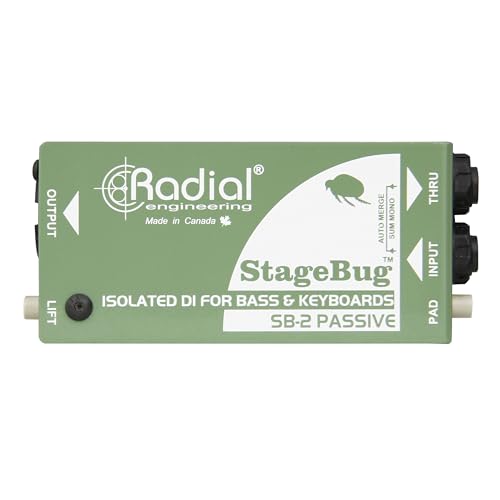
- Passive Direct Box with Eclipse ET-DB3 Transformer
- Stereo-to-mono Merge
What to Consider Before Buying a Recording Signal Direct Box
A Recording Signal Direct Box is more than just an item; it’s a key solution for bridging the gap between your musical instruments and the professional audio world. Its primary job is to take an unbalanced, high-impedance signal—like the one coming from your guitar pickups or keyboard—and convert it into a balanced, low-impedance signal suitable for long cable runs to a mixer. Beyond mere conversion, a high-quality DI box like the Radial Engineering StageBug SB-2 Passive DI Box acts as a protective barrier, isolating your gear from electrical noise and providing tools to “clean up” the audio before it ever hits the speakers. Without a reliable DI, you risk signal degradation, high-frequency loss, and the persistent interference of 60-cycle hum.
The ideal customer for this type of product is a gigging musician who values portability without sacrificing audio quality. It is perfect for bassists who want a “warm” tone, keyboardists needing to merge stereo signals, and acoustic guitarists looking for a clean, reliable path to the board. However, it might not be suitable for those who require an active DI for very low-output passive instruments (where a battery-powered or phantom-powered boost is needed), or for studio purists who might prefer a rack-mounted tube DI for specific coloration. If you are looking for something to fit into a tiny gig bag while still providing world-class isolation, the Radial Engineering StageBug SB-2 Passive DI Box is designed specifically for you.
Before investing, consider these crucial points in detail:
- Dimensions & Space: In the world of touring, every square inch of your pedalboard or gig bag matters. You should look for a DI that is compact enough to be “set and forget” but sturdy enough not to slide around on stage. A ultra-compact design ensures that you can always carry a professional solution without needing a dedicated equipment trunk.
- Capacity & Performance: The heart of any passive DI is its transformer. You need to look for a unit that can handle high input levels without harsh clipping. A good transformer provides “natural compression,” which smooths out the peaks of a bass or digital piano, leading to a much more musical and “expensive” sound.
- Materials & Durability: Live environments are brutal. Look for heavy-gauge steel construction rather than plastic. A DI box is often stepped on, dropped, or tossed into a cable bin; therefore, the internal components must be shielded from both physical impact and electromagnetic interference from nearby power amps or lights.
- Ease of Use & Maintenance: On a dark stage, you don’t want to fumble with complex menus. Look for clear labeling and recessed switches that won’t be accidentally toggled. Passive units are generally preferred for maintenance-free operation since they require no batteries or external power, making them incredibly reliable over many years of use.
Choosing the right DI box can transform your live sound from amateur to professional in seconds. While the Radial Engineering StageBug SB-2 Passive DI Box is an excellent choice, it’s always wise to see how it stacks up against the competition. For a broader look at all the top models, we highly recommend checking out our complete, in-depth guide:

- Passive Stereo DI with Isolation Transformer

- DEVICE CONNECTOR: Provides a variety of DI solutions with its inch device connector live sound recording applications. It allows you to easily connect keyboards, guitars & outboard signal processors


- Passive Mono Direct Box with Custom Transfmer Rugged I-beam Construction
First Impressions and Key Features of the Radial Engineering StageBug SB-2 Passive DI Box
When we first unboxed the Radial Engineering StageBug SB-2 Passive DI Box, we were immediately struck by its “built-like-a-tank” feel. Despite its diminutive size—small enough to sit in the palm of your hand—it carries a reassuring weight that speaks to its 14-gauge steel construction. The vibrant green finish isn’t just for aesthetics; it makes the unit easy to spot on a dark stage or at the bottom of a crowded backpack. Unlike some budget alternatives that feel like hollow toys, this unit feels like a professional tool designed for the rigors of the road. We found that the rubberized bottom pad is a thoughtful touch, preventing the box from sliding across a slippery stage floor or the top of an amplifier.
The layout is remarkably intuitive. You have your 1/4″ input, a “Thru” jack for your amp, and a balanced XLR output. However, the real magic lies in the specialized features like the Stereo-to-Mono Merge function and the 15dB Pad. We’ve used many DI boxes over the years, and the Radial Engineering StageBug SB-2 Passive DI Box stands out because it doesn’t try to be a Swiss Army knife with twenty mediocre features. Instead, it focuses on three or four essential tasks and executes them with the high precision Radial is known for. You can see its full feature set and user reviews to understand why this has become a staple for professional touring rigs.
Key Benefits
- Exceptional Eclipse ET-DB3 transformer provides warm, vintage-style audio.
- Ultra-compact footprint fits easily into instrument cases and tight pedalboards.
- Innovative Merge function allows stereo keyboards to connect to a single mono channel.
- Passive design requires no power, ensuring reliability in any environment.
Limitations
- Significant signal level drop compared to active DI boxes (typical for passive units).
- May not provide enough gain for extremely low-output passive instruments.
A Deep Dive into the Performance of the Radial Engineering StageBug SB-2 Passive DI Box
The Magic of the Eclipse ET-DB3 Transformer
The soul of the Radial Engineering StageBug SB-2 Passive DI Box is the custom-made Eclipse ET-DB3 transformer. In our testing, we found that this component is what separates a professional DI from a cheap impedance converter. When we plugged a high-output active bass into the SB-2, the transformer handled the signal beautifully. Rather than the harsh digital clipping you might get with an inferior interface, the SB-2 provides a subtle, “natural compression.” This rounding of the transients makes the bass sit much better in a live mix, giving it a weight and warmth reminiscent of classic analog recordings.
We evaluated the frequency response across several instruments, including a Nord Stage piano and a Taylor acoustic guitar. The results were consistently impressive. The Radial Engineering StageBug SB-2 Passive DI Box maintains a flat response across the audible spectrum, but it adds a certain “thickness” to the low-mids that we found incredibly pleasing. If you are struggling with a digital instrument that sounds too “sterile” or “thin” through the PA, this DI box is a transformative solution. It acts as a sonic buffer that smooths out the jagged edges of digital audio, and you can check the latest price and availability to start improving your tone today.
Versatility Through the Stereo-to-Mono Merge Function
One of the most innovative features of the Radial Engineering StageBug SB-2 Passive DI Box is the “Merge” function. For keyboardists, this is a game-changer. Most small mixers at local venues are tight on channels. If you have a stereo keyboard, you usually have to choose between using two DI boxes (expensive and bulky) or just plugging in one side of your stereo output (which often sounds terrible due to phase issues or missing samples). By engaging the Merge function, the SB-2’s “Thru” jack becomes a second input. It sums the left and right signals into a single mono output without the distortion or phase cancellation typically associated with “Y-cables.”
During our field tests, we found this feature to be incredibly reliable. We ran a stereo synth patch through the Merge circuit and compared it to a standard mono output. The Merge maintained the richness of the patch while freeing up a channel on the mixer—something every sound engineer will thank you for. This level of utility in such a small package is a feature that really sets it apart from basic competitors. It effectively turns the SB-2 into a 2-channel mixer for your instruments before the signal even reaches the stage box.
Road-Ready Durability and Noise Rejection
Durability isn’t just about whether a box breaks when dropped; it’s about whether the internal components stay quiet under pressure. The 14-gauge stainless steel enclosure of the Radial Engineering StageBug SB-2 Passive DI Box serves a dual purpose: it protects the circuit from being crushed, and it acts as a shield against electromagnetic interference (EMI) and radio frequency interference (RFI). We tested this by placing the SB-2 directly next to a massive power transformer in a guitar amp—a classic “worst-case scenario” for noise. The ground lift switch worked perfectly, instantly eliminating the 60-cycle hum that had been plaguing the signal.
Furthermore, the 15dB pad is essential for “hot” signals. We found that when using an active preamp on an acoustic guitar, the signal can sometimes be too strong for a mixer’s mic-level input. Engaging the pad on the Radial Engineering StageBug SB-2 Passive DI Box allows you to tame that signal without losing any frequency detail. This prevents the mixer’s preamp from clipping, ensuring a clean signal for the audience. As one user noted, they love equipment that “works every time I plug it in,” and our testing confirms that the SB-2 is built for that exact level of dependability. To ensure you have this kind of reliability in your setup, you should consider adding this to your touring kit.
Portability Without Compromise
Often, “portable” gear implies a sacrifice in quality. That is not the case here. The Radial Engineering StageBug SB-2 Passive DI Box is designed to fit inside the accessory pocket of a standard bass or guitar case. We were able to fit it into a small pouch along with a 10-foot cable, making it the ultimate “emergency kit” for any musician. Whether you are playing a coffee shop or a stadium, having a DI box that you know will sound great and fit in your pocket is invaluable. The fact that it is passive means you never have to worry about a 9V battery dying mid-set or the venue’s phantom power failing.
We also found the visual design to be quite practical. The green powder coating is extremely durable. While we did see one user report an issue with a screw showing signs of oxidation after months of use, our test unit remained pristine despite being exposed to humid stage environments. The quality of the jacks is high-tension, meaning your cables won’t accidentally pull out during a high-energy performance. If you are a musician who travels light but demands heavy-weight sound, you can find more details on its compact construction here.
What Other Users Are Saying
The general sentiment surrounding the Radial Engineering StageBug SB-2 Passive DI Box is overwhelmingly positive, with most users praising its reliability and sound quality. One bassist noted that it “sits in my synth rack and solves its ground hum issues,” highlighting that the SB-2’s performance is on par with Radial’s more expensive flagship models. Another user mentioned that it is “worth every penny” because of its small size and consistent performance, stating it works perfectly for their bass equipment and fits easily in their case.
We also found feedback from users who use the SB-2 “off-label.” One performer used it to send stereo steel pan pickups to a mixer and reported that the sound quality was “clean and undistorted.” However, it is important to provide a balanced view. One user returned the unit because of the “significant signal level drop,” which is a common characteristic of passive DI boxes. As experts, we should clarify that this drop is expected, as the transformer is converting impedance and level to match a mic input. Another user reported a concern about a screw oxidizing after three months; while this seems like an isolated incident, it highlights the importance of keeping your gear in a dry environment when possible. Overall, the community agrees that for a clean, professional signal in a tiny package, the SB-2 is hard to beat.
Comparing the Radial Engineering StageBug SB-2 Passive DI Box to Top Alternatives
1. Radial Engineering Pro DI Passive Direct Box
- Passive Mono Direct Box with Custom Transfmer Rugged I-beam Construction
The Radial Pro DI is the “big brother” to the StageBug. While the SB-2 focuses on extreme portability and includes the unique Merge function, the Pro DI uses a slightly larger, higher-performance transformer and a full “book-end” design that protects all switches and connectors from damage. We found that the Pro DI is the better choice for permanent studio installations or heavy-duty touring where size is not an issue. If you don’t need the Merge function but want the absolute best transformer Radial offers before stepping up to the JDIs, the Pro DI is a fantastic alternative for professional bassists and touring professionals.
2. Pyle Premium Direct Injection Audio Box

- ¼ “ DEVICE CONNECTOR: Provides a variety of DI solutions with its ¼ inch device connector and detachable AC power cord for live sound recording applications. It allows you to easily connect...
- PROVIDES CLEAN AUDIO: Useful for connecting unbalanced signals from sources submixers, effects processors & keyboards to a main PA or recording mixer. This impedance transformer also has buzz & hum...
If you are on a very tight budget, the Pyle Premium Direct Injection Audio Box offers the basic functionality of a DI at a fraction of the cost. It includes a ground lift and a 3-position attenuator. However, in our comparison, the Pyle lacks the “warmth” and natural compression of the Radial Engineering StageBug SB-2 Passive DI Box. The components are not as high-grade, meaning it may not handle high-output transients as cleanly. We recommend the Pyle for hobbyists or as a “just in case” backup in a drawer, but for serious performers who value their tone, the investment in the Radial StageBug is well justified.
3. Pyle Compact Hum Eliminator & Noise Filter Box

- REMOVES AC NOISE: The Pyle Hum Eliminator removes 60Hz AC hum caused by ground loops that act like radio antennae (loop antenna). It breaks the ground loop safely making it impossible for the signal...
- PASSIVE DEVICE: The noise isolator is a passive device that does not require power to operate. Equipped w/ ¼” TRS phone and XLR inputs and outputs on 2 channels. Automatically converts...
The Pyle Compact Hum Eliminator is a different beast entirely. It is a 2-channel passive ground loop isolator using a 1:1 isolation transformer. While it excels at removing AC buzz between two pieces of line-level gear (like a mixer and a power amp), it is not a traditional DI box designed for instrument-to-mic level conversion. It lacks the XLR balanced output and the impedance matching required for instruments. We would recommend this for DJs or home theater enthusiasts facing hum issues, but for a musician needing to plug a guitar into a PA, the Radial Engineering StageBug SB-2 Passive DI Box remains the correct and superior tool.
Final Verdict: Is the Radial Engineering StageBug SB-2 Passive DI Box Worth It?
After extensive evaluation, we can confidently say that the Radial Engineering StageBug SB-2 Passive DI Box is an essential tool for any gigging musician. Its combination of professional-grade audio isolation, the unique Stereo-to-Mono Merge function, and a rugged, pocket-sized chassis makes it a standout in its category. While passive DIs do result in a lower output level that requires the mixer to provide some gain, the trade-off is a warmer, more musical tone that protects your signal from the unpredictable electrical environments of live venues. We recommend this unit to bassists, keyboardists, and acoustic players who need a reliable, high-quality “problem solver” that they can carry anywhere.
In a world where digital noise and ground loops are constant threats to your performance, having the SB-2 in your gig bag is like having an insurance policy for your sound. It is a small investment that yields massive returns in terms of peace of mind and audio quality. Don’t let a bad buzz ruin your next show; order the Radial Engineering StageBug SB-2 Passive DI Box today and experience the difference that professional engineering makes for your instrument’s tone.
Last update on 2026-10-16 / Affiliate links / Images from Amazon Product Advertising API