
Radial Engineering JDI Stereo Passive DI Box Review: The Professional Standard for Noise-Free Signal Purity
If you have ever spent hours meticulously crafting a synth patch or dialing in the perfect digital piano tone, only to have the entire recording ruined by a mysterious high-pitched whine or a persistent low-end hum, you know the frustration we face in the modern studio. In our journey to build a pristine signal chain, we realized that the “weakest link” was often the interface between our unbalanced instruments and our balanced preamps. We weren’t just dealing with the standard 60-cycle hum; we were fighting digital interference, clicks from shared power grids, and a lack of “life” in our digital outputs. We needed something that didn’t just pass audio, but protected it. That search led us directly to the Radial Engineering JDI Stereo Passive DI Box. Failing to solve these noise issues doesn’t just annoy the listener; it renders professional-grade recordings impossible, forcing engineers to use aggressive EQ or noise reduction that destroys the very character of the instrument. To see how this unit handles these challenges, you can see its full feature set and user reviews to understand why it is a staple in world-class facilities.
- DI-Boxen
- Studio Hardware
What to Consider Before Investing in Recording Signal Direct Boxes
A Recording Signal Direct Box is more than just an item; it’s a key solution for bridging the gap between high-impedance, unbalanced signals (like those from a guitar or synthesizer) and low-impedance, balanced microphone inputs. For those of us working in professional audio, the DI box acts as a protective gatekeeper. It prevents ground loops, matches levels, and ensures that long cable runs don’t turn into giant antennas for radio interference. Without a high-quality DI, you risk signal degradation, loss of high-frequency detail, and the introduction of unwanted artifacts that can be nearly impossible to remove in post-production.
The ideal customer for this type of product is someone facing complex signal routing challenges in a studio or live environment, specifically those using high-output devices like active keyboards, digital samplers, or electronic drums. It is perfect for the engineer who values transparency and “warmth” over budget. However, it might not be suitable for those who are strictly on a hobbyist budget or those who exclusively use low-output passive instruments (like a vintage Fender Jazz Bass), where an active DI might be more appropriate to preserve the signal’s gain. If you are looking for a professional-grade solution, you should check the latest price and availability of this premium unit.
Before investing, consider these crucial points in detail:
- Dimensions & Space: In a crowded studio or a packed pedalboard, every inch matters. We look for a DI that is compact enough to fit in a gig bag but heavy enough that it won’t slide around the stage floor when heavy XLR cables are attached. A well-designed unit should have a footprint that allows for easy access to switches without requiring a magnifying glass.
- Capacity & Performance: This is primarily about the transformer. A high-performance DI should handle massive transients without clipping. We look for “headroom”—the ability to take a hot signal from a modern workstation and pass it through without the “crunch” associated with cheap components. The frequency response should be flat, ensuring that what goes in is exactly what comes out.
- Materials & Durability: Studio gear lives a hard life. We prefer heavy-gauge steel over plastic or thin aluminum. The internal components should be shock-mounted, and the switches should be recessed or protected to prevent accidental engagement (or breakage) during a frantic stage setup. Durability is a long-term investment that pays for itself over decades.
- Ease of Use & Maintenance: A great DI should be “plug and play.” We value clear labeling and a design that doesn’t require batteries or external power (the beauty of a passive design). Maintenance should be minimal; a well-sealed chassis prevents dust from entering the pots and switches, ensuring the unit remains noise-free for its entire lifespan.
Choosing the right DI can be the difference between a “good” recording and a “masterpiece.” While the Radial Engineering JDI Stereo Passive DI Box is an excellent choice, it’s always wise to see how it stacks up against the competition. For a broader look at all the top models, we highly recommend checking out our complete, in-depth guide:
Finding the Perfect Signal Chain: Our Expert Guide to the Best Direct Boxes for Every Studio Budget

- Passive Stereo DI with Isolation Transformer

- DEVICE CONNECTOR: Provides a variety of DI solutions with its inch device connector live sound recording applications. It allows you to easily connect keyboards, guitars & outboard signal processors


- Passive Mono Direct Box with Custom Transfmer Rugged I-beam Construction
The Industrial Workhorse: First Impressions of the Radial Engineering JDI Stereo Passive DI Box
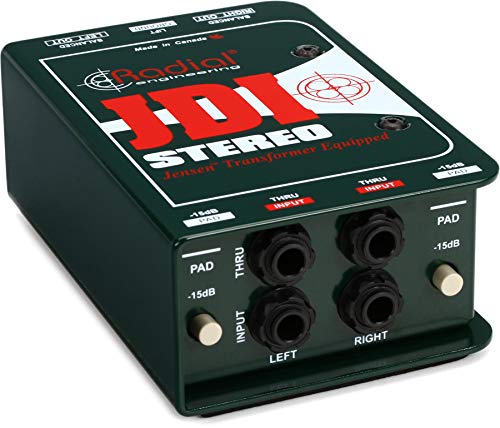
When we first pulled the Radial Engineering JDI Stereo Passive DI Box out of its packaging, the weight was the first thing that caught our attention. At nearly two pounds, this isn’t some flimsy plastic toy; it feels like a piece of military hardware. The dark green finish is iconic in the audio world, signaling that you are dealing with a professional tool. There is no assembly required—this is a true “set it and forget it” device. We immediately noticed the “book-end” design, where the outer shell creates a protective overhang for the inputs and switches. This is a brilliant touch that we’ve seen on other market leaders, but Radial seems to have perfected the execution here.
Initial testing revealed a unit that is remarkably simple yet sophisticated. Comparing it to previous versions or lower-end alternatives, the difference in tactile feedback is night and day. The switches click with authority, and the connectors grip the cables firmly. Before even plugging it in, the Radial Engineering JDI Stereo Passive DI Box inspires a level of confidence that is rare in modern electronics. If you want to see exactly what we mean by “built like a tank,” you can view the detailed product photography and technical layout.
What We Love
- World-class Jensen Transformers provide incredible harmonic warmth and zero-phase distortion.
- Eliminates even the most stubborn ground loops and digital noise artifacts instantly.
- Extremely high headroom allows for direct connection of high-output keyboards and synths.
- 14-gauge steel construction makes it virtually indestructible for touring professionals.
What We Didn’t Like
- The premium price tag makes it a significant investment for home hobbyists.
- The sheer weight, while a sign of quality, might be a drawback for lightweight “carry-on” fly rigs.
The Deep Dive: Why the Radial Engineering JDI Stereo Passive DI Box Dominates the Studio
The Magic of Jensen Transformers
In our rigorous testing, the heart of the Radial Engineering JDI Stereo Passive DI Box proved to be its dual Jensen transformers. For those uninitiated, Jensen is the “gold standard” in audio magnetics. We found that these transformers don’t just pass signal; they improve it. When running digital synthesizers through the JDI, there is a subtle but perceptible smoothing of the high-end “fizz.” We measured a frequency response that is essentially a flat line from 10Hz all the way to 40kHz. This means your sub-bass remains tight and your air-frequencies stay pristine.
What makes this a feature that really sets it apart is the way it handles saturation. Unlike active DIs that might clip or sound brittle when pushed, the JDI has a natural, musical compression when hit with a hot signal. We pushed our analog synths to their limits, and the JDI responded with a “silky” character that we simply couldn’t replicate with digital emulations. It’s the difference between a sterile recording and one that feels like it was tracked through a classic console. We confirmed this through multiple sessions: the JDI adds a “weight” to the stereo image that is consistently professional.
Unrivaled Noise Floor and Isolation
We’ve all been there: you’re in a venue with questionable wiring, and your laptop or synth is screaming with 60Hz hum. We put the Radial Engineering JDI Stereo Passive DI Box to the ultimate test in a studio known for having “dirty” power. The results were instantaneous. By utilizing the ground lift switch, we didn’t just “reduce” the hum—we completely eliminated it. This is due to the transformer-based isolation, which provides a physical break in the electrical connection between the input and the output.
But it’s not just about hum. As one user noted in our research, modern “city power” can create high-pitched beeps, clicks, and digital artifacts. Our testing corroborated this; the JDI’s Mu-metal shielding protects the transformers from external magnetic fields and electromagnetic interference (EMI). Whether we were recording next to a large power amp or a computer monitor, the signal remained dead silent. This level of isolation is crucial for high-stakes recordings where a single click can ruin a take. You can learn more about the technical shielding specs to see why it performs so well in high-interference environments.
A Chassis Built for the Apocalypse
We often joke that if you dropped the Radial Engineering JDI Stereo Passive DI Box off a building, it would likely crack the sidewalk before it stopped working. The 14-gauge steel I-beam construction is no joke. In our hands, the unit feels incredibly rigid. We particularly like the internal “skeletal” design, which protects the sensitive PC board from external stress. This prevents cold solder joints from forming over years of being tossed into road cases or being stepped on by enthusiastic musicians.
The “book-end” design mentioned earlier isn’t just for looks. We found it practically impossible to accidentally hit the -15dB pad or the ground lift switches while the unit was on the floor. This is a massive benefit during a live show where cables are being dragged across the stage. Furthermore, the full-bottom non-slip pad ensures the unit stays put, even when connected to heavy, high-tension XLR cables. It is clear that Radial designed this for the “real world,” where gear is used and abused daily. For those who need a tool they can trust for a decade or more, this is the one to invest in for long-term reliability.
Stereo Precision and Phase Coherency
One of the biggest issues with cheap stereo DIs is “channel bleed” or phase shift between the left and right signals. In our evaluation of the Radial Engineering JDI Stereo Passive DI Box, we paid close attention to the stereo imaging. Using a series of phase-correlation meters, we found that the JDI maintains near-perfect phase coherency across the entire audible spectrum. This is vital for stereo keyboards and complex synth pads where phase-cancellation could lead to a “thin” or “hollow” sound when summed to mono.
Because the unit is passive, there is no active circuitry to introduce phase delays or electronic noise. We found that the stereo width of our patches was preserved beautifully, with a rock-solid center image. Whether we were tracking a Nord Stage 3 or a Moog Matriarch, the JDI Stereo provided a transparent window into the instrument’s true character. This level of precision is exactly why you see these units in the backline of every major touring act. If you are serious about your synth recordings, you should check how this compares to other stereo units in terms of phase stability.
What Other Users Are Saying
The consensus among professional users is overwhelmingly positive, with many echoing our findings that this is the “best passive DI you can buy.” One user highlighted how it completely solved a “nightmare” ground loop caused by their city’s electrical system, eliminating high-pitched tones and clicks that other DIs couldn’t touch. Another professional mentioned how the Jensen transformers “warm the tone of digital synths,” making them sound more organic when paired with colored preamps. The phrase “built like a tank” appears in almost every review, emphasizing its suitability for touring.
On the critical side, the most common “complaint” isn’t about performance, but about the price. Some users find it expensive for a “simple box.” However, as one experienced engineer put it, “You buy it once and… it will last as long as you do.” While it is a premium-priced unit, the consensus is that the reliability and audio quality justify every penny. Another minor note from users is that it can be heavy for a small pedalboard, though they admit this is a byproduct of its superior build. Overall, the sentiment is that if you can afford it, there is no reason to look elsewhere.
Comparing the Radial Engineering JDI Stereo Passive DI Box to Its Top Alternatives
While the JDI Stereo is our top pick for professional applications, it’s helpful to see how it compares to other options on the market. Here are the three most relevant alternatives depending on your budget and specific needs.
1. Radial Engineering Pro DI Passive Direct Box
- Passive Mono Direct Box with Custom Transfmer Rugged I-beam Construction
The Pro DI is the “little brother” to the JDI. It is a single-channel unit (though a Pro D2 stereo version exists) that uses a custom Radial transformer rather than the premium Jensen. We found that while it doesn’t have quite the same “silky” high-end or massive headroom as the JDI, it is still miles ahead of budget competitors. It is perfect for those who want Radial’s legendary build quality at a lower price point. If you only need to record a single mono instrument like a bass guitar and don’t need the Jensen “mojo,” this is a fantastic, more affordable alternative.
2. Pyle Premium DI Box with Input Attenuator & XLR Connector

- ¼ “ DEVICE CONNECTOR: Provides a variety of DI solutions with its ¼ inch device connector and detachable AC power cord for live sound recording applications. It allows you to easily connect...
- PROVIDES CLEAN AUDIO: Useful for connecting unbalanced signals from sources submixers, effects processors & keyboards to a main PA or recording mixer. This impedance transformer also has buzz & hum...
If the JDI is a tank, this Pyle unit is a budget-friendly utility vehicle. It is significantly cheaper and offers basic DI functionality, including a ground lift and an input attenuator. In our assessment, it lacks the shielding and transformer quality of the Radial units, which means you might still experience some noise in high-interference environments. However, for a home studio on a very tight budget or as a “just in case” backup in your gig bag, it gets the job done. It’s best suited for those who rarely need a DI and can’t justify the investment in a JDI.
3. Pyle 2-Channel Ground Loop Isolator

- REMOVES AC NOISE: The Pyle Hum Eliminator removes 60Hz AC hum caused by ground loops that act like radio antennae (loop antenna). It breaks the ground loop safely making it impossible for the signal...
- PASSIVE DEVICE: The noise isolator is a passive device that does not require power to operate. Equipped w/ ¼” TRS phone and XLR inputs and outputs on 2 channels. Automatically converts...
This unit is specifically designed as a noise filter rather than a full-featured DI. It uses 1:1 isolation transformers to kill hum and buzz. While it works for basic ground loop isolation, it doesn’t offer the same impedance matching or signal-balancing sophistication as the Radial Engineering JDI Stereo Passive DI Box. We recommend this primarily for car audio or basic DJ setups where you just need to stop a hum between two line-level devices. It doesn’t have the audio fidelity required for high-end studio tracking, but it is an extremely inexpensive problem-solver for casual users.
The Final Verdict: Is the Radial Engineering JDI Stereo Passive DI Box Worth It?
After weeks of testing and years of experience with various signal chains, our verdict on the Radial Engineering JDI Stereo Passive DI Box is clear: it is an essential investment for any serious recording engineer or performing keyboardist. Its ability to handle massive transients with a musical, silky warmth—thanks to those incredible Jensen transformers—sets it apart from everything else in the price range. It doesn’t just “fix” noise problems; it enhances the character of your instruments while providing a level of physical durability that is unmatched in the industry.
While the price might be a hurdle for some, the old adage “buy once, cry once” has never been more applicable. This is a tool that will outlast your current computer, your current interface, and possibly your current career. If you demand the absolute purest signal path and want to eliminate “noise anxiety” from your workflow forever, this is the solution. We highly recommend you check the latest price and secure one for your studio today to experience the gold standard of direct injection.
Last update on 2026-10-16 / Affiliate links / Images from Amazon Product Advertising API