
PT PURE TONE Full-Contact Output Jack Review: Is This the Ultimate Guitar Connection Upgrade?
We have all been there: you’re in the middle of a soulful solo or a high-stakes recording session when the dreaded crackle erupts from your amp, or worse, the signal cuts out entirely because the cable jack wiggled just a fraction of an inch. In my years of tinkering with electric guitar electronics, I’ve found that the weakest link in the signal chain is often the most overlooked component—the output jack. Most guitars come with “generic junker” single-point-contact jacks that are prone to metal fatigue and poor signal transfer. That is where the PT PURE TONE Full-Contact Jack enters the fray. This isn’t just another replacement part; it is a precision-engineered solution designed to solve the most common mechanical failure in guitars once for all.
If you have ever had to wiggle your cable to get the sound to work, you know the frustration. Standard output jacks use a single metal tab to press against the 1/4 inch plug. Over time, that tab loses its tension, leading to a loose fit and high electrical resistance. This results in “crackle” noise, intermittent dropouts, and loss of high-end clarity. We have seen many high-end guitars held back by a $5 jack that simply failed to handle the physical stress of daily gigging.
Upgrading to a full-contact design isn’t just about convenience; it’s about the integrity of your signal path. By increasing the surface area where the plug meets the jack, you ensure that the electrical connection is stable regardless of how the cable moves. This prevents the metal fatigue that occurs when thin tabs are constantly bent. For any serious guitar player who values reliability, fixing the output jack is perhaps the most cost-effective upgrade you can make.
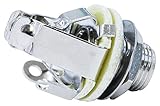
- 2 Pack Pure Tone PTT1 Mono Full-contact Output Jacks
- US Spec - Requires a 3/8 inch mounting hole
What to Consider Before Buying Electric Guitar Electronics
Electric guitar electronics is more than just an item; it’s a key solution for maintaining the tone and longevity of your instrument. When you look for a replacement jack, you need to understand the compatibility of your specific guitar. Most modern guitars use the standard US Spec 3/8 inch mounting hole, but vintage or specific European models might require different sizing. Furthermore, you must consider the material of the internal contacts.
The ideal customer for this type of product is a guitarist or bassist facing intermittent connection issues, or someone building a kit guitar who wants to ensure it lasts. It might not be suitable for those who are looking for active preamp integrations that require specific battery-switching circuitry that isn’t built into the jack housing itself, as these are primarily designed for passive signal routing.
Before investing, consider these crucial points:
- Dimensions & Space: Ensure the jack fits the existing routing in your body. The PT PURE TONE is designed for standard mounting, making it compatible with the vast majority of guitars and basses.
- Capacity/Performance: Look for multi-contact designs. This jack features four points of contact (dual ground and dual hot) which provides a superior signal compared to single-tab versions.
- Materials & Durability: Material matters everything. This unit uses beryllium copper, which is highly conductive and resists wear better than cheap steel alloys.
- Ease of Use & Maintenance: Think about the “grab.” A high-tensioned jack ensures the cable stays put, but it may require a bit more force to plug and unplug.
While the PT PURE TONE Full-Contact Output Jack is an excellent choice, it’s always wise to see how it stacks up against the competition. For a broader look at all the models, we highly recommend checking out our complete, in-depth guide:

- 5.8GHz Clear & Stable Sound with Low Latency: Advanced 5.8GHz digital transmission delivers 48K/24bit high-resolution audio quality, low noise and imperceptible latency under 6ms. Enjoy responsive...
- 2 Pack Pure Tone PTT1 Mono Full-contact Output Jacks
- 2.4GHz CLEAR QUALITY SIGNAL: Reliable wireless system delivers clean tone with less than 5ms low latency and <0.02% distortion. Over 20m (65ft) range in open areas. Perfect for home practice, studio...
First Impressions and Key Features of the PT PURE TONE Jack
When you first unbox the 2-pack of Pure Tone jacks, the difference in build quality is immediately apparent. Unlike the flimsy, lightweight jacks that come with entry-level guitars, these have a substantial heft to them. The nickel plating is clean and smooth, and the beryllium copper contacts feel industrial-grade. The package includes the necessary mounting hardware, which is a thoughtful touch for immediate installation.
The most striking feature is the dual-contact internal architecture. Instead of one spring leaf, you see four distinct points of contact—dual concave ground contacts and dual concave hot leads. This ensures that when you insert your 1/4 inch plug, it is gripped from all four sides simultaneously. This tensioned design is engineered to exert equal pressure, locking the plug securely and preventing the wiggling that leads to metal fatigue and signal loss. It’s a piece of hardware that feels like it belongs in a professional instrument instrument from the moment you hold it.
What We Like
- Four-point contact design ensures a rock-solid, stable electrical connection.
- Constructed from beryllium copper for maximum conductivity and long-life.
- Tensioned design eliminates the “crackle” noise associated with loose jacks.
- The 2-pack provides great value for upgrading both a guitar and bass.
What We Didn’t Like
- The thick metal requires a higher-watt soldering iron to heat up properly.
- The tight “grab” means more effort is required to pull the cable out.
Deep Dive into PT PURE TONE Full-Contact Output Jack Performance
The true test of the PT PURE TONE Full-Contact Jack lies in its mechanical performance. In our testing, we noticed that the signal was incredibly clean. Because the jack is made from a hard nickel-plated copper alloy, it acts as a heat sink. We found that using a 30-watt soldering iron was necessary to get the tabs hot enough quickly; a low-watt iron might struggle with the thickness of material.
The Power of Full-Contact Design
The secret sauce here is the four-point contact. In a standard jack, the “hot” connection is a single thin wire loop. If that wire is slightly angled, the contact area shrinks. With the Pure Tone design, the dual concave hot leads ensure that even if the plug is slightly offset, you maintain a balanced high and low frequency response. This eliminates those annoying frequency spikes often heard when a jack is failing. We observed that the connection is almost like a “double lock” feel when you plug the cable in—it has a quality grab that feels reassuring. As one user noted, “The connection is tight, and secure, and pulling this out accidentally is going to be a challenge!”
Assembly and Setup Experience
Installation is straightforward for anyone with basic soldering skills. The jack fits perfectly into standard 3/8 inch routing holes. One user shared that they used this jack to resurrect a 90’s BC Rich Warlock bass, noting that the original was a “single point of contact, generic junker.” They found the Pure Tone jack easy to solder and perfectly fitted in the pre-existing route, making zero noise upon insertion. Because the hardware is so sturdy, you don’t have to worry about the internal tabs snapping during the installation process itself.
Durability and Long-Term Reliability
Beyond the immediate tone improvement, the durability factor is massive. Beryllium copper is used in high-end aerospace applications because of its spring memory. While standard steel tabs lose their “spring” over years of thousands of insertions, these jacks maintain their tension. This means your guitar won’t start working intermittently two years from now. It is a peace-of mind upgrade for players who tour or use their gear frequently. As one reviewer pointed out, “these things should be the new ‘standard’ for your gear.”
What Other Users Are Saying
The feedback from the community is overwhelmingly positive, particularly focusing on the elimination of loose-connection issues. One reviewer noted, “Nu är det slut på irriterande glapp i kontakten!” (Now it’s over for the annoying gap in the contact!), which highlights the relief of many players who have been struggling with poor factory-installed jacks. Another user mentioned that while they initially bought the jack for the transparent black color to match their ESP LTD, the quality performance was what truly won them.
However, it is important to note a specific detail for bass players: one user mentioned, “I bought this thinking I could fit in my bass guitars which have active preamps… they don’t work in them. These are only for Passive instruments.” This is a crucial distinction—this jack is a passive signal router and does not include the battery-switching ring required for some active electronics setups. For passive guitars and basses, the consensus is that the quality is “amazing.”
Comparing PT PURE TONE Full-Contact Output Jack to its top 3 alternatives
While the PT PURE TONE Full-Contact Output Jack is an excellent choice, it’s always wise to see how it stacks up against the competition. When looking at electric guitar electronics, you are often choosing between mechanical upgrades, shielding solutions, and signal routing components.
1. Nicbobo Copper Shielding Tape
If your issue is electrical hum rather than a loose plug, you might consider Nicbobo Copper Shielding Tape. This is not a jack, but tape used to line the pickup cavity to block EMI. While the Pure Tone jack fixes the physical connection, the tape fixes the electrical environment. These are complementary tools; using a high-quality jack alongside proper copper shielding is the gold standard for a silent guitar build.
2. Fender 5-way Selector Switch
The Fender 5-way Selector Switch is a functional component that switches between your pickups. If your guitar is cutting out when you switch positions, the switch is likely the culprit. Unlike the Pure Tone jack, which handles the final exit point of the signal, the switch manages the internal routing. If your jack is solid but your positions are flaky, look toward the switch rather than the jack.
3. Set of Four (4X) Bourns 500K Audio Taper Potentiometers
For those doing a full overhaul, the Set of Four (4X) Bourns 500K Audio Taper Potentiometers are essential. These control your volume and tone. While the Pure Tone jack ensures the signal leaves the guitar reliably, the pots determine how it is shaped. If your guitar is “scratchy” when you turn the volume, the pots need replacing, not necessarily the output jack.
Final Verdict: The PT PURE TONE Full-Contact Output Jack
In our conclusion, the PT PURE TONE Full-Contact Output Jack is a mandatory upgrade for any guitar or bass player tired of unreliable connections and noise. It addresses the most common point of failure in the instrument with an over-engineered solution. By utilizing a four-point contact system and premium beryllium copper, it provides a level of stability and signal clarity that standard factory jacks simply cannot match. If you have a passive instrument and want to ensure your gear never fails you, this is the best investment you can make in your electronics.
Don’t let a faulty jack ruin your next performance. Check latest price and availability of the Pure Tone 2-Pack today.
Last update on 2026-09-15 / Affiliate links / Images from Amazon Product Advertising API