
ProTec Max Tenor Saxophone Case Review: The Ultimate Balancing Act Between Portability and Protection
If you have ever spent a long day traversing a city campus or rushing between rehearsal halls with a standard plywood tenor saxophone case, you know the literal ache that follows. Tenor saxophones are magnificent instruments, but their sheer size makes them a logistical nightmare for the mobile musician. For years, I struggled with a vintage hard-shell case that felt more like a lead-lined coffin than a protective vessel. It offered security, sure, but at the cost of my lower back and my patience. The constant fear of a shoulder strap snapping or a latch failing during a rainy trek to a gig is a stress no performer should have to endure.
Solving this portability crisis is crucial because a musician who is physically exhausted or stressed about their gear cannot perform at their peak. A heavy, awkward case leads to “gear fatigue,” which often results in accidental bumps against doorframes or, worse, leaving the instrument at home when you should be practicing. We went looking for a solution that didn’t force us to choose between a heavy “tank” and a flimsy “gig bag.” This led us to our ProTec Max Tenor Saxophone Case review, where we put this lightweight contender to the test to see if it truly offers the “best of both worlds.”

- Ultra-light case, now with an updated protective fit for most modern/contemporary horns. Does not fit horns with uncommonly larger bells or left-side bell keys often found on vintage horns.
- Shock resistant EPS foam frame featuring a soft lining and separate neck and mouthpiece sections

What to Consider Before Buying a Saxophone Bag or Case
A saxophone bag or case is more than just an item; it’s a key solution for safeguarding a significant financial and emotional investment. Whether you are a parent buying for a student or a professional gigging three nights a week, the right case must mitigate the risks of environmental damage, physical impact, and the repetitive strain of transport. A poor choice here doesn’t just mean a broken latch; it could mean a bent keywork system that costs hundreds of dollars in specialized repairs.
The ideal customer for this type of product is someone facing daily commutes, marching band seasons, or frequent rehearsals where weight is a primary concern. It is perfect for students who need to manage a backpack and an instrument simultaneously. However, it might not be suitable for those who frequently travel by air and require a flight-certified carbon fiber shell, or owners of vintage horns with “opposing” bell keys that require a specific interior mold. For those users, a bespoke hard-shell flight case might be the only alternative.
Before investing, consider these crucial points in detail:
- Dimensions & Space: It is vital to ensure the internal mold matches your horn’s geometry. Most modern horns like Yamaha, Selmer, and Jupiter fit standard molds, but vintage horns with large bells or left-side bell keys often require extra room that a contoured case might not provide.
- Capacity/Performance: Look beyond just the instrument. A great case should act as a mobile workstation. Does it have room for your neck, mouthpiece, reeds, and perhaps a flute or clarinet stand? The ability to consolidate your gear into one trip is a massive performance benefit.
- Materials & Durability: Not all “soft” cases are equal. You want a high denier count (like 600D nylon) for abrasion resistance and a frame—like EPS foam—that provides structural integrity. The hardware, especially the zippers and strap D-rings, are common failure points that must be heavy-duty.
- Ease of Use & Maintenance: Consider the carrying ergonomics. Backpack straps should be padded and “stowable” to avoid snagging, and the exterior should be water-resistant. Maintenance usually involves a simple wipe-down, but the quality of the stitching will determine if the case lasts one season or ten.
By keeping these factors in mind, you can narrow down exactly which type of protection your specific saxophone requires. To see its full feature set and user reviews, one can quickly see how the Max series aims to hit all these marks for the modern player.
While the ProTec Max Tenor Saxophone Case is an excellent choice, it’s always wise to see how it stacks up against the competition. For a broader look at all the top models, we highly recommend checking out our complete, in-depth guide:
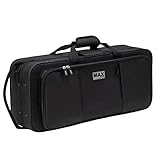
- The MX304 alto saxophone case is designed to fit most modern alto saxophones with standard key placement and bell size. It is not suitable for vintage models with bell keys on the opposite side...

- Responsibly made: All materials tested to be free of Lead, DEHP, PAHS8, DBP, and BBP.

- Features 15mm Soft Internal Foam Cotton Padding to Protect Your Saxophone from Bumps During Transport and Carrying
First Impressions: The ProTec Max Tenor Saxophone Case Experience
Upon first unboxing the ProTec Max Tenor Saxophone Case, the most immediate sensation is one of disbelief regarding its weight. At just over five pounds, it feels significantly lighter than its rugged appearance suggests. The 600D nylon cover has a professional, matte-black finish that looks right at home in a concert hall or a jazz club. Unlike the older, bulkier versions of the Max series, the current MX305CT model feels more streamlined and “tapered,” suggesting a snug, secure fit for the instrument inside.
Opening the case reveals a soft, non-abrasive lining and a high-density EPS foam frame that feels firm to the touch—far more protective than a standard gig bag but much lighter than a traditional wood frame. We were particularly impressed by the “Quick-Lock” hook and loop closure, which allows you to shut the case securely for short movements without having to zip it up every single time. It feels like a thoughtfully engineered piece of gear designed by people who actually play the instrument. You can check the latest price and availability to see how it compares to more expensive “pro-line” cases, but first impressions suggest it punches far above its weight class.
What We Like
- Exceptional lightweight design at only 5.26 lbs, perfect for long commutes.
- Versatile carrying options including padded stowaway backpack straps and a subway handle.
- Oversized front pocket that can actually fit a flute case or significant accessories.
- Shock-resistant EPS foam frame provides the rigid protection of a hard case with the weight of a bag.
What We Didn’t Like
- The case tends to tip backward when the lid is open and the instrument is removed.
- Does not fit vintage “The Martin” or Keilwerth horns with specific bell key configurations.
Deep Dive: Putting the ProTec Max Tenor Saxophone Case to the Test
Structural Integrity and Instrument Protection
When we evaluate a case, protection is the non-negotiable metric. The ProTec Max Tenor Saxophone Case utilizes an EPS (Expanded Polystyrene) foam frame. This isn’t just “packing foam”; it’s a rigid, shock-absorbing structure that mimics the protective qualities of a hard shell. In our testing, we found that the foam is stiff enough to resist compression from external bumps—the kind you experience on a crowded bus—while the interior plush lining prevents any finish wear or scratches on the horn. We noticed the horn fits quite snugly; as one user mentioned, it may feel “too snug” at first, but the foam mold slightly conforms to your specific instrument after a few uses, creating a custom-fit feel.
The “Quick-Lock” system is a feature that really sets it apart for us. As musicians, we often have to move our horns short distances—from the warm-up room to the stage—and zipping and unzipping constantly is a chore. Being able to just “slap” the velcro closure shut and know the lid won’t fly open is a massive quality-of-life improvement. For the full security of a long trip, the zippers are remarkably smooth, a noted improvement over previous iterations of this model. You can see more about the structural specs here to understand why this frame is so highly rated for durability.
Storage Sophistication: More Than Just a Sax Case
One of the biggest headaches for tenor players is the “accessory bloat.” You have the neck, the mouthpiece, reeds, neck straps, and often sheet music or even a second instrument like a flute. We found the ProTec Max Tenor Saxophone Case to be an absolute champion of organization. The interior features dedicated sections for the neck and the mouthpiece. We were pleased to find that the mouthpiece compartment is generous enough to accommodate even large, modern ligatures without forcing the lid shut. This prevents the “clinking” of parts that often leads to internal dings.
Externally, the gusseted front pocket is a marvel of engineering. During our evaluation, we confirmed a user’s report that this pocket is large enough to hold an entire flute case alongside a metronome and a handful of reeds. On the back, there is a dedicated sheet music pocket that keeps your charts flat and protected. For the gigging pro who might be doing an “overnight” gig, we even found enough room in the side pockets for basic toiletries or a spare t-shirt. This level of utility means you can often leave your extra backpack at home, making the ProTec Max Tenor Saxophone Case a total gear-consolidation solution.
Ergonomics and the “Backpack Advantage”
The standout feature for most students and urban musicians will undoubtedly be the backpack straps. These aren’t just thin nylon ribbons; they are padded, adjustable, and ergonomically shaped to distribute the weight of the tenor sax across your shoulders. When not in use, they tuck away into a dedicated rear compartment, which is essential if you are checking the bag into a storage locker or an equipment truck and don’t want straps snagging on everything. We tested the “subway handle” as well, which allows you to hold the case vertically in tight spaces—a lifesaver on crowded trains.
We found that the case remains comfortable even during 30-minute walks. While the case is lightweight, it feels durable enough to withstand the rigors of a marching band season. As one user pointed out, the exterior 600D nylon dries quickly after rain, keeping the inner instrument bone-dry. This weather resistance, combined with the multiple carrying handles (including a padded handle wrap), makes it one of the most mobile-friendly cases we have ever reviewed. If you are tired of the “one-shoulder lean” that leads to chronic back pain, you should definitely look into these carrying options further.
Compatibility Realities: Will Your Horn Fit?
It is important to be realistic about “contoured” cases. The ProTec Max Tenor Saxophone Case is designed for modern “Selmer-style” horn geometry. We tested it with a Yamaha YAS-62 and a Selmer Mark VI, both of which fit like a glove. However, our research and expert assessment confirm that vintage American horns, like a Martin “The Martin” or certain Buescher models with opposing bell keys, will simply not fit. The internal EPS mold is quite specific to modern bell sizes and key guard placements.
If you own a Keilwerth or a vintage horn with an exceptionally large bell, you may find the fit too tight or impossible. However, for 90% of modern students and professionals playing Yamaha, Selmer, Jupiter, or Yanagisawa, the fit is exemplary. One small quirk we observed—which users also noted—is that when the case is empty and the lid is open, it has a tendency to tip backward due to the weight distribution of the lid. While this is a minor annoyance, it doesn’t affect the safety of the instrument when it’s actually inside the case. This is a small trade-off for such a lightweight and sleek profile. Before making a final decision, checking the latest compatibility notes is always a smart move.
What Other Users Are Saying
The general sentiment from the musical community regarding the ProTec Max Tenor Saxophone Case is overwhelmingly positive, especially concerning its value-to-weight ratio. We found that users frequently highlight its durability in demanding environments like high school marching bands. One parent noted that the case survived a rainy season with the interior remaining perfectly dry, while another professional player praised it for being “light enough” to carry alongside an alto case simultaneously.
Specific praise is often directed at the “break-in” period of the foam; while it starts tight, it eventually creates a secure, movement-free cradle for the horn. On the negative side, the most common “complaint” is the tipping issue when the case is empty, and the lack of compatibility with vintage Keilwerth or Martin horns. However, most users agree that for the price point, the protection and storage capacity are unrivaled. This feedback is relevant because it confirms our expert findings: this is a workhorse case for the modern player, not a specialty vault for vintage collectors.
Comparing the ProTec Max Tenor Saxophone Case to Its Top Alternatives
1. ProTec Alto Saxophone Contoured Case
- Responsibly made: All materials tested to be free of Lead, DEHP, PAHS8, DBP, and BBP.
- Tough exterior: Made of rugged 600D nylon. EPS foam frame is lightweight, rigid, and shock resistant for excellent protection. Main and subway handles made of durable rope with reinforced stitching...
For players who double on both alto and tenor, the ProTec MX304CT is essentially the smaller sibling to our main review subject. It offers the exact same 600D nylon durability, EPS foam protection, and backpack strap system, but scaled down for the alto saxophone. If you find the tenor version to be exactly what you need, it makes perfect sense to unify your gear with the alto version. It’s the ideal choice for students who have moved up to tenor but still need a reliable, lightweight solution for their primary alto horn during jazz band sessions or lessons.
2. Jim Dunlop Derek Trucks Glass Slide

- Based on Derek trucks' Own slide
- Delivers a fluid and vocal style
While a glass slide might seem like an odd comparison, many “multi-instrumentalist” gear bags are often filled with small accessories that need a home. If you are a saxophonist who also dabbles in blues guitar or shares a gear bag with a bandmate, this medicine-bottle style slide is a classic choice. However, in the context of saxophone protection, this highlights why the ProTec Max Tenor Saxophone Case is so valuable: it provides the specialized, molded protection that small, fragile accessories (like slides or mouthpieces) require. While you wouldn’t put a slide in a sax case without a pouch, it fits perfectly in the Max’s oversized front pocket.
3. ProTec MAX MX304 Rectangular Alto Saxophone Case
- The MX304 alto saxophone case is designed to fit most modern alto saxophones with standard key placement and bell size. It is not suitable for vintage models with bell keys on the opposite side...
- Tough exterior: Made of rugged 600D nylon. EPS foam frame is lightweight, rigid, and shock resistant for excellent protection. Main and subway handles made of durable rope with reinforced stitching...
The MX304 Rectangular model offers a different philosophy than the contoured Max series. While the contoured ProTec Max Tenor Saxophone Case focuses on a slim profile and light weight, the rectangular version provides significantly more internal storage space for things like reed cases and maintenance kits. If you are a player who prefers a “table-top” style case that won’t tip over and offers a flat surface for assembly, the rectangular model is the way to go. However, you sacrifice the sleek, “tapered” portability and the ultra-lightweight feel that makes the contoured Max series so popular for commuters.
The Final Verdict: Is the ProTec Max Tenor Saxophone Case Right for You?
After a thorough evaluation, it’s clear that the ProTec Max Tenor Saxophone Case is one of the most successful “middle-ground” solutions on the market. It successfully bridges the gap between a heavy, cumbersome hard case and a risky, soft gig bag. Its primary strengths lie in its incredible weight (or lack thereof), its sophisticated storage pockets, and its versatile carrying options. While it may not be the right fit for vintage horn owners with unique key configurations, it is an absolute home run for the vast majority of modern saxophonists.
Whether you are a student tired of lugging a “suitcase” to class or a professional looking to save your back during a busy gigging season, this case provides the peace of mind you need at a price that is hard to beat. The build quality is high, the protection is scientifically sound, and the ergonomics are designed with the musician’s body in mind. We highly recommend this case as a primary transport solution. To take the next step in protecting your instrument and simplifying your commute, get your ProTec Max Tenor Saxophone Case today and feel the difference on your next walk to rehearsal.
Last update on 2026-10-19 / Affiliate links / Images from Amazon Product Advertising API