
Pioneer DJ DDJ-REV1 2-Deck DJ Controller Review: The Ultimate Battle-Style Entry Point?
For years, aspiring scratch DJs and open-format performers faced a significant hurdle: the gear gap. To get a layout that mirrored what the pros were using in competitions—specifically the classic combination of two turntables and a battle-style mixer—you usually had to shell out thousands of dollars for a high-end setup. We have seen countless beginners struggle with standard “club-style” controllers that, while functional, just didn’t feel right for the quick-cutting, crossfader-heavy style required for scratching. This disconnect often leads to frustration, as the muscle memory developed on a standard controller doesn’t always translate to professional setups. The search for a portable, affordable solution that doesn’t compromise on the traditional battle layout led us directly to the Pioneer DJ DDJ-REV1 2-Deck DJ Controller, a device that promises to bridge this gap without breaking the bank.

- Learn to Scratch the Right Way: An open, battle-style layout mirrors a classic turntable and battle mixer setup
- Start for Free: Unlocks Serato DJ Lite so you can plug in and begin performing straight away

What to Consider Before Buying a DJ Controller
Choosing a DJ controller is more than just an item; it’s a key solution for creative expression and technical development. For the modern DJ, the controller is the heart of the performance, acting as the interface between your musical intuition and the digital software. Whether you are aiming to play at local house parties, stream on platforms like Twitch, or eventually take the stage at major clubs, the right hardware determines how quickly you can master essential skills like beatmatching, EQing, and scratching. A poorly chosen controller can hinder your progress with unresponsive jog wheels or a cluttered layout that feels unintuitive during a high-pressure set.
The ideal customer for this type of product is someone facing the challenge of learning the ropes of open-format DJing, particularly those with an interest in hip-hop and scratching. It is also a fantastic choice for professional turntablists who need a reliable, lightweight backup unit for smaller gigs or practice sessions while traveling. On the other hand, it might not be suitable for those who strictly prefer the traditional club layout found on the CDJ/DJM series, as the orientation of the controls is fundamentally different. If you are focused solely on long-form electronic music transitions, you might find the battle-style layout more of a novelty than a necessity.
Before investing, consider these crucial points in detail:
- Dimensions & Space: Consider where you will be practicing and performing. A controller that is too large may not fit on a standard desk or in a backpack, while one that is too small might feel cramped during intense scratch sessions. The Pioneer DJ DDJ-REV1 2-Deck DJ Controller strikes a balance here, being compact enough for travel but wide enough to provide a spacious layout for your hands.
- Capacity & Performance: Look at the number of decks the controller can handle and the quality of the internal soundcard. Higher-bitrate soundcards (like the 24-bit/48 kHz found here) ensure that your audio remains crisp and professional, even when pushed through large PA systems. Also, check if the controller supports “4-deck” control via software toggles.
- Materials & Durability: Since DJ gear is often transported and subjected to heavy use, the build quality is paramount. While many entry-level controllers are plastic, the quality of that plastic and the reinforcement of the faders and knobs determine if the unit will last six months or six years. We always recommend checking if the crossfader feels “loose” enough for scratching but robust enough for longevity.
- Ease of Use & Maintenance: Software compatibility is the “hidden” cost of many controllers. A “plug and play” experience with industry-standard software like Serato DJ Lite or Pro is essential for beginners. Furthermore, check how the unit is powered; USB bus power is incredibly convenient as it eliminates the need for an external power brick, though it does draw from your laptop’s battery.
By keeping these factors in mind, you can ensure that your first or next controller purchase aligns with your long-term goals as a DJ. While the Pioneer DJ DDJ-REV1 2-Deck DJ Controller is an excellent choice, it’s always wise to see how it stacks up against the competition. For a broader look at all the top models, we highly recommend checking out our complete, in-depth guide:
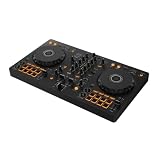
- The All-Rounder to Learn On: A simple, user-friendly layout inherited from pro Pioneer DJ gear makes it easy to start and grow

- Flagship Performance Controller: Built for serious hobbyists, mobile DJs, and pros who want a future-proofed open-format tool

- Closest Stepping Stone to the Club: A CDJ-3000 and DJM-A9 inspired layout builds muscle memory that transfers to the booth
First Impressions and the Bold Battle-Style Design
Unboxing the Pioneer DJ DDJ-REV1 2-Deck DJ Controller for the first time, I was immediately struck by its unique aesthetic. Most controllers in this price range attempt to look like mini-versions of professional club gear, but the REV1 goes in a completely different direction. It emulates the layout of two PLX turntables and a DJM-S series mixer. This means the pitch sliders are located at the top of the deck sections and positioned horizontally—a signature of “battle-style” setups where turntables are rotated 90 degrees to keep the tonearms out of the way of the performer’s hands.
The unit feels incredibly lightweight at just 5 pounds, yet the matte black finish gives it a professional, sleek appearance. When we first plugged it in, the LEDs were bright and clear, providing excellent visual feedback even in a dimly lit room. The jog wheels are noticeably larger than those on previous entry-level Pioneer models, which is a massive win for anyone serious about scratching. To get the most out of these hardware features, you should check the latest price and availability to see if this fits into your current studio budget. Comparing it to its predecessor, the DDJ-SB3, the REV1 feels more specialized and purposeful. It doesn’t try to be a “jack-of-all-trades” but instead masters the specific niche of open-format performance.
Key Benefits
- Authentic battle-style layout that mirrors professional competition setups.
- Tracking Scratch feature allows beginners to perform complex scratches with ease.
- Integrated microphone audio into the master output, perfect for live streaming.
- Large, responsive jog wheels that provide better control than standard entry-level decks.
Limitations
- Primary construction is high-grade plastic, which lacks the premium feel of metal.
- Includes Serato DJ Lite; a paid upgrade is required for the full “Pro” features.
A Deep Dive into the Performance of the Pioneer DJ DDJ-REV1 2-Deck DJ Controller
The Battle-Style Layout: A Game Changer for Scratching
The standout feature of the Pioneer DJ DDJ-REV1 2-Deck DJ Controller is undoubtedly its ergonomics. In our testing, the horizontal pitch sliders and the placement of the performance pads in the mixer section—rather than under the jog wheels—completely changed how we interacted with the music. For someone used to a traditional turntable setup, this layout feels like “coming home.” It opens up the space around the jog wheels, ensuring that you don’t accidentally trigger a hot cue or an effect while you’re in the middle of a vigorous scratch routine. We found that this configuration encourages a more physical, performance-oriented style of DJing.
Moreover, the vertical orientation of the mixer section mimics the professional DJM-S series. This isn’t just about looks; it’s about building the correct muscle memory. If you eventually move up to a professional setup like the DJM-S11, your hands will already know exactly where the EQs, filters, and crossfader are located. This makes the Pioneer DJ DDJ-REV1 2-Deck DJ Controller an incredible investment for your future skills. During our long practice sessions, we appreciated the tactile feedback of the knobs and the smooth glide of the crossfader, which felt surprisingly durable for a controller at this price point. One user review we analyzed echoed this, stating that the “old school look and feel” was exactly what they needed to get back into the groove of classic DJing.
Advanced Scratching Made Accessible: Tracking Scratch & Jog Wheels
Scratching is one of the most difficult skills to master in DJing, but the Pioneer DJ DDJ-REV1 2-Deck DJ Controller introduces a feature that acts as a “bridge” for beginners: Tracking Scratch. When activated, this feature automatically returns the track to your chosen cue point the moment you move the jog wheel backward or take your hand off it. This eliminates the need for perfect crossfader timing when you’re just starting out, allowing you to focus on the rhythmic movement of the platter. While some purists might scoff at “automated” features, we found it to be an excellent teaching tool that helps beginners understand the rhythm of scratches like the “transformer” or “flare.”
Supporting this feature are the jog wheels themselves. They are significantly larger than what you typically find on a controller of this size. This extra surface area is crucial for fine-tuned control. In our experience, the tension of the wheels is well-calibrated—not too loose that they spin out of control, and not too tight that they feel sluggish. We noticed that when we performed fast “baby scratches” and “tears,” the 24-bit soundcard kept the audio from distorting, preserving the sharp, percussive sound that scratch DJs crave. If you are looking to elevate your performance, you can see its full feature set and user reviews to understand why so many professional turntablists are picking this up as a secondary deck.
Streamer-Ready Audio and Lever FX
In the age of digital content, the ability to stream high-quality audio is paramount. The Pioneer DJ DDJ-REV1 2-Deck DJ Controller solves a common headache for streamers: microphone integration. Usually, getting your voice into a DJ stream requires an external mixer or complex software routing. However, the REV1 mixes the microphone audio directly into the master output within the hardware. This means your voice is sent to your computer via the same USB cable as your music, making it incredibly easy to talk to your audience while you play. We tested this with Serato DJ Lite and found the setup to be virtually instantaneous.
Complementing the audio features are the Lever FX. Instead of standard buttons to trigger effects, the REV1 uses paddles that you can pull down to apply effects momentarily or flick up to lock them in place. This is another feature pulled directly from high-end battle mixers. We found that using the levers felt much more organic and “musical” than tapping a button. It allows for dynamic “stabs” of echo or flanger that sync perfectly with the beat. It’s a feature that really sets it apart from the competition, and you can check its current pricing here to see how much value is packed into this 2-deck powerhouse.
Connectivity, Portability, and 4-Deck Control
Despite being labeled a “2-deck” controller, the Pioneer DJ DDJ-REV1 2-Deck DJ Controller has a hidden superpower: 4-deck control within Serato DJ Lite and Pro. By using the deck select buttons, you can switch the control of the left jog wheel from Deck 1 to Deck 3, and the right from Deck 2 to Deck 4. While it takes some practice to manage four decks on a two-channel mixer, it opens up massive possibilities for layering acapellas or loops over your main tracks. We found this especially useful for open-format sets where you might want to keep a transition tool ready on a third deck while mixing between two main songs.
The unit is entirely USB Type-B bus powered. We took it on a weekend trip and were able to practice in a hotel room using nothing but a laptop and a pair of headphones. There was no need to hunt for an extra power outlet, which is a major plus for mobile DJs. The 103 dB signal-to-noise ratio ensures that the output is clean enough for professional use, and we didn’t experience any noticeable latency during our testing. This reliability is why we consider it one of the best options for DJs who are always on the move. Whether you’re a seasoned pro looking for a “travel controller” or a beginner starting your journey, the REV1 provides a stable, professional platform.
What Other Users Are Saying
The general sentiment among users for the Pioneer DJ DDJ-REV1 2-Deck DJ Controller is overwhelmingly positive, particularly regarding its value-to-performance ratio. Many users highlight that it is the “best battle-style controller” available for those who don’t want to spend four figures on gear. One experienced vinyl turntablist noted that they bought it as a backup unit and were impressed by how the features are “amazing, easy to use, fun, and are plug and play.” This confirms our finding that the REV1 appeals to both ends of the skill spectrum.
However, the feedback isn’t without its critiques. Some users pointed out that the small size of the jog wheels—while large for this class—still can’t compare to full-sized 12-inch vinyl platters, making certain advanced techniques slightly more difficult. Another user mentioned receiving their unit without a USB cable, which highlights the importance of checking your package contents immediately upon arrival. Despite these minor gripes, the consensus is that for under $300, it is nearly impossible to find another controller that offers this specific battle-style layout and feature set. It’s widely regarded as the “go-to” for anyone serious about scratching on a budget.
Comparing the Pioneer DJ DDJ-REV1 2-Deck DJ Controller to Top Alternatives
1. Pioneer DJ DDJ-FLX4 2-Deck DJ Controller
The Pioneer DJ DDJ-FLX4 is the most direct internal competitor to the REV1. While the REV1 focuses on the battle-style layout and Serato users, the FLX4 is designed with a “club-style” layout that mimics the CDJ-3000 and DJM-900NXS2 setup. It is also compatible with both Rekordbox and Serato, making it a more versatile choice for those who haven’t committed to a specific software ecosystem yet. We recommend the FLX4 for DJs who want to eventually play in traditional club environments, whereas the REV1 is superior for scratch enthusiasts and open-format DJs who prefer the ergonomics of a battle mixer.
2. Numark Mixtrack Platinum FX 4-Deck DJ Controller

- Complete Serato DJ System - DJ Controller for Serato DJ Lite (Included) with 4 decks of control, built-in 24bit audio interface and plug and play USB connectivity for Mac and Windows
- Visualize Your DJ Mix - Large 6-inch capacitive-touch jog wheels with high-resolution color displays that show beats per minute (BPM), platter position, beats remaining and pitch adjustment or key
The Numark Mixtrack Platinum FX offers a different set of advantages. Its most striking feature is the inclusion of small high-resolution displays in the center of the jog wheels, showing BPM, time remaining, and deck position. For many, having this information on the hardware rather than the laptop screen is a huge benefit. Like the REV1, it features paddle triggers for effects. However, it follows the standard club layout. If you value visual feedback on the controller itself and don’t care about the battle-style orientation, the Numark is a very strong alternative that often sits in a similar price bracket.
3. Native Instruments Maschine Mikro Mk3 Drum Controller
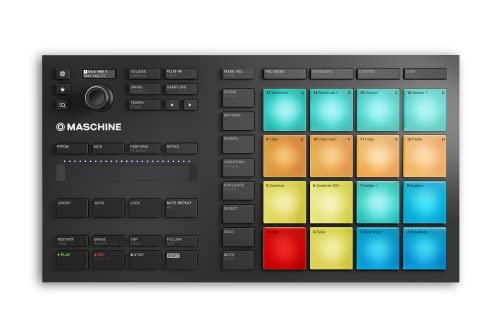
- Compact, music production instrument that integrates powerful software with tactile, responsive hardware
- Four ways to input sound using the 16 pads – drum in pad mode, play melodies in Keyboard mode, create chord progressions in Chord mode, and program in a classic step-sequencer style from Step mode
It’s important to note that the Native Instruments Maschine Mikro Mk3 is not a traditional DJ controller but rather a production and performance instrument. We include it here because many DJs are increasingly incorporating finger drumming and live beat-making into their sets. If your goal is to create music from scratch or perform live remixes rather than mixing existing tracks, the Maschine Mikro is the better tool. However, for traditional DJing, scratching, and crossfading, it lacks the jog wheels and mixer controls found on the Pioneer DJ DDJ-REV1 2-Deck DJ Controller. It’s a great companion piece, but not a replacement.
Final Verdict: Is the Pioneer DJ DDJ-REV1 2-Deck DJ Controller Right for You?
After extensive hands-on testing and analyzing the feedback from a wide range of users, the Pioneer DJ DDJ-REV1 2-Deck DJ Controller stands out as a unique and powerful entry into the world of DJing. Its primary strength lies in its specialized battle-style layout, which was previously unavailable at this price point. The inclusion of professional-grade features like Lever FX, Tracking Scratch, and integrated microphone audio makes it a powerhouse for both performers and streamers. While its plastic construction and the limitations of the “Lite” software are worth noting, they are minor trade-offs considering the incredible value provided. We found it to be reliable, intuitive, and, most importantly, incredibly fun to play on.
We recommend the Pioneer DJ DDJ-REV1 2-Deck DJ Controller to any beginner who wants to learn the art of scratching, as well as to seasoned professionals who need a portable, battle-ready backup unit. It successfully bridges the gap between affordable hobbyist gear and professional competition setups. If you’re ready to take your scratching and open-format skills to the next level with a layout that actually makes sense for your style, we suggest you grab the Pioneer DJ DDJ-REV1 2-Deck DJ Controller today and start your journey.
Last update on 2026-09-20 / Affiliate links / Images from Amazon Product Advertising API