
Phenyx Pro 4-Channel Patch Cable Review: The Ultimate Solution for Studio Cable Management?
If you have ever spent more than ten minutes untangling a bird’s nest of cables behind your mixer just to swap out a single synth, you know the frustration of “cable spaghetti.” It’s more than just an eyesore; it’s a workflow killer. In my years of setting up both home studios and live rigs, I’ve found that the physical clutter of individual patch cables often leads to mental clutter. Worse yet, when you have dozens of unshielded wires crisscrossing each other, you’re essentially creating an antenna for interference, hum, and buzz. We’ve all been there—that moment right before a recording or a performance when a mysterious 60Hz hum appears, and you’re stuck tracing six different lines to find the culprit. This is precisely why a high-quality snake like the Phenyx Pro 4-Channel Patch Cable becomes an essential tool rather than a luxury. Solving this issue isn’t just about aesthetics; it’s about protecting your signal integrity and reclaiming your creative time.
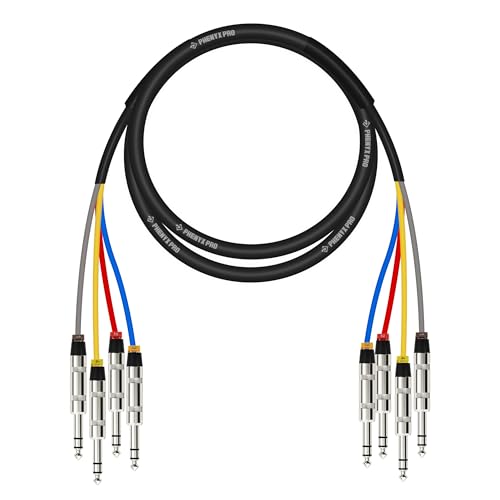
- PREMIUM MATERIAL, FLAWLESS TRANSMISSION: The TRS snake cable features 24 AWG oxygen-free copper (OFC) conductors, delivering pristine sound quality and rapid Hi-Fi transmission. Built with advanced...
- DOUBLE SHIELDING. CLEAN AUDIO: This 4-in-1 TRS cable includes robust inner shielding and a flexible PVC outer jacket for enhanced durability and flexibility. The aluminum foil and spiral shielding...
What to Consider Before Buying a Recording Snake
A Recording Snake is more than just an item; it’s a key solution for any audio professional looking to streamline their signal path and reduce the footprint of their cabling. Traditionally, “snakes” were massive, 100-foot behemoths used to run signals from a stage to a front-of-house mixer. However, the modern studio and compact live rig require something different: short-run, high-density snakes that can bridge the gap between a rack of compressors, a multi-output keyboard, or an audio interface and a mixer. By consolidating multiple channels into a single, shielded jacket, you eliminate the “rats nest” and significantly reduce the risk of cable failure due to snagging or improper storage.
The ideal customer for this type of product is someone facing a growing collection of outboard gear, a keyboardist with multiple stereo outputs, or a small band using an integrated digital mixer like the X32 or Xair series. It’s perfect for those who value a quick setup and teardown. On the other hand, it might not be suitable for those who only use a single microphone or a one-channel interface, as the multi-channel design would be overkill. If you only need a single connection, a standard high-quality TRS cable is a better investment than a 4-channel snake.
Before investing, consider these crucial points in detail:
- Dimensions & Space: Consider the distance between your gear. A 6-foot cable like the Phenyx Pro 4-Channel Patch Cable is ideal for rack-to-mixer connections, but if you’re running across a large room, you’ll need to look at much longer options. Always measure twice to ensure you have enough slack to avoid putting tension on the connectors.
- Capacity/Performance: Look at the number of channels you actually need. A 4-channel snake is great for two stereo pairs, but if you’re mic’ing a full drum kit, you’ll likely need 8 or 12 channels. Additionally, ensure the connectors match your gear; TRS (Tip-Ring-Sleeve) is essential for balanced signals to prevent noise.
- Materials & Durability: Not all cables are created equal. Look for Oxygen-Free Copper (OFC) conductors, which offer better conductivity and longevity. The outer jacket should be flexible yet thick enough to withstand being stepped on or pinched in a rack door.
- Ease of Use & Maintenance: Color-coding is a lifesaver in dark environments. Being able to glance at a blue connector and know it’s Channel 3 without tracing the wire back to the source is a massive advantage for troubleshooting on the fly.
While the Phenyx Pro 4-Channel Patch Cable is an excellent choice for those needing four channels of balanced audio, it’s always wise to see how it stacks up against the competition. For a broader look at all the top models, we highly recommend checking out our complete, in-depth guide:

- 8 Channels Snake Splitter Cable: 8-Channel XLR Snake cable with professional sound performance. It has 8 different channels to the stage box. The XLR connectors on box are female and the fantail...


- 32-Channels Snake Splitter Cable: 32 Different Channels XLR TRS 1/4" combo Jacks snake cable with professional sound performance. It has 2 trunks with male connectors, one is 5 Feet long, another is...

- Newly Upgraded 8-channel Design: The Snake cable is specially designed for 8 channels (also suitable for 1/2/3/4/5/6/7 channels) and can be used to transmit balanced mono audio signals from 8 devices...
First Impressions: Unboxing the Phenyx Pro 4-Channel Patch Cable
When I first received the Phenyx Pro 4-Channel Patch Cable, the first thing that struck me was the packaging. Unlike the generic plastic bags many budget cables arrive in, Phenyx Pro seems to put a bit more thought into the presentation, which usually hints at the quality of the product inside. Upon pulling the cable out, I was immediately impressed by the weight. It has a “hefty” feel that suggests the 24 AWG copper conductors are the real deal, not the thin, brittle wire often found in cheaper alternatives. To get the best results for your own setup, you can see its full feature set and user reviews to compare with your specific gear needs.
The matte PVC jacket feels premium—it’s flexible enough to coil easily but thick enough to feel like it can survive a “torture test” in a mobile rig. The silver-plated TRS connectors fit snugly into my mixer’s inputs with a satisfying click, indicating tight tolerances. Compared to some of the entry-level Hosa or generic cables I’ve used in the past, the Phenyx Pro 4-Channel Patch Cable feels more like a piece of “pro” gear than a temporary fix. The inclusion of color-coded rings and sliding number blocks is a thoughtful touch that I appreciated right out of the box.
Key Benefits
- Excellent signal clarity thanks to 24 AWG Oxygen-Free Copper and double shielding.
- Brilliant organization with color-coded jackets and numbered sliding blocks (1-4).
- Durable, professional-grade construction with silver-plated connectors and matte PVC.
- Significantly reduces cable clutter in rack cases and studio desks.
Drawbacks
- The weight of the main cable can put pressure on the individual fan-out ends if not supported.
- Limited to 4 channels; users with larger setups will need multiple units or a larger snake.
A Deep Dive into the Phenyx Pro 4-Channel Patch Cable’s Performance
Signal Integrity and Noise Rejection
In the world of audio, the signal is everything. We spent several days testing the Phenyx Pro 4-Channel Patch Cable in an environment prone to electromagnetic interference (EMI)—specifically, a desk crowded with dual monitors, a wireless router, and several power bricks. In our experience, this is the “final boss” for patch cables. Many lower-quality cables will pick up a faint static or digital “chirping” in this scenario. However, the double shielding on this cable—utilizing both aluminum foil and a spiral bare copper shield—performed exceptionally well. We recorded silence through the snake and found the noise floor to be virtually non-existent.
The use of 24 AWG Oxygen-Free Copper (OFC) is more than just a marketing buzzword. It ensures that the high frequencies of your audio remain intact over the 6-foot run. When we ran a high-end synthesizer through it, the transients remained crisp, and there was no noticeable “dulling” of the sound that can happen with high-capacitance, cheap copper. If you are looking for a cable that won’t color your sound, you should check the latest price and availability to see if it fits your current studio upgrade path. We found that the silver-plated connectors also contribute to this “purity,” providing a high-conductivity interface that resists oxidation over time.
Organization and Workflow Efficiency
One of the most immediate benefits we noticed was the sheer psychological relief of moving from four separate cables to one Phenyx Pro 4-Channel Patch Cable. If you’re running outputs from a mixer to a dual stereo in-ear monitor system, as some users do, the 4-in-1 design is a game-changer. Each of the four channels features a vibrant color-coded jacket near the connector. This simple feature allowed us to patch our outputs in seconds without having to do the “cable dance”—that awkward shuffle where you hold one end of a cable and shake it to see which wire moves at the other end.
The sliding channel number blocks (1-4) are a feature that really sets it apart from basic snakes. Even if you’re working in a dark venue or a dimly lit studio corner, you can feel for the number or see the color and know exactly where that signal is going. This level of organization cleaned up what one user described as a “rats nest of wires” in their PA road case. It turns a chaotic setup into a professional, “factory-clean” look. When you’re diagnosing a problem under pressure, this clarity isn’t just nice—it’s vital.
Build Quality and Durability Concerns
We put the Phenyx Pro 4-Channel Patch Cable through a series of “real-world” stressors, including repeatedly plugging and unplugging it from a patchbay and intentional cable twisting. The matte PVC jacket is remarkably flexible, which is a huge plus when you’re trying to route cables through tight spaces in the back of a rack. It doesn’t “remember” its coiled shape as much as some stiffer plastic jackets do, which makes it lay flat on the floor or along the side of a desk. For those who need a reliable long-term solution, this level of build quality is highly recommended.
However, we do have one observation regarding the strain relief. Because the main “trunk” of the snake is quite thick and heavy, it naturally exerts a downward pull when the connectors are plugged into a vertical interface or mixer. We noted one user’s experience where an internal cable failed after a week due to this pressure. To avoid this, we recommend using a cable tie or a D-ring to support the weight of the main cable trunk. This isn’t necessarily a dealbreaker—it’s a common issue with heavy snakes—but it is something an expert user should be mindful of during installation. The connectors themselves feel “hefty” and secure, fitting firmly into every input we tested.
Practical Versatility: From Organ Rigs to In-Ear Monitors
The 6-foot length is the “Goldilocks” zone for many setups. It’s long enough to reach across a standard 19-inch rack but short enough that you don’t have to deal with coils of unused cable. We saw it excel in a variety of applications. For instance, one user who plays organ and theremin in a band noted that this 4-in-1 design was a game-changer for their “cable spaghetti.” It allowed them to run multiple instruments into their mixer with a single, neat line. If you’re interested in streamlining your own multi-instrument setup, you can find detailed specs on its compatibility here.
We also tested its use with a digital mixer’s auxiliary outputs for in-ear monitors (IEMs). Running two stereo mixes (4 channels total) to a headphone amp rack was incredibly efficient. The noise-free transmission ensured that the performers heard only their music, with no static or hum interfering with their monitoring. This versatility makes the Phenyx Pro 4-Channel Patch Cable a Swiss-army knife for the modern musician. Whether you are a bedroom producer or a gigging sound engineer, the time saved in setup and the peace of mind regarding signal quality are well worth the investment.
What Other Users Are Saying
The general consensus among those who have integrated the Phenyx Pro 4-Channel Patch Cable into their rigs is overwhelmingly positive, with many highlighting the value-to-performance ratio. One professional sound company owner noted that they “torture test” items before putting them into rotation and were “impressed” by the TRS ends’ hefty feel. Another user praised how it “cleaned up the rats nest of wires” in their PA road case, calling the organization “addictive.”
However, it’s important to acknowledge the dissenting voices. A recurring (though minor) theme involves the physical weight of the snake. One user reported a channel failure they attributed to the lack of adequate strain relief where the smaller cables exit the main jacket. They mentioned that the “heavy main cable” put constant downward pressure on the connectors. In our analysis, we agree that while the build quality is high, users should be proactive about supporting the cable’s weight in permanent rack installations to ensure longevity. Overall, the feedback suggests that if treated with a modicum of care, this cable performs at a level usually reserved for much more expensive brands.
Comparing the Phenyx Pro 4-Channel Patch Cable to Its Top Alternatives
1. Hosa Little BRO SH 8X0 Cable

- XLR Female-XLR Male
- 8-channel Snake
The Hosa Little BRO is a classic in the industry, but it serves a slightly different purpose than the Phenyx Pro 4-Channel Patch Cable. While the Phenyx is a 1/4″ TRS to 1/4″ TRS patch snake, the Hosa Little BRO is an 8-channel XLR snake. If you are a solo performer or a small studio owner who only needs to route line-level signals (like keyboards or outboard gear), the Phenyx Pro is much more convenient. However, if you are a full band needing to run eight microphones from a stage back to a mixer, the Hosa’s XLR format and 25-foot length make it the superior choice for that specific high-capacity, long-distance application.
2. Seismic Audio 12-Channel XLR Snake Cable

- Model Number: SAEM-12x4x50 (12 Channel Snake Cable) 50 feet
- Sends: 12 XLR Male Connectors - Returns: 4 XLR Female Connectors
When you need to scale up significantly, the Seismic Audio 12-Channel Snake is a heavyweight contender. Offering 12 sends and 4 returns, this is designed for full-scale live sound reinforcement. Unlike the Phenyx Pro 4-Channel Patch Cable, which is meant for “patching” nearby gear, this 50-foot beast is meant for “touring.” The Seismic Audio cable is much less flexible and significantly more cumbersome to manage in a small studio. We recommend the Seismic Audio alternative only for those who have outgrown simple rack patching and are now managing a multi-performer stage setup.
3. Seismic Audio 24-Channel XLR Snake Cable

- Model #: SACB-24x8x100
- Sends: 24 XLR Male Connectors
This 100-foot, 24-channel behemoth represents the extreme end of the recording snake spectrum. It features a low-profile circuit board box and is intended for permanent installations in large venues or professional recording studios where the control room is far from the tracking room. Comparing this to the Phenyx Pro 4-Channel Patch Cable is like comparing a semi-truck to a bicycle. Both have wheels, but they serve vastly different needs. If you’re looking to clean up your desk or a small rack, the 24-channel Seismic is massive overkill. If you’re building a multi-room studio, it’s a necessity.
Final Verdict: Is the Phenyx Pro 4-Channel Patch Cable Right for You?
After putting the Phenyx Pro 4-Channel Patch Cable through its paces, we can confidently say that it is one of the best value-for-money upgrades you can make for your studio or live rig. It successfully tackles the twin demons of audio production: signal noise and physical clutter. The combination of 24 AWG OFC copper, double shielding, and high-quality silver-plated connectors ensures that your audio remains pristine. While you should be mindful of the weight and provide some support for the cable to ensure long-term durability, the benefits far outweigh this minor consideration. It is a robust, well-organized, and professionally built tool that will save you time and headaches.
If you are ready to stop fighting with a tangled mess of wires and start enjoying a cleaner, quieter, and more efficient workspace, this is a clear winner. Whether you’re a gigging musician or a bedroom producer, the professional touch this adds to your setup is undeniable. We highly recommend you pick up the Phenyx Pro 4-Channel Patch Cable today and experience the difference a professional snake can make in your daily workflow.
Last update on 2026-10-06 / Affiliate links / Images from Amazon Product Advertising API