
Orange Terror Stamp Guitar Amplifier Review: The Pint-Sized Powerhouse for Your Pedalboard
For decades, the standard for “real” guitar tone involved hauling a forty-pound head and a hundred-pound cabinet into a van, hoping the venue had a stage large enough to accommodate the rig. I’ve been there—sweating through load-ins and dealing with sound engineers who constantly tell me to “turn it down” because my 50-watt tube amp doesn’t wake up until the windows are rattling. The problem is clear: we want that authentic, saturated valve tone, but our backs and modern stage volume requirements demand something smaller. If you’ve ever tried to bring a full stack to a small church gig or a coffee house set, you know the struggle of trying to get a decent sound at “1” on the volume knob. It sounds thin, fizzy, and uninspiring. This is exactly why the Orange Terror Stamp Guitar Amplifier caught my eye. It promises to solve the “heavy lifting” problem without sacrificing the legendary Orange grit we crave.
Without a solution like this, many guitarists find themselves relying on digital modelers that, while convenient, sometimes lack the physical “push” and tactile response of a real amplifier. Others try to use distortion pedals directly into a PA system, resulting in a sterile, “bees-in-a-can” sound that lacks the harmonic complexity of a vacuum tube. We needed something that bridged the gap between a traditional amp head and a portable pedalboard-friendly format. When I first held the Orange Terror Stamp Guitar Amplifier, I realized the game had changed. It’s not just a pedal; it’s a fully functional 20-watt hybrid engine designed to live at your feet.
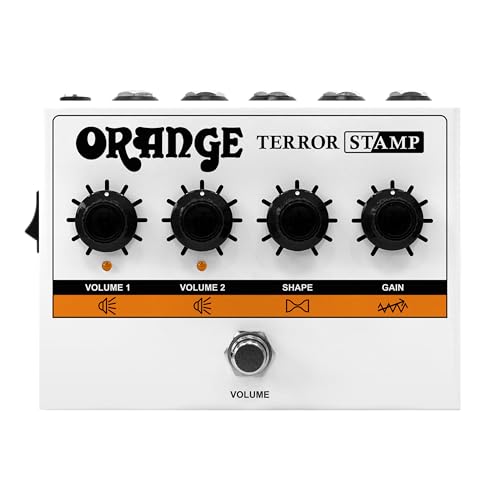
- 20W Hybrid Guitar Amplifier Head with Shape Control
- Cab Sim Headphone Output

Choosing the Right Electric Guitar Amplifier Head: A Comprehensive Buyer’s Guide
Selecting an Electric Guitar Amplifier Head is more than just an item; it’s a key solution for your entire signal chain and defines your sonic identity. The amplifier is the heart of your sound; it takes the weak signal from your pickups and transforms it into the air-pushing force that moves an audience. A high-quality head provides the headroom for your pedals to shine, the EQ controls to fit into a mix, and the reliability to survive the rigors of travel. Whether you are playing blues, metal, or ambient soundscapes, the way your amp interacts with your guitar is the most crucial relationship in your gear setup.
The ideal customer for this type of product is someone facing the challenges of limited space, frequent travel, or the need for a reliable backup. It’s perfect for the gigging professional who wants to keep their stage volume low while using in-ear monitors, or the bedroom player who needs a “real” amp sound through headphones. However, it might not be suitable for those who require 100 watts of pure tube headroom for massive outdoor festival stages without PA support. If you need a pristine, jazz-clean tone at ear-splitting volumes, you might consider a larger solid-state or high-wattage tube head instead.
Before investing, consider these crucial points in detail:
- Dimensions & Space: In the world of pedalboard-integrated amps, every square inch matters. You want a unit that provides maximum power without displacing your favorite delay or reverb pedals. Look for a compact footprint that uses standard power connections if possible, though some high-wattage units require dedicated supplies.
- Capacity/Performance: 20 watts might sound small, but in a hybrid configuration, it’s remarkably loud. Consider the speaker cabinets you’ll be driving; a 20W head can easily push a 1×12 or even a 4×12, but the efficiency of the speakers will dictate your final volume and headroom.
- Materials & Durability: Since this unit will be on the floor, it must be built like a tank. A metal enclosure is non-negotiable for a “stomp” style amp. Check the quality of the foot-switches and the feel of the potentiometers, as these are the points most likely to fail under heavy use.
- Ease of Use & Maintenance: A complicated interface can be a nightmare on a dark stage. Look for intuitive controls that allow for quick adjustments. Additionally, consider the maintenance of the hybrid system—vacuum tubes like the 12AX7 eventually need replacement, so ease of access to the internal components is a plus for long-term ownership.
Understanding these factors will help you narrow down the vast field of amplifiers. While the Orange Terror Stamp Guitar Amplifier is an excellent choice, it’s always wise to see how it stacks up against the competition. For a broader look at all the top models, we highly recommend checking out our complete, in-depth guide:
Our Definitive Rankings of the Top Electric Guitar Amplifier Heads for Every Style and Budget
- Channel Switching & Independent Control: The BanTamp XL series features a dedicated footswitch for channel switching and six knobs. This allows you to independently control both the CLEAN and...

- Channel Switching & Independent Control: The BanTamp XL series features a dedicated footswitch for channel switching and six knobs. This allows you to independently control both the CLEAN and...
First Impressions and the “Tiny Terror” Heritage: Unboxing the Orange Terror Stamp
When I first pulled the Orange Terror Stamp Guitar Amplifier out of its packaging, I was immediately struck by the weight. Despite its small 5.28-inch width, it feels incredibly dense and substantial—a hallmark of Orange’s “built for the road” philosophy. The classic orange and white livery is present, and the “Shape” and “Volume” icons are instantly recognizable to any fan of the Terror series. It’s a hybrid design, meaning it houses a genuine 12AX7 vacuum tube in the preamp section, paired with a 20-watt Class AB solid-state power amp. This is the same winning formula used in the Micro Terror and Micro Dark heads, but flattened into a pedal format.
Initial setup was a breeze. Unlike many digital “amp-in-a-box” pedals that require menu diving, the Stamp is purely analog in its interface. There are no screens, no hidden global settings, and no firmware updates required. You plug your guitar into the input, your cabinet into the speaker out, and you’re ready to rock. We found that it fits comfortably on a standard Pedaltrain board, though you’ll want to make sure you have room for its included power supply, which is a bit chunky but necessary to provide the voltage required for the internal tube. Comparing it to previous “Terror” heads, the Stamp feels more integrated into a modern workflow, especially with the addition of the second master volume control.
Key Benefits
- Genuine 12AX7 tube preamp provides authentic warm, harmonic saturation.
- Dual master volume controls allow for a footswitchable “boost” for solos.
- Integrated Cab Sim headphone output is perfect for silent practice and recording.
- Buffered effects loop ensures your time-based pedals sound crystal clear.
Limitations
- The single “Shape” knob lacks the precision of a full 3-band EQ.
- At very high gain settings, there is a noticeable noise floor common to tube circuits.
A Deep Dive into the Orange Terror Stamp Guitar Amplifier’s Performance
The Hybrid Engine: 12AX7 Warmth Meets 20W Power
The heart of the Orange Terror Stamp Guitar Amplifier is its hybrid architecture. We’ve tested many solid-state amps that claim to mimic tube feel, but there is simply no substitute for having an actual vacuum tube in the signal path. When we engaged the gain, we could feel that familiar “sag” and compression that defines the Orange sound. The 12AX7 preamp tube isn’t just for show; it’s the primary source of the unit’s drive. As you turn up the gain, the sound transitions from a chimey, British clean to a hairy crunch, and finally into a thick, saturated fuzz-like distortion that Orange is famous for.
In our testing, the 20-watt power section proved to be surprisingly gutsy. We hooked it up to a 4×12 cabinet loaded with Celestion Vintage 30s, and it moved enough air to keep up with a heavy-hitting drummer. This aligns with user feedback suggesting it has “plenty of power to push the cabinet.” It’s important to note that because it’s a Class AB solid-state power amp, it stays relatively clean as you increase the volume, allowing the tube preamp’s character to remain the star of the show. We found this especially useful when using it as a “clean platform” for other drive pedals, where the 12AX7 adds a layer of warmth that purely solid-state pedals often lack.
The “Shape” of Your Sound: Simplifying the EQ
The Orange Terror Stamp Guitar Amplifier uses a single “Shape” control instead of the traditional Bass, Middle, and Treble knobs. Initially, I was skeptical—how much control can one knob really provide? However, after spending several hours twisting it, I realized the genius of its design. At the far left, you get a mid-forward, vintage-leaning tone that is perfect for classic rock and blues. As you turn it toward the right, it implements a sophisticated “mid-scoop” while simultaneously boosting the lows and highs. This makes the Orange Terror Stamp Guitar Amplifier incredibly versatile for shifting between genres on the fly.
We found that at the 12 o’clock position, the tone is balanced and works well for most “indie” and alternative sounds. Users have noted that while the onboard shaping is limited with one knob, the tones are “easy enough to dial in.” If you are a player who needs to surgically remove a specific frequency at 400Hz, you might need an EQ pedal in the loop. But for the guitarist who wants to plug in and find a “good” sound in five seconds, the Shape control is a godsend. It effectively manages the complex relationship between frequencies so you can focus on playing rather than tweaking.
Mastering the Stage: The Dual Volume and Effects Loop
One of the standout features that sets the Orange Terror Stamp Guitar Amplifier apart from its “Micro” siblings is the dual master volume. This was a stroke of brilliance from the Orange engineering team. The footswitch on the unit doesn’t change channels; it toggles between Volume 1 and Volume 2. This allows you to set a rhythm level and a lead level, effectively giving you a built-in solo boost. We found this incredibly useful in a live setting, where cutting through the mix for a few bars is essential. One clever user even suggested setting Volume 2 to zero to use the footswitch as a “system mute,” which is a brilliant workaround for noisy stages.
The buffered effects loop is another high-end feature packed into this small chassis. Many small amps skimp on the loop or use a non-buffered version that sucks the life out of your signal. On the Stamp, we ran a complex chain of delays and reverbs through the loop, and the signal remained robust and vibrant. Because the loop is placed after the preamp tube but before the power section, your time-based effects aren’t distorted by the 12AX7. This makes the Orange Terror Stamp Guitar Amplifier a perfect hub for a comprehensive pedalboard setup.
Connectivity: Silence, Studio, and Speakers
In our modern era, an amp needs to be more than just a loud box. The Orange Terror Stamp Guitar Amplifier includes a dedicated Cab Sim headphone output that emulates a 4×12 Orange cabinet. We tested this for late-night practice sessions and found it to be one of the better analog cabinet simulators on the market. It doesn’t have the “lifeless” quality often found in budget sims, though, as one user correctly pointed out, adding a touch of reverb in the effects loop makes the headphone experience feel much more “three-dimensional.”
The speaker output is 8/16 ohm compatible, giving you the flexibility to plug into almost any standard cabinet. We even tried running it directly into a DAW using the Cab Sim output as a line out. While it doesn’t replace a high-end IR loader, it’s more than capable of capturing high-quality demos or providing a reliable DI signal to a front-of-house mixer. This makes it an ideal tool for church players who need to “eliminate dragging a half stack around” and just want a consistent tone through the PA system. You can see its full feature set and user reviews to see how others are integrating it into their silent stages.
What Other Users Are Saying
The consensus among the guitar community is that the Orange Terror Stamp Guitar Amplifier is a “little monster” that punches way above its weight class. One user who primarily plays at church mentioned that they were looking for a way to keep stage volume down while maintaining the Orange sound they loved. They found that the Stamp “sounds great and is more controllable than an amp,” especially when running into a 4×12 cabinet. Another veteran player with a 19-pedalboard build praised the “impeccable fit and finish,” using it as a clean power amp for various “Orange-flavored” drive pedals.
However, it’s not without its critics. A few users noted a “noise floor with any decent gain setting,” which is a common characteristic of high-gain tube circuits but something to be aware of if you play in very quiet environments. Another user mentioned that the “line out” was a bit weak compared to the speaker out. These negative points are relatively minor when weighed against the unit’s price and portability. Most users agree that the value for money is exceptional, with one reviewer stating it’s “worth double the price to be honest.” This balanced feedback confirms our findings: it’s a rugged, toneful tool that excels in specific, modern use cases.
Comparing the Orange Terror Stamp Guitar Amplifier to Top Alternatives
While the Stamp is a unique beast, there are other compact heads in the Orange family and beyond that might better suit your specific needs. It’s always worth comparing the Orange Terror Stamp Guitar Amplifier to these popular alternatives before making your final decision.
1. Orange Micro Dark Terror 20W Guitar Amp Head

- Power: 20Watt (hybrid)
- Tube: one 12AX7 (preamp)
The Micro Dark is the Stamp’s closest cousin. It features the same 12AX7 hybrid design but in a traditional “mini head” format rather than a pedal. The main difference lies in the gain structure; the Micro Dark is voiced for much higher gain and aggressive metal styles, featuring a matte black aesthetic. If you don’t need the footswitchable volume of the Stamp and prefer a head that sits on top of your cabinet, the Micro Dark is a fantastic alternative. However, for pedalboard integration, the Stamp’s form factor is far superior.
2. JOYO Zombie-II 20W Mini Tube Guitar Amp
- Channel Switching & Independent Control: The BanTamp XL series features a dedicated footswitch for channel switching and six knobs. This allows you to independently control both the CLEAN and...
- Versatile High-Gain Platform & Clean Pedal Foundation: The ZOMBIE-II excels at lower gain settings and responds brilliantly to your favorite overdrive pedals, letting you push into higher gain with...
The JOYO Zombie-II is a strong competitor from the BanTamp XL series. Like the Orange, it uses a 12AX7 tube, but it offers two distinct channels (Clean and Overdrive) with independent controls. It also includes Bluetooth connectivity for jamming along to backing tracks. While the JOYO offers more features for a lower price point, it lacks the rugged “stompbox” build quality of the Orange and the specific “British” growl that Orange is famous for. It’s a great choice for budget-conscious metal players, but lacks the professional, “road-ready” feel of the Stamp.
3. Orange Micro Terror 20W Hybrid Amp Head

- Power: 20 watt (hybrid)
- Tube: 1 12AX7 tube preamp with solid state power amp
The original Micro Terror is the amp that started the hybrid revolution. It’s the simplest of the bunch, with just Volume, Tone, and Gain. It lacks the “Shape” control and the effects loop of the Stamp. While it’s slightly more affordable, the lack of an effects loop is a major drawback for modern players who use delay and reverb. We recommend the Orange Terror Stamp Guitar Amplifier over the original Micro Terror for almost everyone, as the added features (loop, dual volume, cab sim) are well worth the small price increase.
The Final Verdict: Is the Orange Terror Stamp the Ultimate Gigging Tool?
After putting the Orange Terror Stamp Guitar Amplifier through its paces, we can confidently say it’s one of the most practical pieces of gear for the modern guitarist. It successfully shrinks the “Terror” DNA into a package that fits in a gig bag pocket. Its strengths lie in its authentic tube feel, its incredible volume-to-size ratio, and the thoughtful inclusion of a footswitchable volume boost. While the single-knob EQ might be a limitation for some, and the noise floor at high gain requires a noise gate for high-gain aficionados, these are small trade-offs for such a portable powerhouse.
We recommend the Stamp to any guitarist who is tired of hauling heavy amps, players who need a bulletproof backup for their main rig, and church musicians who need a high-quality “silent” solution. It’s a rugged, great-sounding, and affordable way to get real valve tone onto your pedalboard. If you’re ready to simplify your setup without sacrificing your sound, you should definitely check the latest price and availability of this incredible little amp and see why it’s becoming a staple on boards around the world.
Last update on 2026-09-19 / Affiliate links / Images from Amazon Product Advertising API