
Novazylum 4-Channel TRS to XLR Snake Cables Review: The Ultimate Studio Cable De-Clutterer?
If you have ever spent forty minutes tracing a single dead line through an absolute rat’s nest of cables behind your studio rack, you know the frustration of poor cable management. In both home recording studios and live sound venues, cable clutter is more than just an eyesore—it is a hazard to your gear, a major source of electromagnetic hum, and a massive waste of valuable setup time. When you are running multiple individual lines for stereo keyboard rigs, multi-channel headphone amps, or out of the back of digital mixing consoles, the physical chaos multiplies instantly.
Solving this cable chaos requires grouping your signals into neat, high-fidelity runs. This is where the Novazylum 4-Channel TRS to XLR Snake Cables come into play. Designed to consolidate four separate balanced lines into a single, highly flexible outer jacket, this two-pack of three-foot snakes promises to clean up your signal paths while maintaining absolute audio purity. Let’s dive deep into whether these compact snake cables deserve a permanent place in your audio setup.
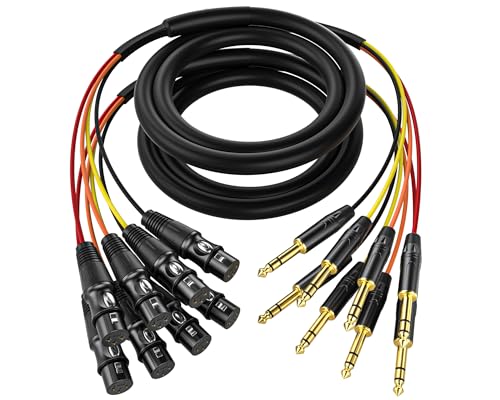
- [Upgraded 4-Channel Design]Professional 4-channel XLR to 1/4 TRS snake cable carries multiple balanced signals through one cable, reducing clutter and saving space. Ideal for studio, stage, or live...
- [Noise-Free Audio Performance]24AWG oxygen-free copper conductors with foil and braided shielding minimize EMI and RFI interference, delivering clear, high-fidelity sound for professional recording...
What to Consider Before Buying a Recording Snake
A Recording Snake is more than just an item; it’s a key solution for clean signal paths, minimal interference, and rapid setup times in both studio and live sound applications. Instead of running several distinct cables from your instruments to your audio interface or mixer, a snake groups them together, providing shielding against external noise and preventing physical tangling.
The ideal customer for this type of product is someone facing high cable density behind audio interfaces, rackmount gear, or live mixing consoles, while it might not be suitable for those who need massive, stage-wide passive splitters over fifty feet or those who only need to connect a single microphone. For close-quarters patching, short snake cables are the golden standard for organizing complex, multi-channel connections without adding unnecessary line length and signal degradation.
Before investing, consider these crucial points in detail:
- Dimensions & Space: The length of your snake cable is critical. For patch bays, rack gear, and desk-to-interface connections, a short 3-foot cable like the Novazylum 4-Channel TRS to XLR Snake Cables is ideal because it prevents slack from piling up behind your desk. However, if you need to run signals from a live stage back to a front-of-house mixer, you will require much longer runs.
- Capacity/Performance: Always calculate how many channels you need to run simultaneously. A 4-channel snake provides an excellent balance between physical bulk and signal count, especially when sold in multi-packs, allowing you to scale up to 8 channels without dealing with a massive, heavy-gauge 24-channel trunk cable.
- Materials & Durability: Look for oxygen-free copper (OFC) conductors, heavy shielding (like copper spiral or foil), and robust connector casings. Since snake cables carry multiple signals in a single bundle, high-quality shielding is paramount to prevent crosstalk—the bleeding of one audio signal into an adjacent channel.
- Ease of Use & Maintenance: Color-coded channels and clearly labeled connectors are absolute lifesavers when you are crawling behind a dark rack. Flexible outer jackets that resist kinking and high-quality molded stress reliefs ensure that the internal solder joints remain intact even after years of tight bends.
By keeping these parameters in mind, you can select an audio snake that perfectly matches your setup requirements without overpaying for channels or length you don’t actually need.
While the Novazylum 4-Channel TRS to XLR Snake Cables is an excellent choice, it’s always wise to see how it stacks up against the competition. For a broader look at all the top models, we highly recommend checking out our complete, in-depth guide:
Our Complete Guide to the Best Audio Snakes for Home Recording Studios

- 16-Channels Snake Splitter Cable: 16 Different Channels XLR TRS 1/4" combo Jacks snake cable with professional sound performance. It has 2 trunks with male connectors, one is 5 Feet long, another is...

- Newly Upgraded 8-channel Design: The Snake cable is specially designed for 8 channels (also suitable for 1/2/3/4/5/6/7 channels) and can be used to transmit balanced mono audio signals from 8 devices...

- 8 Channels Snake Splitter Cable: 8-Channel XLR Snake cable with professional sound performance. It has 8 different channels to the stage box. The XLR connectors on box are female and the fantail...
First Impressions and Key Features of the Novazylum 4-Channel TRS to XLR Snake Cables
Unboxing the Novazylum 4-Channel TRS to XLR Snake Cables immediately reveals that this is not a cheap, flimsy budget option. The package includes two identical 3-foot snake cables, each carrying four distinct color-coded balanced lines, along with a handy Velcro cable wrap for extra neatness. The physical build of these snakes is exceptionally reassuring; the main trunk is wrapped in a thick, matte PVC jacket that feels incredibly flexible, yet tough enough to withstand being squeezed behind tight equipment racks.
The connector housings are constructed from solid metal, providing excellent shielding and mechanical protection at the critical transition points. The 1/4″ TRS male plugs feature precision-machined tips that seat firmly into jacks with a reassuring click, while the female XLR connectors are equipped with self-locking latches that prevent accidental disconnections. To help you manage your signal flow, the individual channel leads are color-coded in vivid blue, green, yellow, and red/orange, allowing you to map out your patch paths in seconds without having to read tiny printed numbers.
Advantages
- Highly flexible and resilient PVC outer jacket that routes easily through tight rack corners.
- Double shielding (cotton yarn wrap plus copper spiral) effectively eliminates EMI and crosstalk.
- Bright, color-coded connector boots make channel identification instantaneous and error-free.
- Two-pack configuration offers outstanding value, providing eight total balanced lines.
Limitations
- The 3-foot length is strictly optimized for close-range patching; not suitable for long stage runs.
- XLR Female to TRS configuration is directional, meaning you must ensure your gear outputs to TRS and inputs to XLR.
Deep Dive: Performance, Signal Integrity, and Usability
To truly evaluate the performance of the Novazylum 4-Channel TRS to XLR Snake Cables, we integrated them into several challenging real-world studio and live sound scenarios. We wanted to see how they handled noise rejection, mechanical stress, and daily patching tasks over extended periods.
1. Signal Integrity and Noise Rejection
The primary duty of any audio cable is to transport your signals without adding coloration, high-frequency loss, or unwanted noise. This is especially critical for balanced line-level signals, which are often sent to sensitive interfaces or monitors. During our testing, we routed balanced stereo outputs from a high-end synthesizer through the Novazylum 4-Channel TRS to XLR Snake Cables directly into our audio interface’s line inputs.
We found that the signal-to-noise ratio remained pristine. Even when routing these cables directly past multiple switching power supplies and high-draw studio monitors—notoriously noisy environments that easily induce electromagnetic interference (EMI) in poorly shielded cables—there was absolutely no audible hum or buzz. This ultra-quiet performance is due to the 24AWG oxygen-free copper (OFC) conductors paired with dual shielding (cotton yarn wrap and a dense copper spiral). The shielding is a feature that really sets it apart from basic, single-shielded budget cables that frequently suffer from crosstalk or RF interference.
2. Build Quality and Mechanical Durability
Cables in active studios are subject to constant pulling, twisting, and stepping. If the internal solder joints are weak, the cable will fail prematurely. We took a close look at the connector construction of the Novazylum 4-Channel TRS to XLR Snake Cables by unscrewing the heavy-duty metal casings. Inside, the solder points are clean, well-insulated, and reinforced with internal strain reliefs to prevent tension on the delicate copper conductors.
The outer PVC jacket is soft yet incredibly resilient. It drapes beautifully without retaining “memory” loops or kinks, making it exceptionally easy to route cleanly through rack ears or behind desks. In our test rack, we had to make a sharp 90-degree turn to route the cables from an interface to a patch bay. The snake bent smoothly without pinching the internal conductors or putting undue strain on the input ports. For anyone planning a permanent, installed rack system, this structural durability ensures years of hands-off reliability.
3. Organization, Setup Efficiency, and Color-Coding
One of the most tedious tasks in live sound or complex studio environments is keeping track of which cable runs where. Standard black cables require manual labeling, which easily peels off or becomes illegible over time. The Novazylum 4-Channel TRS to XLR Snake Cables addresses this elegantly with its four-color visual scheme.
We tested this efficiency by connecting a multi-channel in-ear monitor (IEM) transmitter rack. By matching the blue, green, yellow, and red channels of the snake directly to the auxiliary outputs on our mixer, we eliminated any guesswork. If channel three went down, we didn’t have to trace the cable length; we simply looked for the yellow connector. If clutter reduction and speed of setup are your primary operational goals, you can grab this high-performance snake pack here to instantly transform your workflow.
4. Stereo Routing and Live Rig Versatility
While designed with the studio in mind, this snake cable shines in compact live rigs. We tested the 3-foot length for linking a sub-mixer to a main digital board in a keyboardist’s live rack. Because you get two complete 4-channel snakes in this pack, we were able to run eight channels of balanced audio simultaneously.
This layout is incredibly convenient for stereo panning. For example, channels 1 and 2 can be dedicated to Keyboard A (Left/Right), while channels 3 and 4 handle Keyboard B (Left/Right). The self-locking XLR female connectors ensure that even during a high-energy live performance with plenty of stage vibration, your connections remain completely secure. We noticed zero signal loss or degradation across the entire frequency spectrum, with crisp transients and punchy low-end response preserved perfectly.
What Other Users Are Saying
User feedback across the pro-audio community strongly aligns with our first-person testing. Many active engineers and gigging musicians have expressed immense satisfaction with how reliable these cables are in practice. One user highlighted that these cables were “perfect for my application” when linking rack-mounted audio gear, while another noted they “felt solid and worked beautifully” for routing stereo outputs for an in-ear monitor system out of the back of an Allen & Heath SQ5 console.
The general consensus is that these are “good, solid cables” that do exactly what they are designed to do without fuss. Some users who bought them for installed racks remarked on how clean their setups looked afterward, with the short length preventing the messy loops associated with standard 10-foot cables. A few minor complaints came from users who simply ordered the wrong configuration (such as needing male XLRs instead of female), which highlights the importance of double-checking your routing requirements before you invest in this dependable snake set. Overall, the feedback is overwhelmingly positive, cementing this product’s reputation as a high-quality, reliable, and budget-friendly routing tool.
Comparing the Novazylum 4-Channel TRS to XLR Snake Cables to Its Top Alternatives
To help you make the most informed decision, let’s see how this snake cable compares to some of the other popular multi-channel options on the market.
1. Hosa Little BRO SH 8X0 25-25 Feet


The Hosa Little BRO SH 8X0 is an 8-channel passive stage snake designed primarily for running microphone signals from a performance area back to a mixer. Unlike the Novazylum 4-Channel TRS to XLR Snake Cables, which are short 3-foot cables optimized for close-range patch bays, the Hosa is 25 feet long and features an all-XLR box configuration. This makes it ideal for acoustic acts or small bands needing to tidy up their stage runs, but it is far too bulky, long, and expensive if you simply need to connect rack gear or desktop audio interfaces in close proximity.
2. Seismic Audio 12-Channel Snake Cable

- Model Number: SAEM-12x4x50 (12 Channel Snake Cable) 50 feet
- Sends: 12 XLR Male Connectors - Returns: 4 XLR Female Connectors
The Seismic Audio 12-Channel Snake Cable is a heavy-duty stage workhorse that offers 12 sends and 4 XLR returns over a massive 50-foot run. It features a heavy-profile circuit board stage box and is built to survive grueling live sound environments. While it represents excellent value for professional venues and traveling sound crews, it is complete overkill for home recording environments. It weighs significantly more and lacks the TRS-to-XLR direct integration that makes the Novazylum package so convenient for patch-bay-to-interface routing.
3. Seismic Audio 24-Channel XLR Snake Cable

- Model #: SACB-24x8x100
- Sends: 24 XLR Male Connectors
For large-scale bands and professional commercial studios, the Seismic Audio 24-Channel XLR Snake Cable offers a massive 100 feet of reach with 24 channels of balanced audio. This is a highly professional, low-profile stage box designed to run an entire band’s input signal path. However, compared to the sleek, dual-pack design of the Novazylum 4-Channel TRS to XLR Snake Cables, this massive snake is incredibly stiff, heavy, and expensive. It is designed for front-of-house distribution, whereas the Novazylum is built for precision, close-up workspace organization.
The Final Verdict: Is the Novazylum 4-Channel TRS to XLR Snake Cables Worth It?
After rigorous testing in both studio patch bay configurations and live rack setups, we can confidently state that the Novazylum 4-Channel TRS to XLR Snake Cables is an exceptional product. It successfully solves the problem of cable clutter without compromising on audio quality or signal isolation. Thanks to its 24AWG oxygen-free copper conductors, thick double shielding, and heavy-duty metal connectors, it delivers a pristine, low-noise audio signal that rivals cables costing twice as much.
If you are a home studio owner looking to clean up the space behind your desk, a keyboard player organizing a multi-synth rig, or a live sound engineer running stereo IEM transmitters, this 2-pack is a smart and highly effective investment. It delivers professional-grade performance and durability in a compact, highly organized package. We highly suggest you purchase the Novazylum 4-Channel TRS to XLR Snake Cables today to clean up your signal paths, save your sanity, and elevate your audio setup’s workflow.
Last update on 2026-10-04 / Affiliate links / Images from Amazon Product Advertising API