
Novation Summit 61-Key Polyphonic Synthesizer Review: The Ultimate Hybrid Powerhouse for Modern Sound Design
In the world of synthesis, we often find ourselves caught in a perpetual cycle of “GAS” (Gear Acquisition Syndrome). I remember spending years rotating through vintage analog polysynths that were beautiful but temperamental, and modern digital workstations that felt powerful but lacked soul. The problem is simple: most musicians need a tool that offers the warmth of analog circuitry with the limitless possibilities of digital wavetables, all without requiring a PhD to navigate. When you’re in the middle of a session, the last thing you want is to be menu-diving for a basic filter sweep. Failing to find a synth that balances these worlds usually leads to a cluttered studio and a stifled creative flow. That’s exactly why the search for a flagship controller led us to the Novation Summit 61-Key Polyphonic Synthesizer, a machine that promises to be the centerpiece of any professional setup.

- Two-part multitimbral 16-voice polyphonic synthesizer
- Three nco new Oxford Oscillators per voice, enabling Subtractive, wave table or FM synthesis

What to Consider Before Buying a Tabletop or Polyphonic Synthesizer
A Tabletop Synthesizer or a full-scale polyphonic keyboard is more than just an item; it’s a key solution for sonic branding and musical identity. Whether you are scoring a film or producing the next underground techno hit, the synthesizer is the heart of your sound. It solves the problem of “preset fatigue” by giving you the tools to craft sounds that no one else has. The main benefit here is total creative control over the harmonic spectrum, from the initial waveform to the final spatial effect.
The ideal customer for this type of product is someone facing the limitations of software plugins or entry-level hardware—someone who needs tactile feedback and high voice counts for complex chords. It is perfect for the professional producer or the dedicated hobbyist who values build quality and “knob-per-function” layouts. However, it might not be suitable for those who are strictly budget-conscious or beginners who might find 16 voices and three oscillators per voice overwhelming. For those users, a simpler mono-synth or a compact groovebox might be a better entry point.
Before investing, consider these crucial points in detail:
- Dimensions & Space: At nearly 40 inches wide, the Novation Summit 61-Key Polyphonic Synthesizer requires a dedicated stand or a large desk. You must measure your studio space to ensure it fits comfortably, especially considering the depth needed for rear-panel cable management. A synth this size is a commitment to your physical workflow.
- Capacity & Performance: Look at the voice count and multitimbrality. With 16 voices, you can play massive, long-release pads without “note stealing.” Being two-part multitimbral means you can layer two different sounds or split the keyboard, essentially giving you two 8-voice synths in one chassis.
- Materials & Durability: High-end synths should be built like tanks. We look for metal enclosures and sturdy pots. The use of wood end-cheeks isn’t just aesthetic; it often signals a premium build intended for longevity. If you plan on gigging, the weight (23.5 lbs) and the rigidity of the frame are paramount.
- Ease of Use & Maintenance: A great synth should have a “knob-per-function” philosophy. Long-term care involves keeping the keybed clean and ensuring the firmware is updated. Check if the manufacturer offers a solid warranty; for instance, the 3-year protection on this model is a significant peace of mind for such a major investment.
Choosing a flagship synth is a long-term decision. Before you commit, you can see its full feature set and user reviews to gauge if it fits your specific musical style.
While the Novation Summit 61-Key Polyphonic Synthesizer is an excellent choice, it’s always wise to see how it stacks up against the competition. For a broader look at all the top models, we highly recommend checking out our complete, in-depth guide:

- 【Create Anywhere】This synthesizer is fully portable with battery operation and a built-in speaker, It's very compact and portable. 27 full-range silicone keys with soft, comfortable touch...
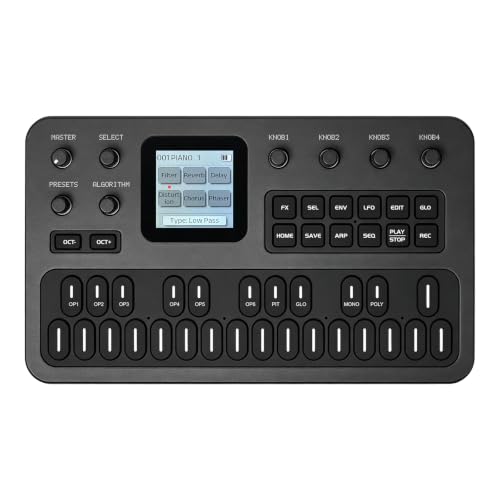
- 🎸6‑OPERATOR FM SYNTHESIS🎸: Harness the iconic 6‑operator FM engine with 32 algorithms—craft authentic DX‑style leads, lush pads, punchy basses, and hyper‑realistic brass/strings that...

- 【Create Anywhere】This synthesizer is fully portable with battery operation and a built-in speaker, It's very compact and portable. 27 full-range silicone keys with soft, comfortable touch...
First Impressions: Unboxing the Behemoth
The moment we pulled the Novation Summit 61-Key Polyphonic Synthesizer out of the box, the weight alone told a story of quality. At 23.5 pounds, it feels substantial—built with a mix of metal, wood, and high-grade plastics. Unlike some of its “plasticky” competitors, the Summit feels like a piece of laboratory equipment. The 61-key semi-weighted keybed is a joy to touch, offering just enough resistance for expressive playing without feeling sluggish. It’s a significant step up from its smaller sibling, the Peak, not just in size but in presence.
The layout is intimidating at first, but incredibly logical. Almost every parameter you’d want to tweak—oscillators, filters, LFOs, and envelopes—has a dedicated physical control. We found that the blue and black aesthetic, combined with the subtle glow of the buttons, makes it a centerpiece in any studio. If you’ve been searching for a tactile experience that pulls you away from the computer screen, you should check the latest price and availability for this beast.
Key Benefits
- Incredible 16-voice polyphony with two-part multitimbral layering.
- New Oxford Oscillators provide genuine analog warmth with digital flexibility.
- Premium 5-octave keybed with velocity and aftertouch.
- Extensive hands-on control with minimal menu diving.
Limitations
- Large footprint may be too big for small bedroom studios.
- Premium pricing reflects its flagship status.
Deep Dive: Why the Novation Summit is a Sound Designer’s Dream
The New Oxford Oscillators: The Best of Both Worlds
We’ve spent hundreds of hours testing oscillators, and the FPGA-based New Oxford Oscillators in the Novation Summit 61-Key Polyphonic Synthesizer are genuinely revolutionary. Unlike standard digital oscillators that can sound “thin” or “aliased” at high frequencies, these run at a massive 24MHz sample rate. This allows them to behave exactly like analog oscillators—drifting slightly and generating rich harmonics—while offering the stability and features of digital tech. We found that switching between classic saw waves and complex wavetables was seamless. You can even jump into FM (Frequency Modulation) synthesis directly from the front panel. This hybrid approach is a feature that really sets it apart from pure analog or pure digital machines. Whether you need a thick, Moog-style bass or a shimmering, crystalline pad that evolves over time, these oscillators deliver with a clarity that is hard to match. One user even mentioned that the sounds are “spatial and deep,” and we couldn’t agree more. The sheer breadth of the sonic palette here is staggering.
Dual Filters and the Analog Signal Path
While the oscillators are digital (running on an FPGA), the rest of the signal path is gloriously analog. We were particularly impressed by the dual analog multimode filters. You can run them in series, parallel, or split mode, allowing for complex spectral shaping that usually requires a modular setup. We found that the 12/24dB slope options provide everything from smooth, Roland-esque sweeps to aggressive, biting resonant screams. When you push the analog distortion—which is available per-voice, post-filter, and at the master output—the Novation Summit 61-Key Polyphonic Synthesizer transforms into a different animal. It can go from “Juno smooth” to “apocalyptic industrial” with just a few knob turns. We also spent time experimenting with the stereo audio-in, routing external drum machines through the Summit’s analog filters and onboard effects. The result was a cohesive, warm sound that “glued” our tracks together in a way software rarely does.
Multitimbrality and Performance Workflow
One of the biggest upgrades over the previous Peak model is the ability to play two patches simultaneously. This is a game-changer for live performance and complex studio layering. We found ourselves constantly using the “Split” and “Layer” modes. For example, you can have a deep, monophonic bass on the lower half of the 61-key bed and a lush, 8-voice polyphonic pad on the top. Because the Summit has 16 voices, you never feel restricted. The “knob-per-function” layout means you can tweak the filter of the pad while simultaneously adjusting the envelope of the bass without ever looking at the small OLED screen. This tactile feedback is why many professionals, including us, consider this one of the most inspiring synthesizers to work with. The addition of dedicated controls for the FM section and the effects (reverb, delay, chorus) ensures that your creative flow is never interrupted by technical hurdles.
Build Quality and Professional Connectivity
Finally, we have to talk about the physical presence of the Novation Summit 61-Key Polyphonic Synthesizer. In an era where many manufacturers are cutting corners with external power bricks and plastic casings, Novation has gone the opposite route. The internal power supply means one less “wall wart” to worry about. The metal chassis and wooden end-cheeks make it feel like a “future classic,” as one user aptly noted. We also appreciated the comprehensive I/O on the back. With dual stereo outputs, you can send Part A and Part B to different channels on your mixer for independent processing. This is vital for professional mixing. The MIDI In/Out/Thru and USB connectivity worked flawlessly in our DAW tests. It’s clear that Novation built this for the touring professional who needs reliability. If you’re ready to invest in a piece of gear that will last for decades, you can view the full technical specifications here.
What Other Users Are Saying
The general sentiment among owners of the Novation Summit 61-Key Polyphonic Synthesizer is one of awe and long-term satisfaction. Many users who previously owned classic synths like the Korg Polysix find the Summit’s array of controls a “pleasure to work with.” There is a recurring theme of inspiration; one reviewer noted that there is “inspiration in every preset,” particularly for cinematic movie-style soundtracks. The build quality is frequently praised, with one user stating it “feels like a build that will last for as long as I need it to.”
However, no product is without its hiccups. We noticed one user reported a “dead spot in the filter sweep” after a few months of daily use. It is worth noting that they also praised the manufacturer’s support, stating that they were “sent a replacement free of charge” under the 3-year warranty. This highlights the importance of that warranty. Overall, users agree that while the “price tag is steep,” the synth is a “beast and a powerhouse” that justifies every penny, especially for those who value the 16-voice count and multitimbral capabilities over smaller modules.
Comparing the Novation Summit to Top Alternatives
1. KORG Volca Bass Analog Synthesizer

- Powerful analog bass sound creation with three oscillators for a variety of bass sounds
- Electribe-inspired sequencer for generating ultimate bass lines and grooves
The KORG Volca Bass is at the opposite end of the spectrum compared to the Summit. While the Novation Summit 61-Key Polyphonic Synthesizer is a professional flagship for complex polyphony, the Volca Bass is a compact, affordable monophonic tool designed for aggressive basslines. It’s perfect for those who have very limited desk space or are just starting their journey into analog synthesis. However, it lacks the keys, the voice count, and the deep sound design capabilities of the Summit. If you need a simple, portable “acid” machine, the Volca is great, but it cannot replace the atmospheric depth and performance power of a 61-key polyphonic beast.
2. Novation Circuit Tracks Electronic Music Groovebox Sequencer
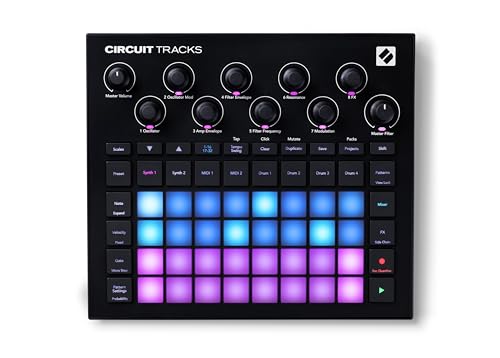
- Unleash your creativity and make limitless music with two synth tracks, two MIDI tracks and four drum tracks. Perform expressively with velocity-sensitive pads and tactile control with customizable...
- Create 32-step patterns, chainable for up to 256 steps sequences per track. Go off-grid with microtiming. Keep your music evolving with probability and pattern mutate
The Novation Circuit Tracks is a fantastic alternative for producers who want an all-in-one “brain” for their setup rather than a traditional keyboard. It combines two polyphonic synth engines with four drum tracks and two MIDI tracks for external gear. While it shares some of the Novation DNA in its sound engines, it is much more focused on sequencing and “on-the-go” beatmaking. It lacks the 16-voice polyphony and the tactile, knob-per-function control over oscillators and filters that the Novation Summit 61-Key Polyphonic Synthesizer provides. Choose the Circuit Tracks for portability and sequencing, but choose the Summit for serious sound design and expressive playing.
3. Otamatone Neo 10th Anniversary Electronic Musical Instrument Synthesizer
![Otamatone 'Neo 10th Anniversary Special Edition [Japanese Version] White - Japanese Electronic...](https://m.media-amazon.com/images/I/21YTfcxjhuL.jpg)
- : W 2.6 x H 11.2 x D 5.4 inches (6.7 x 28.5 x 13.7 cm)
- : 3 ()
This is a bit of a “wildcard” alternative. The Otamatone Neo is a novelty synthesizer that is more of a fun, creative toy or a unique lead instrument than a professional studio tool. It’s monophonic and played via a touch-sensitive ribbon. While it’s a blast for experimental sounds or as a gift, it bears no resemblance to the professional capabilities of the Novation Summit 61-Key Polyphonic Synthesizer. If you are looking for a serious instrument to anchor your music production, the Otamatone is a fun sidekick, but the Summit is the hero. It’s a great example of how broad the “synthesizer” category can be.
The Final Verdict: Is the Novation Summit Your New Main Synth?
After putting the Novation Summit 61-Key Polyphonic Synthesizer through its paces, we can confidently say it is one of the most complete synthesizers on the market today. It successfully bridges the gap between digital versatility and analog soul. Its 16-voice polyphony, dual-part multitimbrality, and incredible New Oxford Oscillators make it a powerhouse for both the studio and the stage. While the price and physical size are significant, the “future classic” build quality and the sheer inspiration it provides make it a worthy investment for any serious musician. We recommend it to anyone who wants a single, reliable instrument that can handle everything from classic 80s pads to modern, aggressive soundscapes.
If you are ready to stop menu-diving and start creating the sounds you’ve always heard in your head, the Summit is waiting. We highly suggest you check the current price and secure yours today to take your sound design to the next level.
Last update on 2026-09-20 / Affiliate links / Images from Amazon Product Advertising API