
MOTU M4 4×4 USB-C Audio Interface Review: The Professional Studio Powerhouse That Fits in Your Backpack
We have all been there: you spend hours perfecting a vocal take or a guitar riff, only to realize during playback that there is a subtle, annoying hiss in the background. Or worse, you’re trying to record, but the delay between your performance and what you hear in your headphones—that dreaded latency—makes it impossible to stay in the pocket. For many home studio enthusiasts and professional creators, the audio interface is often the bottleneck that holds back a great performance. If you are struggling with “plastic-sounding” preamps, confusing software mixers, or a lack of visual feedback on your levels, you are likely searching for a solution that bridges the gap between consumer-grade gear and high-end rack-mounted units. The MOTU M4 4×4 USB-C Audio Interface promises to be that bridge, offering professional-grade ESS Sabre32 Ultra DAC technology in a portable, affordable desktop format. Solving these technical hurdles isn’t just about better specs; it’s about removing the barriers between your creativity and the final recording.
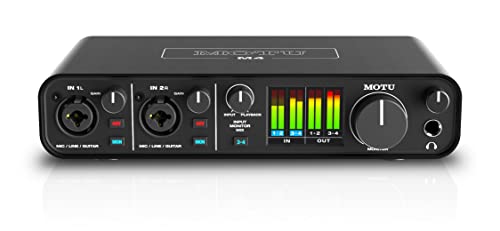
- 4-in/4-out USB-C Audio Interface with 2 Microphone Preamps
- 6+GB of Free Content - Mac/PC/iOS
What You Must Consider Before Investing in a Professional Audio Interface
A Computer Recording Audio Interface is more than just an item; it’s a key solution for any digital audio workstation. It serves as the “brain” of your studio, converting delicate analog signals from microphones and instruments into digital data your computer can process. The main benefits of a high-quality interface include significantly lower latency, higher fidelity audio conversion, and the ability to monitor your signals in real-time without hardware lag. When you see its full feature set and user reviews, you realize that the right interface doesn’t just record sound—it defines the quality of your entire production workflow.
The ideal customer for this type of product is a serious musician, podcaster, or content creator who requires more than just a basic two-channel setup. If you need to record a stereo instrument while simultaneously having two microphones ready, or if you need to loop back your computer’s audio for a live stream, the MOTU M4 4×4 USB-C Audio Interface is designed specifically for you. However, it might not be suitable for those who only need a simple “plug-and-play” USB microphone for occasional Zoom calls, or for massive professional studios requiring 24+ simultaneous inputs. In those cases, a simpler dongle or a massive Thunderbolt rack system might be a better fit.
Before investing, consider these crucial points in detail:
- Dimensions & Space: Consider your desk real estate. You want a unit that is heavy enough not to slide around when you plug in heavy XLR cables, but compact enough to fit in a laptop bag for remote sessions. The MOTU M4 4×4 USB-C Audio Interface strikes a great balance here with its 1-pound weight and rugged metal chassis.
- Capacity/Performance: Look beyond just the number of inputs. Pay attention to the dynamic range (measured in dB) and the sample rates. A high-quality interface should support up to 192 KHz to ensure you are future-proofing your recordings, and the DAC (Digital-to-Analog Converter) quality will determine how “detailed” your monitors sound.
- Materials & Durability: Plastic housings are common in budget gear, but they don’t shield against electromagnetic interference as well as metal. We always recommend an all-metal construction for both durability and noise rejection, especially if you plan on traveling with your gear.
- Ease of Use & Maintenance: Check for driver stability and software compatibility. An interface that “just works” on Windows, Mac, and even iOS without a week of troubleshooting is worth its weight in gold. Also, look for hardware features like visual level meters that reduce your reliance on looking at your computer screen.
Choosing the right interface can be overwhelming given the number of options available today. While the MOTU M4 4×4 USB-C Audio Interface is an excellent choice, it’s always wise to see how it stacks up against the competition. For a broader look at all the top models, we highly recommend checking out our complete, in-depth guide:
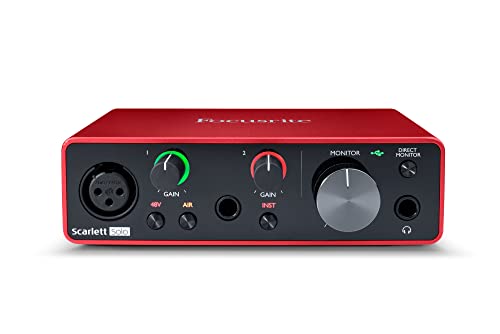
- Pro performance with great pre-amps - Achieve a brighter recording thanks to the high performing mic pre-amps of the Scarlett 3rd Gen. A switchable Air mode will add extra clarity to your acoustic...
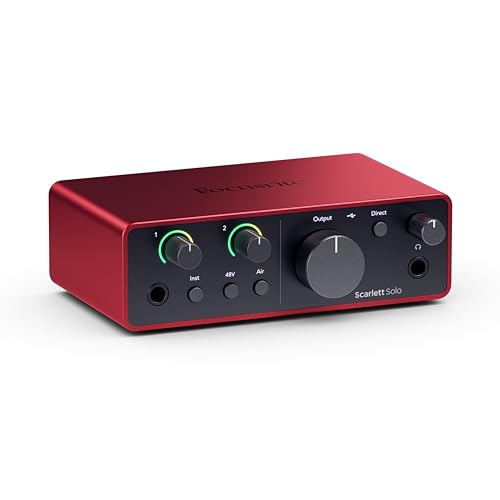
- The new generation of the songwriter's interface: Plug in your mic and guitar and let Scarlett Solo 4th Gen bring big studio sound to wherever you make music

- The new generation of the artist's interface: Connect your mic to Scarlett's 4th Gen mic pres. Plug in your guitar. Fire up the included software. Start making your first big hit
First Impressions: Unboxing the MOTU M4 4×4 USB-C Audio Interface
When we first pulled the MOTU M4 4×4 USB-C Audio Interface out of the box, the immediate takeaway was the build quality. It doesn’t feel like a toy; it feels like a piece of high-end rack equipment that has been shrunk down. The brushed aluminum finish is sleek, and the knobs have a satisfying, smooth resistance to them—they aren’t loose or “wiggly,” which is a common complaint with other interfaces in this price bracket. The standout feature, of course, is the full-color LCD screen on the front panel. Most interfaces in this range use simple “halo” lights or basic LEDs to show if you are clipping, but the M4 gives you actual high-resolution meters for all inputs and outputs.
Before you invest in this specific model, you’ll notice it occupies a unique spot in the market. It’s priced slightly higher than entry-level 2×2 units, but it offers the same ESS Sabre32 Ultra DAC technology found in interfaces costing thousands of dollars. We found the setup to be remarkably straightforward, though we did note that for Mac M1 users, following the specific driver installation sequence is vital for a smooth experience. It’s a handsome unit that looks professional on any desk, and the addition of a dedicated power switch on the back is a small but much-appreciated touch that many competitors strangely omit.
What We Like
- Exceptional audio clarity thanks to the high-end ESS Sabre32 Ultra DAC.
- Best-in-class full-color LCD metering for precise level management.
- Low-latency drivers that perform flawlessly on both Windows and Mac.
- Hardware Loopback feature is a game-changer for streamers and podcasters.
What We Didn’t Like
- Included USB cable feels a bit thin and “budget” compared to the unit itself.
- Headphone amp may struggle to drive very high-impedance (250ohm+) studio headphones to high volumes.
A Deep Dive into the MOTU M4 4×4 USB-C Audio Interface’s Performance
Sound Quality and the ESS Sabre32 Ultra DAC
The “secret sauce” of the MOTU M4 4×4 USB-C Audio Interface is undoubtedly its internal conversion. While many interfaces use standard off-the-shelf converters, MOTU has integrated the ESS Sabre32 Ultra DAC. In our testing, this resulted in a stunningly wide dynamic range of 120 dB on the outputs. What does this mean for you? It means the silence is actually silent, and the peaks are crisp and undistorted. We found that when listening back to familiar tracks through our studio monitors, we could hear subtle details in the reverb tails and stereo imaging that were previously smeared on cheaper interfaces. This level of transparency is usually reserved for much more expensive gear, making it a feature that really sets it apart from the budget pack.
The preamps are equally impressive. They provide a clean, transparent gain that doesn’t color your microphone’s natural sound. Whether we were using a sensitive condenser microphone for vocals or a dynamic mic for a loud guitar cab, the M4 handled the input with grace. We confirmed this by comparing it to several user findings where people transitioned from older, larger setups; the consensus is that the “depth and clarity” are immediately noticeable. It manages to capture exactly what you want without getting in the way of the signal.
Visual Feedback: The Power of the LCD Screen
We cannot overstate how useful the full-color LCD screen is during a session. Most home recordists have to constantly glance at their DAW (Digital Audio Workstation) on the computer screen to make sure they aren’t red-lining. With the MOTU M4 4×4 USB-C Audio Interface, you can keep your eyes on the hardware. The meters are fast, accurate, and provide a level of detail that “clip lights” simply cannot match. You can see the exact relationship between your four inputs and four outputs at a glance.
During our evaluation, we found this particularly helpful when setting gain levels for a multi-mic podcast. Being able to see both hosts’ levels side-by-side on the unit allowed us to make adjustments in real-time without interrupting the flow of the conversation. One minor point noted by us and some users is a slight bit of LED backlight bleed on the screen in very dark rooms, but it in no way affects the functionality or readability of the meters. It’s a professional touch that makes the unit feel like a “real” piece of studio hardware.
Latency, Drivers, and the Loopback Advantage
Latency is the enemy of a good recording, and the MOTU M4 4×4 USB-C Audio Interface tackles this with expertly written drivers. We tested the RTL (Round Trip Latency) on a Windows system and found it to be incredibly low, even at modest buffer settings. This allows you to monitor your performance through software plugins (like an amp sim or a vocal plate reverb) without any perceptible delay. For those on Linux, we were pleasantly surprised to find that the M4 “just works” out of the box without the need for proprietary drivers—a massive win for the open-source community.
The Loopback feature is another standout. For streamers, this is a lifesaver. It allows you to mix your live microphone input with your computer’s output (like game audio or a YouTube video) and send that combined signal back into your streaming software. You can check the latest price and availability here to see how this unit compares to specialized streaming mixers; in our opinion, the M4 offers better audio quality than most of those dedicated “vlogger” interfaces while providing the same essential loopback functionality.
Connectivity and Versatility
With four inputs and four outputs, the MOTU M4 4×4 USB-C Audio Interface is surprisingly versatile for its size. You get two combo XLR/TRS jacks on the front with individual 48V phantom power and “Monitor” buttons for zero-latency hardware monitoring. On the back, you have two additional balanced 1/4-inch inputs, which are perfect for synth players or those using external preamps. We also loved that it provides both balanced TRS and unbalanced RCA outputs for the main monitors. This means you can easily connect to high-end studio monitors and a consumer-grade stereo system simultaneously for A/B testing your mixes.
The inclusion of MIDI I/O is the icing on the cake. Many modern interfaces are ditching MIDI to save space, but for those of us with older hardware synths or controllers, having these ports built-in is essential. It keeps your desk clutter to a minimum and ensures that your timing stays rock-solid. During our time with the unit, it switched between devices cleanly via a KVM switch, proving that it’s a robust workhorse for those who juggle multiple computers in their workflow.
What Other Users Are Saying
The general sentiment surrounding the MOTU M4 4×4 USB-C Audio Interface is overwhelmingly positive, with many users considering it the best interface in its price range, often comparing it favorably against the popular Scarlett series. One user who previously used a $5,000 Roland control surface noted that the sound quality of the M4 was “beyond expectations” for its price, proving that you don’t need to spend thousands to get professional results. Another user praised its performance on Windows, stating it “runs flawlessly” when connected directly to an integrated USB-C motherboard port.
However, no product is perfect. Some users have pointed out that the headphone amp, while clear, doesn’t have the same “oomph” as some competitors when driving high-impedance headphones like the DT990 250-ohm model. If you use high-impedance cans, you might find yourself turning the volume knob nearly to the max. Additionally, one user mentioned a failure in the volume pot for the headphones after a few weeks of use, suggesting that while the build is generally superb, occasional quality control issues can occur. This is often cited as a reason to purchase the unit for professional workflows where the 2-year warranty provides peace of mind.
How the MOTU M4 4×4 USB-C Audio Interface Compares to the Competition
1. Focusrite Vocaster Two Podcasting Interface 2-Mic Inputs

- Broadcast quality sound – Get studio sound in seconds from Vocaster’s premium mic input
- Over 70dB of gain – Get the best out of any mic, no booster needed
The Focusrite Vocaster Two is a highly specialized tool designed specifically for podcasters. While the MOTU M4 4×4 USB-C Audio Interface is a general-purpose studio powerhouse, the Vocaster Two focuses on features like Auto Gain and “Enhance” presets to make speech sound broadcast-ready with zero effort. It’s smaller and lighter, making it great for travel, but it lacks the professional-grade ESS DAC and the high-resolution metering of the MOTU. If you are strictly recording voices for a show, the Vocaster’s workflow is faster, but for music production or high-fidelity listening, the MOTU M4 wins on raw audio performance every time.
2. Behringer UMC202HD 2×2 USB Audio Interface

- Phantom Power
- Compatible with popular recording software including avid pro tools*, Ableton live*, Steinberg Cubase*, etc
The Behringer UMC202HD is the budget king. It’s significantly cheaper than the MOTU and offers Midas-designed preamps that sound surprisingly good for the price. However, you get what you pay for in terms of features and build. The Behringer is a simple 2×2 unit without the LCD screen, without the loopback features, and with noticeably higher latency drivers on Windows. If you are just starting out and every dollar counts, the Behringer is a solid entry point, but the MOTU M4 is the “forever” interface you buy when you’re ready to stop compromising on sound quality and visual feedback.
3. IK Multimedia iRig Pro I/O Audio Interface
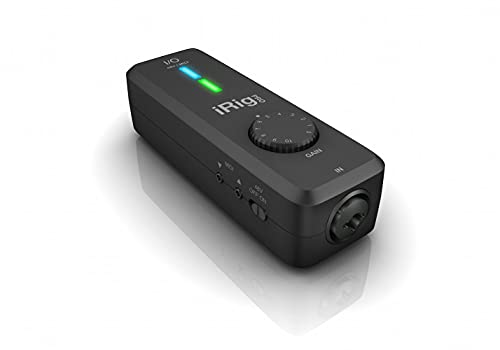
- CREATE HIGH-QUALITY DIGITAL MUSIC PROJECTS: The perfect combination of performance and value, this iPhone audio interface provides 24-bit/96 kHz audio quality for performance, recording, and...
- COMPLETE RECORDING PACKAGE: A XLR and Hi-Z combo input lets you connect your favorite instrument or mic, with +48v phantom power for condenser microphones, and MIDI In/Out to connect controllers...
The iRig Pro I/O is all about extreme portability. It’s designed to fit in a pocket and work seamlessly with iPhones and iPads. While the MOTU M4 4×4 USB-C Audio Interface is compatible with iOS, it’s a desktop unit first. The iRig is a single-channel interface, meaning it’s great for a solo guitarist or singer on the go, but it can’t compete with the M4’s four inputs, dedicated monitor outputs, and professional metering. Choose the iRig if you record primarily on your phone while traveling; choose the MOTU M4 if you want a centerpiece for your actual home studio.
The Final Verdict: Is the MOTU M4 the Right Choice for You?
After putting the MOTU M4 4×4 USB-C Audio Interface through its paces, we can confidently say it is one of the most impressive pieces of audio gear we have tested in recent years. It successfully brings high-end conversion and professional features down to a price point that is accessible to almost any creator. Its strengths lie in its incredible DAC quality, the indispensable LCD metering, and its rock-solid driver stability across Windows, Mac, and Linux. While the headphone amp might be a bit lean for those with 250-ohm headphones, and the included cable is nothing to write home about, these are minor gripes in the face of its overall performance.
Whether you are a musician looking to capture clean instrument takes, a streamer needing a reliable loopback solution, or a producer who wants to hear their mixes with more depth and clarity, this interface delivers in spades. It replaces the need for larger, more expensive setups without sacrificing the audio integrity your work deserves. Get the MOTU M4 4×4 USB-C Audio Interface today and elevate your sound to a professional level with a unit that truly respects your creative vision.
Last update on 2026-04-04 / Affiliate links / Images from Amazon Product Advertising API