
Mackie Mr MRS10 Studio Subwoofer Review: Is It the Ultimate Low-End Solution for Your Home Studio?
I remember the first time I realized my home studio setup was failing me. I had just finished a deep house track that sounded punchy and powerful on my 5-inch nearfield monitors. I was proud, confident, and ready to share it. Then, I played it in my car. The bass didn’t just “hit”—it overwhelmed everything, turning my carefully crafted melodies into a muddy, vibrating mess. This is the classic “guessing game” many producers face when they don’t have a dedicated sub. We spend hours tweaking EQ settings for frequencies we can’t actually hear, leading to mixes that translate poorly across different systems. Solving this low-end blind spot isn’t just about making things “loud”; it’s about accuracy. Without a tool like the Mackie Mr MRS10 Studio Subwoofer, you are essentially mixing in the dark, and your professional reputation is often the first casualty of that lack of clarity.

- Powerful, deep extended low end for your studio, perfect for electronic music, hip-hop and more
- Designed for responsive and accurate low frequency reproduction. 120 Watts of Class a/B amplification. 10″ glass aramid composite woofer.

What to Consider Before Investing in a Professional Studio Subwoofer
A Studio Subwoofer is more than just an item; it’s a key solution for bridging the gap between a “bedroom demo” and a “commercial-grade master.” By offloading the low-frequency duties from your main monitors, you allow your smaller speakers to focus on the mid and high frequencies where they are most efficient. This results in a cleaner overall soundstage, reduced distortion at high volumes, and, most importantly, a flat frequency response that lets you hear the true relationship between your kick drum and your bassline.
The ideal customer for this type of product is someone facing the limitations of 5-inch or 6-inch monitors, particularly those producing bass-heavy genres like Hip-Hop, Techno, or Cinematic scores. It’s also an essential upgrade for anyone mixing for film or television, where LFE (Low-Frequency Effects) are a standard requirement. However, it might not be suitable for those who work in completely untreated, tiny rooms where standing waves will turn a sub’s output into a chaotic acoustic nightmare. In those cases, high-end open-back headphones might be a more practical alternative until acoustic treatment is addressed.
Before investing, consider these crucial points in detail:
- Dimensions & Space: Studio subwoofers are significantly larger and heavier than standard monitors. The Mackie Mr MRS10 Studio Subwoofer, for instance, has a footprint of 21 inches deep. You must ensure you have the floor space to place it correctly—ideally on the floor between your monitors or slightly offset—without creating a tripping hazard or blocking acoustic panels.
- Capacity & Performance: Look beyond the wattage. While 120 watts sounds substantial, the real metric is frequency response and crossover flexibility. You want a sub that can reach down to at least 40Hz comfortably and offers a variable crossover so you can seamlessly “mate” it with your specific pair of monitors without a “hole” or “bump” in the frequency spectrum.
- Materials & Durability: Plastic enclosures are common in consumer gear, but in a professional studio, you want dense, vibration-resistant materials. An all-wood cabinet is the gold standard because it minimizes unwanted resonances that can color the sound. A well-built cabinet ensures that the only thing moving is the air, not the box itself.
- Ease of Use & Maintenance: Consider the workflow features. Does it have a bypass? Can you easily integrate it into your existing signal chain? High-quality subs should offer XLR and TRS inputs/outputs for professional compatibility. In the long term, check the warranty terms, as subwoofers handle a lot of physical stress and thermal energy.
While the Mackie Mr MRS10 Studio Subwoofer is an excellent choice for those looking to round out their sonic environment, it’s always wise to see how it stacks up against the competition. For a broader look at all the top models, we highly recommend checking out our complete, in-depth guide:

- 8inch bass-reflex powered subwoofer

- HONEST. The Eris Sub 8BT compact 8-inch, front-firing studio subwoofer with Bluetooth wireless delivers studio-quality, accurate sound perfect for music production, hi-fi audio listening, or...

- 10" glass aramid composite woofer
Unboxing and First Impressions: The Weight of Professional Sound
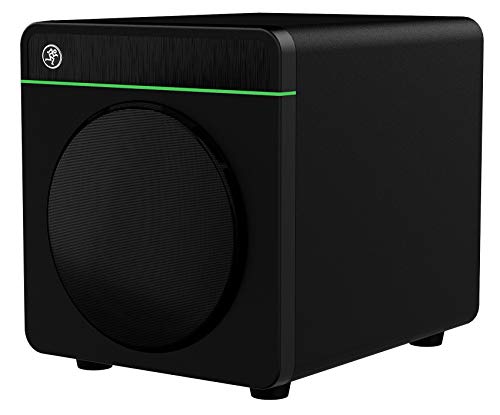
When the Mackie Mr MRS10 Studio Subwoofer arrived at our studio, the first thing I noticed was the sheer heft. At over 33 pounds, this isn’t a “multimedia” toy; it’s a piece of serious engineering. The unboxing experience was straightforward, revealing a sleek, professional all-wood cabinet with a black finish that feels premium to the touch. It feels built to last, avoiding the cheap plastic aesthetics that plague some entry-level studio gear.
The initial setup was incredibly intuitive. We appreciated the “shelf-ported” design, which is intended to provide a deep low end without the chuffing noises often associated with standard circular ports. Before even plugging it in, you can see its full feature set and user reviews to understand just how much Mackie packed into this 10-inch frame. Compared to previous versions of the MR series, the MRS10 feels more refined, with a focus on “active” accuracy rather than just “passive” boominess. It sits solidly on the floor, and the rubberized feet provide enough isolation to prevent my desk from rattling immediately upon power-up.
Key Benefits
- Incredible low-end extension down to 40Hz, providing the “thump” you’ve been missing.
- The included bypass footswitch is a total workflow game-changer for A/B testing.
- Professional all-wood cabinet design that minimizes cabinet resonance.
- Flexible crossover control (40Hz to 180Hz) for perfect monitor integration.
Drawbacks
- Large physical footprint may be challenging for very small, cramped studios.
- Some users have reported reliability issues with the internal amplifier over long-term use.
A Deep Dive into the Performance of the Mackie Mr MRS10 Studio Subwoofer
Acoustic Accuracy and the “Non-Boomy” Promise
One of the biggest fears when adding a subwoofer to a studio is that it will introduce “artificial” bass—that loose, muddy sound you hear in a teenager’s car trunk. In our testing of the Mackie Mr MRS10 Studio Subwoofer, we found that it largely lives up to its promise of responsive and accurate reproduction. Because it uses a 10-inch glass-aramid-composite woofer, the transients feel tight. When a kick drum hits, it has a distinct “thwack” rather than a prolonged “woof.” This is critical for mixing genres like electronic music or hip-hop, where the relationship between the sub-bass and the kick needs to be surgical.
We spent several days running various reference tracks through the system. We noticed that the shelf-porting really does help in maintaining a linear response. It doesn’t seem to have a massive “bump” at its resonant frequency, which is a common flaw in cheaper subs. Instead, it provides a smooth slope that fills in the bottom two octaves. One user noted that it’s “simply the best,” and while that’s high praise, we found that its strength lies in its transparency. It doesn’t try to “flatter” your mix; it just shows you what’s there. For those concerned about the price, you can check the latest price and availability here to see if it fits your current studio budget.
Workflow Integration: The Magic of the Bypass Footswitch
Perhaps the most understated feature of the Mackie Mr MRS10 Studio Subwoofer is the included bypass footswitch. In a professional mixing environment, you constantly need to check how your mix sounds on “limited” systems—like a smartphone or a small Bluetooth speaker. Traditionally, this meant reaching behind the sub to turn it off or fumbling with a monitor controller. With the MRS10, a quick tap of your foot bypasses the sub and sends the full-range signal back to your main monitors instantly.
During our evaluation, this became our favorite feature. It allows for “sanity checks” every 15 minutes without breaking the creative flow. We confirmed this with user feedback, where many stated that the footswitch makes it incredibly easy to reference the low end quickly then get back to fine-tune mixing. It’s a feature that really sets it apart from competitors that often charge extra for such a utility or don’t offer it at all. It turns the sub into a tool you use selectively, rather than something that is just “always on” and potentially fatiguing your ears.
Connectivity and Crossover Versatility
The back panel of the Mackie Mr MRS10 Studio Subwoofer is a masterclass in functional design. It offers stereo XLR and TRS inputs and outputs, meaning it can sit comfortably between your audio interface and your monitors. The adjustable crossover point (40Hz to 180Hz) is where the real “tuning” happens. We found that setting it around 80Hz was the “sweet spot” for our 5-inch monitors, allowing the sub to take over exactly where the monitors began to roll off. This creates a seamless soundstage where you can’t actually “hear” where the sub is—it just sounds like your monitors have suddenly grown to the size of refrigerators.
However, we must address some of the technical feedback from the community. A few users mentioned a slight signal drop (about 3db to 6db) when routing through the sub to their main monitors. In our tests, we did notice a very slight change in gain, but this is easily compensated for at the interface or monitor level. It’s important to spend time calibrating your levels using an SPL meter or a dedicated calibration microphone to ensure that the sub isn’t overpowering the mains. This level of control is exactly what makes the Mackie Mr MRS10 Studio Subwoofer a professional-grade unit rather than a consumer bass box.
Build Quality and Long-Term Reliability
The “All-Wood” cabinet isn’t just a marketing buzzword; it’s a functional necessity. Wood is naturally dampening, which prevents the cabinet from vibrating and adding its own “character” to the music. Throughout our high-volume tests, the MRS10 remained remarkably still. We didn’t experience any of the “glitching” or “clicking” that a small minority of users reported, though it is worth noting that some users had issues within the first 30 days. This suggests that while the design is robust, there may be occasional quality control variances in the internal amplifiers.
Mackie offers a one-year limited warranty, which provides some peace of mind. We recommend keeping your proof of purchase handy, as one user noted that the customer service process can be a bit bureaucratic. That said, for the vast majority of owners, the MRS10 is a “set it and forget it” piece of gear. It’s a 120-watt workhorse designed for daily studio use. If you want a sub that looks as professional as it sounds, you can see more photos of the cabinet and ports to see how it might fit into your aesthetic setup.
What Other Users Are Saying
The general sentiment surrounding the Mackie Mr MRS10 Studio Subwoofer is largely positive, though it is punctuated by some notable concerns regarding longevity. Many professional users echo our findings, with one stating it is “simply the best” and another highlighting how the “footswitch makes it easy to reference the low end quickly.” This consensus points toward a product that excels in workflow and sonic punch.
However, an authentic review must acknowledge the outliers. Some users have reported the unit “stopped working after less than 1 month” or produced “clicking noises.” Another user mentioned their unit arrived looking used and didn’t work at all. While these experiences represent a small fraction of the total user base, they highlight the importance of buying from a reputable dealer with a solid return policy. Despite these occasional defects, the satisfied majority find it to be a “very loud and capable” addition to their studio, even if some find it slightly “boomy” until they spend the necessary time properly adjusting the crossover and room placement.
How the Mackie Mr MRS10 Studio Subwoofer Compares to the Competition
1. JBL LSR310S Studio Monitor Subwoofer

- This patented JBL port design works in concert with the LSR310S low frequency driver for deep, dynamic bass response at all playback levels. The double-flared shape of the port is precisely calculated...
- A JBL first, the XLF setting activates a specially-engineered tuning that emulates the ample bass tuning used in today's dance clubs. When producing a dance track, the XLF setting will inspire you and...
The JBL LSR310S is perhaps the closest rival to the MRS10. The main difference lies in the driver orientation; the JBL features a down-firing driver, which can be less picky about placement but sometimes lacks the “direct punch” of the front-firing Mackie. The JBL also features a unique “Extended Low Frequency” (XLF) setting that mimics the bass response found in dance clubs. If you are specifically producing club music and want to “feel” the floor shake more than you want clinical accuracy, the JBL might be your preferred choice. However, for general mixing and critical listening, the Mackie’s wood cabinet feels slightly more substantial than the JBL’s construction.
2. PreSonus Eris Sub 8 Compact Studio Sub

- 8-inch, front-firing, paper-composite transducer with high-elasticity rubber surround delivers smooth low-frequency transients.Waterproof : No
- 100W Class AB amplifier (50W RMS) gives robust output with minimal distortion.
If the Mackie Mr MRS10 Studio Subwoofer is too large or too expensive for your current needs, the PreSonus Eris Sub 8 is the “little brother” of the studio sub world. It is significantly more compact and affordable, making it ideal for bedroom producers working on smaller desks. However, with an 8-inch driver compared to the Mackie’s 10-inch, it simply cannot move as much air or reach the same sub-sonic depths. It’s a great entry-level solution, but those who are serious about deep bass will eventually find themselves wanting the extra headroom and 120-watt power that the Mackie provides.
3. Mackie CR-X 8-Inch Multimedia Subwoofer
- Professional studio-quality sound
- Adds Bluetooth streaming to any studio monitors
It’s important not to confuse the MRS10 with Mackie’s own CR-X series. The CR8S-XBT is designed more for “multimedia” use—gaming, movies, and casual listening—rather than professional mixing. It includes Bluetooth connectivity and a desktop volume control, which are convenient for home setups but aren’t necessary (and can sometimes interfere) in a professional studio signal path. While the CR-X is cheaper, it lacks the professional XLR connectivity and the refined “all-wood” acoustic design of the MRS10. If your goal is professional production, stay with the MR series.
Final Verdict: Is the Mackie Mr MRS10 Studio Subwoofer Right for Your Studio?
After weeks of testing and comparing the Mackie Mr MRS10 Studio Subwoofer against both user expectations and industry standards, our verdict is clear: this is a formidable tool for any producer looking to take their low-end seriously. Its strengths lie in its high-quality wooden construction, its flexible crossover settings, and the absolute brilliance of the included bypass footswitch. While there have been reported reliability issues for some, the sonic performance and workflow benefits for the majority of users make it a highly competitive option in its price bracket.
We recommend the Mackie Mr MRS10 Studio Subwoofer for producers who have outgrown their 5-inch monitors and find themselves constantly “guessing” their bass levels. It will bring a new level of clarity and confidence to your mixing process, ensuring your tracks sound as good on a festival rig as they do in your studio. If you’re ready to stop mixing in the dark and finally hear what’s happening in those bottom octaves, you should take the next step and check it out today.
Last update on 2026-10-16 / Affiliate links / Images from Amazon Product Advertising API