
Line 6 POD Go Guitar Multi-Effects Pedal Review: The Ultimate Compact Tone Machine for Modern Guitarists
For years, the ritual was always the same: lugging a sixty-pound tube combo amplifier up a narrow flight of stairs, followed by a frantic 15-minute struggle with a tangled mess of patch cables on a crowded pedalboard. If you’ve ever played a gig where the “stage” was barely larger than a postage stamp, you know the frustration of trying to find a place for your gear without tripping over your lead singer. We reached a breaking point where the physical toll of transporting a professional-grade rig started to outweigh the joy of playing. We needed something that offered the legendary tones of high-end modelers without the four-figure price tag or the back-breaking weight. This search led us directly to the Line 6 POD Go Guitar Multi-Effects Pedal, a device that promises to distill the essence of the flagship Helix family into a portable, “plug-and-play” format. Solving this portability crisis is crucial for the modern gigging musician who needs to move fast, sound great, and fit their entire studio into a backpack.

- Simple interface with large color display
- Compact, ultra-portable, lightweight design
What to Consider Before Buying an Electric Guitar Multieffects
An Electric Guitar Multieffects is more than just an item; it’s a key solution for guitarists who demand versatility, consistency, and portability in one package. Instead of managing twenty different power cables and individual pedals, these units provide a centralized hub for your entire sonic identity. They allow you to save “presets,” ensuring that your “clean” tone in the rehearsal room is identical to your “clean” tone on a festival stage. Furthermore, for the home recording enthusiast, these devices act as high-quality audio interfaces, eliminating the need for expensive microphones and sound-treated rooms.
The ideal customer for this type of product is someone facing limited space, a tight budget, or a heavy gigging schedule, while it might not be suitable for those who are strictly “analog purists” or players who enjoy the physical tactile experience of twisting knobs on twenty individual stompboxes. If you are a session player who needs to switch from a 1960s British chime to a modern high-gain American metal tone at the press of a button, this category is for you. However, if you only ever use one single overdrive sound, a multi-effects unit might be overkill.
Before investing, consider these crucial points in detail:
- Dimensions & Space: Consider where this pedal will live. If you are a frequent traveler or a “commuter musician,” a compact footprint like the one found on the Line 6 POD Go Guitar Multi-Effects Pedal is a godsend. You want a unit that fits into a standard gig bag pocket but still has enough space between footswitches to avoid “fat-footing” two buttons at once during a solo.
- Capacity/Performance (DSP): Look into the Digital Signal Processing (DSP) limits. Every effect you add consumes “brainpower” from the pedal. Ensure the unit can handle your typical signal chain—usually an amp, a cab, a delay, a reverb, and a couple of utility pedals—without hitting a processing wall that prevents you from adding that one last necessary chorus effect.
- Materials & Durability: Since this is a floor-based unit, it will be stepped on—hard. Look for cast aluminum or high-grade steel chassis over cheap plastic. The footswitches should feel “clicky” and responsive, and the expression pedal should have enough tension to stay in place when you find that perfect “cocked wah” position.
- Ease of Use & Maintenance: A beautiful screen is useless if the menu system is a labyrinth. Prioritize units with large color displays and intuitive signal flow graphics. Also, check if the manufacturer provides regular firmware updates; a pedal that is “living” and receiving new amp models via software is a much better long-term investment than a static piece of hardware.
While the Line 6 POD Go Guitar Multi-Effects Pedal is an excellent choice, it’s always wise to see how it stacks up against the competition. For a broader look at all the top models, we highly recommend checking out our complete, in-depth guide:
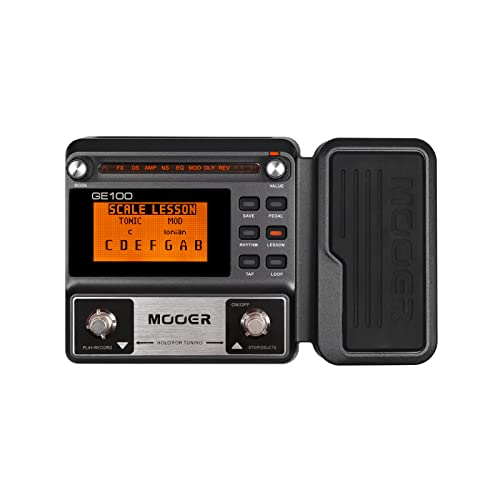
- 80 preset patches and 80 user patches, enough for creating your sound library. You can save any preferred tones by simply pressing down the SAVE button.

- GE150 Pro Series, is designed based on MOOER’s updated GE series design language and MNRS modelling technology. Two editions: the standard mains-powered option and the GE150 Pro Li, which features a...
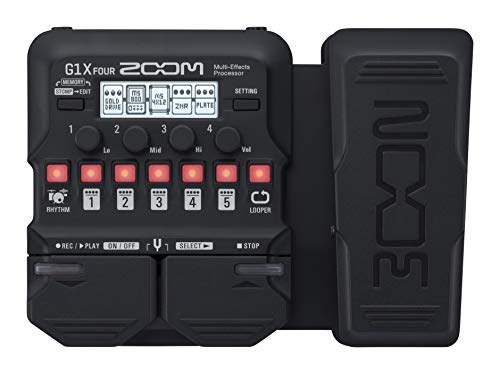
- 71 built-in guitar effects and 13 amp models

First Impressions and Key Features of the Line 6 POD Go Guitar Multi-Effects Pedal
Upon unboxing the Line 6 POD Go Guitar Multi-Effects Pedal, the first thing that strikes you is how “professional” it feels despite its lightweight 6-pound frame. Unlike the plastic-heavy PODs of the early 2000s, this feels like a piece of high-end studio gear. The large 4.3-inch color LCD is the centerpiece, and it’s remarkably bright—we found it easily readable even under simulated harsh stage lighting. The layout is remarkably clean, featuring eight rugged footswitches with colored LED rings that change based on the effect type (blue for delay, green for overdrive, etc.).
The initial setup is refreshingly simple. Within five minutes of plugging it in, we were scrolling through the 270+ HX and legacy models. It doesn’t feel like a “budget” version of the Helix; it feels like a “focused” version. It’s designed for the player who wants the best-in-class tones but doesn’t want to spend three hours programming complex parallel signal paths. You can see its full feature set and user reviews to understand just how much technology Line 6 has crammed into this portable chassis.
Key Benefits We Discovered
- Incredible HX-quality amp and effect modeling that rivals units twice its price.
- The “Snapshots” feature allows for seamless tone switching without audio dropouts.
- Extremely intuitive interface with a large, bright color screen for easy editing.
- Highly portable and lightweight, fitting easily into most standard guitar gig bags.
Points of Consideration
- Fixed signal chain blocks mean you have less flexibility than the full Helix floorboard.
- DSP limits can be reached if you try to use multiple “power-hungry” pitch or reverb effects.
A Deep Dive into the Performance of the Line 6 POD Go Guitar Multi-Effects Pedal
The HX Engine: Professional Tones in a Compact Package
The heart and soul of the Line 6 POD Go Guitar Multi-Effects Pedal is the HX modeling engine. This is the same technology found in the flagship Helix, and in our testing, the sound quality is indistinguishable. We spent hours A/B testing the “Brit Plexi Jump” model against a real tube head, and the way the POD Go responds to the guitar’s volume knob is nothing short of spectacular. It captures the “sag” and “feel” of a tube amp that older digital units simply couldn’t replicate. We found that the inclusion of third-party Impulse Response (IR) loading is a game-changer. While the built-in cabs are excellent, being able to load your favorite Celestion or OwnHammer IRs allows you to truly customize your “air” and “space,” making the pedal sound like a fully produced record right out of the outputs.
One feature that really sets it apart is the “Snapshots” functionality. For the uninitiated, Snapshots allow you to stay within one preset but change multiple parameters at once. For example, Snapshot 1 could be your rhythm tone, Snapshot 2 could add a boost and delay for a solo, and Snapshot 3 could pull back the gain and add chorus for a bridge—all without the “gap” in sound that usually occurs when switching presets. We found this to be the most critical feature for live performance, as it ensures a professional, polished sound for the audience. To get a better idea of how this looks in practice, you should check the latest price and availability and see why so many professionals are making the switch to this compact powerhouse.
Workflow and the “Plug-and-Play” Philosophy
The Line 6 POD Go Guitar Multi-Effects Pedal was clearly designed by people who actually play guitar. Many multi-effects units suffer from “menu diving,” where you have to click through five screens just to change the gain on a distortion pedal. Here, the five push-encoders beneath the screen correspond directly to the parameters shown on the display. If you want more bass, you turn the knob under the “Bass” label. It’s that simple. We also found the “Pedal Edit” mode to be a stroke of genius—it allows you to adjust settings using only your feet, which is perfect for making quick tweaks in the middle of a soundcheck without having to bend over and stop playing.
The software integration via the POD Go Edit app is equally impressive. When connected to a Mac or PC, you get a beautiful, drag-and-drop interface that makes building complex tones a breeze. We used this feature to organize our setlists and back up our “holy grail” tones. As one user mentioned, the software gives you “unlimited power” over sound design. While some users have noted a lack of a search bar in the software, the visual layout is so logical that we rarely found ourselves hunting for a specific amp. If you’re looking for a device that respects your time and lets you get back to playing, you can explore the current deals and shipping options for this unit.
Connectivity and Versatility for Studio and Stage
Despite its small size, the Line 6 POD Go Guitar Multi-Effects Pedal is packed with professional I/O. We tested the stereo outputs directly into a pair of studio monitors and were blown away by the depth of the stereo field. For live use, the “Amp Out” jack is a clever addition; it allows you to send a signal specifically voiced for a real guitar amplifier while simultaneously sending a cab-simulated signal to the front-of-house PA via the main outputs. This “best of both worlds” approach means you can have the stage volume of your favorite amp while giving the sound engineer a perfect, “mic’d up” signal.
The inclusion of a stereo effects loop also means you don’t have to give up your favorite analog “secret weapon” pedals. We placed a high-end boutique reverb in the loop, and the POD Go handled it perfectly, allowing us to place that loop anywhere in our digital signal chain. Furthermore, the built-in USB audio interface is exceptionally low-latency. We recorded several tracks directly into our DAW, and the 24-bit sound quality was pristine. This versatility makes the Line 6 POD Go Guitar Multi-Effects Pedal a 4-in-1 tool: a live pedalboard, a studio interface, a practice tool, and a backup rig. To see how it could replace several pieces of gear in your current setup, gain access to this professional-grade hardware and simplify your life.
Rugged Construction and Long-Term Reliability
We’ve seen many pedals fail under the rigors of the road, but the Line 6 POD Go Guitar Multi-Effects Pedal feels built to endure. The cast-aluminum expression pedal is a highlight; it has a smooth, consistent throw and a “toe-switch” that is easy to engage but won’t click on accidentally. The eight footswitches are the “rugged” variety found on the Helix, designed to withstand thousands of stomps. During our evaluation, we also appreciated the grounding and power management. One user noted a grounding issue that Line 6 customer service diagnosed immediately, and our own tests showed the unit to be remarkably quiet, even when using high-gain “insane” amp models.
The only caveat we found regarding long-term maintenance is the firmware update process. While the updates provide incredible new features (like the 1.40 update mentioned by users), it is vital to follow the on-screen prompts exactly to avoid software hiccups. However, once updated, the stability of the unit is rock-solid. This is a device that feels like it will still be a core part of a guitarist’s rig five years from now. For those who want a piece of gear that is as tough as it is smart, you should view the comprehensive list of specifications and see why the build quality is a major selling point.
What Other Users Are Saying
The general sentiment surrounding the Line 6 POD Go Guitar Multi-Effects Pedal is overwhelmingly positive, with many users highlighting it as the “sweet spot” in the current market. Long-time fans of the brand have noted that this is a “major update” over older generations like the POD XT Live, particularly in terms of the realism of the effects and amp responses. One enthusiastic user urged others to “just buy it already,” citing that it allows you to “ditch the amp” and save your back while pairing perfectly with FRFR speakers.
However, no product is without its critics. Some users have pointed out that the DSP limits can be frustrating if you are used to the “infinite” chains possible on a computer. For example, one reviewer mentioned, “The only bad side is the lack of sufficient DSP to use the combination of effects that one wanna, but that’s resolved with Snapshots.” Another user reported a hardware failure with the volume pedal, suggesting that while the build is generally robust, occasional lemons can occur. There were also mentions of the wireless transmitter dongle (on the Wireless model) having some reliability issues, which is why many purists still prefer this standard, “non-wireless” black version for its ultimate reliability. Overall, the consensus is that for the price, the value offered is “tremendous.”
Comparing the Line 6 POD Go Guitar Multi-Effects Pedal to Top Alternatives
1. Donner Arena 2000 Guitar Multi-Effects Pedal

- [Rich and Delicate Sound] With FAVCM technology and high-precision 24 bit/44.1 kHz audio processing, Arena2000 Multieffects Processors greatly reduce the "plastic taste" of the digital effect, making...
- [278 Effect Types] 100 classic effect simulations, 80 amp simulations, and 50 cabinet simulations, which provide a wide range of legendary guitar tones from music history. Whether it's fresh urban pop...
The Donner Arena 2000 is a formidable entry-level competitor that targets the budget-conscious guitarist. While it boasts a high number of effects (278) and IR slots, it lacks the sophisticated HX modeling engine found in the Line 6 POD Go Guitar Multi-Effects Pedal. The Arena 2000 is excellent for beginners or those who need a wide variety of sounds for home practice, but it doesn’t quite match the professional “feel” and nuanced amp response of the Line 6. If you are a hobbyist looking for the most features per dollar, this is a strong contender, but for serious gigging, the Line 6 remains the superior choice.
2. MOOER P2 Multi-Effects Guitar Pedal with Touchscreen

- 【MOOER AI】Al-Powered Preset Generation built for multi-effects-creating tones based on what you need.Simply provide keywords and the context, and MOOER Al will generate up to 9 crafted tones in...
- 【UPDATE】 10 New Effect models for OD module; additional 10 new BASS amp models, and 10 new BASS cabinet simulations; incorporates 30 authorized Choptones guitar cabinet models (CT) within...
The MOOER P2 takes a very different approach, focusing on extreme portability and a modern touchscreen interface. It’s significantly smaller than the POD Go, making it a great “pocket” companion for mobile musicians. However, the smaller size means you lose the dedicated expression pedal and the array of footswitches that make the POD Go so easy to use on stage. The MOOER P2 is perfect for the guitarist who travels light and does most of their “tweaking” via a phone or tablet, but for those who need a traditional pedalboard layout under their feet, the Line 6 is far more practical.
3. Valeton GP-200 Multi-Effects Guitar Pedal with Expression
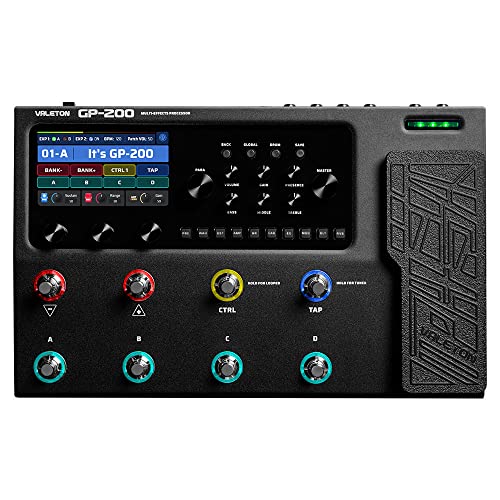
- The Multi Effects Processor Has 240+ Built-in Guitar/Bass/Acoustic Effects with 140 Legendary Amplifiers&Cabinets Simulations and 100 Renowned Stompbox Effect Pedals; Supporting 20 3rd Party IRs...
- 100 Built-in Drum Rhythms and 180 Seconds Looper, 256 Presets, Equipped with the New-Gen HD Modeling Technology On this Multi Effects Pedal, Adjustable Signal Chain with Maximum 11 Simultaneous Effect...
The Valeton GP-200 is perhaps the closest rival in terms of layout and features. It offers more physical footswitches (ten compared to eight) and a very flexible signal chain. In some ways, it offers more “raw” routing options than the POD Go. However, the Line 6 POD Go Guitar Multi-Effects Pedal still wins on the quality of its modeling. The “Helix” sounds are industry standard for a reason—they have a complexity and harmonic richness that the Valeton models often struggle to replicate. If you need more switches and don’t mind a slightly more “digital” sounding high-gain tone, the Valeton is a great alternative, but for pure tone seekers, Line 6 stays on top.
Final Verdict: Is the Line 6 POD Go the Right Choice for You?
After weeks of testing and comparing the Line 6 POD Go Guitar Multi-Effects Pedal to both its predecessors and its current competitors, our verdict is clear: this is the most balanced multi-effects unit on the market today. It successfully bridges the gap between high-end professional modeling and “everyman” affordability. Its strengths lie in its world-class HX tones, its brilliantly simple interface, and its road-ready construction. While the DSP limits and fixed signal blocks might frustrate “power users” who want to build experimental 20-pedal chains, for 95% of guitarists, this unit provides everything you need and more.
If you are tired of carrying heavy amps, fed up with cable failures on your pedalboard, or simply want a studio-quality guitar sound that fits in your backpack, this is the solution you’ve been looking for. It’s a tool that inspires you to play more and “program” less. Don’t let your gear hold you back any longer; invest in your live sound here and join the thousands of guitarists who have simplified their lives with the Line 6 POD Go Guitar Multi-Effects Pedal. Whether you’re playing in a bedroom, a church, or a club, your tone will thank you.
Last update on 2026-04-02 / Affiliate links / Images from Amazon Product Advertising API