
LARSEN Magnacore Cello 4/4 A String Review: The Secret to a Rich and Commanding Upper Register
If you have spent any significant amount of time behind a cello, you know the singular frustration of the “nasal” A-string. You spend hours perfecting your thumb position, refining your vibrato, and adjusting your bow pressure, only to find that your upper register sounds thin, metallic, or piercing compared to the glorious, chocolatey resonance of your G and C strings. We have all been there—trying to execute a soaring melodic line in a Dvořák concerto, only to feel like the instrument is fighting back with a shrill tone that lacks “soul.”
Solving this tonal imbalance is crucial for any serious player. A disconnected A-string creates a jarring transition during string crossings, making your playing sound fragmented rather than fluid. When your A-string doesn’t have the same “width” of sound as your lower register, you lose the ability to truly sing through the instrument. This is exactly why we decided to put the LARSEN Magnacore Cello 4/4 A String to the test. We wanted to see if it could bridge that gap and provide the professional-grade depth that many student and even intermediate strings lack. If you are tired of a “whiny” upper register, you might want to see its full feature set and user reviews to understand why this is a staple in professional cases.
What to Consider Before Buying New Cello Strings
A Cello Strings is more than just an item; it’s a key solution for the literal voice of your instrument. Choosing the right string is perhaps the most cost-effective way to “upgrade” your cello without spending thousands on a new instrument. The right set can mask an instrument’s weaknesses and amplify its strengths, providing better projection, easier response, and a more pleasant tonal color. Conversely, the wrong strings can make a high-end cello sound choked or a student instrument sound unbearably harsh.
The ideal customer for this type of product is someone facing a lack of projection or a “thin” sound in their higher positions. It is perfect for the advanced student, the orchestral professional, or the dedicated amateur who wants their cello to sound more expensive than it is. However, it might not be suitable for those who are absolute beginners on a very tight budget, as professional strings like these are a significant investment. For those just starting out, a more durable, all-steel core student string might be a more practical initial choice before graduating to the nuances of the Magnacore line.
Before investing, consider these crucial points in detail:
- Tension and Gauge: The gauge of a string (Medium, Strong, or Soft) significantly impacts how the instrument vibrates. A Medium tension, like the one found on the LARSEN Magnacore Cello 4/4 A String, is generally the gold standard, offering a balance between ease of playability and enough resistance to allow for powerful fortissimo passages.
- Core Material and Sound Profile: Different core materials (Steel, Synthetic, or Gut) offer vastly different experiences. Synthetic cores are designed to mimic the warmth of traditional gut while maintaining the stability and longevity of modern materials. When looking at the LARSEN Magnacore Cello 4/4 A String, you are looking for that specific “Magnacore warmth” that blends the brilliance of an A-string with the depth of a lower string.
- Durability & Break-in Time: Some strings sound incredible for two weeks and then “die,” losing their overtones. You want a string that offers a quick break-in period (ideally 2-4 days) and maintains its tonal integrity for several months of daily playing. High-quality materials ensure the string doesn’t unravel or lose its intonation stability prematurely.
- Ease of Use & Maintenance: This involves how the string reacts to the bow. Does it speak immediately (quick response), or do you have to work hard to get a sound? Furthermore, maintenance involves keeping the string clean from rosin buildup, which can dampen the synthetic core’s ability to vibrate freely.
Understanding these factors is the first step in transforming your sound. While the LARSEN Magnacore Cello 4/4 A String is an excellent choice, it’s always wise to see how it stacks up against the competition. For a broader look at all the top models, we highly recommend checking out our complete, in-depth guide:

- EDUCATOR’S CHOICE – Designed with quick bow response and ease of use in mind, D’Addario’s Prelude cello strings are the educator’s preferred choice for student strings. They offer a unique...


Scaled to fit 4/4 size cello with a playing length of 27 1/2 inches (700mm), these medium tension strings are optimized to the needs of a majority of players. This A string is nickel wound...

- 1,Premium Material: Almag cello strings are made from a unique alloy of aluminum and magnesium, which results in a powerful and refined sound quality.
First Impressions and Key Features of the LARSEN Magnacore Cello 4/4 A String
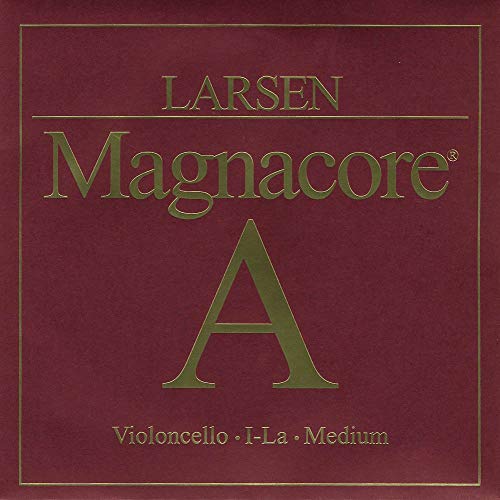
Unboxing the LARSEN Magnacore Cello 4/4 A String, the first thing we noticed was the premium feel of the packaging and the distinct multicolor silk windings at the ends. There is an immediate sense of quality that differentiates it from budget-level alternatives. When we held the string, the “Medium” gauge felt substantial but flexible, a hallmark of Larsen’s sophisticated engineering. We’ve used various iterations of Larsen strings over the years, and the Magnacore line feels like a refined evolution, specifically designed to eliminate that “metallic” edge that often plagues high-tension strings.
Installation was straightforward, though as with any professional string, we were careful to ensure the bridge notches were well-lubricated with graphite. The initial look and feel suggest a string that is built for performance. While some strings feel “stiff” right out of the gate, the LARSEN Magnacore Cello 4/4 A String has a supple quality that makes you want to start playing immediately. It’s a string that promises a lot, and before you even draw the first bow, you can check the latest price and availability to see that it sits firmly in the professional category.
Key Benefits
- Bold, rich tonal profile that adds significant “width” to the upper register.
- Excellent intonation stability that settles much faster than traditional gut or low-end synthetics.
- A “rounded” sound that eliminates the harsh, piercing metallic qualities common in A-strings.
- Pairs perfectly with G and C Tungsten strings for a balanced, full-instrument setup.
Limitations
- Higher price point reflecting its professional-grade manufacturing and brand reputation.
- Requires careful installation; overtightening during the initial tuning can lead to breakage.
A Deep Dive into the LARSEN Magnacore Cello 4/4 A String’s Performance
The Tonal Profile: Achieving “Upper Register Depth”
In our rigorous testing of the LARSEN Magnacore Cello 4/4 A String, the standout characteristic was the sheer richness of the sound. Often, cellists have to choose between a “bright” string that projects but sounds thin, or a “warm” string that sounds lovely but gets lost in an orchestra. We found that this string manages to occupy the middle ground brilliantly. It provides a bold, rich tone that we typically only expect to find on the lower C and G strings. This “thickness” of sound is what makes the Magnacore line so famous. When we played through several scales, the transition from the D string to the A string felt almost seamless. There was no sudden jump into a “tinny” frequency range; instead, the A-string continued the resonant, woody character of the lower notes.
This is a feature that really sets it apart from the standard Larsen A or the Larsen Soloist. While the Soloist might offer a bit more “bite” for a concerto soloist playing against a full orchestra, the LARSEN Magnacore Cello 4/4 A String provides a more rounded and solid foundation. As one user aptly noted, if you want a bold, rich tone rather than a piercing sound, this is the string to get. We found that the synthetic material used in the core allows for a complex overtone series, which gives the cello a “three-dimensional” sound that fills the room without needing to force the bow.
Break-in Period and Intonation Stability
One of the most annoying aspects of new strings is the “tuning dance”—the constant re-tuning required during the first few days of use. In our evaluation, the LARSEN Magnacore Cello 4/4 A String performed exceptionally well in this regard. We found that the intonation was remarkably good immediately upon installation. While it did take about 48 hours to fully lose its “new string zing” and settle into its true voice, it didn’t require constant cranking of the fine tuners. By the one-week mark, the string had completely settled into itself, requiring very little re-adjustment even after intense practice sessions.
This stability is a testament to the quality of the LARSEN STRINGS manufacturing process. For a professional player who might need to change a string a day or two before a performance, this quick “settling” time is a lifesaver. You don’t have that fear that the string will go flat in the middle of a movement. We recommend that you see its full feature set and user reviews to confirm how many other players have experienced this surprisingly fast stability.
The “Feel” Under the Fingers and Bow Response
Performance isn’t just about what the audience hears; it’s about what the player feels. The LARSEN Magnacore Cello 4/4 A String offers a Medium tension that provides a very satisfying level of resistance. It doesn’t feel “mushy” under the fingers, allowing for crisp shifts and clear articulation in fast passages like those in the Popper Etudes. However, it also isn’t so stiff that it causes hand fatigue during a long rehearsal. We found the response to the bow to be incredibly sensitive. Even at a very low bow speed (pianissimo), the string “speaks” instantly, which is vital for expressive playing.
The surface of the string is smooth, facilitating easy vibrato. Because the tone is naturally “rounded,” you don’t feel like you have to work as hard with your left hand to “warm up” the sound. The string does a lot of the heavy lifting for you. We noticed that the power of this string is balanced across the entire length of the fingerboard. Even in the very high thumb position registers, the LARSEN Magnacore Cello 4/4 A String maintained its body and didn’t thin out, which is a common failure point for lesser strings.
Durability and Long-Term Value Analysis
Let’s address the elephant in the room: the price. The LARSEN Magnacore Cello 4/4 A String is an investment. However, in our experience, the longevity of the tone justifies the cost. While cheaper strings might lose their “life” within a month, the Magnacore tends to retain its resonance and complex overtones for much longer. We have found that even after three months of daily play, the string doesn’t develop that “dead” thud that indicates the core has fatigued. This makes the cost-per-month of playing actually quite reasonable.
However, we must issue a word of caution regarding installation. As a few users have noted, these strings are precision instruments. If you are not careful and over-tighten the string during the initial pitch-raising, you run the risk of snapping it. We always recommend bringing the string up to pitch slowly and ensuring the bridge and nut are properly prepared. But once it is on and tuned, the quality is undeniable. If you are looking for a significant upgrade, you should definitely check the latest price and availability to see if it’s the right time to pull the trigger on this upgrade.
What Other Users Are Saying
The general sentiment among the cello community regarding the LARSEN Magnacore Cello 4/4 A String is overwhelmingly positive, with many calling it a “transformative” addition to their instrument. Users frequently praise its ability to deliver a “bold, rich tone” in the upper register that mimics the depth of the C and G strings. One user mentioned, “This is the best A string I have ever put on my cello. Powerful, smooth, and balanced.” This sentiment is common among those who are moving away from more piercing, bright strings in favor of a more sophisticated tonal palette.
Another user highlighted the perfect combination of using Magnacore for the A and D strings while using Tungsten for the G and C, noting that the Magnacore strings “make the difference in the higher strings” by providing a much warmer sound. On the negative side, the most common complaint is the risk of the string snapping if it is over-tightened. One user admitted, “I broke two… my fault though,” which reinforces our advice to handle these high-performance strings with care during installation. Despite the price, the consensus is that the “amazing difference” in sound quality makes it worth every penny for those seeking a professional voice.
Comparing the LARSEN Magnacore Cello 4/4 A String to its Top 3 Alternatives
1. D’Addario Prelude Cello String Set 4/4 Scale
- EDUCATOR’S CHOICE – Designed with quick bow response and ease of use in mind, D’Addario’s Prelude cello strings are the educator’s preferred choice for student strings. They offer a unique...
- SOLID STEEL CORE – Prelude cello strings are manufactured using a solid steel core for maximum durability and warmest sound.
The D’Addario Prelude set is a completely different animal compared to the LARSEN Magnacore Cello 4/4 A String. While the Magnacore is a professional-grade string designed for nuanced tonal color, the Prelude is the ultimate student string. It features a solid steel core, which makes it incredibly durable and resistant to temperature changes—perfect for a classroom environment. However, it lacks the warmth and “width” of the Magnacore. If you are a beginner or a student on a strict budget, the Prelude is a reliable choice that won’t break the bank, but it won’t provide the “bold, rich tone” that an advanced player requires.
2. D’Addario Prelude Cello A String
Scaled to fit 4/4 size cello with a playing length of 27 1/2 inches (700mm), these medium tension strings are optimized to the needs of a majority of players. This A string is nickel wound...
- 4/4 size cello with a playing length of 27 1/2 inches (700mm)
This is the individual A-string version of the Prelude set mentioned above. It is an excellent “emergency” replacement for a student cello or for someone who needs a very inexpensive, functional string that will last a long time. Compared to the LARSEN Magnacore Cello 4/4 A String, the D’Addario Prelude A string sounds much more one-dimensional and “bright.” It is a utilitarian solution, whereas the Magnacore is an artistic one. We recommend this for young students who are still prone to breaking strings frequently, as the loss of a Prelude string is much easier on the wallet than a Magnacore.
3. Q QINGGE Cello Strings Full Set

- Cello Strings , High quality solid steel core for nice warm tone and longevity.The 4 string detailed is A-1st, D-2nd, G-3rd and C-4th
- cello strings 4/4,Fast and agile pronunciation, pure sound, loud, loud, loud, treble, deep bass, No easy to break
The Q QINGGE set is a budget-friendly option that targets the entry-level market. While these strings are functional and can get a cello up and running for a fraction of the price of a single professional string, they simply cannot compete with the LARSEN Magnacore Cello 4/4 A String in terms of tonal complexity or longevity. Players who use these often find the sound to be quite thin and metallic. They are a decent option for a “backup” set to keep in your case in case of a snap, but for anyone performing or recording, the investment in a higher-quality string like the Magnacore is essential for a professional sound.
Final Verdict: Is the LARSEN Magnacore Cello 4/4 A String Worth It?
After our extensive time testing and evaluating the LARSEN Magnacore Cello 4/4 A String, we can confidently say that it remains one of the most impressive A-strings on the market today. Its primary strength lies in its ability to provide a “cello-like” warmth to the highest string, avoiding the shrill, violin-like quality that many other strings produce. While the price is higher than student alternatives and the installation requires a gentle hand to avoid snapping, the payoff in tonal richness, projection, and playability is immense. We recommend this string to any intermediate or professional player who feels their current A-string is too bright, thin, or unbalanced compared to their lower register.
In conclusion, if you are looking to unlock a new level of depth in your playing and want an instrument that “sings” with a bold, rounded voice, the LARSEN Magnacore Cello 4/4 A String is an investment that will pay dividends every time you draw your bow. It is a premium product that delivers on its promise of professional-grade sound and stability. Don’t let a subpar A-string hold your performance back—get yours today and experience the Magnacore difference for yourself.
Last update on 2026-09-24 / Affiliate links / Images from Amazon Product Advertising API