
KORG KDM3WH Digital Metronome Review: A Masterclass in Modern Timing and Classic Design
In our years of teaching and performing, we have seen countless students struggle with the most fundamental aspect of music: keeping time. It sounds simple, yet the transition from a wandering internal pulse to a rock-solid rhythmic foundation is the hurdle that separates amateurs from professionals. For a long time, we relied on the traditional wooden mechanical metronomes—those beautiful, swinging pendulums that provided a comforting “thwack” but were notoriously fragile and often inaccurate if the surface wasn’t perfectly level. Then came the digital age, bringing us tiny, beeping plastic boxes and eventually, smartphone apps. However, we found that apps are a double-edged sword. There is nothing more disruptive to a focused practice session than a notification popping up or a phone call interrupting your scales. That is precisely why we went on a quest to find a dedicated device that bridges the gap between old-world charm and modern precision. In this KORG KDM3WH Digital Metronome review, we explore why this specific unit has become a permanent fixture on our piano and music stands.
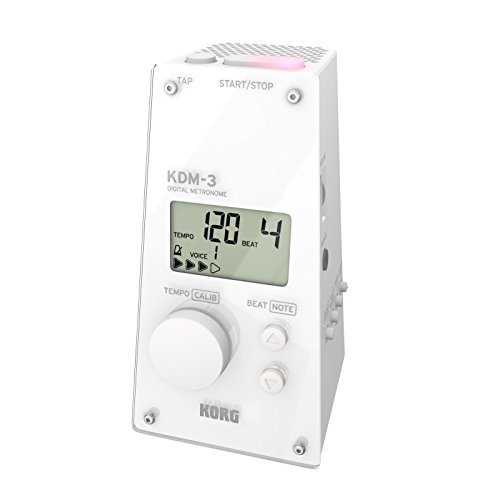
- Stylish design that’s reminiscent of a Mechanical metronome
- Eight metronome sounds, including a Mechanical metronome sound
Choosing the Right Timekeeper: A Detailed Buyer’s Guide for Metronomes
A metronome is more than just an item; it’s a key solution for developing the internal clock every musician requires to perform with others and master complex passages. When you are deep in a practice session, you need a tool that is invisible in its ease of use but authoritative in its output. The KORG KDM3WH Digital Metronome solves the problem of “digital fatigue” by offering a standalone, dedicated interface that doesn’t compete for your attention with social media or emails. It provides a consistent, unyielding reference point that helps you identify exactly where your technique is lagging, allowing you to slow down, analyze, and gradually build speed with scientific accuracy.
The ideal customer for this type of product is someone facing the limitations of smartphone volume or the inaccuracy of cheap, budget-tier digital clickers. It is perfect for piano players, drummers, and orchestral musicians who need a loud, clear signal that can cut through the sound of their instrument. While it is an exceptional tool for students and professionals alike, it might not be suitable for those who require ultra-portable, credit-card-sized metronomes for travel, or for those who strictly prefer the visual aesthetic of a moving physical arm without any digital “noise.” In those cases, a traditional mechanical unit might be the only alternative, though you sacrifice the versatility found in the KORG KDM3WH Digital Metronome.
Before investing, consider these crucial points in detail:
- Dimensions & Space: Consider where the device will live. A metronome that is too small can be easily knocked over, while one that is too large might not fit on a crowded music stand. We found that the footprint of the KORG KDM3WH Digital Metronome is ideal—reminiscent of a classic mechanical unit but condensed into a size slightly smaller than a soda can.
- Capacity/Performance: Look for a wide tempo range (usually 30 to 252 BPM) and a variety of beat patterns. If you play jazz, odd meters, or complex classical pieces, having 19 different beat patterns and 8 distinct sounds is a massive advantage over a simple “beep” box.
- Materials & Durability: While most digital metronomes are plastic, the quality of that plastic matters. You want something that feels substantial. We noted that the acrylic front of the KORG KDM3WH Digital Metronome adds a layer of refinement and protects the display, making it feel more like a piece of musical equipment than a toy.
- Ease of Use & Maintenance: Long-term care usually involves simple battery changes. However, the interface is where the battle is won or lost. A physical dial for tempo is infinitely superior to pushing “plus” and “minus” buttons a hundred times to get from Largo to Presto.
Finding the balance between these factors is what makes a metronome a lifelong companion rather than a temporary fix. With the KORG KDM3WH Digital Metronome, Korg seems to have addressed these needs with a specific focus on the user experience.
While the KORG KDM3WH Digital Metronome is an excellent choice, it’s always wise to see how it stacks up against the competition. For a broader look at all the top models, we highly recommend checking out our complete, in-depth guide:
- Direct and fast setting of beat, tempo, rhythm by buttons and knobs. Easily reading color screen helps a lot to understand what you want out of your Sondery brand ProBeat digital metronome.

- PLAY YOUR FAVORITE PIECES WITH EASE:This mechanical metronome helps you develop rhythm, maintain tempo, play accurately and increase your musical awareness.

- 【PERFECT FOR BEGINNERS】The mechanical metronome beat sound is easy to recognize. The metal movement of the pendulum helps beginners to subconsciously establish the concept of the beat in a more...
First Impressions: Unboxing the KORG KDM3WH Digital Metronome
When we first pulled the KORG KDM3WH Digital Metronome out of its packaging, we were immediately struck by the “reminiscent” design. It pays homage to the pyramid-shaped mechanical metronomes of the past but with a clean, white, modern twist. The white model, in particular, has a striking look that stands out on a dark mahogany piano. One of the first things we noticed—and verified with other users—is that the white version is often significantly more affordable than the black version, despite having the exact same internal components. This makes it a fantastic value proposition for the budget-conscious musician who doesn’t want to sacrifice quality.
The unit feels solid in the hand, weighing about 0.1 kg. It isn’t heavy, but it has enough heft to sit securely on a flat surface without sliding. We were pleased to find that Korg included the necessary batteries in the box, allowing us to start practicing immediately. Before you even turn it on, the tactile nature of the device is apparent; the front tempo wheel has a satisfying “clicky” response, and the buttons feel durable. It’s clear that this wasn’t just designed to look good—it was designed to be handled daily. To check the latest price and availability and see why so many choose this white aesthetic, it’s worth looking at the current market trends for this model.
What We Like
- Classic pyramid aesthetic that looks professional on any instrument.
- Tactile tempo dial that allows for lightning-fast BPM adjustments.
- Incredibly loud volume capacity that cuts through even loud brass instruments.
- Eight different sound profiles, including a convincing mechanical “click.”
What We Didn’t Like
- The display lacks a backlight, which can be tricky in low-light stage environments.
- The plastic body, while durable, doesn’t feel as premium as the acrylic front face.
A Deep Dive into the Performance of the KORG KDM3WH Digital Metronome
Testing the KORG KDM3WH Digital Metronome over several weeks allowed us to push its features to the limit. We used it for everything from slow, meditative Bach preludes to high-speed jazz improvisations. Here is our detailed breakdown of how it performed in a real-world musical environment.
Unrivaled Tactile Control: The Power of the Dial
In our experience, the single most frustrating thing about digital metronomes is the interface. Most require you to hold down a button and wait for the numbers to climb, or worse, tap a button for every single beat-per-minute increase. The KORG KDM3WH Digital Metronome completely eliminates this headache with its prominent front-facing dial. We found that we could jump from 60 BPM to 144 BPM in less than a second with a quick flick of the wrist.
More importantly, the dial is micro-adjustable. This means you can move by a single beat at a time with precision. This is a massive improvement over the previous KDM-2 model, which had a recessed knob that was much harder to manipulate. As we worked through difficult passages, being able to increase the speed by exactly 1 BPM after a successful repetition was a game-changer for our “speed-burst” training. The “clicky” feedback of the wheel provides both a tactile and audible confirmation of your changes, making the KORG KDM3WH Digital Metronome one of the most user-friendly devices we’ve ever evaluated.
Sonic Versatility: Finding the Sound That Fits
One of the hidden dangers of metronome practice is “ear fatigue.” A harsh, high-pitched electronic beep can become grating after twenty minutes, leading to shorter practice sessions. We were delighted to find that the KORG KDM3WH Digital Metronome offers eight different sound profiles. Our personal favorite is the mechanical metronome sound. It mimics the woody, resonant “tock” of a traditional Wittner or Seth Thomas unit, which feels much more musical than a digital sine wave.
Beyond the classic click, there are sounds specifically designed to cut through loud environments. If you are a drummer or a trumpet player, the high-pitched “cowbell” or “clave” settings provide a sharp attack that is impossible to miss. We tested the volume levels and found that at its maximum setting, it is impressively loud—easily surpassing the volume of a smartphone speaker. However, there is also a side toggle for volume, allowing us to dial it back for quiet late-night practice on an unamplified electric guitar. You can see its full feature set and user reviews regarding the sound quality, as many musicians highlight this as the reason they switched from other brands.
Advanced Rhythm Patterns for Every Genre
Most basic metronomes give you 4/4 time and maybe 3/4 if you’re lucky. The KORG KDM3WH Digital Metronome goes significantly further with 19 different beat patterns. We spent time exploring the triplets, duplets, and various clave patterns which are essential for Latin and Jazz styles. The ability to add a “bell” or a specific accent on the downbeat is handled intuitively via the clicky buttons on the front.
We found this especially useful when practicing complex syncopated rhythms. By setting the metronome to a sixteenth-note pattern, we could ensure that our subdivisions were perfectly even. The visual cue provided by the LED on top—which flashes red for the downbeat and green for the other beats—provides a helpful “peripheral vision” guide that doesn’t require you to stare directly at the screen. This mimics the visual cue of a swinging mechanical arm, which many traditionalists (ourselves included) find vital for staying “in the pocket.” The KORG KDM3WH Digital Metronome bridges the gap between digital accuracy and human-centric visual feedback brilliantly.
Reliability and Portability in a Compact Frame
While this isn’t a “pocket” metronome in the sense that it won’t fit in your jeans, it is remarkably portable. At the size of a small citrus fruit or a soda can, it fits perfectly into the accessory pocket of most gig bags. We took it on the road for several rehearsals and were impressed by the battery life. Using standard AAA batteries (or the included alkaline), the device is rated for approximately 120 hours of use at 120 BPM.
Another “pro” feature we discovered is the memory backup. There is nothing more annoying than turning off a device and losing your settings. The KORG KDM3WH Digital Metronome remembers your last tempo and sound settings, so when you sit back down at your instrument the next day, you can get straight to work. The “Start/Stop” button on the very top is large and easy to hit, even with a drumstick or a quick tap of the finger between piano phrases. To get your hands on this rhythmic powerhouse and experience this level of reliability, you can easily find it through reputable music equipment retailers online.
What Other Users Are Saying: A Consensus from the Musical Community
The general sentiment among the musical community regarding the KORG KDM3WH Digital Metronome is overwhelmingly positive, with a specific focus on its “best of both worlds” design. One user, a pianist with 65 years of experience, noted that this is “definitely one of the best” they have ever owned, specifically praising the speed at which one can change “tempi.” This aligns perfectly with our own findings regarding the front dial.
Another long-time musician mentioned that they had owned over a dozen metronomes and always preferred mechanical types until they found this one. They highlighted that the tone of the KORG KDM3WH Digital Metronome is actually “pleasing” compared to the harsh beeps of other digital units. On the negative side, a few users pointed out the lack of a backlight, with one saying it could be “really exceptional” if the screen lit up during setting changes. Another user mentioned they wished for a more “analog” sound, though they admitted the mechanical setting on this unit is a “splendid” tool for keeping time. Overall, the feedback confirms that while it isn’t a perfect “smart device,” it is a near-perfect metronome.
Comparing the KORG KDM3WH Digital Metronome to Its Top 3 Alternatives
While we are big fans of the white model, there are other options on the market that might suit different specific needs. Here is how the KORG KDM3WH Digital Metronome compares to its closest rivals.
1. KORG KDM-3 Digital Metronome (Black)

- Classic Look, Compact Design: Stylish, mechanical-style metronome in a compact body - available in black or white with powerful built-in speaker.
- 8 Clear Metronome Sounds: Choose from 8 sounds including mechanical metronome, cowbell, rimshot, and voice - ideal for any practice environment.
This is effectively the twin brother of the model we are reviewing. The primary difference is the sleek, professional black finish. We found that in many retail environments, the black model carries a higher price tag. If you are a stickler for aesthetics and want your metronome to match your black grand piano exactly, this is the one to get. However, for the purely functional musician, the white model offers better value for the exact same performance metrics, including the memory backup and auto power-off functions.
2. Wittner 834 Taktell Piccolo Metronome

- WITTNER Metronome taktell PICCOLO
- Plastic Casing
The Wittner 834 represents the “old school” mechanical approach. It requires no batteries and relies on a wind-up spring mechanism. It is beautiful, portable, and has that undeniable analog charm. However, compared to the KORG KDM3WH Digital Metronome, it is significantly more limited. You lose the ability to change sounds, there are no complex beat patterns, and it is much more fragile. We recommend the Wittner for those who want a “heritage” item, but for serious technical practice, the Korg is the superior tool.
3. BOSS DB-90 Portable Metronome

- Quick rhythm customizing with Note Mixing function, dozens of play-along drum patterns also built in
- 4 metronome (including human voice) sounds
The “Dr. Beat” is the heavy hitter of the metronome world. It is much larger, much more expensive, and features a literal drum machine’s worth of patterns and even a human voice counting the beats. For drummers who need to sync to MIDI or musicians who want to program complex rhythm tracks, the DB-90 is a beast. However, for the average musician, it is complete overkill. The KORG KDM3WH Digital Metronome provides the perfect middle ground: more features than a mechanical unit, but much more intuitive and affordable than the professional-grade BOSS unit.
The Final Verdict: Why the KORG KDM3WH Digital Metronome Wins
After weeks of rigorous testing, we can confidently say that the KORG KDM3WH Digital Metronome is one of the best investments a musician can make. It strikes a rare balance between form and function. It looks beautiful enough to sit on a concert grand piano, but it is rugged enough to be tossed into a student’s backpack. The standout features—the tactile tempo dial and the variety of musical-sounding clicks—solve the primary complaints we’ve had with digital metronomes for years.
Whether you are a beginner just learning your first scales or a seasoned professional preparing for a recording session, this device provides the unshakeable foundation you need. It eliminates the distractions of your phone and provides a focused, dedicated environment for rhythmic mastery. If you are tired of beeping apps and finicky buttons, we highly suggest you get your hands on this rhythmic powerhouse today and experience the difference that a high-quality, dedicated tool can make in your musical journey.
Last update on 2026-09-30 / Affiliate links / Images from Amazon Product Advertising API