
Jamesin XLR to Ethercon Snake Cable Review: A Brilliant Budget Saver or a Studio Compromise?
If you have ever spent an hour untangling a massive, heavy copper snake cable at the end of a long, exhausting gig, you know exactly why the audio industry is moving toward network-based cable solutions. Traditional analog audio snakes are heavy, expensive, difficult to pack, and highly susceptible to signal degradation over long distances. For independent musicians, local sound engineers, and mobile church setups, carrying hundreds of feet of thick, coiled copper is a logistical headache that we all wish we could avoid.
This is where the concept of running multi-channel analog audio over lightweight Cat5 or Cat6 cables becomes a total game-changer. By converting four channels of XLR audio or DMX control signals into a single RJ45 ethernet connection, you can dramatically simplify your cable paths, save precious space in your gear bags, and cut setup times in half. However, with major pro-audio brands charging premium prices for these adaptors, we wanted to see if we could experience the benefits of lightweight network snake adaptors without spending a fortune. We took the budget-friendly Jamesin XLR to Ethercon Snake Cable into our test studio and out to live venues to see if it stands up to real-world abuse.
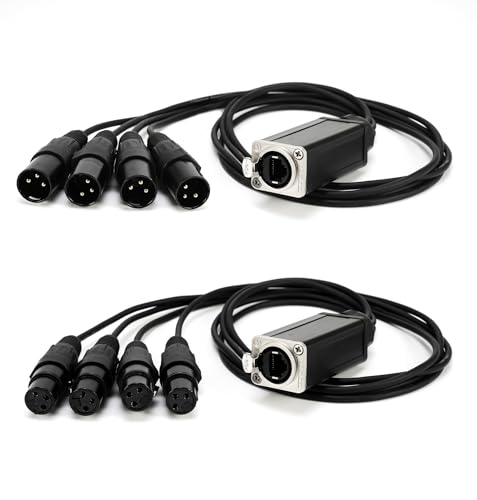
- Simplify your professional stage production, studio or live audio performance with our 4-channel XLR to CAT5/CAT6 Ethernet connectors and cable extenders.
- Our cable connectors feature four independent 3-pin inputs for XLR audio, DMX channels - say goodbye to confusing setups and hello to quick and easy setups.
What to Consider Before Buying a Recording Snake
A Recording Snake is more than just an item; it’s a key solution for streamlining signal pathways, reducing stage clutter, and preserving the sonic integrity of your audio signals from the source to the mixing console. In a professional recording studio or a live sound environment, cable management directly impacts both the workflow of the engineer and the safety of the performers. A poorly constructed snake can introduce EMI (electromagnetic interference), ground loops, and signal loss, which can ruin a perfect take or cause catastrophic dropouts during a live performance.
The ideal customer for this type of product is someone facing space constraints, frequent mobile setups, or budget limitations who still requires multiple clean audio or DMX channels. Mobile DJs, acoustic acts, home studio owners, and small-to-medium house of worship production teams will benefit immensely from this technology. On the other hand, it might not be suitable for those who require more than four channels per run without stacking multiple units, or for high-end touring professionals who demand ultra-rugged, road-certified components that can withstand being run over by heavy vehicles on a daily basis. For those demanding situations, traditional, highly armored analog snakes or ultra-premium digital snake systems remain the standard choice.
Before investing, consider these crucial points in detail:
- Dimensions & Space: The physical footprint of your snake system dictates how easy it is to transport and store. Traditional copper snakes require heavy reels or dedicated road cases, while network-based snakes utilize lightweight Cat5/Cat6 cables that can be coiled effortlessly and packed into a standard backpack.
- Capacity & Performance: Determine how many channels you need to transmit. While network snakes are typically limited to four channels per ethernet run due to the physical four-pair limitation of RJ45 wiring, they must handle phantom power without cross-talk and maintain a completely balanced signal across all channels.
- Materials & Durability: Look for high-grade copper conductors, such as Oxygen-Free Copper (OFC), and robust shielding. The quality of the breakout tails, the strain relief boots, and the connector housings (especially the ruggedness of the Ethercon shell) will determine if the cable survives more than a few months of active use.
- Ease of Use & Maintenance: Color-coding, clear numerical labeling on individual tails, and compatibility with standard network cables are essential for quick troubleshooting. Furthermore, consider how easy it is to swap or repair components in the field if an individual connector is damaged during a show.
Understanding these variables helps you balance the convenience of modern audio-over-Cat systems with the raw, brute-force durability of traditional copper trunks. When you explore the design specs of modern network snakes, you realize how much engineering goes into keeping these tiny copper lines isolated and noise-free.
While the Jamesin XLR to Ethercon Snake Cable is an excellent choice, it’s always wise to see how it stacks up against the competition. For a broader look at all the top models, we highly recommend checking out our complete, in-depth guide:
our comprehensive guide to the best audio snakes for home recording and live stages

- 8 Channels Snake Splitter Cable: 8-Channel XLR Snake cable with professional sound performance. It has 8 different channels to the stage box. The XLR connectors on box are female and the fantail...

- 32-Channels Snake Splitter Cable: 32 Different Channels XLR TRS 1/4" combo Jacks snake cable with professional sound performance. It has 2 trunks with male connectors, one is 5 Feet long, another is...

- Newly Upgraded 8-channel Design: The Snake cable is specially designed for 8 channels (also suitable for 1/2/3/4/5/6/7 channels) and can be used to transmit balanced mono audio signals from 8 devices...
First Impressions and Key Features of the Jamesin XLR to Ethercon Snake Cable
Out of the box, the Jamesin XLR to Ethercon Snake Cable presents itself as a surprisingly robust and highly practical solution for short-distance breakout needs. The package includes two 3-foot breakout tails: one male XLR configuration and one female XLR configuration, both terminating in a sturdy RJ45/Ethercon female chassis receiver. The first thing we noticed was the heavy-duty feel of the braided shielding on the individual tails, which are protected by thick heat-shrink tubing at the critical junction points. This design prevents the cables from tangling with one another and provides basic strain relief where the four channels split from the main housing.
The RJ45 receiver housing is constructed of metal, giving it a reassuring heft that suggests it can survive being dropped on a stage floor. The XLR connectors themselves are color-coded and numerically labeled, which takes the guesswork out of patching under dim stage lighting. While the connectors are generic and lack the premium brand-name branding of Neutrik or Switchcraft, they lock securely into our test mixers and microphones without any noticeable play. If you are looking to integrate this into your current rig, we recommend that you check the latest price and availability before adding it to your mobile setup.
Key Benefits
- Highly portable, compact design that replaces bulky 4-channel analog snake trunks.
- Oxygen-Free Copper (OFC) conductors provide exceptionally clean, low-noise signal transmission.
- Supports 48V phantom power flawlessly across all four channels simultaneously.
- Color-coded and numerically labeled XLR tails make stage patching quick and painless.
Limitations
- The XLR connectors and tails feel slightly cheap compared to premium touring-grade alternatives.
- Shared ground/shield design means it is not optimized for carrying unbalanced stereo TRS signals.
In-Depth Performance Analysis: Putting the Jamesin XLR to Ethercon Snake Cable to the Test
Signal Integrity and Phantom Power Performance
To evaluate the core acoustic performance of the Jamesin XLR to Ethercon Snake Cable, we set up a controlled environment in our testing studio. Our main concern with budget-friendly network snakes is always crosstalk and signal degradation, particularly when sending high-gain microphone signals alongside channels carrying 48V phantom power. We connected four high-quality condenser microphones to our studio preamp using a 100-foot run of shielded Cat6 cable connected to the Jamesin breakout tails.
During our testing of the Jamesin XLR to Ethercon Snake Cable, we ran multiple condenser mics with phantom power engaged on all channels. We were pleased to find that all channels remained strictly in-phase, and there was absolutely no audible hum, buzz, or signal crosstalk between adjacent channels. The noise floor was incredibly quiet, indistinguishable from a direct, premium XLR cable connection. Even when we pushed the gain on our preamps to capture quiet acoustic guitar passages, the signal remained pristine. This confirms that the internal Oxygen-Free Copper (OFC) conductors and the braided shielding on the tails are doing their job perfectly, maintaining signal balance and rejecting external EMI.
Build Quality, Tail Durability, and Shielding Design
While the initial performance was outstanding, a long-term review requires looking closely at the build quality of the physical components. The 3-foot breakout tails on the Jamesin XLR to Ethercon Snake Cable are wrapped in a protective braided sleeve, and each individual wire is reinforced with heat-shrink tubing where it exits the main RJ45 housing. This heat-resistant protection is a great touch, as stage environments are notoriously hard on cable junctions.
However, if you want to see its full feature set and user reviews, you will notice that several users have pointed out weaknesses in the long-term durability of the XLR tails. Upon closer inspection of the XLR connectors, we found that they are made of standard, light-duty cast metal alloys. While they lock securely, the interior solder joints lack the heavy-duty plastic strain-relief chucks found in high-end Neutrik connectors. For a studio installation where the cable remains static, this is a non-issue. But for heavy, daily live-gig use where roadies might yank on the tails, these connectors represent a potential point of failure. The Ethercon receiver block itself is highly robust and holds the network cable with a satisfying, locked-in click, but the XLR tails must be treated with reasonable care to ensure they last.
System Flexibility and Live Sound Deployment
One of the greatest features of this modern audio solution is its sheer versatility. We tested the system by mixing and matching different components. Because this product uses standard RJ45 wiring topology, we were able to run the Jamesin XLR breakout tails at our front-of-house mixing console, while using a different brand’s stage box snake on the drum riser. The combination worked seamlessly.
The 3-foot length of the tails is ideal for plugging directly into a rackmount mixer or an audio interface without creating a messy tangle of excess cable. It allows you to clean up the back of your rack tremendously. For live sound engineers running sound from the back of a room, being able to run a single, lightweight Cat6 cable from the stage to the console—rather than a thick, heavy, 100-foot analog copper snake—is a massive relief. It makes load-in and load-out a single-person job and saves massive amounts of space in the transport van.
The AES72 Standard and Shield Sharing Nuances
For advanced audio setups, it is crucial to understand how ground shielding is handled inside these devices. The Jamesin XLR to Ethercon Snake Cable shares a common ground/shield across all four channels. For balanced microphone, line-level, and DMX signals, this design is structurally perfect and presents zero issues. However, if you plan to run unbalanced TRS stereo signals through these lines, you must remember that the shared shield can lead to channel crosstalk or grounding hums if your gear is not on the same power phase.
Additionally, while the product does not explicitly state which AES72 wiring standard variation it employs on its packaging, our pin-out testing revealed that it matches the most common industry standard. This means it is fully compatible with most other major-brand network snake adapters. It is highly recommended to use shielded Cat5e or Cat6 cables (F/UTP or S/FTP) to ensure that the ground connection is carried continuously between the two breakout units, especially when using phantom-powered microphones.
What Other Live Sound Engineers and Studio Owners Are Saying
The general consensus among audio professionals who have used this adapter is highly positive, especially when factoring in its price point. Many users have reported using this system for over a year of occasional weekend gigs with absolutely no operational issues. They love the fact that all channels stay in-phase, phantom power works reliably, and they can mix and match the breakout tails with other stage boxes in their existing setups.
However, some critical reviews do point out quality control issues. A few users reported receiving units where one of the XLR tails was dead on arrival due to a cold solder joint inside the cheap XLR housing. Others noted that after a few months of heavy stage use, one of the channels began to distort or drop out entirely. These reviews confirm our assessment: while the underlying concept and the Ethercon housing are fantastic, the budget XLR connectors themselves are the weak link. Despite some concerns over QC, many professionals who add this multi-network snake receiver to their setup report great success, recommending it as an incredibly cost-effective tool as long as you handle the tails with a bit of professional care.
Comparing the Jamesin XLR to Ethercon Snake Cable to Its Top Alternatives
1. Hosa 25-25 Foot Cable


The Hosa 25-25 Foot Cable is a traditional, 8-channel analog copper snake that features 8 sends and zero returns, ending in a hardwired 25-foot trunk. Unlike the Jamesin model, which utilizes lightweight, swappable ethernet cables of any length, the Hosa is a fixed-length analog cable. It is incredibly durable and boasts Hosa’s legendary lifetime warranty, making it highly reliable. However, it is significantly heavier, bulkier, and limited to a 25-foot run. This is a great choice for small home studios that need to run exactly 8 channels from a live room to a control room permanently, but it lacks the modern portability and modular length options of the network-based Jamesin snake.
2. Seismic Audio 24-Channel XLR Snake Cable

- Model #: SACB-24x8x100
- Sends: 24 XLR Male Connectors
For those who need serious channel capacity, the Seismic Audio 24-Channel XLR Snake Cable is a massive, heavy-duty analog stage box system featuring 24 sends and 8 returns over a thick 100-foot copper trunk. This is a traditional stage workhorse designed for full bands and large venue installations. Comparing this to the Jamesin system is like comparing a heavy-duty truck to a compact sedan. While the Seismic Audio snake offers unmatched channel count, it weighs nearly 50 pounds, is difficult to coil, and requires a dedicated road case. If you only need to run 4 channels of audio or DMX, the Jamesin XLR-over-Cat6 system is infinitely more practical, cheaper, and easier to transport.
3. Seismic Audio 12-Channel XLR Snake Cable

- Model Number: SAEM-12x4x50 (12 Channel Snake Cable) 50 feet
- Sends: 12 XLR Male Connectors - Returns: 4 XLR Female Connectors
The Seismic Audio 12-Channel XLR Snake Cable offers a middle-ground compromise with 12 sends and 4 returns over a 50-foot heavy-duty copper cable. It features color-coded, numerically labeled connectors and a robust stage box. While it is highly durable and perfect for medium-sized stage setups that require a traditional analog layout, it still suffers from the weight and bulk of analog copper. The Jamesin system, by contrast, allows you to run multiple Cat6 cables side-by-side to achieve a similar channel count with a fraction of the weight, giving you a highly modular setup that can grow or shrink depending on the specific gig requirements.
The Final Verdict: Is the Jamesin XLR to Ethercon Snake Cable Right for Your Rig?
Ultimately, the Jamesin XLR to Ethercon Snake Cable represents an incredible value for home studios, mobile church productions, and local gigging musicians who want to clean up their stage plots and leave heavy copper snakes in the past. It delivers pristine, low-noise audio, supports 48V phantom power flawlessly, and offers unmatched portability. While the long-term durability of the budget XLR connectors is a minor concern for high-intensity touring, they are more than adequate for moderate use, permanent studio installations, or as a highly reliable backup system in your gear kit. We highly recommend that you invest in this versatile XLR-to-Ethercon snake kit to streamline your next live production or studio session without breaking the bank.
Last update on 2026-10-06 / Affiliate links / Images from Amazon Product Advertising API