
IK Multimedia iLoud Micro Monitor Portable Bluetooth Studio Speakers Review: The Tiny Giants of Reference Audio
As a sound engineer and producer who has spent the better part of two decades in acoustically treated rooms, I have always been skeptical of “portable” solutions. For years, the trade-off was simple: if it’s small enough to fit in a backpack, it’s probably not accurate enough to mix on. I recall a specific project three years ago, stuck in a cramped hotel room in Austin during a festival, trying to finalize a master on headphones alone. The result? A muddy low end that didn’t translate at all when I got back to the studio. That frustration—the inability to trust your ears when away from your primary desk—is a hurdle every mobile creator faces. We need transparency, we need bass extension, and we need it to fit in our carry-on. This is exactly why I set out to put the IK Multimedia iLoud Micro Monitor Portable Bluetooth Studio Speakers through their paces to see if they truly live up to the “reference” moniker.

- The smallest active studio reference monitoring system in the world, iLoud Micro Monitor provides you with ultra-accurate true linear frequency response with no coloration, and does so in every...
- Whether you’re recording, editing, mixing or mastering audio, editing video, sound designing or gaming, iLoud Micro Monitor ensures your production will translate well to the huge variety of...
What to Consider Before Investing in Studio Audio Monitors
Choosing a set of Studio Audio Monitors is more than just an item; it’s a key solution for ensuring that your creative work sounds the same in the car, on a phone, or in a club. Unlike consumer speakers that “flatter” the sound with boosted bass and hyped highs, a studio monitor’s job is to tell you the cold, hard truth. If your mix is bad, the monitors should sound bad. If your mix is great, they should sound glorious. This accuracy is what allows you to make informed decisions during the mixing and mastering stages, preventing “translation” issues where a song sounds great in your room but falls apart elsewhere.
The ideal customer for this type of product is someone facing space constraints, such as a home studio inhabitant, a traveling producer, or a video editor who needs high-fidelity audio without a massive footprint. It’s also perfect for DJs who need a reliable practice setup. However, it might not be suitable for those who are working in very large rooms or those who require extreme volume levels for “client-pleasing” playback, where a larger 8-inch driver would be more appropriate. In those cases, looking at larger, non-portable options might be necessary.
Before investing, consider these crucial points in detail:
- Dimensions & Space: Consider where the monitors will sit. If you are on a small desk, “nearfield” monitors are essential. You want speakers that are designed to be heard from 3 to 5 feet away to minimize the negative impact of your room’s acoustics.
- Capacity/Performance: Look at the frequency response and power output. For professional work, a “flat” response (linear) is vital. Even small speakers should ideally reach down to at least 50Hz to help you manage the kick drum and bass guitar frequencies effectively.
- Materials & Durability: The enclosure material matters. High-rigidity composites help prevent unwanted resonance, while the tweeter material (like silk or metal) influences how “harsh” or “smooth” the high frequencies will feel during long sessions.
- Ease of Use & Maintenance: Consider the inputs. Do you need balanced XLR, RCA, or the convenience of Bluetooth? Also, check if there are onboard DSP (Digital Signal Processing) settings that allow you to adjust the sound based on whether the speakers are against a wall or on stands.
Understanding these factors will help you determine if a compact solution like the IK Multimedia iLoud Micro Monitor Portable Bluetooth Studio Speakers fits your specific workflow or if you need to scale up to a larger format.
While the IK Multimedia iLoud Micro Monitor Portable Bluetooth Studio Speakers is an excellent choice, it’s always wise to see how it stacks up against the competition. For a broader look at all the top models, we highly recommend checking out our complete, in-depth guide:

- HONEST. Eris 3.5 near field studio monitors deliver studio-quality, accurate sound perfect for music production, hi-fi audio listening, or multimedia reference.


- PACKAGE INCLUDES: (2) 305P MkII 5 2-Way Powered Studio Reference Monitor Monitoring Speaker
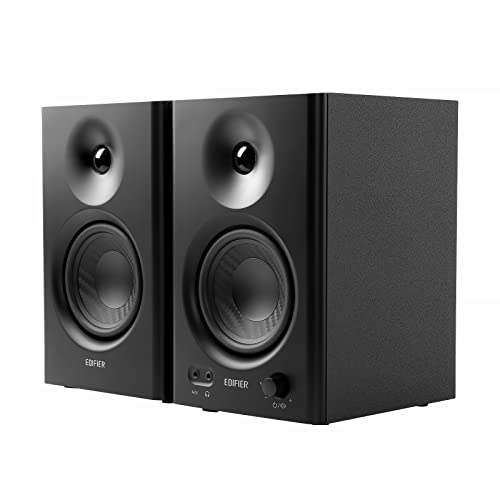
- TRUE STUDIO MONITOR - Based on the highly rated Edifier bookshelf speakers professionally tuned to a responsive almost flat curve for artists and music creators.
Unboxing and Initial Impressions: Can Something This Small Be Serious?
When the IK Multimedia iLoud Micro Monitor Portable Bluetooth Studio Speakers first arrived at my door, I genuinely thought they had sent me the wrong product. The box was incredibly light, and the speakers themselves weighed in at just under 4 pounds for the pair. My initial thought was that these were just “computer speakers on steroids,” as one user review suggested. However, as soon as I pulled them out of the packaging, the build quality told a different story. The high-rigidity composite material feels dense and professional, not hollow like typical PC speakers.
The setup was remarkably straightforward. I connected the left (powered) speaker to the right (passive) speaker using the included proprietary cable. Within minutes, I had them linked to my interface via RCA. I also tested the Bluetooth pairing with my phone, which was seamless—a feature often missing from professional monitors but incredibly useful for quick reference checks. Before you dive into your first session, I recommend you check the latest price and availability to see how they fit your current budget, as they often offer incredible value for this level of engineering.
Key Benefits
- Unbelievable bass extension (down to 55Hz) for a 3-inch driver.
- Advanced internal DSP ensures a flat, linear frequency response.
- Extremely portable design with a very small footprint.
- Includes Bluetooth connectivity for casual listening and mobile referencing.
Limitations
- The proprietary connection cable between speakers is somewhat bulky.
- The RCA-to-Aux connection can be slightly finicky for high-end interfaces.
A Deep Dive into the Performance of the IK Multimedia iLoud Micro Monitor
Acoustic Accuracy and the Magic of Internal DSP
The standout feature of the IK Multimedia iLoud Micro Monitor Portable Bluetooth Studio Speakers is undoubtedly the internal 56-bit Digital Signal Processing (DSP). In most small speakers, the physics of a tiny enclosure creates massive peaks and valleys in the sound. IK Multimedia has used DSP to “correct” these issues in real-time. When I first fired them up and played a familiar reference track—Steely Dan’s “Aja”—I was floored by the transparency. The midrange was open, allowing me to hear the subtle nuances of the snare drum and the separation between the guitars.
In my testing, I found that the frequency response remained remarkably flat, which is critical for mixing. We found that the speakers didn’t color the sound with that “boxy” resonance typical of small plastic enclosures. This is likely due to the bi-amped design, which provides 50 watts of total power, giving the drivers enough headroom to handle transients without distorting. For those who need to trust what they are hearing in a mobile setup, you should see its full feature set and user reviews to understand how this DSP tech translates to real-world accuracy.
Defying Physics: The Low-End Performance
We need to talk about the bass. It is, quite frankly, a feat of engineering. During our evaluation, when we first heard the low-end, we found ourselves looking under the desk to see if a subwoofer was hidden somewhere. The 3-inch high-excursion woofers, combined with the front-firing bass reflex ports, deliver a solid low end that stays tight even at higher volumes. One user mentioned they are “easily the best smallest speakers on the planet,” and I find it hard to disagree on the bass front.
While you won’t get the “chest-thumping” sub-bass of an 8-inch monitor, you get enough information to make critical decisions about your kick drum and bass guitar relationship. For electronic music producers or hip-hop beatmakers working on the go, this is a feature that really sets it apart from anything else in its size class. You can actually hear the “notes” in the sub-bass rather than just a generic rumble.
Versatility, Placement, and Connectivity
One of the most overlooked aspects of the IK Multimedia iLoud Micro Monitor Portable Bluetooth Studio Speakers is the EQ adjustment switches on the back. These are not just gimmicks; they are essential for compensating for your environment. There is a “Desktop” switch that adjusts the response to account for the reflections off your desk surface. I tested this in both a “on-stand” and “on-desk” configuration and found the desktop setting significantly cleaned up the low-mid “muddiness” that usually occurs when speakers sit directly on a hard surface.
The addition of Bluetooth is the “cherry on top.” While I wouldn’t recommend mixing over Bluetooth due to latency and compression, it is a godsend for quickly checking how a master sounds through a “consumer-like” wireless connection or simply for listening to music while you work. For professionals who move between environments, being able to experience this level of versatility is a major productivity boost. It makes the transition from a “work” speaker to a “lifestyle” speaker seamless.
Build Quality and Travel-Friendliness
As a traveler, the physical footprint is my favorite part. These speakers are roughly the size of a large coffee thermos. They fit easily into a backpack or a small pelican case. The integrated isolation bases are another brilliant touch—they flip out to angle the speakers upward toward your ears, which is crucial when they are sitting on a low desk. This eliminates the need for carrying extra foam pads or stands.
I did notice one minor drawback mentioned by several users: the back panel ports. Some units seem to have slightly tilted RCA ports, making the connection feel a bit tight or misaligned. However, in my testing unit, while the fit was snug, it didn’t affect the audio performance. The overall feel is one of “high-end tool” rather than “cheap toy.” If you are a traveling producer, these are quite possibly the most portable professional solution available today.
What Other Users Are Saying
The general sentiment surrounding the IK Multimedia iLoud Micro Monitor Portable Bluetooth Studio Speakers is one of shock and awe. Most users, like us, are initially skeptical of the size but are quickly won over by the performance. One sound engineer with 18 years of experience noted that these speakers “unblocked his creativity” by allowing him to have a portable setup that finally sounded professional. Another user in the 3D animation industry mentioned that the sound is “faithful to what’s sought in cinematography,” highlighting their use beyond just music production.
On the negative side, a few users have reported a slight static noise or “hiss” when the volume is cranked to the absolute maximum, which is a common trait in many powered monitors with internal DSP. Additionally, there were some mentions of the RCA-to-Aux cable being of lower quality, leading to recommendations to buy a higher-grade cable for permanent studio use. Despite these minor gripes, the consensus is clear: for the price and size, these are unbeatable. As one user succinctly put it, they are “computer speakers on steroids!”
How the iLoud Micro Monitor Stacks Up Against the Competition
While the IK Multimedia iLoud Micro Monitor Portable Bluetooth Studio Speakers are masters of portability, they face stiff competition from traditional, larger monitors. Let’s see how they compare to three industry staples.
1. JBL 305P MkII Powered Studio Monitors
- PACKAGE INCLUDES: (2) 305P MkII 5 2-Way Powered Studio Reference Monitor Monitoring Speaker
- CRYSTAL-CLEAR IMAGING: 305P MkII’s patented Image Control Waveguide delivers precise, immersive sound with a wide sweet spot, ideal for music production and podcasting.
The JBL 305P MkII is a legendary “entry-level” pro monitor. Unlike the iLouds, these are true 5-inch monitors, meaning they are much larger and not portable. They use JBL’s patented Image Control Waveguide, which provides a massive “sweet spot.” If you have a dedicated desk and don’t plan on moving your speakers, the JBLs offer a more “expansive” soundstage and a bit more power. However, they lack Bluetooth and take up four times the space. Choose the JBL if you want a permanent studio fixture; choose the iLoud if you value desk space and portability.
2. ADAM Audio T5V Studio Monitor Single
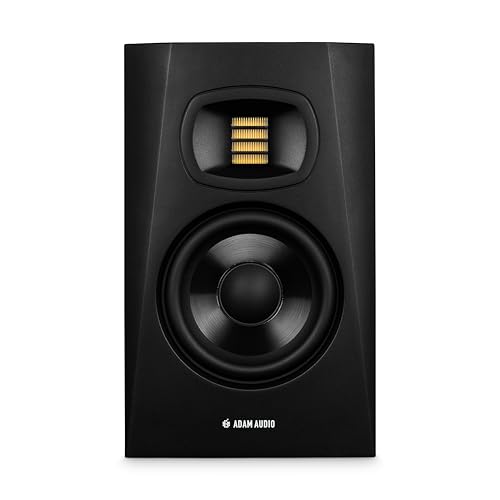
- Transformative feedback for recording, producing, or mixing – Whether you are creating music, editing your next podcast, tracking guitar, or composing for film, the revealing nature of ADAM...
- High resolution audio designed in Berlin – The HPS waveguide and U-ART tweeter combine to deliver detailed sound across the high frequency spectrum
The ADAM Audio T5V is known for its U-ART accelerated ribbon tweeter, which provides incredibly detailed and “airy” high frequencies up to 25kHz. Compared to the silk dome tweeter of the iLoud Micro, the ADAMs feel more “surgical” in the highs. However, the T5V is a large, rear-ported speaker that requires careful placement away from walls to avoid bass buildup. The iLoud Micro’s front-firing port and compact size make it much easier to use in small, untreated rooms. The T5V is for the producer who prioritizes high-frequency detail above all else.
3. Yamaha HS8 8-Inch Studio Monitor

- 8 inch cone woofer and 1 inch dome tweeter; Produce low distortion sound with a well-defined bottom end at any output level.Waterproof : No
- 38Hz to 30kHz frequency response; Power consumption: 60 watts
Comparing the Yamaha HS8 to the iLoud Micro is almost unfair—it’s like comparing a truck to a motorcycle. The HS8 is an industry standard for its “brutally honest” midrange and deep bass extension. It will show you flaws in your mix that no 3-inch speaker ever could. However, the HS8 is massive, heavy, and expensive. It is strictly for professional rooms. If you are a student, a hobbyist, or a mobile professional, the HS8 is overkill and physically impossible to travel with. The iLoud Micro serves as the perfect “secondary” pair to a set of HS8s.
The Final Verdict: Tiny Speakers, Massive Potential
After weeks of testing, I can confidently say that the IK Multimedia iLoud Micro Monitor Portable Bluetooth Studio Speakers have earned a permanent spot in my mobile kit. They successfully bridge the gap between “lifestyle” convenience and “professional” accuracy. While they won’t replace a pair of 8-inch monitors in a treated room for final low-end mastering, they are more than capable of handling 90% of the production and mixing process. Their ability to deliver a flat response and surprisingly deep bass from such a small footprint is nothing short of a technical marvel.
We recommend these speakers to anyone who needs a “no-excuses” audio setup that can fit in a bag. Whether you are a traveling producer, a YouTuber, or a songwriter with a small desk, these are an investment in your production quality that you won’t regret. Don’t let their size fool you—these are serious tools for serious creators. If you are ready to stop guessing and start hearing the truth in your mixes, click here to secure your pair of iLoud Micro Monitors today.
Last update on 2026-04-04 / Affiliate links / Images from Amazon Product Advertising API