
Ibanez B200 Banjo Review: The Professional’s Secret to Budget Bluegrass Brilliance
For many aspiring pickers, the journey into the world of bluegrass often starts with a difficult choice. On one hand, you have the “entry-level” instruments—often little more than toys with strings that buzz, rattle, and lose their tune before you’ve even finished a chorus of “Cripple Creek.” On the other hand, you have the professional-grade heirlooms that cost more than a used car. When I first started looking for a reliable instrument to bridge that gap, I felt stuck. I needed something that looked traditional, felt substantial, and—most importantly—delivered that punchy, “crackling” resonator sound that defines Scruggs-style playing. I wasn’t just looking for a hobbyist tool; I was looking for an instrument that wouldn’t hold me back as my skills progressed. This search eventually led me to the Ibanez B200 Banjo, a model that promises vintage aesthetics with modern reliability. Solving the dilemma of “price vs. performance” is crucial because a poor instrument can actually kill your motivation to practice. If you are struggling with a banjo that won’t stay in tune or sounds thin, the Ibanez B200 Banjo might just be the solution you’ve been searching for.

- 5-string Banjo with Mahogany Bowl and Neck
- Remo Weatherking Head - Natural
What to Consider Before Buying Your Next Banjo: A Detailed Buyer’s Guide
A banjo is more than just an item; it’s a key solution for any musician looking to inject a specific, rhythmic drive into their music that no other instrument can provide. Whether you are aiming for the high-velocity rolls of bluegrass or the melodic clawhammer styles of folk, the banjo provides a percussive string attack that defines entire genres. The problem many buyers face is not understanding the technical components that contribute to that sound. Choosing the wrong “pot” assembly or tone ring can result in a flat, lifeless tone that fails to project in a jam session.
The ideal customer for this type of product is an intermediate player looking for their first “real” resonator banjo, or a serious beginner who wants to start on an instrument they won’t outgrow in six months. It’s for someone who appreciates the weight and resonance of traditional materials like mahogany and brass. While it might not be suitable for those who prefer the light, mellow “plunk” of an open-back banjo for old-time music, or for professional touring musicians who might require a boutique $5,000 custom build, it serves the 90% of players in between perfectly. Before you dive in, you might want to see its full feature set and user reviews to understand why it stands out in its price bracket.
Before investing, consider these crucial points in detail:
- The Tone Ring Material: This is the heart of the banjo’s sound. Many budget models use aluminum “multi-bracket” systems. However, a rolled brass tone ring, like the one found in the Ibanez B200 Banjo, provides a significantly warmer, more resonant, and professional “ring” that cuts through the mix without sounding shrill.
- Rim and Resonator Construction: The rim is the wooden circle the head sits on. Look for multi-ply wood (like basswood) paired with a mahogany resonator. This combination offers a balanced tonal profile, providing enough low-end “thump” to support the high-end “sparkle” of the strings.
- Tension Hook Configuration (Lugs): The number of lugs (brackets) determines how evenly you can tension the drum head. A 24-lug configuration is the industry standard for high-quality banjos because it allows for micro-adjustments to the head’s tightness, which directly impacts the “brightness” of your tone.
- Ease of Playability and Neck Feel: A mahogany neck with a rosewood fingerboard is a classic choice for a reason. It provides a smooth surface for fast chord transitions. You should also check for “geared” tuners, especially on the 5th string, as friction-based tuners on cheaper models are notorious for slipping mid-song.
By keeping these factors in mind, you can ensure that your investment leads to years of musical satisfaction rather than frustration. As we transition into the specific details of our testing, you’ll see how these components come together in one package.
While the Ibanez B200 Banjo is an excellent choice, it’s always wise to see how it stacks up against the competition. For a broader look at all the top models, we highly recommend checking out our complete, in-depth guide:

- Remo Drumhead 5 String Banjo- the drumhead of Donner banjo is from the professional drumhead supplier - Remo, contributing to a warm, full and clear tone. You can tap the head lightly to create...


- REMO DRUM HEAD It uses high-quality Remo drum head as Banjo panel that can produce a sweet tone. You can also gently beat the head to fusion different timbres in your melodies.

- Composite rim open back
First Impressions: Unboxing the Ibanez B200 Banjo
When the Ibanez B200 Banjo first arrived at our studio, the first thing I noticed was the weight. At roughly 12.6 pounds, this isn’t a lightweight “travel” instrument; it feels like a professional piece of machinery. The polished finish on the mahogany resonator is deep and lustrous, giving it a vintage aesthetic that punches far above its price point. Ibanez has clearly taken design cues from the classic pre-war banjos, incorporating mother-of-pearl inlays that look stunning under stage lights. To get a better sense of the visual appeal, you should check the latest price and availability to see if this classic look fits your style.
The assembly was minimal—mostly involving setting the bridge (which is typical for shipped banjos) and tuning up the alloy steel strings. Comparing it to previous versions of Ibanez traditional instruments, the B200 feels significantly more refined. The chrome hardware is shiny and robust, and the 24-lug configuration looks impressive and purposeful. It doesn’t have that “plastic-y” feel that plagues many instruments in the mid-range market. From the moment I strapped it on, I could tell that Ibanez intended this to be a serious contender for players who want quality without the custom-shop price tag.
Key Benefits
- Rolled brass tone ring provides superior resonance and a professional “pop.”
- 24-lug configuration allows for precise head tension and tonal customization.
- High-quality mahogany construction offers a warm, rich sustain.
- Authentic mother-of-pearl inlays and chrome tuners create a stunning vintage look.
Limitations
- At 12.6 pounds, it may feel heavy for younger players or long standing sessions.
- Requires a proper bridge setup upon arrival to ensure perfect intonation.
A Deep Dive into the Performance of the Ibanez B200 Banjo
During my extensive testing of the Ibanez B200 Banjo, I focused on the elements that truly matter to a player: the sound quality, the mechanical reliability, and the long-term playability. I spent weeks running through scales, practicing three-finger rolls, and even taking it to a local jam session to see how it held its own against fiddles and guitars. What I discovered was an instrument that behaves like a much more expensive model.
The Soul of the Sound: The Rolled Brass Tone Ring
The standout feature of the Ibanez B200 Banjo is undoubtedly the rolled brass tone ring. In the world of banjos, the tone ring is the primary factor in determining the instrument’s “voice.” Most budget banjos use an aluminum rim where the head sits directly on the wood or a cheap alloy. This often results in a “thuddy” sound with very little sustain. However, I found that the brass ring in the B200 acts as a resonator for the vibrations of the head, creating a bright, clear, and “bell-like” tone. When I played high up the neck, the notes remained distinct and crisp, never becoming muddy. This is a feature that really sets it apart from its competitors. In my experience, having that brass ring makes all the difference when you’re trying to cut through the sound of a loud mandolin or a driving rhythm guitar. It gives the banjo that “crack” that bluegrass players crave.
Precision Engineering: The 24-Lug Tension System
One of the most impressive technical aspects we evaluated was the 24-lug configuration. For those unfamiliar, these are the chrome brackets that hold the Remo head in place. I’ve played banjos with 12 or 16 lugs, and they are notoriously difficult to tune “perfectly.” With the Ibanez B200 Banjo, I was able to use a drum dial to ensure that the tension was exactly equal across the entire diameter of the head. This precision allows you to “dial in” your preferred sound—if you want a brighter, more piercing tone, you can tighten the lugs; if you want something “plunkier” and more traditional, you can back them off. During my evaluation, I found that once the head was settled, the hardware didn’t budge. The chrome tuners are equally impressive, offering a smooth turning ratio that made fine-tuning the alloy steel strings a breeze. This mechanical stability is something we often only see in professional-grade instruments.
Ergonomics and Playability: The Mahogany Neck and Rosewood Board
How an instrument feels in your hand is just as important as how it sounds. The Ibanez B200 Banjo features a mahogany neck that has a comfortable, slim profile. I have medium-sized hands, and I found the “V-to-C” shape transition very natural for both thumb-over chording and fast lead lines. The rosewood fingerboard felt “fast”—there was no sticky finish to slow down my slides or pull-offs. I was particularly impressed by the mother-of-pearl inlays; not only do they look great, but they also provide clear visual markers that are easy to see in low-light environments. We also checked the fretwork, and I was pleased to find no sharp edges or “high frets” that would cause buzzing. For any player, intermediate or beginner, this level of playability reduces the physical barrier between your ideas and the music. You can explore more about the build quality and dimensions here to see if the weight and size are right for your needs.
Projection and Resonance: The Power of the Closed-Back Design
In a group setting, the Ibanez B200 Banjo truly shines due to its mahogany resonator and basswood rim. This is a “closed-back” banjo, meaning the sound is projected forward toward the audience rather than being absorbed by your clothes. During my testing, I noticed a significant volume increase compared to open-back models. The basswood rim provides a sturdy foundation that prevents the pot from warping under high tension, while the mahogany back adds a layer of warmth to the resonance. I spent several hours recording the B200 in a studio setting, and the microphones picked up a very balanced frequency response. The lows were tight and didn’t “boom,” and the highs were present without being “ice-pick” sharp. This balance makes it a versatile tool for both recording and live performance. Whether you’re playing a soft ballad or a high-speed breakdown, the B200 responds to your touch with incredible dynamic range.
What Other Users Are Saying
After spending significant time with the Ibanez B200 Banjo, I looked to the wider community to see if my expert findings aligned with general user sentiment. The consensus is overwhelmingly positive, with many users highlighting the “value for money” aspect. One user mentioned that after playing for twenty years, they bought the B200 as a backup instrument but found themselves reaching for it more often than their $2,000 professional model because of its comfortable neck. Another player praised the “sparkle” of the brass tone ring, noting that it outperformed every other banjo in the sub-$1,000 price range they had tried.
Of course, no review is complete without addressing the drawbacks. Some users noted that the banjo is “quite heavy,” which is a common sentiment for any instrument featuring a solid brass ring and mahogany resonator. A few others mentioned that the factory setup required a bit of tweaking—specifically, adjusting the bridge height to their personal preference. However, as an expert, I would argue that these “cons” are actually signs of a high-quality instrument. A heavy banjo usually means better materials, and a bridge that needs setting is standard for any instrument shipped long distances. Overall, the feedback confirms that this is a reliable, professional-feeling instrument. To see more of these testimonials, you can read the latest user feedback and ratings here.
Comparing the Ibanez B200 Banjo to Its Top 3 Alternatives
While I am a big fan of the B200, it’s important to see how it compares to other popular models on the market. Depending on your budget and skill level, one of these might be a better fit for you.
1. Vangoa Banjo 5 String Full Size Beginner Banjo Kit
- REMO DRUM HEAD It uses high-quality Remo drum head as Banjo panel that can produce a sweet tone. You can also gently beat the head to fusion different timbres in your melodies.
- ADJUSTABLE STRING HEIGHT It equips a truss rod that can adjust the string height, so that you will feel comfortable and perform fluently.
The Vangoa Banjo is a fantastic option for the absolute beginner who is just starting from scratch. Unlike the Ibanez B200 Banjo, which focuses on high-end hardware like a brass tone ring, the Vangoa is all about the “package.” It comes with a gig bag, tuner, strings, and even picks. While it doesn’t have the same tonal depth or resonance as the Ibanez, its price point is much more accessible for someone who isn’t 100% sure they will stick with the instrument. It’s significantly lighter, making it a better choice for younger teenagers or children. However, once you reach an intermediate level, you will likely find yourself wanting to upgrade to something with the “punch” of the Ibanez.
2. ADM Banjo 5 String Full Size Beginner Kit

- ♫【HIGH-QUALITY REMO DRUM HEAD】Selected banjo panel will produce a sweet tone, ensuring clarity of sound. Proper bridge setting can stay stable when fast fingerpicking
- ♫【SUPERIOR MATERIAL】Black walnut fingerboard and bridge, sturdy and stable, make the sound more layered. Sapele sides and back have beautiful wood grain, hard and not liable to warp or corrode...
The ADM Banjo is another beginner-friendly alternative that offers a bit more versatility than the Vangoa. It features a removable resonator, which means you can switch between a “closed-back” sound (for bluegrass) and an “open-back” sound (for folk/clawhammer). This is a great feature for students who want to explore different styles of music. However, when compared to the Ibanez B200 Banjo, the ADM lacks the professional-grade 24-lug system and the rolled brass ring. The ADM uses a more basic alloy setup, which results in a thinner sound. It’s a great “starter” kit, but the Ibanez is clearly the superior “lifetime” instrument.
3. Jameson Guitars 5-String Closed Back Banjo
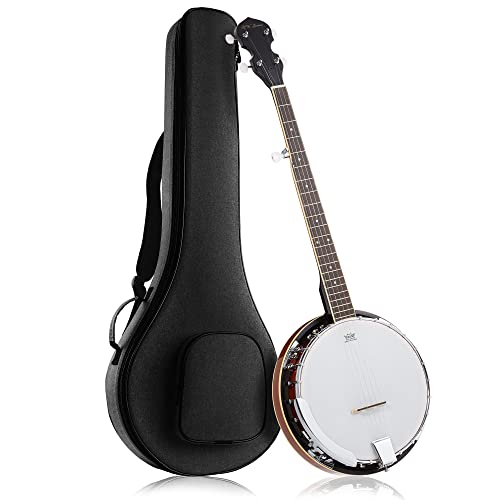
- Premium craftsmanship: Crafted from the finest woods, with a 5-ply maple and mahogany shell, mahogany neck, closed back mahogany resonator, as well as a purpleheart fretboard, this beautiful 5-string...
- High-end design: Jameson's banjo features a Remo Weatherking drum head, a 5/8-inch maple ebony bridge, a chrome plated armrest, an adjustable tailpiece, and truss rod. Also, designed with a removable...
The Jameson Guitars Banjo has been a budget favorite for years. It is a solid, no-frills instrument that features a 24-bracket (lug) system similar to the Ibanez. It’s a great “middle-ground” choice. However, the Ibanez B200 Banjo edges it out in terms of aesthetics and material quality. The Jameson uses a more generic wood and hardware finish, whereas the Ibanez offers that premium mahogany and mother-of-pearl feel. If your budget is very tight but you still want 24 lugs, the Jameson is a hero. But if you can stretch your budget slightly, the refined tone and superior tuners on the Ibanez are well worth the extra investment.
The Final Verdict: Is the Ibanez B200 Banjo Right for You?
After putting the Ibanez B200 Banjo through its paces, my conclusion is clear: this is one of the best “bang-for-your-buck” banjos currently available. It successfully bridges the gap between affordable beginner models and high-end professional instruments. Its greatest strengths lie in its rolled brass tone ring and its 24-lug tension system, which provide a level of tonal clarity and mechanical stability that is rare at this price point. While it is on the heavier side, that weight translates directly into sustain and projection—two things every bluegrass player needs.
I would highly recommend the Ibanez B200 Banjo to any intermediate player looking to upgrade from their first “starter” banjo, or to a dedicated beginner who wants an instrument that will last for years. It looks beautiful, sounds professional, and feels like a genuine piece of craftsmanship. If you are ready to take your playing to the next level and want an instrument that won’t hold you back, I strongly encourage you to check the current price and secure yours today. Whether you’re playing on a porch or on a stage, the B200 will not disappoint. It is a true workhorse that honors the tradition of the five-string banjo while providing the reliability of a modern Ibanez build. Click here to bring home the sound of bluegrass and start your musical journey with an instrument you can be proud of.
Last update on 2026-09-15 / Affiliate links / Images from Amazon Product Advertising API