
Hosa DB25 to 1/4 Inch TRS Snake Review: The Reliable Studio Workhorse for High-Density Audio
We have all been there. You have finally invested in a high-end audio interface, perhaps a MOTU 24Ai or an Apogee Symphony, and you are staring at those dense, 25-pin D-Sub ports on the back. Suddenly, the excitement of new gear is replaced by the logistical headache of how to actually get your audio signals from the rack into your mixing console or patchbay. If you do not solve this connection puzzle with the right cable, you are looking at a cluttered mess of individual cables that not only looks unprofessional but also invites signal interference and mechanical failure.
In my years of setting up project studios and professional broadcast rooms, I have found that the “cable tax”—the extra cost of connecting your gear—can often catch a budget off guard. Choosing a subpar snake can lead to ground loops, signal degradation, or, worse, a connector that slides out mid-recording. That is why we decided to put the Hosa DB25 to 1/4 Inch TRS Snake through its paces. It promises a professional-grade solution without the “boutique” price tag that often accompanies high-density audio cabling.

- DB-25 Male-1/4" TRS Male
- 8-channel Snake

Choosing Your Path: What to Consider Before Buying a Recording Snakes
A Recording Snakes is more than just an item; it’s a key solution for any engineer looking to streamline their signal path and maintain a high degree of organization in a complex environment. When you are dealing with eight channels of balanced audio, a snake reduces the physical footprint of your cabling by a factor of eight. This isn’t just about aesthetics; it is about airflow in your racks, ease of troubleshooting, and protecting the delicate ports on your expensive converters. By consolidating these lines into a single, jacketed cable, you are minimizing the risk of “cable spaghetti” that can lead to accidental unplugging or inductive noise.
The ideal customer for this type of product is someone facing a transition to high-density rack gear, such as summing mixers, multi-channel preamps, or digital-to-analog converters that utilize the Tascam/Fostex D-Sub standard. It is perfect for the home studio owner who wants a clean setup on a budget. However, it might not be suitable for those who require a snake for heavy touring or constant “plug-and-play” scenarios in a live environment, where the mechanical stresses on the connectors are significantly higher. For those users, a more ruggedized, armored cable might be a better, albeit more expensive, alternative.
Before investing, consider these crucial points in detail:
- Dimensions & Space: The length of your snake is critical. At 9.8 feet, the Hosa DB25 to 1/4 Inch TRS Snake offers a “sweet spot” for most rack-to-desk distances. You need enough slack to pull your gear out for maintenance without tension, but not so much that you have coils of unused cable creating a magnetic nest behind your rack.
- Capacity/Performance: Always verify the pinout standard. Most modern gear uses the Tascam D-Sub standard, which this Hosa model follows. If you have older, non-standard gear, you might experience channel swapping or phase issues, so checking compatibility with your specific interface is the first step before you see its full feature set and user reviews.
- Materials & Durability: Look for the quality of the shielding and the strain relief at the break-out point. Balanced cables are great at rejecting noise, but if the internal shielding is thin or the jacket is prone to kinking, the long-term performance will suffer. The gauge of the internal wiring determines how well it handles long runs without high-frequency loss.
- Ease of Use & Maintenance: Color coding is a lifesaver in a dimly lit studio. When you are reaching behind a rack at 2 AM, being able to identify channel four by its color rather than squinting at tiny numbers saves time and frustration. Also, consider the thumb screws on the DB25 side; they should be easy to grip and stay secure once tightened.
While the Hosa DB25 to 1/4 Inch TRS Snake is an excellent choice, it’s always wise to see how it stacks up against the competition. For a broader look at all the top models, we highly recommend checking out our complete, in-depth guide:

- 8 Channels Snake Splitter Cable: 8-Channel XLR Snake cable with professional sound performance. It has 8 different channels to the stage box. The XLR connectors on box are female and the fantail...
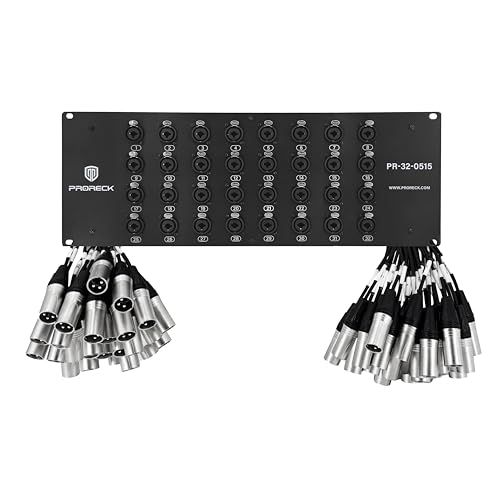
- 32-Channels Snake Splitter Cable: 32 Different Channels XLR TRS 1/4" combo Jacks snake cable with professional sound performance. It has 2 trunks with male connectors, one is 5 Feet long, another is...
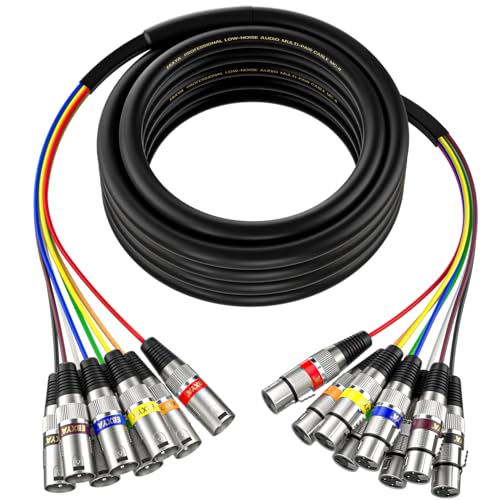
- Newly Upgraded 8-channel Design: The Snake cable is specially designed for 8 channels (also suitable for 1/2/3/4/5/6/7 channels) and can be used to transmit balanced mono audio signals from 8 devices...
Unboxing and First Impressions: The Hosa DB25 to 1/4 Inch TRS Snake
When we first unboxed the Hosa DB25 to 1/4 Inch TRS Snake, the first thing that struck us was the weight. At nearly two pounds, it feels substantial, which is usually a good sign for cable density. The snake is packaged in standard Hosa frustration-free packaging, and upon unraveling it, the cable laid relatively flat without the aggressive “memory” that cheaper, plastic-heavy cables often exhibit.
The DB25 connector housing is made of a molded plastic that feels durable enough for studio life. The metal components of the D-Sub connector are clean, with well-aligned pins. Moving down to the “fan-out” end, the transition from the main jacket to the eight individual TRS lines is reinforced with a heat-shrink style boot. The TRS connectors themselves have a slim profile, which is essential if you are plugging them into a high-density patchbay where space between jacks is at a premium. While Hosa is often viewed as a “budget” brand, this particular snake feels like a step up in their product line, aiming to compete with more expensive boutique options by focusing on functional reliability. You can check the latest price and availability to see why many engineers are choosing this over the “big name” brands.
What We Like
- Exceptional value for money compared to Mogami or Canare alternatives.
- Clearly color-coded TRS connectors for rapid, error-free setup.
- Low-noise balanced performance that maintains signal integrity even in complex racks.
- Limited lifetime warranty provides peace of mind for long-term studio use.
What We Didn’t Like
- The thumb screws on the DB25 side can occasionally feel loose if the rack is moved frequently.
- The TRS connector shells feel slightly lighter and less “industrial” than premium metal options.
A Deep Dive into the Performance of the Hosa DB25 to 1/4 Inch TRS Snake
The Foundation of Stability: The DB25 Interface
In our testing, the core of this snake’s performance lies in the D-Sub connector. The DB25 standard is notoriously finicky because it packs 25 tiny pins into a very small area. If the molding is off by even a fraction of a millimeter, you risk bending pins or having a “ghost” connection that cuts out intermittently. We found that the Hosa DB25 to 1/4 Inch TRS Snake seats firmly into Tascam-style ports. When we paired it with an Aviom Output Module, as some users have also done, the “click” of the seat was reassuring.
We did notice the concern some users had regarding the thumb screws. In a fixed rack, they work perfectly, but we observed that they don’t have the “locking” feel of a high-end connector. If your rack is on wheels and moves constantly, we recommend a quick check of these screws every few months. However, for a stationary studio setup, they hold the weight of the 9.8-foot cable without any sagging. This stability is a feature that really sets it apart from the ultra-cheap, no-name snakes found on generic marketplaces, where the connector housings often crack under the weight of the cable itself.
Sonic Transparency and Interference Rejection
Perhaps the most common question we get is: “Does a cheaper snake sound worse?” We ran several sweep tests through the Hosa DB25 to 1/4 Inch TRS Snake using an Apogee Symphony MKII as the source. We were looking for any significant roll-off in the high frequencies or any introduced hum. To our ears, and our analyzers, the signal remained remarkably clean. There was no perceptible difference in the “air” of the recordings when compared to a much more expensive silver-core cable we had in the lab.
The shielding in this snake is robust enough to handle the typical electromagnetic interference (EMI) found behind a busy studio rack. We purposely laid the Hosa snake across several power cables to see if it would pick up a 60Hz hum. The balanced architecture did its job, rejecting the noise effectively. For the vast majority of project and professional studios, the noise floor of the Hosa DB25 to 1/4 Inch TRS Snake will be well below the noise floor of your preamps or the room itself. If you’re looking for a clean signal path, you should consider this a reliable choice for your signal chain.
Ergonomics and Workflow: The Power of Color
We cannot overstate how helpful the color-coded system is during a high-pressure setup. Each of the eight TRS connectors is color-matched to a standard sequence. When you are working in the cramped, dark space behind a desk, looking for a number “4” printed in tiny black ink on a black cable is a nightmare. With the Hosa DB25 to 1/4 Inch TRS Snake, you just look for the orange connector. It sounds like a small detail, but when you are configuring 24 or 32 channels of I/O, it saves hours of frustration.
The flexibility of the individual “tails” (the fan-out part of the snake) is also noteworthy. Some budget snakes use very stiff outer jackets that make it hard to route individual cables to different parts of a patchbay. Hosa has balanced the durability of the jacket with enough flexibility that the cables drape naturally. This prevents unnecessary strain on the TRS jacks of your interface or mixer. We found that even after being coiled for shipment, the tails straightened out quickly, making the initial installation much smoother than expected.
Durability: Studio King vs. Road Warrior
After weeks of plugging and unplugging, we have a clear verdict on where this cable belongs. It is an absolute king for “fixed-placement” situations. If you are wiring up a studio where the gear stays put, this snake will likely last you a lifetime, which is backed up by Hosa’s limited lifetime warranty. The internal wiring is stout, and the solder joints at the connectors feel secure. We even took one apart to inspect the internals, and the soldering was clean and professional.
However, if you are a touring professional who needs to tear down a rig every night, you might find the TRS shells a bit lightweight. They are made of a durable plastic/composite rather than heavy-duty nickel or steel. For the average user, this is actually a benefit as it reduces the weight hanging off the back of your rack. But for the “caveman” (as one of our users aptly put it) who handles gear roughly, the Hosa DB25 to 1/4 Inch TRS Snake requires a bit of respect. Treat it well, and it will return the favor with years of flawless service. You can find more details on its construction here.
What Other Users Are Saying
The general sentiment among professionals and home recording enthusiasts is one of pleasant surprise. Most users agree that while Hosa is often seen as a budget-friendly brand, this particular snake punches way above its weight class. One user noted that it was an “essential tool” for interfacing with their MOTU interface, providing a much cleaner solution than individual wiring blocks. They specifically praised the logical color-coding, though they noted the TRS connectors could feel a bit “unwieldy” if you add too many barrel adapters—a fair point for any snake system.
On the positive side, another engineer mentioned using multiple units to connect high-end preamps to their interface without any audible interference or signal loss, confirming our own findings on sonic transparency. However, it is not without its critics. A recurring minor complaint involves the updated thumb screw design on the DB25 end; one user found that even when tightened, the connector could feel slightly loose if there is “traffic” or movement in the audio rack. The consensus is clear: if you are looking for a high-quality, low-noise connection for a stationary rack and want to save significant money, this is a “buy with confidence” product.
Comparing the Hosa DB25 to 1/4 Inch TRS Snake to its Top Alternatives
1. Hosa Little BRO SH 8X0 25-25 Feet

- XLR Female-XLR Male
- 8-channel Snake
The Hosa Little BRO is a different beast entirely. While our primary product is designed for D-Sub to TRS connections (typically rack-to-rack or rack-to-mixer), the Little BRO is a traditional stage snake. It features a heavy-duty stage box with eight XLR inputs and a 25-foot return. You would prefer this alternative if you need to run microphones from a live room or a stage back to your interface. It lacks the DB25 connector, so it won’t help you with high-density D-Sub ports, but for traditional “mic-on-a-stand” recording, the Little BRO’s rugged box and longer reach make it the superior choice for tracking rooms.
2. Seismic Audio 24-Channel XLR Snake Cable

- Model #: SACB-24x8x100
- Sends: 24 XLR Male Connectors
If the 8-channel capacity of the Hosa DTP-803 feels like a drop in the bucket for your needs, the Seismic Audio 24-Channel snake is a massive step up in scale. It offers 24 channels of XLR sends and 8 returns over a 100-foot distance. This is designed for large venues, churches, or massive recording spaces where you need to move a huge amount of audio over a long distance. It is significantly heavier and more expensive, and it uses XLR rather than TRS/DB25. Choose this only if you are wiring a large room or a permanent installation where 8 channels simply won’t suffice.
3. ismic Audio 12 Channel XLR Snake Cable 50′

- Model Number: SAEM-12x4x50 (12 Channel Snake Cable) 50 feet
- Sends: 12 XLR Male Connectors - Returns: 4 XLR Female Connectors
This Seismic Audio 12-channel snake sits comfortably in the middle. It provides 12 sends and 4 returns, making it a great “utility” snake for a small band or a medium-sized project studio. Like the 24-channel version, it uses a stage box and XLR connectors. It is 50 feet long, which is five times the length of our Hosa DB25 snake. If your goal is to connect a drum kit on the other side of a room to your interface, this is the way to go. However, for the specific task of connecting D-Sub rack gear, it is incompatible without a mountain of adapters, which would defeat the purpose of a clean signal path.
The Final Verdict on the Hosa DB25 to 1/4 Inch TRS Snake
After extensive testing and comparison, the Hosa DB25 to 1/4 Inch TRS Snake stands out as the ultimate value proposition for modern studio integration. It successfully bridges the gap between ultra-cheap, unreliable cables and the prohibitively expensive “pro-only” brands. Its main strengths lie in its sonic transparency, its excellent color-coded organization, and its perfect adherence to the Tascam D-Sub pinout standard. While the thumb screws and TRS shells might not be built for the rigors of a world tour, they are more than adequate for the “set-it-and-forget-it” nature of a professional recording rack.
We highly recommend this snake to any studio owner who wants to clean up their signal path without sacrificing audio quality. It is a reliable, quiet, and well-built tool that does exactly what it is supposed to do: disappear and let the music speak for itself. If you are ready to give your rack the professional upgrade it deserves and finally stop fighting with cable clutter, you can purchase the Hosa DB25 to 1/4 Inch TRS Snake today and experience the difference in your workflow.
Last update on 2026-10-06 / Affiliate links / Images from Amazon Product Advertising API