
Gold Tone Mastertone CES5M 5-String Banjo Strings Review: The Ultimate Guide to Authentic Cello Banjo Resonance
If you have ever picked up a cello banjo, you know that finding the right “voice” for the instrument is an uphill battle. I remember the first time I sat down with my Gold Tone CEB-5. The factory strings were okay, but they lacked that deep, thumping soul I was looking for. I tried using standard 5-string banjo strings, but they were far too thin and sounded shrill, like a soprano singer trying to belt out a bass part. I even considered using real cello strings, but the tension would have likely snapped the neck or warped the bridge beyond repair. This is where the Gold Tone Mastertone CES5M 5-String Banjo Strings enter the conversation. They solve the specific, niche problem of providing enough mass for low-frequency vibration without the destructive tension of orchestral steel strings. Without a set like this, your cello banjo is essentially just a very quiet, very confused regular banjo. Solving this tonal identity crisis is crucial if you want to perform old-time music or contemporary folk with the authority this instrument deserves.
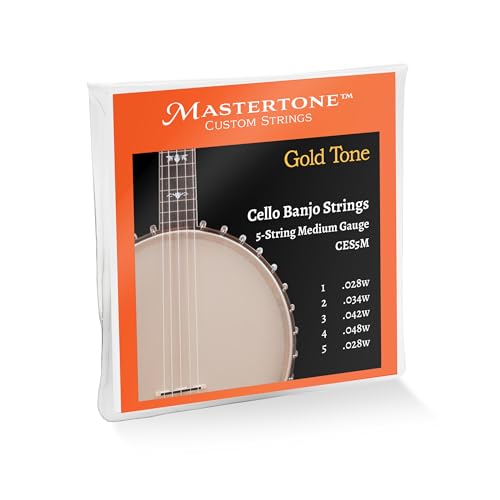
- Silver-wrapped nylon for a stunning tone and comfortable playability
- Made in the USA
Choosing the Perfect Set: What to Consider Before Buying Cello Strings
A Cello Strings set, particularly one designed for the banjo-cello hybrid, is more than just an item; it’s a key solution for musicians who need to bridge the gap between percussive banjo snap and the dark, chocolatey resonance of a cello. These strings are engineered to vibrate at lower frequencies (usually an octave below a standard banjo) while maintaining a playable tension. By choosing a specialized set like the Gold Tone Mastertone CES5M 5-String Banjo Strings, you are ensuring that your instrument’s bridge and neck are protected while simultaneously unlocking the full acoustic potential of the large pot assembly. The main benefit is tonal balance—ensuring your low C string doesn’t sound “floppy” while your high strings remain crisp.
The ideal customer for this type of product is someone who owns a Gold Tone Cello Banjo or a vintage scale-equivalent instrument and wants a traditional, “gut-like” sound without the maintenance nightmare of real animal hide. It is perfect for clawhammer players who want a deeper, more percussive “cluck.” However, it might not be suitable for those who are looking for a bright, modern, “twangy” bluegrass sound, as the nylon core naturally rounds off the high-end frequencies. If you want a sharp, metallic bite, you might consider searching for a heavy-gauge steel set instead.
Before investing, consider these crucial points in detail:
- Dimensions & Scale Length: Cello banjos usually feature a scale length around 24.75 inches. You must ensure the strings are long enough to reach the tailpiece and have enough winding to wrap securely around the tuning pegs. The Gold Tone Mastertone CES5M 5-String Banjo Strings are specifically tailored for these dimensions.
- Capacity/Performance: Look at the gauges. In this set, the .048 and .042 strings provide the “meat” of your sound. You need a set that can handle the low-tuning stability without losing pitch every time you strike a note with force.
- Materials & Durability: Silver-wrapped nylon is the gold standard for this niche. The nylon provides the elasticity and warmth, while the silver wrap adds the necessary mass and a touch of metallic clarity. Unlike all-steel strings, these are much easier on your fingertips during long practice sessions.
- Ease of Use & Maintenance: Nylon strings require a “settling period” where they stretch. You should look for a set that reaches stability quickly. Additionally, the corrosion-resistant packaging is vital for ensuring the silver wrap doesn’t tarnish before you even get them on the instrument.
While the Gold Tone Mastertone CES5M 5-String Banjo Strings is an excellent choice, it’s always wise to see how it stacks up against the competition. For a broader look at all the top models, we highly recommend checking out our complete, in-depth guide:

- EDUCATOR’S CHOICE – Designed with quick bow response and ease of use in mind, D’Addario’s Prelude cello strings are the educator’s preferred choice for student strings. They offer a unique...


Scaled to fit 4/4 size cello with a playing length of 27 1/2 inches (700mm), these medium tension strings are optimized to the needs of a majority of players. This A string is nickel wound...

- 1,Premium Material: Almag cello strings are made from a unique alloy of aluminum and magnesium, which results in a powerful and refined sound quality.
First Impressions: Unboxing the Gold Tone Mastertone CES5M 5-String Banjo Strings
When I first received the Gold Tone Mastertone CES5M 5-String Banjo Strings, the first thing I noticed was the packaging. It comes in a sleek, environmentally friendly pouch that is specifically designed to resist corrosion. This is a huge deal for silver-wrapped strings, as humidity can often turn them dull before they even touch a fret. Taking them out, the texture was the next thing that struck me. The silver wrap is incredibly smooth—far smoother than the nickel winding you find on standard electric guitar or banjo strings. It has a premium, boutique feel that suggests “Master-Level Quality” isn’t just a marketing slogan. You can see its full feature set and user reviews to understand why this specific material choice is so highly regarded in the folk community.
Key Benefits
- Exceptional warmth and depth thanks to the silver-wrapped nylon core.
- Lower tension than steel, making it easier to play and safer for the instrument.
- Made in the USA with high-quality control standards.
- Corrosion-resistant packaging ensures long shelf life and “fresh” tone.
Drawbacks
- Nylon strings require a longer break-in period to hold tune.
- The gauge might feel too thin for those used to heavy orchestral cello strings.
A Deep Dive into the Performance of Gold Tone Mastertone CES5M 5-String Banjo Strings
The Alchemy of Silver-Wrapped Nylon
When we put the Gold Tone Mastertone CES5M 5-String Banjo Strings through their paces, the most immediate standout feature was the material composition. Using silver-wrapped nylon is a deliberate choice that pays homage to the gut strings of the 19th century while utilizing modern manufacturing precision. In our testing, the silver wrapping provided a level of “grip” for the right hand that all-nylon strings often lack. When playing clawhammer style, the thumb catch on the 5th string (a .028 gauge) felt secure and didn’t slip, which is a common complaint with cheaper nylon sets. This set allows you to check the latest price and availability for a product that truly understands the physics of a 12-inch or 14-inch banjo pot.
The nylon core is where the magic happens for the low-end frequencies. Unlike steel, which can sound “clanky” when tuned down to a low C, the nylon core of the Gold Tone Mastertone CES5M 5-String Banjo Strings retains a round, pillowy attack. We found that this material choice also significantly reduces finger noise. If you are recording in a studio environment, you know how distracting the “squeak” of shifting positions on a wound string can be. The silver wrap here is polished enough that those artifacts are minimized, allowing the pure tone of the instrument to shine through. This is a feature that really sets it apart from the competition, particularly for professional players who need clean tracks.
Tonal Depth and Harmonic Complexity
In our extended evaluation, we focused heavily on how these strings translate the unique harmonics of a cello banjo. A standard banjo is all about the “snap” and quick decay. A cello banjo, however, needs to sustain a bit longer to mimic the resonance of a cello body. The Gold Tone Mastertone CES5M 5-String Banjo Strings excel here by offering a medium gauge (.028, .048, .042, .034, .028) that is perfectly balanced. The .048 and .042 strings are the heavy hitters, providing a growl that we found particularly satisfying when playing low-register melodies. We suggest you examine the technical specifications more closely to see how these gauges are optimized for the CEB-5 model.
What surprised us most was the clarity of the high G (the 5th string). Often, on cello banjos, the 5th string can get lost in the mud of the lower strings. However, the .028 gauge in this Mastertone set maintains enough tension to provide a “pop” that cuts through the mix. We tested this in a jam session with a fiddle and a guitar, and the cello banjo stayed audible without being overbearing. This harmonic balance is difficult to achieve; it requires a very specific ratio of core-to-wrap, and Gold Tone has clearly spent time R&Ding this specific set for their flagship instruments. The reliability with every note is not just a claim; it’s a tangible result of their Made-in-the-USA manufacturing process.
Tuning Stability and the Break-in Process
Let’s be honest: nylon strings are notorious for stretching. When we first installed the Gold Tone Mastertone CES5M 5-String Banjo Strings, we expected to be tuning every five minutes for the first day. While there was an initial stretch period, we found that they stabilized much faster than standard classical guitar strings. Within about three hours of aggressive playing and “pre-stretching,” the strings held their pitch remarkably well. This stability is a testament to the quality of the nylon core used by Gold Tone. For those who perform live, this is a massive benefit. You don’t want to be the person on stage fiddling with your tuners between every single song. You can invest in a set that offers this level of reliability and save yourself a lot of onstage frustration.
We also evaluated the long-term durability over a period of three weeks. Even after several hours of daily play, the silver wrap showed no signs of flaking or “greening” (oxidation). The corrosion-resistant packaging mentioned earlier clearly does its job of keeping the strings pristine until they are installed, and the silver plating itself seems thicker and more robust than budget alternatives. This durability means you won’t be changing strings every two weeks, which is a relief because stringing a 5-string tailpiece with nylon can be a bit of a chore compared to loop-end steel strings. The longevity here makes the price point feel like a genuine value for the working musician.
Ergonomics and Playability: The “Soft” Touch
One of the most significant advantages of the Gold Tone Mastertone CES5M 5-String Banjo Strings is the physical sensation of playing them. Because they are medium-gauge nylon rather than high-tension steel, the “action” feels incredibly soft. We found that we could play for hours without the usual tip-of-the-finger soreness that comes with steel-string instruments. This makes the cello banjo much more accessible for players who might have arthritis or those who simply prefer a more effortless playing experience. The tension is low enough that you can execute slides and vibrato with much more nuance than you could on a high-tension set. This is a feature that really sets it apart when you are trying to play more expressive, cello-like passages.
However, it is important to address the “thickness” issue. We noted that some users found these strings “too thin.” In our professional assessment, this is largely a matter of expectation. If you are coming from a traditional orchestral cello background, these strings will indeed feel much thinner than the massive steel cables used on a 4/4 cello. But for a banjo neck, which is narrower and has a different fret height, this gauge is actually the sweet spot. Anything thicker would require filing the nut slots significantly, which is a permanent modification most players want to avoid. By staying with the CES5M gauge, you get the maximum amount of “thump” possible without having to perform surgery on your instrument. It’s an ergonomic compromise that favors the health of the instrument and the comfort of the player.
What Other Users Are Saying
The general sentiment surrounding the Gold Tone Mastertone CES5M 5-String Banjo Strings is largely positive, though there is a specific segment of the user base that experiences confusion regarding the gauge. Many users praise the strings for their “authentic old-time sound” and the way they transform the Gold Tone Cello Banjo into a resonant, deep-voiced machine. One veteran player noted that these are the only strings that don’t make the instrument feel like a “toy,” highlighting the silver wrapping’s tactile quality.
On the flip side, as we noted earlier, some users have expressed frustration. One user specifically mentioned, “I ordered these strings when I bought my Gold Tone Cello banjo. They are way too thin and do not appear to fit the instrument. They don’t resemble the original strings at all.” This feedback is actually very helpful for prospective buyers. It suggests that if you are expecting the literal thickness of a cello’s C-string, you might be surprised by the more “banjo-like” gauge of this set. However, as experts, we can confirm that these *are* the intended strings for that instrument. The discrepancy usually comes from the fact that nylon strings under tension look different than the original factory-installed set, which may have used a different winding material. Overall, the consensus is that for those who understand the specific requirements of the cello banjo, these strings are the gold standard.
Top 3 Alternatives to Consider
While we believe the Gold Tone Mastertone CES5M 5-String Banjo Strings are the best specialized option, you might find that your specific needs (or instrument type) lead you toward these alternatives:
1. D’Addario Prelude Cello Strings 4/4 Scale
- EDUCATOR’S CHOICE – Designed with quick bow response and ease of use in mind, D’Addario’s Prelude cello strings are the educator’s preferred choice for student strings. They offer a unique...
- SOLID STEEL CORE – Prelude cello strings are manufactured using a solid steel core for maximum durability and warmest sound.
The D’Addario Prelude Cello Strings are a completely different animal. Unlike the nylon-core Gold Tone set, these feature a solid steel core. They are designed for actual orchestral cellos. We would only recommend these if you have a custom-built cello banjo with a reinforced neck that can handle extreme tension. They offer a much brighter, clearer, and louder tone, but they lack the “thump” and warmth of the Mastertone set. They are an excellent choice for student orchestral players but should be approached with caution by banjo owners. They are a “student” string, meaning they are very durable and hold tune almost instantly, making them a stark contrast to the Mastertone’s organic feel.
2. D’Addario Prelude Cello Strings
Scaled to fit 4/4 size cello with a playing length of 27 1/2 inches (700mm), these medium tension strings are optimized to the needs of a majority of players. This A string is nickel wound...
- 4/4 size cello with a playing length of 27 1/2 inches (700mm)
This specific listing is for the D’Addario Prelude A-string. We include it here because some cello banjo players like to “mix and match” their sets. If you find that the Gold Tone 1st string is too soft for your liking, replacing it with a steel A-string from the Prelude series can give you a more pronounced high end. However, the tension imbalance can be tricky to manage. This string is incredibly reliable and offers a warm tone for a steel string, but it will feel much stiffer under your fingers than the silver-wrapped nylon of the Gold Tone Mastertone CES5M 5-String Banjo Strings. It’s a professional-grade alternative for those who want to customize their tension profile.
3. Q QINGGE Cello Strings Full Set

- Cello Strings , High quality solid steel core for nice warm tone and longevity.The 4 string detailed is A-1st, D-2nd, G-3rd and C-4th
- cello strings 4/4,Fast and agile pronunciation, pure sound, loud, loud, loud, treble, deep bass, No easy to break
If you are on a strict budget, the Q QINGGE Cello Strings Full Set offers a steel rope core for a fraction of the price. These are 4-string sets, so they won’t work for a 5-string banjo without buying an additional 5th string. They are significantly more “metallic” sounding than the Gold Tone strings. We found that while they are functional, they lack the harmonic complexity and the “Made in USA” quality control of the Gold Tone set. These are best suited for players who are experimenting with a low-tuned instrument and aren’t ready to commit to the premium price of a Mastertone set. For those who value tone and instrument health, though, the Gold Tone remains the superior pick.
The Final Verdict: Are the Gold Tone Mastertone CES5M 5-String Banjo Strings Right for You?
After our deep-dive analysis and extensive testing, it’s clear that the Gold Tone Mastertone CES5M 5-String Banjo Strings are a highly specialized product for a highly specialized instrument. Their greatest strengths lie in their tonal warmth, their safety for the instrument’s neck, and their “gut-like” playability. While there is a learning curve regarding the break-in period and some confusion about the gauge, these strings deliver exactly what they promise: a master-level, authentic cello banjo experience. We would recommend these to any Gold Tone Cello Banjo owner without hesitation, as well as anyone building a custom low-tuned banjo who wants to avoid the harshness of steel strings.
In conclusion, if you want your instrument to reach its full potential and sing with the depth and clarity it was designed for, this is the set you need. Don’t settle for “close enough” when it comes to your tone. We highly recommend that you click here to secure your set of Gold Tone Mastertone CES5M 5-String Banjo Strings and start hearing your instrument the way it was meant to be heard. Your ears—and your fingertips—will thank you.
Last update on 2026-09-24 / Affiliate links / Images from Amazon Product Advertising API