
FLAMMA FC17 Analog Delay Pedal Review: The Warmest Secret on My Pedalboard
There is a specific moment in every guitarist’s journey where they realize their tone feels “flat.” You have the right guitar, a decent tube amp, and maybe a drive pedal that kicks, but when you stop playing, the sound dies instantly. It lacks depth, space, and that elusive “atmosphere” that makes a solo feel legendary. I spent years trying to fill that void with expensive digital processors, only to find they often sounded clinical and sterile. The problem isn’t just about repeating a note; it’s about how those repeats decay and melt into the background. Without a quality delay, your playing can feel naked and exposed in all the wrong ways. Finding a pedal that offers genuine analog warmth without taking up half your pedalboard or emptying your bank account is a challenge many of us face. That is exactly why I decided to put the FLAMMA FC17 Analog Delay Pedal through its paces to see if it could solve the “dry signal” dilemma once and for all.
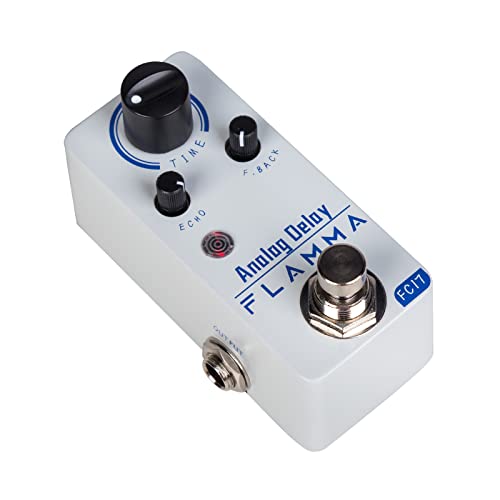
- The FC17 mini guitar pedal features a warm and vintage analog delay pedal.
- Delay time range: 25ms-600ms.
What to Consider Before Buying Electric Guitar Delay & Reverb Effects
An Electric Guitar Delay & Reverb Effects unit is more than just an item; it’s a key solution for creating a sense of three-dimensional space in your music. Whether you are playing rhythmic “U2-style” dotted eighth notes or just looking for a subtle “slapback” to thicken up a blues lick, the delay pedal is the architect of your sound’s environment. Choosing the right one determines whether your repeats will stay crisp and clear (digital) or become progressively darker and more “lo-fi” (analog). For those of us who prioritize a vintage feel, the analog route is almost always the preferred choice because it mimics the organic degradation of old tape machines.
The ideal customer for this type of product is someone facing a crowded pedalboard who needs a small footprint, or the gigging musician who wants a “set and forget” pedal for constant ambiance. It is perfect for those who find digital delays too bright or complicated. However, it might not be suitable for those who require precise tap-tempo, ultra-long delay times (over 1 second), or the ability to save multiple presets. If you are a shoegaze artist needing massive, shimmer-filled washes of sound, you might consider a dedicated multi-effect or a digital workstation instead.
Before investing, consider these crucial points in detail:
- Dimensions & Space: In the modern era of “mini” pedals, size matters. If your board is already packed, a micro-pedal like this is a lifesaver. You need to ensure the pedal is small enough to fit but heavy enough not to slide around when you stomp on it during a performance.
- Capacity/Performance: Look at the delay time range. For analog pedals, 600ms is the “sweet spot” that covers everything from quick country slapback to moderate David Gilmour-style leads. Ensure the “Mix” control is granular enough to allow the effect to sit behind your dry signal rather than overpowering it.
- Materials & Durability: Since these devices are literally stepped on, a metal shell is non-negotiable. Plastic housings might save a few dollars, but they won’t survive a year of consistent gigging or rehearsal. High-quality footswitches and pots are essential for long-term reliability.
- Ease of Use & Maintenance: Consider the power requirements and control layout. Most pedals use a standard 9V center-negative power supply. You want knobs that are easy to read on a dark stage, though on mini pedals, this is often a trade-off for the compact size.
While the FLAMMA FC17 Analog Delay Pedal is an excellent choice, it’s always wise to see how it stacks up against the competition. For a broader look at all the top models, we highly recommend checking out our complete, in-depth guide:

- Digital Delay/Plate Reverb 2 effects in 1 guitar effects pedal

- [Analog Delay Pedal]: Reproduces the warm and natural classic vintage analog delay sound


- [2-in-1 Pedal]: The 2-in-1 Revecho pedal seamlessly integrates meticulously chosen delay and reverb effects, offering musicians a powerful combination of tonal possibilities in a single, compact pedal
First Impressions: The FLAMMA FC17 Analog Delay Pedal Unboxing
When the FLAMMA FC17 Analog Delay Pedal first arrived, I was immediately struck by just how tiny it is. Measuring just over 3 inches long, it fits in the palm of your hand. The unboxing experience was straightforward—no fluff, just a sturdy little box containing the pedal and a manual. Despite its small stature, it has a surprising heft to it thanks to the durable metal shell. Before you even plug it in, you can see its full feature set and user reviews which hint at a build quality that punches far above its price bracket.
The “FC17 Delay” colorway is a clean, modern aesthetic that looks professional on any board. I was particularly pleased to see the true bypass circuitry mentioned in the specs. In my initial testing, clicking the pedal on and off resulted in zero “pop” or signal coloration when disengaged—a common flaw in cheaper pedals. Comparing it to some of the bulkier boutique pedals I’ve used, the FLAMMA FC17 Analog Delay Pedal feels like a concentrated dose of tone. It’s designed for the minimalist who refuses to sacrifice the “warmth” of an analog circuit for the sake of board space.
Key Benefits
- Authentic analog warmth with beautifully “dark” repeats that don’t clash with your playing.
- Ultra-compact metal construction makes it perfect for crowded pedalboards.
- True bypass ensures your core guitar tone remains transparent when the effect is off.
- Incredible price-to-performance ratio compared to boutique alternatives.
Limitations
- The small knobs for “Time” and “Echo” can be a bit fiddly for precise adjustments mid-song.
- The plastic potentiometers feel slightly less premium than the metal housing itself.
A Deep Dive into the Performance of the FLAMMA FC17 Analog Delay Pedal
The Tonal Character: Vintage Warmth and Decaying Echoes
The heart of any analog delay is how it handles the “repeats.” We found that the FLAMMA FC17 Analog Delay Pedal excels at providing a very specific type of sonic degradation. Unlike digital delays that create an exact photocopy of your note, this pedal uses a classic circuit design that filters out higher frequencies as the repeats continue. This results in a “darker” sound that naturally sits under your live playing. When I tested this with a Stratocaster into a clean tube amp, the echoes felt like they were drifting away into the distance, providing a beautiful sense of depth without getting in the way of the actual notes I was playing.
For those who love to experiment with “self-oscillation,” this pedal is a hidden gem. By cranking the “Feedback” knob, you can create those rising, spaceship-like swells of sound that characterize psychedelic rock. It handles this transition from standard delay to chaotic noise very smoothly. We found that even at the maximum delay time of 600ms, the signal remains musical, though it gains a pleasant, lo-fi grit that digital pedals simply cannot replicate. To truly understand how this fits into your signal chain, you should check the latest price and availability and consider it as a permanent “always-on” addition for tonal thickness.
Usability and Control: Mastering the Micro Interface
Operating a mini pedal always comes with a learning curve, and the FLAMMA FC17 Analog Delay Pedal is no exception. It features one large central knob for the delay time and two much smaller knobs for “Echo” (the mix level) and “Feedback” (the number of repeats). During our evaluation, we discovered that the “Echo” control is particularly well-calibrated. One user mentioned that they like to keep a delay on all the time but turned down low in the mix, and this pedal is perfect for that. Many delays have a mix control that jumps from “inaudible” to “too loud” very quickly, but the FC17 allows for a very subtle blending.
The only real gripe we had—and this was echoed by several guitarists in the community—is the size of the smaller knobs. If you have larger fingers, making a tiny adjustment to the feedback level in the middle of a dark stage can be tricky. However, once you find your “sweet spot,” the knobs stay in place firmly. I personally found that setting the delay time to a moderate slapback and leaving it there provided an incredible “thickening” effect that made my lead lines sound twice as big. This is a feature that really sets it apart from other budget mini pedals that often feel like toys rather than musical instruments.
Build Integrity and Board Integration
One of the biggest concerns with “budget” pedals is whether they will add noise to your signal chain. We put the FLAMMA FC17 Analog Delay Pedal through a high-gain test, placing it after a heavy distortion pedal. Surprisingly, the noise floor was remarkably low. The true bypass switch is a high-quality component; there’s a satisfying “click” without any electrical interference. Because it only draws 25mA of current, it won’t tax your power supply, making it a very “friendly” neighbor to your other pedals. It is a corded electric power source only, so you’ll need your standard 9V adapter ready.
The durability of the metal shell cannot be overstated. I’ve seen many mini pedals with thin aluminum casings that dent easily, but the FC17 feels solid and dense. Its weight of 0.18 kilograms is just enough to keep it planted on the Velcro of your board. For players who are “usually fans of digital delay” but want to dip their toes into the analog world, this compact analog powerhouse offers a risk-free way to experiment with those classic, call-and-response playing styles without sacrificing precious real estate or signal integrity.
Dynamic Response: From Country Slapback to Ambient Washes
Versatility is often the trade-off for size, but the FLAMMA FC17 Analog Delay Pedal manages to cover a lot of ground. At the shortest delay settings (around 25ms-50ms), it produces a classic 1950s rockabilly slapback that is tight and percussive. As you move the large knob toward the 12 o’clock position, you enter the territory of rhythmic, melodic delays. We found that the “Feedback” knob is very responsive to your picking dynamics. If you play softly, the repeats stay polite; if you dig in, the analog circuit seems to compress and react with a bit more “hair” on the edges.
I spent several hours using this pedal for “ambient” swells by turning the mix up high and using my guitar’s volume knob. The way the FLAMMA FC17 Analog Delay Pedal handles the trailing echoes is incredibly smooth. It doesn’t have the “digital stepping” sound you sometimes hear when turning knobs on a DSP-based pedal. Instead, it feels like a physical, mechanical process. For anyone looking to finding the right feedback level for their specific genre, this pedal provides a wide enough sweep to accommodate everything from jazz fusion to heavy metal leads.
What Other Users Are Saying
The general sentiment surrounding the FLAMMA FC17 Analog Delay Pedal is overwhelmingly positive, especially among players who are tired of the complexity of modern digital units. We found that most users are shocked by the quality of the analog “smear” given the price point. One guitarist noted that while they have nearly ten different delay pedals, this one became their favorite for a “low mix, always-on” setting because it doesn’t color the original tone aggressively. Another user mentioned that while they typically prefer digital for long, rhythmic repeats, this analog unit “packs a lot of character” into its small frame.
On the critical side, the small plastic knobs are the primary point of contention. Some users felt they felt “cheap” compared to the rest of the metal chassis, and others wished for a slightly larger footprint to allow for easier foot-adjustments of the delay time. However, even these critics admitted that the sound quality is “better than most brands” in this price tier. A Spanish-speaking user summed it up perfectly, noting that it doesn’t “color the sound” too much and has a “fair price,” making it a superior choice to many other entry-level brands available today. This balanced feedback confirms our expert assessment: it’s a high-performance tool with minor ergonomic trade-offs.
Comparing the FLAMMA FC17 Analog Delay Pedal to Top Alternatives
1. BOSS DD-8 Digital Delay Guitar Pedal

- The most advanced BOSS compact series delay ever
- Eleven versatile modes include basic digital delay, vintage echoes, shimmer, mod, looper, and more
The BOSS DD-8 is essentially the “Swiss Army Knife” of delay pedals. Unlike the analog-only focus of the FLAMMA FC17 Analog Delay Pedal, the DD-8 offers multiple modes including Shimmer, Reverse, and Loop. It is a digital powerhouse with tap-tempo and stereo inputs. While it offers significantly more features and a much longer delay time, it is also three times the price and twice the size. The DD-8 is for the player who needs 11 different delay types in one box, whereas the FC17 is for the purist who wants one perfect, warm analog sound.
2. JHS Pedals 3 Series Reverb Pedal
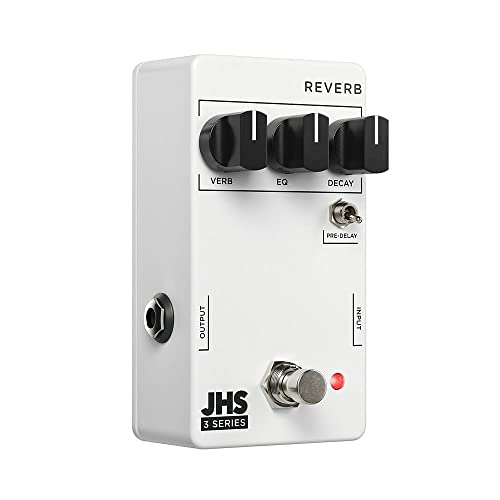
- Made in Kansas City USA
- An extremely versatile unit that allows you to achieve any reverberation effect, all the way from small room sounds to nearly endless washes of ambiance
The JHS 3 Series Reverb is a fantastic alternative if you find that what you actually need is “space” rather than “repeats.” While it’s a reverb and not a delay, it shares the same philosophy of simplicity and quality that the FLAMMA FC17 Analog Delay Pedal champions. The JHS pedal offers a very high-quality, streamlined experience with simple controls. It’s built in the USA and feels more “boutique,” but it lacks the rhythmic capabilities of a true delay. If you want a wash of sound rather than a rhythmic echo, this is the one to pick.
3. Walrus Audio Slö Multi Texture Reverb

- Allows players to create lush, modulated, sleepy and ambient soundscapes
- Dark – add a lower octave to your reverb trail. Here you'll create deep and wide atmospheric sounds and channel nightmarish soundscapes. X knob sets the level of a -1 octave signal that feeds the...
The Walrus Audio Slö is a different beast entirely. It is a highly creative, multi-textured reverb designed for soundscapes and ambient textures. While the FLAMMA FC17 Analog Delay Pedal is a tool for enhancing your existing tone, the Slö is a tool for transforming it completely. It features a “sustain” switch and multiple modulation modes. It is significantly more expensive and has a much steeper learning curve. Choose the Slö for cinematic experimentalism, but stick with the FC17 for classic guitar tones and vintage-style delay.
Final Verdict: Should You Add the FLAMMA FC17 to Your Rig?
After extensive testing and comparing it with the collective experience of the guitar community, the FLAMMA FC17 Analog Delay Pedal stands out as a triumph of “mini-pedal” engineering. It successfully captures the elusive warmth of a vintage analog delay circuit and squeezes it into a housing that could fit in a jacket pocket. Its primary strengths—the 600ms of dark, musical repeats and the transparent true bypass—far outweigh the minor ergonomic issues of the small control knobs. It is a “no-nonsense” pedal that does one thing exceptionally well, providing a depth of tone that usually costs twice as much.
Whether you are a beginner looking for your first delay or a seasoned pro needing to fill a 2-inch gap on your board, this pedal is an extraordinary value for money. It solves the problem of “sterile” digital sound and provides a rugged, gig-ready solution for any genre of music. If you are ready to stop playing into a “dry” room and start enjoying the rich, atmospheric echoes of a classic bucket-brigade style circuit, we highly recommend you add this vintage warmth to your board today. You won’t find a better combination of size, price, and pure analog soul.
Last update on 2026-03-31 / Affiliate links / Images from Amazon Product Advertising API