
EROK 10-Band EQ Pedal Review: Pro-Level Tone Sculpting Without the Boutique Price Tag
We have all been there. You spend thousands on a high-end tube amplifier and a professional-grade guitar, yet something still feels missing. Your low-end is “muddy,” your mids are “boxy,” or perhaps your high-end sizzle feels more like a shrill piercing of the eardrums. I have spent years in the studio and on stage, and I’ve learned that the secret weapon of the pros isn’t usually a more expensive guitar—it is the humble equalizer. Without the ability to surgically target specific frequencies, you are at the mercy of your amp’s limited “Bass, Middle, Treble” knobs. When you can’t fix those frequency overlaps, your sound gets lost in the mix, leading to frustration and endless “tone chasing.” This is where a precision tool like the EROK 10-Band EQ Pedal becomes an absolute necessity for your signal chain.

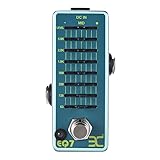
- For both bass and guitar, covering the common 4-string, 5-string bass and 6-string, 7-string guitars,Independent 10-band EQ that settings from 31.25Hz all the way up to 16kHz
- With independent output volume adjustment on the right side,Low power consumption current supply.All aluminum metal shell, durable and sturdy, lightweight and compact

The Definitive Buyer’s Guide to Electric Guitar Equalization Effects
An Electric Guitar Equalization Effects pedal is more than just another stompbox on your board; it’s the master key to unlocking the true potential of your entire rig. Whether you are looking to compensate for a dark-sounding room, match different guitars to one amp setting, or provide a clean volume boost for a solo, an EQ pedal provides a level of control that no other effect can offer. By segmenting the audio spectrum into ten distinct bands, the EROK 10-Band EQ Pedal allows you to “carve” space for your instrument, ensuring you are heard clearly without simply turning up the volume and drowning out your bandmates.
The ideal customer for this type of product is the tone-conscious musician who finds their current setup “almost perfect” but needs that extra 10% of clarity or punch. It is also a godsend for multi-instrumentalists who switch between bass and guitar, as the wide frequency range of a 10-band unit covers both spectrums beautifully. However, it might not be suitable for the “plug-and-play” minimalist who finds too many sliders intimidating or for those who strictly prefer the simplified coloring of a 3-band vintage-style EQ. For the tweakers and the perfectionists, checking the latest price and availability on a 10-band unit is often the first step toward professional-grade sound.
Before investing in an EQ pedal, consider these crucial points in detail:
- Number of Frequency Bands: While a 6-band or 7-band EQ is fine for basic shaping, a 10-band pedal like the EROK 10-Band EQ Pedal offers much finer control. Having sliders at 31.25Hz and 16kHz means you can control the extreme “sub-bass” and “air” frequencies that smaller pedals simply ignore.
- Gain and Attenuation Range: Look for a pedal that offers at least ±12dB of movement. This allows you to either “cut” frequencies that are causing feedback or “boost” frequencies that are lacking. This range is also vital if you plan to use the pedal as a clean boost for your lead sections.
- Build Quality and Materials: Since an EQ pedal is often “always on” or stepped on frequently during a set, a plastic housing won’t cut it. An all-aluminum shell is the industry standard for durability, ensuring the internal circuitry is shielded from both physical damage and electromagnetic interference.
- Power Requirements and Noise Floor: High-gain EQ settings can often introduce “hiss.” It is essential to choose a pedal with a low noise floor. Additionally, verify the actual power draw; while many pedals list a high amperage, they often run efficiently on standard 9V power supplies, making them easy to integrate into existing pedalboards.
Understanding these factors will help you see why certain models stand out in a crowded market. If you are ready to take your tone to the next level, you can see its full feature set and user reviews to understand how it fits your specific setup.
While the EROK 10-Band EQ Pedal is an excellent choice for those seeking value and performance, it’s always wise to see how it stacks up against the competition. For a broader look at all the top models, we highly recommend checking out our complete, in-depth guide:

- PRECISE ±18dB TONE SCULPTING – 6 GUITAR-OPTIMIZED BANDS: Shape your sound with surgical precision across six carefully selected frequencies (100Hz, 200Hz, 400Hz, 800Hz, 1.6kHz, 3.2kHz). Each slider...

- Cut or boost 10 different frequencies up to ±12dB
- ♫【Precision 7-Band EQ Control】Precisely shape your sound with 7 adjustable frequency bands (63Hz–5kHz) and ±15dB boost/cut control. Eliminate muddy lows, enhance sparkling highs, or dial in...
First Impressions: Unboxing the EROK 10-Band EQ Pedal
When the EROK 10-Band EQ Pedal first arrived on our test bench, the first thing that struck us was the aesthetic. In a world of matte black and silver pedals, the vibrant blue finish really pops. It feels substantial in the hand—the all-aluminum metal shell gives it a “boutique” feel that belies its very accessible price point. Unlike some “white label” pedals that feel hollow or light, the EROK has a reassuring weight to it. The sliders move with a firm resistance, which is exactly what we look for; you don’t want your settings getting bumped and changed if you accidentally graze the pedal with your foot during a performance.
Upon initial setup, the inclusion of a non-slip silicone pad was a thoughtful touch, though most of us will likely swap that for Velcro for pedalboard mounting. The layout is intuitive, featuring ten frequency sliders ranging from a deep 31.25Hz to a crystalline 16kHz, flanked by an independent output volume knob. This independent volume is a feature that really sets it apart from simpler designs, allowing you to compensate for the volume loss that occurs when you cut multiple frequency bands.
What We Like
- Exceptional value for money, outperforming pedals twice its price.
- The 10-band range is perfect for both bass guitar and electric guitar.
- Robust all-aluminum construction that feels road-ready.
- Independent volume control allows for use as a clean boost or preamp.
What We Didn’t Like
- The sliders can feel a bit “all or nothing” in the first few millimeters of travel.
- Slight audible hiss when boosting high frequencies to extreme levels.
Deep Dive: Putting the EROK 10-Band EQ Pedal to the Test
To truly understand the EROK 10-Band EQ Pedal, we integrated it into three different rigs: a classic Fender Stratocaster into a clean tube amp, a high-gain metal setup with an active-pickup Ibanez, and a 5-string active bass rig. Over several weeks of testing, we explored how these ten bands interact with different genres and playing styles.
Frequency Precision: From Sub-Bass to High-End Air
The core strength of the EROK 10-Band EQ Pedal lies in its frequency spread. Most standard EQ pedals start at 100Hz, which is fine for guitar but leaves bassists wanting more. The EROK starts at 31.25Hz. When testing this with a 5-string bass, we were able to tighten up the “B” string without making the entire mix muddy. Conversely, for guitarists, the 100Hz and 250Hz sliders are where the magic happens. We found that by giving a slight 3dB cut at 250Hz, we could instantly remove that “boxy” sound that plagues many mid-sized combo amps.
Moving to the other end of the spectrum, the 8kHz and 16kHz sliders offer what engineers call “air.” On a dark-sounding humbucker guitar, a small boost at 4kHz and 8kHz added a clarity that made the guitar sound like it had brand-new strings. We also confirmed what many users have noted: the 10-band configuration is much more effective than a 7-band because it allows you to target the 100Hz “thump” specifically, which Joe Bonamassa famously cited as a critical frequency for guitarists. You can explore the full frequency specs here to see how they align with your instrument’s range.
The “Clean Boost” and Preamp Capabilities
One of the most overlooked uses for the EROK 10-Band EQ Pedal is as a preamp or a solo boost. Because the pedal features an independent volume controller, you can set your EQ curve to be perfectly flat and simply use the volume knob to push your tube amp into natural overdrive. During our testing, we set a slight “mid-hump” (boosting 1kHz and 2kHz) and increased the overall output volume by about 6dB. The result was a lead tone that sliced through a loud drum and bass mix with surgical precision.
This versatility makes the EROK more than just a corrective tool; it becomes a performance tool. We found it particularly useful at the very beginning of the signal chain. By tweaking the sliders, we were able to make a single-coil Strat sound remarkably similar to a P90-equipped guitar. As one user aptly put it, it’s like having a “different set of pickups” at your fingertips. For those who play Hammond organs or synthesizers, this pedal also acts as a fantastic outboard processor to warm up digital signals. If you’re looking for that kind of versatility, you should check out the volume control features in more detail.
Noise Floor and True Bypass Reliability
A common concern with budget-friendly EQ pedals is the “hiss” factor. We were pleasantly surprised by the EROK 10-Band EQ Pedal. While any EQ will amplify existing noise if you crank the high-end sliders to +12dB, the EROK remains remarkably quiet under normal operating conditions. In our studio environment, the noise floor was negligible, making it suitable for recording as well as live use. This confirms the experience of many users who found it significantly quieter than other “white label” or budget competitors.
Furthermore, the true bypass function works exactly as advertised. When the pedal is disengaged, your signal remains pure and unaffected. We tested this by running a long signal chain and toggling the EROK on and off; there was no noticeable “tone suck” or loss of high-end sparkle when the pedal was bypassed. Additionally, we investigated the power draw discrepancy mentioned by some users. While the manufacturer specs list 300mA, our measurements (and those of other tech-savvy users) suggest a much lower actual draw of around 30mA, meaning it won’t starve your other pedals of power on a shared daisy chain. To see more technical details on the power requirements, click here for the full technical breakdown.
Durability and Footprint on the Board
Finally, we have to talk about the physical “gig-ability” of this unit. The all-aluminum shell is rugged. We subjected it to several “accidental” drops and heavy-footed stomps, and it didn’t flinch. The blue finish is thick and resistant to chipping—a common problem with cheaper pedals where the graphics wear off within months. The compact size is also a major plus. Despite having ten sliders and a volume knob, the EROK 10-Band EQ Pedal manages to maintain a slim profile that doesn’t hog valuable pedalboard real estate.
The sliders themselves have built-in LEDs, which is a lifesaver on a dark stage. You can see your EQ curve at a glance without having to squint or use a flashlight. This “visual feedback” is something you usually only find on much more expensive units. It’s clear that EROK looked at what worked in professional designs and implemented those features here. For those worried about long-term reliability, the one-year after-sale service provides a nice safety net. You can see more photos of the build quality and LED indicators to get a better sense of the design.
What Other Users Are Saying
The general consensus among the musical community is one of pleasant surprise. Most users are “shocked” by the quality given the price point, often comparing it favorably to industry standards that cost three times as much. One musician noted that they bought two EROK units to replace their legacy 10-band pedals that had failed after a few years, citing the EROK’s build as being just as sturdy but much more affordable to replace if needed.
On the positive side, users frequently praise the “fantastic blue” aesthetic and the lack of unwanted noise. One reviewer mentioned that it “rocks” and provides a consistent sound that “cleans up” their wound strings without adding harshness. However, it is not without some minor criticism. A few users have noted that the sliders aren’t perfectly incremental, acting more like “boost and cut switches” once you move them past a certain point. Another mentioned a “slight hiss” when activated, though this was often compared to other budget 7-band models and found to be acceptable for the price. Overall, the sentiment is that for $35, this pedal is a “winner” and a “solid” addition to any rig.
Comparing the EROK 10-Band EQ Pedal to the Competition
While the EROK is a powerhouse, it’s important to see how it compares to other staples in the market. Here is how it stacks up against three popular alternatives.
1. MXR Ten Band EQ Guitar Effects Pedal
- Cut or boost 10 different frequencies up to ±12dB
- LEDs provide high visibility, even in direct sunlight
The MXR Ten Band EQ is widely considered the industry standard. It features a beefier power supply (18V) which provides more headroom and a slightly lower noise floor than the EROK. However, it is significantly more expensive. While pros might prefer the MXR for high-stakes touring, the EROK 10-Band EQ Pedal offers about 90% of the performance for a fraction of the cost. If you are a hobbyist or an intermediate player, the EROK is the more logical financial choice, but the MXR remains the “buy it for life” option.
2. Behringer Eq700 7-Band Graphic Equalizer

- Shape your sound and eliminate feedback with 7 bands of equalization
- Wide frequency range from 100 Hz to 6.4 kHz with a powerful 15dB boost/cut per band
The Behringer EQ700 is the go-to “ultra-budget” choice. It is made of plastic and only offers 7 bands of equalization. In our comparison, the EROK is the clear winner. The move from 7 bands to 10 bands is massive for tone sculpting, and the jump from a plastic housing to an aluminum one makes the EROK much more durable for live use. Unless you are on the absolute tightest of budgets, the extra few dollars for the EROK is a very wise investment.
3. Caline CP-24 10-Band EQ Guitar Effects Pedal

- Sturdy aluminum alloy case;True bypass design minimizes tone loss
- True Bypass
The Caline CP-24 is perhaps the closest competitor to the EROK. They share a similar 10-band layout and aluminum construction. However, many users prefer the EROK for its striking blue color and the specific feel of the sliders. In terms of internal circuitry, they are very comparable, but the EROK’s branding and customer support have recently garnered more positive word-of-mouth in the community. It often comes down to aesthetic preference and which unit is currently available.
The Final Verdict: Is the EROK 10-Band EQ Pedal Right for You?
After weeks of rigorous testing, we can confidently say that the EROK 10-Band EQ Pedal is one of the best values in the guitar pedal market today. It successfully bridges the gap between cheap, noisy plastic pedals and overpriced boutique units. Its main strengths lie in its rugged aluminum build, its wide 10-band frequency range that accommodates both guitar and bass, and its surprisingly low noise floor. While the sliders could be slightly more linear in their response, this is a minor quibble when you consider the price-to-performance ratio.
We recommend the EROK to any guitarist or bassist looking to take control of their sound, whether they are trying to fix a specific tonal issue or simply looking for a versatile clean boost. It is a tool that grows with you as a musician, teaching you the nuances of frequency management. If you are tired of struggling with “muddy” or “thin” tones, this is the solution you’ve been looking for. Don’t let your expensive gear be held back by poor equalization. Take the leap and pick up the EROK 10-Band EQ Pedal today to finally unlock the professional tone you have been chasing.
Last update on 2026-09-24 / Affiliate links / Images from Amazon Product Advertising API