
Ernie Ball Microfiber Polish Cloth Review: The Essential Secret to a Pristine Instrument Finish
We have all been there: you finish a blistering practice session or a high-energy gig, and you look down at your prized instrument only to see it covered in a hazy film of sweat, oils, and unsightly fingerprints. For years, many of us—myself included—resorted to whatever was within arm’s reach. An old cotton T-shirt, a stray paper towel, or even a sleeve. However, as I learned the hard way, these “solutions” often do more harm than good. They can leave micro-scratches on a delicate nitrocellulose finish or simply smear the grime around rather than lifting it away. This is where the Ernie Ball Microfiber Polish Cloth enters the frame.
Solving the problem of instrument hygiene isn’t just about aesthetics; it is about preservation. Acidic sweat can eat away at hardware and deaden strings, while accumulated dust can act as an abrasive on the wood’s finish. When I first decided to invest in high-quality instrument care, I was looking for something that offered professional results without a professional price tag. Failing to use a dedicated microfiber cloth often leads to a dulling of the gloss that even the best polishes can struggle to restore. This review dives deep into why this specific cloth has become a permanent resident in every one of my guitar cases.
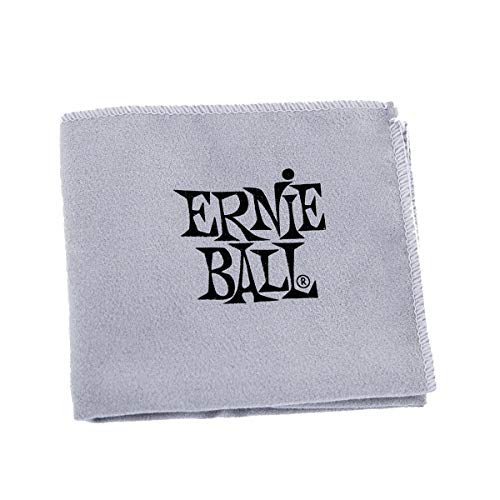
- Safely polish your guitar or bass with Ernie Ball’s microfiber polish cloth.
- The fiber density of microfiber cloth makes it much more effective than traditional cloth for instrument care.

Choosing the Right Tools: A Guitar Cleaning & Care Buyer’s Guide
A Guitar Cleaning & Care Product is more than just an item; it’s a key solution for maintaining the longevity and playability of your musical investment. Whether you are holding a budget-friendly starter guitar or a vintage masterpiece, the materials you use to maintain it will dictate how well it ages. High-quality cleaning tools are designed to interact safely with various finishes—polyurethane, polyester, and nitro—without causing chemical reactions or physical damage. The primary benefit of specialized microfiber over traditional cloth is the “hook” shape of the fibers, which are designed to trap particles rather than push them across the surface.
The ideal customer for this type of product is someone facing the daily reality of “player’s grime,” while it might not be suitable for those who rarely play or those who prefer a “relic” look where dirt and wear are part of the charm. If you are a gigging musician or a studio enthusiast who values a mirror-like shine and smooth-feeling strings, a dedicated cloth is non-negotiable. For those looking for deep structural repairs, a cloth won’t help; you’d need luthiery tools instead.
Before investing, consider these crucial points in detail:
- Dimensions & Space: The size of a cleaning cloth determines how much surface area you can cover before the cloth becomes saturated with oils. A standard 12″ x 12″ size is generally the “sweet spot,” providing enough fabric to fold multiple times so you always have a clean edge to work with, while still being small enough to fit into a standard accessory pocket.
- Capacity/Performance: In the world of microfiber, performance is measured by absorbency and “grab.” You want a cloth that can pull moisture off strings instantly and lift fingerprints with a single pass. Look for a high density of fibers that feel soft to the touch but have enough texture to remove stubborn “crud.”
- Materials & Durability: Not all microfibers are created equal. Some are thin and fray easily, while others, like the Ernie Ball Microfiber Polish Cloth, feature stitched edging to prevent unraveling. A durable cloth should be able to withstand dozens of wash cycles without losing its electrostatic properties or becoming coarse.
- Ease of Use & Maintenance: Your cleaning tools shouldn’t require a cleaning regimen of their own. The best products are machine washable and can be tumbled dry on low heat. Avoid cloths that require specialized solvents to work, as the goal is to simplify your maintenance routine, not complicate it.
Once you understand these fundamentals, it becomes clear why certain brands rise to the top. While the Ernie Ball Microfiber Polish Cloth is an excellent choice, it’s always wise to see how it stacks up against the competition. For a broader look at all the top models, we highly recommend checking out our complete, in-depth guide:
- Our 5 piece cleaning kit gives your acoustic, electric or bass guitar a total spa treatment from the body and neck to the fretboard and hardware. Whether using for general everyday maintenance or a...
- ONE STEP TO CLEAN, POLISH, AND PROTECT: Get a spotless shine and lasting protection with Music Nomad's ultimate guitar polish. Perfect for all stringed instruments such as electric, acoustic & bass...

- ONE STEP TO CLEAN, POLISH, AND PROTECT: Guitar ONE gives a spotless shine and lasting protection. Perfect for all stringed instruments. Music Nomad Guitar ONE is safe for all lacquer finishes...
First Impressions: Unboxing the Ernie Ball Microfiber Polish Cloth
Upon receiving the Ernie Ball Microfiber Polish Cloth, the first thing I noticed was the thoughtful packaging. Unlike many budget cloths that come in a throw-away plastic wrap, this one arrives in a resealable ziplock bag. It might seem like a small detail, but for a guitarist, it’s a game-changer. It keeps the cloth clean and free of abrasive dust while it sits in your gig bag. When I pulled it out, the fabric felt significantly more substantial than the generic “3-pack” cloths I had used previously.
The 12″ x 12″ dimensions are generous, and the stitched edging gives it a finished, professional look. It feels incredibly soft—almost like a high-end lens cloth but with more “grip.” Comparing it to previous versions of Ernie Ball cloths or other market leaders, the density of the microfiber stands out. It doesn’t feel like it’s going to “pill” or leave lint behind, which is the ultimate frustration when trying to get a dark-colored guitar perfectly clean. Before even touching a guitar, you should check the current pricing and detailed specifications to see why this has become a staple for so many.
Key Benefits
- Superior microfiber technology that traps dust and oils without scratching.
- Convenient 12″ x 12″ size is perfect for both bodies and fretboards.
- Comes with a resealable storage bag to prevent contamination.
- Incredibly cost-effective compared to boutique cleaning brands.
Limitations
- The outside stitching, while durable, might be a minor tactile preference for some.
- Only available in one color/style (Grey), which might not suit everyone’s “vibe.”
A Deep Dive into the Performance of the Ernie Ball Microfiber Polish Cloth
Testing a cleaning cloth might sound straightforward, but when you are dealing with high-gloss finishes and expensive hardware, the stakes are higher than they appear. I put the Ernie Ball Microfiber Polish Cloth through its paces over a period of three months, using it on everything from a vintage nitro-finished acoustic to a modern “shred machine” with a thick poly coat. The results were consistently impressive, revealing nuances in its design that separate it from the pack.
Microfiber Efficiency and Finish Protection
The core promise of this cloth is safe polishing. We found that the microfiber technology used here is exceptionally efficient at “lifting” rather than “dragging.” When I wiped down a black Les Paul—a finish notoriously difficult to keep streak-free—the cloth removed oily fingerprints in a single pass. I didn’t need to apply excessive pressure, which is crucial because pressure is what usually causes “swirl marks” in the clear coat. The Ernie Ball Microfiber Polish Cloth manages to be gentle enough for the most sensitive finishes while having enough “tooth” to grab onto particles. To truly appreciate the difference, you can discover why thousands of guitarists trust it for their high-end instruments.
User feedback consistently backs this up. Many owners have noted that they keep one specifically in their case for “dry wiping” after every session. I found that even without using any liquid polish, this cloth restored a significant amount of luster just by removing the atmospheric dust and skin oils that dull a finish over time. It’s a testament to the quality of the synthetic fibers used by Ernie Ball.
String Maintenance and Longevity
One of the most overlooked uses for a high-quality cloth is string care. I have found that my strings last significantly longer when I use the Ernie Ball Microfiber Polish Cloth to wipe them down immediately after playing. The cloth is thin enough to fold over the string and slide up and down the neck, effectively “sandwiching” the string to remove sweat from the underside. This prevents the dark corrosion that often leads to a dull tone and “scratchy” feel. One user even mentioned that they saw a noticeable decrease in string crud after implementing this routine, and I concur. By removing the moisture before it has a chance to oxidize the metal, you are essentially extending the life of your strings by 30-50%.
This “preventative maintenance” aspect makes the cloth pay for itself within a few months. If you are tired of your strings going “dead” after just one or two rehearsals, this is the most cost-effective solution available. It’s worth it to see its full feature set and user reviews regarding string longevity, as it’s a benefit that isn’t always highlighted in the product description.
Versatility Beyond the Fretboard
While designed for guitars and basses, I quickly discovered that the Ernie Ball Microfiber Polish Cloth is an “all-arounder.” Because it is non-abrasive and highly absorbent, I started using a second one for my iPad screen, my smartphone, and even my studio monitors. It performs better than many dedicated “tech cloths” because it has a slightly higher pile, which allows it to trap more dust. In the studio, I use it to wipe down the glass on my rack gear and the screens of my digital interfaces. It leaves a streak-free finish every time.
The fact that it’s less expensive than many specialized electronic cleaning cloths is a massive bonus. I now keep a “clean” one in my desk drawer and a “guitar-only” one in my gig bag. One user pointed out that they even use it for their glasses, which I tested and found to be quite effective, though I’d recommend washing it first to ensure there’s no factory lint. This versatility is a feature that really sets it apart from more rigid, single-use products.
Durability and Long-Term Care
A cleaning cloth is only as good as its last wash. Some cheap microfibers become “crunchy” or lose their softness after a single trip through the laundry. I have washed my Ernie Ball Microfiber Polish Cloth multiple times—tumble drying on low as instructed—and it has retained its original texture perfectly. The stitched edging is vital here; it prevents the edges from fraying or unraveling in the washing machine, which can happen with “cut-edge” cloths. This means you aren’t just buying a disposable item; you are buying a tool that will last for years.
Maintenance is simple: machine wash with like colors and avoid fabric softeners, as softeners can clog the microfiber pores and reduce its effectiveness. When you consider that you can get professional-grade cleaning results for such a low entry price, the value proposition is undeniable. It’s built to be used, abused, and then cleaned back to its original state.
What Other Users Are Saying
The consensus among the guitar community is overwhelmingly positive. Most users praise the Ernie Ball Microfiber Polish Cloth for its “no-nonsense” performance and high-quality feel. One user mentioned, “The only cloth I ever get for my guitars, works great on keeping everything clean and feels high quality.” This sentiment is echoed across many platforms, with musicians appreciating that it “just keeps working” even after heavy use on the road.
A particularly insightful review highlighted the value, stating, “In fact, Ernie Ball cloths are less expensive than most of the competing companies’ cloths. Buy one for each guitar case.” I found this to be a very relevant piece of advice. The only minor “gripe” I encountered was from a user who noted, “As long as you don’t mind the outside stitching then these cloths are great.” For a tiny minority, the stitched edge is a tactile distraction, but for the vast majority, it is seen as a sign of durability that prevents the cloth from falling apart.
Overall, the feedback reinforces our findings: this is a reliable, soft, and highly absorbent accessory that performs exactly as advertised. It captures dust, removes fingerprints, and—most importantly—does so without leaving a single scratch on the instrument’s finish.
Comparing the Ernie Ball Microfiber Polish Cloth to the Competition
While the Ernie Ball Microfiber Polish Cloth is an incredible standalone tool, it often works best in conjunction with other maintenance products. Let’s see how it compares to some of the other heavy hitters in the guitar care world.
1. Jim Dunlop Formula 65 Guitar Polish

- Cleans totally and quickly, restoring finish to its original luster
- Leaves a micro-thin, stain-resistant protective layer that won't build up
The Jim Dunlop Formula 65 is a liquid polish and cleaner rather than a cloth. While the Ernie Ball cloth is your primary tool for lifting dust and sweat, the Formula 65 is what you use when you need to “deep clean” a finish that has become hazy over years of neglect. I found that using the Ernie Ball cloth to apply and then buff out the Formula 65 results in a spectacular, mirror-like shine. If you have a heavily soiled instrument, you might prefer starting with this liquid cleaner, but you will still need a high-quality microfiber cloth like the Ernie Ball to finish the job without leaving streaks.
2. Boveda 49% Guitar Humidifier Kit

- NO MORE WETTING HOSES OR SPONGES! SWITCH TO AN EASIER WAY to maintain ideal moisture for your wood instrument—no mess, nothing to add, automatic. Use this starter kit for an acoustic guitar or bass...
- HOW BOVEDA WORKS FOR MUSICAL INSTRUMENTS: Boveda 49% RH protects wood instruments & their accessories by stabilizing the humidity within the ideal range—45–55% RH. If the air inside a case is too...
Comparing a cloth to a humidification kit might seem like apples and oranges, but they both fall under the “essential care” umbrella. While the Ernie Ball Microfiber Polish Cloth handles the exterior hygiene, the Boveda 49% Kit handles the internal structural health of your acoustic guitar. If you live in a dry climate, the Boveda kit is more important for preventing cracks, but it won’t do anything for your fingerprints. Ideally, a serious guitarist should have both: the Boveda in the case for humidity control and the Ernie Ball cloth for surface maintenance.
3. D’Addario Humidipak Guitar Maintain Packets
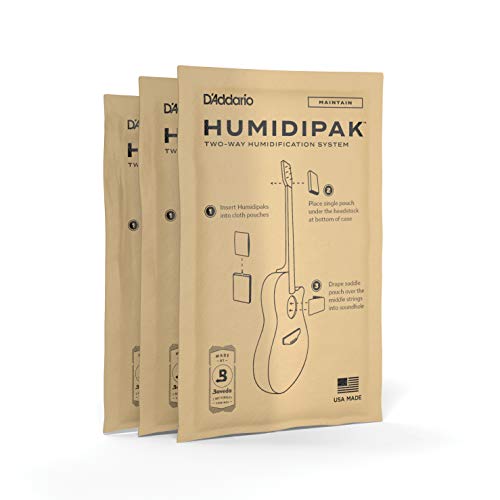
- TWO-WAY HUMIDITY CONTROL – D’Addario Two-Way Humidification System is the only maintenance-free two-way humidity control system for guitar. It automatically maintains the optimal 45-50% relative...
- REPLACEMENT PACKETS – Now available in 3-packs that are perfect for luthiers and guitar repair shops. On average, the packets will last 2-6 months depending on the geographic location and the...
Similar to the Boveda system, the D’Addario Humidipak is a “set it and forget it” solution for internal moisture. It competes with the Ernie Ball cloth only in terms of “gig bag space.” If you are on a tight budget and can only buy one “care” item this month, the Ernie Ball cloth is the more immediate “hands-on” tool for daily use. However, for long-term storage of wooden instruments, the Humidipak is a crucial partner to ensure the wood doesn’t warp while the cloth ensures the finish stays shiny. They are complementary products that every guitar owner should consider.
The Final Verdict: Is the Ernie Ball Microfiber Polish Cloth Worth It?
After months of testing and comparing it against both budget and boutique alternatives, the Ernie Ball Microfiber Polish Cloth stands out as an essential accessory for any serious musician. It strikes the perfect balance between softness and cleaning power, all while being durable enough to survive the washing machine. Its ability to protect sensitive finishes while doubling as a fantastic string cleaner makes it a multi-functional tool that far exceeds its modest price point. Whether you’re wiping down a $5,000 custom-shop guitar or your first entry-level bass, this cloth provides the peace of mind that you aren’t doing damage while you clean.
The included resealable bag and the 12″ x 12″ size are the “icing on the cake” that make this product a superior choice over generic microfibers. I can confidently say that this is the best “bang-for-your-buck” maintenance item in my kit. If you value your instrument’s appearance and longevity, don’t settle for subpar cleaning materials. You can order yours today and keep your gear pristine; it’s a small investment that pays dividends in the look, feel, and sound of your guitar.
Last update on 2026-10-16 / Affiliate links / Images from Amazon Product Advertising API