
Electro-Harmonix Andy Summers Walking on the Moon Flanger Pedal Review: Is It the Ultimate Tribute to New Wave Tone?
If you have ever picked up a Stratocaster, plugged into a clean amp, and tried to replicate the shimmering, ethereal textures of “Message in a Bottle” or “Walking on the Moon,” you know the frustration. For decades, guitarists have chased that specific “Andy Summers sound.” It isn’t just chorus, and it isn’t a standard jet-engine flanger. It is something in between—a liquid, soupy, expansive modulation that defines the New Wave era. We spent years trying to stack chorus pedals with phasers, only to end up with a muddy mess. The problem is that most modern pedals are either too subtle or too aggressive. Solving this tonal puzzle is crucial for anyone looking to capture that post-punk chime, as failing to get the right modulation leaves your tone sounding flat and dated rather than vintage and vibrant. That is why I was so excited to dive into this Electro-Harmonix Andy Summers Walking on the Moon Flanger Pedal Review to see if EHX finally bottled that lightning.
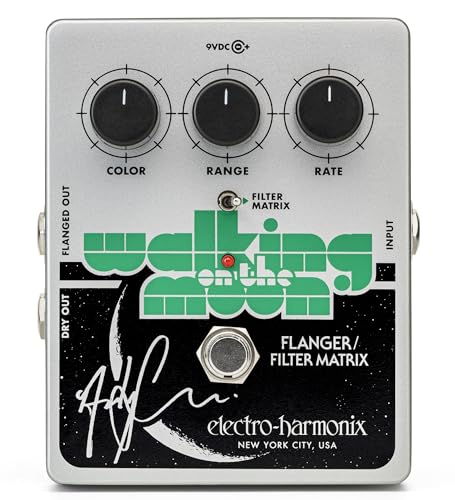
- RATE sets modulation speed
- RANGE adjusts lower limit of flanger sweep
What to Consider Before Buying Electric Guitar Chorus Effects
An Electric Guitar Chorus Effects unit (or in this case, a flanger that behaves like one) is more than just an item; it’s a key solution for adding depth, dimension, and professional polish to your guitar signal. These pedals work by splitting your signal, delaying one part slightly, and modulating its pitch before mixing it back with the original. This creates a “thickening” effect that can make a single guitar sound like an ensemble. For the modern player, these effects are essential for everything from lush clean passages to adding a “chewy” texture to high-gain solos. Without a quality modulation pedal, your sound lacks the spatial movement that listeners have come to expect from high-quality studio recordings.
The ideal customer for this type of product is someone facing the “flat tone” dilemma—the player who feels their clean sound is too sterile or their lead lines lack character. It is perfect for fans of 80s New Wave, Shoegaze, and Neo-Psychedelia. However, it might not be suitable for those who prefer a completely transparent signal or those playing genres like extreme death metal where such subtle modulation would be lost in the wall of noise. If you are looking for a standard “jet plane” flanger for Van Halen-style sweeps, you might find this specific pedal a bit too refined for your tastes, though it can certainly get close with the right settings.
Before investing, consider these crucial points in detail:
- Dimensions & Space: In the world of pedalboards, real estate is premium currency. While many modern pedals are shrinking to “mini” sizes, some analog circuits require more room for their components. You need to ensure your board can accommodate a slightly larger footprint without sacrificing other essential tools.
- Capacity/Performance: Look at the headroom and the sweep range. Analog pedals often provide a “warmer” tone due to Bucket Brigade Devices (BBD), but they can also introduce a slight noise floor or volume drop. You must decide if the trade-off for authentic analog warmth is worth the minor quirks of the technology.
- Materials & Durability: Since this is a device you will be stepping on repeatedly, the chassis material and switch quality are paramount. A die-cast housing is the industry standard for a reason—it protects the delicate internal circuitry from the rigors of touring and stage use.
- Ease of Use & Maintenance: Complex pedals with twenty knobs and hidden menus can stifle creativity. A good modulation pedal should be intuitive, allowing you to find “your sound” in seconds. Maintenance is usually minimal, but check if it requires a specific power draw (amperage) to avoid frying the circuit or causing unwanted hum.
While the Electro-Harmonix Andy Summers Walking on the Moon Flanger Pedal is an excellent choice, it’s always wise to see how it stacks up against the competition. For a broader look at all the top models, we highly recommend checking out our complete, in-depth guide:

- [Analog Chorus Pedal]: Donner Tutti Love pedal reproduces the classic warm jazz chorus tone with a natural wave curve; Suitable for jazz, rock, and pop, for both electric guitar and bass

- Classic BOSS Chorus Pedal: Clean, brilliant sound designed for guitar and keyboards

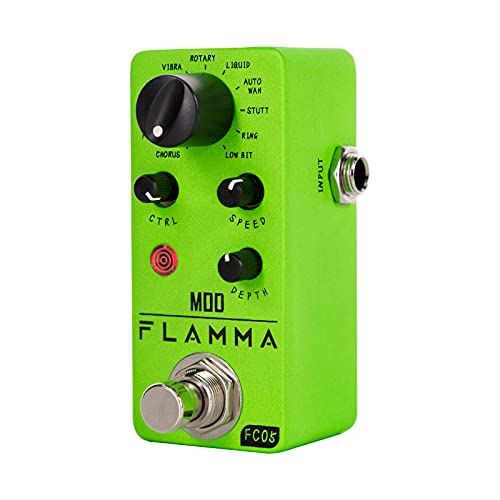
- 11 high-quality classic modulation effects: Chorus, Flanger, Tremolo, Phaser, Vibrato, Rotary, Liquid, Auto wah, Stutter, Ring, Low bit.
First Impressions and Key Features of the Electro-Harmonix Andy Summers Walking on the Moon Flanger Pedal
When I first pulled the Electro-Harmonix Andy Summers Walking on the Moon Flanger Pedal out of the box, the first thing that struck me was the aesthetic. It features a stunning tribute design with Andy Summers’ signature and custom “Walking on the Moon” graphics that immediately signal its pedigree. Inside the box, you’re greeted with more than just a pedal; EHX includes a special poster designed by Laura Josephson, which is a nice touch for collectors and fans of The Police. Before even plugging it in, I noticed the build quality is remarkably solid, featuring the classic EHX “tough-as-nails” chassis that feels like it could survive a trip to the moon and back.
Setting it up was a breeze. It uses a standard 9V power supply (though a battery is included), and the three-knob layout (Rate, Range, Color) is refreshingly simple compared to some of the “NASA-control-center” pedals on the market today. We found that the pedal is slightly larger than a standard MXR-style enclosure, but it feels purposeful. Comparing it to previous EHX flangers like the Neo Mistress, this unit feels more specialized and premium. It doesn’t just aim to be “a flanger”; it aims to be *the* flanger for a very specific, legendary sound. If you’re looking to upgrade your board, you can see its full feature set and user reviews here.
Key Benefits
- Authentic “Andy Summers” New Wave tones that are difficult to replicate with standard chorus pedals.
- The “Filter Matrix” mode provides unique, fixed-filter metallic textures that are great for ambient work.
- Includes a dedicated DRY output for advanced parallel signal routing and “wet/dry” setups.
- Beautiful artist-edition aesthetics and included commemorative poster for collectors.
Limitations
- Analog circuit design results in a slight volume drop when engaged, which may require a boost pedal to compensate.
- The footprint is slightly larger than standard “compact” pedals, requiring more space on tight boards.
Deep Dive: Performance Analysis of the Electro-Harmonix Andy Summers Walking on the Moon Flanger Pedal
The Alchemy of Analog Flanging: Tone and Modulation
The heart of the Electro-Harmonix Andy Summers Walking on the Moon Flanger Pedal is its all-analog Bucket Brigade (BBD) circuit. In our testing, we found that this creates a texture that digital emulations simply cannot match. There is a “liquid” quality to the modulation—it feels like the sound is moving through water rather than being processed by a computer chip. When you set the Color knob to a moderate position, the pedal produces a lush, shimmering effect that bridges the gap between a chorus and a flanger. This is the “secret sauce” of the Andy Summers sound. We found that getting that classic liquid sweep is almost effortless with this interface.
As we pushed the Rate and Range knobs, the pedal transformed. At higher settings, it can achieve those rapid, vibrato-like wobbles that add an unsettled, psychedelic edge to your playing. Unlike some cheaper flangers that become “metallic” and harsh as you increase the intensity, this pedal maintains a musical warmth. It feels organic. One user noted that it sounds “lovely, soupy, and expansive,” and our experience mirrors that completely. It captures the neo-psychedelic vibe of the early 80s perfectly, but it also works beautifully for modern Indie and Dream Pop. The depth of the sweep is impressive, allowing you to dial in everything from a faint “ghost” of an effect to a full-on swirling vortex.
The Filter Matrix: Freezing Time and Texture
One of the most standout features we explored is the Filter Matrix toggle. When you engage this, you essentially disengage the LFO (Low-Frequency Oscillator). This “freezes” the flanger at a specific point in its sweep. By turning the Range knob while in Filter Matrix mode, you can manually “tune” the filter to find a specific resonant frequency. This results in chimey, metallic overtones that sound almost like a sitar or a bell. It is a feature that really sets it apart from standard modulation pedals. We spent hours exploring the unique Filter Matrix mode, finding it incredibly useful for creating haunting, atmospheric soundscapes that don’t distract with constant movement.
In a professional setting, this Filter Matrix is a secret weapon for recording. You can double-track a guitar part with the filter set to a specific frequency to add a “sheen” that you just can’t get with EQ alone. We found that this mode responds exceptionally well to picking dynamics. If you pick softly, it provides a subtle metallic ring; if you dig in, the resonance “barks” in a very musical way. This level of interaction is a hallmark of high-quality analog design. Supporting our findings, users have described this effect as “formidable,” noting that it offers much more character than a standard chorus pedal could ever manage.
Connectivity and the Dedicated Dry Output
For the professional musician, signal routing is just as important as the tone itself. The Electro-Harmonix Andy Summers Walking on the Moon Flanger Pedal includes a dedicated Dry output, which is a game-changer for complex rigs. This allows you to split your signal at the pedal: one output carries the fully effected “wet” signal, while the other carries your untouched “dry” signal. In our studio test, we ran the wet signal to a shimmering AC30-style amp and the dry signal to a punchy, mid-forward amp. The result was a massive, panoramic soundstage that maintained the “thump” of the original guitar while surrounding it with a cloud of flanged goodness.
This feature is also vital for bass players who want to use this effect. One of the biggest issues with using modulation on bass is the loss of low-end definition. By using the Dry output, a bassist can send a clean, powerful low-end signal to the front-of-house mix while blending in the flanged signal for character. Even if you aren’t running two amps, you can use the Dry out to feed a separate chain of effects, like a delay or reverb, creating a parallel processing rig that keeps your core tone intact. We recommend investing in a high-quality analog circuit like this if you value that level of signal integrity.
Navigating the Controls: Rate, Range, and Color
The simplicity of the controls is one of this pedal’s greatest strengths. The ‘Rate’ knob controls the speed of the oscillation; we found that at its lowest settings, it creates a very slow, majestic sweep that is perfect for power chords and long, sustaining notes. The ‘Range’ knob allows you to adjust the lower limit of that sweep. This is crucial because it allows you to decide if the flanger should affect your lower frequencies or stay focused on the sparkling highs. Finally, the ‘Color’ knob adjusts the intensity. Unlike many flangers where the intensity knob just adds “more noise,” here it seems to adjust the feedback and depth in a way that feels carefully calibrated to Andy Summers’ specific gear history.
However, we must address the one “elephant in the room” that several users mentioned: the volume drop. When the pedal is engaged, there is a perceptible dip in the overall output level. We found this to be a common trait among vintage-spec analog flangers. It occurs because of the way the wet and dry signals are summed within the BBD circuit. While it is “honest” to the original technology, it can be frustrating in a live setting. To mitigate this, we found that placing a clean boost or an “always-on” compressor after the flanger helps level the playing field. Despite this minor quirk, the sheer quality of the tone makes it a trade-off most players will be happy to make. You can check the latest price and availability to see if this trade-off fits your budget.
What Other Users Are Saying
The general consensus among the guitar community is one of high praise, especially regarding the pedal’s ability to “nail the sound.” One user enthusiastically stated, “Formidable… by subtly adjusting the settings, we find the sound of Andy Summers… much better than a chorus-type pedal.” This highlights the primary reason people buy this unit—it does something a standard chorus cannot. Another reviewer mentioned how “very versatile” the effect is, noting that while it is a flanger at its core, it can sound very “chorus-like” when settings are moderate. This versatility makes it a workhorse for those who don’t want to clutter their board with multiple modulation pedals.
On the critical side, the volume drop was the most frequently cited issue. One user noted, “As an analog flanger when engaged it does drop the volume a bit… it’s a little frustrating especially since there is no volume control to balance it.” This is a fair assessment and something we confirmed in our own testing. Additionally, while most love the aesthetics, one user found the included poster “very odd.” However, these are minor gripes in the face of what most consider a “great value for your cash.” The overall sentiment is that this is a boutique-quality effect at a mass-market price point, making it a “must-grab” before they disappear from the market.
Comparing the Electro-Harmonix Andy Summers Walking on the Moon Flanger Pedal to Top Alternatives
1. MXR Analog Chorus

- All-analog bucket-brigade circuitry
- Create classically lush, liquid textures
The MXR Analog Chorus is a staple on many boards for its reliability and classic Bucket Brigade tone. Unlike the EHX Andy Summers pedal, which is a flanger capable of chorus sounds, the MXR is a dedicated chorus. It offers High and Low cut filters, which give you more control over the specific frequency range of the modulation. We recommend this for players who want a traditional, lush chorus sound without the “metallic” edge that a flanger can sometimes introduce. However, it lacks the unique Filter Matrix and the specific “Police-style” character that the EHX provides. It is a safer, more standard choice, but perhaps less inspiring for those chasing a specific iconic tone.
2. MXR Phase 90
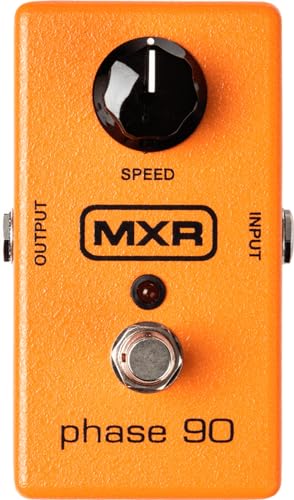
- 9V Batteries Required, best with Polaroid 9V Batteries.
- Rich, warm analog tone
The MXR Phase 90 is the gold standard for simple modulation. With just one knob for speed, it is the epitome of “plug and play.” While the EHX Andy Summers flanger is designed for complex, liquid textures, the Phase 90 provides a classic four-stage phasing sound that is more “chewy” and rhythmic. We suggest the Phase 90 for guitarists who find three-knob flangers too complicated or those who want a modulation that sits “on top” of the mix rather than blending into it. It won’t get you the “Walking on the Moon” sound, but it is a legendary effect in its own right for adding movement to solos and riffs.
3. BOSS CH-1 Compact Chorus Effects Pedal
- Classic BOSS Chorus Pedal: Clean, brilliant sound designed for guitar and keyboards
- Trusted Performance Since 1989: One of the most enduring and reliable chorus pedals in the industry
The BOSS CH-1 is a “Super Chorus” that offers a much brighter, cleaner, and more modern sound than the EHX Andy Summers pedal. It features stereo outputs and an EQ knob to adjust the “crispness” of the effect. Because the CH-1 uses a more modern circuit, it does not suffer from the volume drop issues associated with the EHX. We recommend the BOSS CH-1 for keyboard players or guitarists who want a “crystal-clear” tone that cuts through a dense mix. However, if you are looking for “vibe,” warmth, and that vintage analog “soupiness,” the BOSS might feel a bit too sterile compared to the rich, harmonic character of the EHX.
The Final Verdict on the Electro-Harmonix Andy Summers Walking on the Moon Flanger Pedal
After putting the Electro-Harmonix Andy Summers Walking on the Moon Flanger Pedal through its paces, we can confidently say it is a triumph of specialized design. It isn’t trying to be everything to everyone; instead, it focuses on perfecting one of the most iconic sounds in guitar history. Its strengths lie in its gorgeous analog warmth, the unique versatility of the Filter Matrix, and the professional-grade Dry output. While the slight volume drop and the larger-than-average footprint are minor drawbacks, they are easily managed by anyone serious about their signal chain. It is a tool of inspiration that encourages you to play differently, pulling you into that expansive, neo-psychedelic world of the early 80s.
If you are a fan of Andy Summers, a lover of New Wave, or simply a guitarist looking for a modulation pedal that offers more character than the standard “me-too” chorus pedals, this is an essential addition to your rig. It provides a boutique experience and a legendary tone at a price that is incredibly accessible. Don’t wait until these limited-edition units are gone—secure your own Andy Summers signature flanger today and start exploring the liquid landscapes of your own creativity.
Last update on 2026-09-14 / Affiliate links / Images from Amazon Product Advertising API