
dbx PB-48 Point Patch Bay Review: A Studio Essential with Surprising Versatility
In the world of audio production, few things are as universally frustrating as a tangled mess of cables behind your mixer, audio interface, and rack gear. We’ve all been there: a critical session underway, a sudden need to reroute a signal, and you’re left fumbling in the dark, blindly feeling for the right jack, inevitably pulling the wrong one or worse, damaging a precious input on an expensive piece of equipment. This isn’t just about aesthetics; it’s about workflow, equipment longevity, and the sheer mental fatigue of dealing with disorganization. A chaotic cabling setup introduces unnecessary points of failure, degrades signal integrity through repeated wear and tear on ports, and can bring creative momentum to a grinding halt. Solving this problem isn’t merely a luxury; it’s a fundamental step towards a professional, efficient, and enjoyable studio environment. Without a proper solution, your creative energy is sapped by technical frustrations, and your valuable gear faces premature degradation. This is precisely where a well-designed patch bay becomes indispensable, acting as the central nervous system for your entire audio setup, and the dbx PB-48 Point Patch Bay aims to be that solution.

- 48-point patch bay - 48 ¼” jacks on the front panel, 48 ¼” jacks on the back panel
- Provides clear, easy, noise-free access to a mixer or other audio gear.
Before You Plug In: What to Look for in Recording Studio Furniture, Including Patch Bays
While the broader category of “Recording Studio Furniture” encompasses everything from desks to acoustic panels, the dbx PB-48 Point Patch Bay falls into a specialized but vital subset: rack-mounted audio infrastructure. A patch bay is far more than just an item; it’s a key solution for streamlining signal flow, protecting your expensive gear’s input/output jacks from constant wear, and facilitating rapid, creative rerouting without ever having to reach behind your racks. It centralizes all your connections, turning a spaghetti tangle into an organized, easily accessible front panel. Its main benefits include enhanced workflow efficiency, extended equipment lifespan, and the flexibility to experiment with different signal chains effortlessly.
The ideal customer for a patch bay like the dbx PB-48 Point Patch Bay is someone facing cable management challenges in a home project studio, a small commercial studio, or even a live rack setup. It’s perfect for engineers, producers, and musicians who frequently reconfigure their signal paths, integrate multiple outboard processors, or simply want to clean up their cabling. Conversely, it might not be suitable for those who rarely change their setup, operate entirely in-the-box, or require a patch bay with integrated microphone preamps or phantom power capabilities. For those needing XLR connections or phantom power for condenser microphones, this specific unit would require additional interfacing, pushing them towards more specialized, often higher-priced alternatives.
Before investing, consider these crucial points in detail:
- Dimensions & Space: A patch bay, like the dbx PB-48 Point Patch Bay, typically comes in a standard 1U rack-mountable form factor. This means it’s designed to fit seamlessly into any standard 19-inch audio equipment rack. Before purchasing, measure your available rack space to ensure it will fit comfortably without interfering with other racked components. Consider the depth as well, as you’ll need room for cabling on both the front and back.
- Capacity/Performance: The dbx PB-48 Point Patch Bay offers 48 points, which translates to 24 stereo pairs or 48 mono connections, using ¼” TRS jacks on both front and back. This capacity is ample for most small to medium-sized studios, allowing you to connect mixers, preamps, compressors, EQs, effects units, and audio interfaces. Key performance indicators include noise-free operation and the type of connections supported (TRS in this case, meaning balanced or unbalanced mono, or stereo unbalanced).
- Materials & Durability: The construction material significantly impacts a patch bay’s longevity and signal integrity. The dbx PB-48 Point Patch Bay boasts rugged metal construction, specifically steel, for its main frame, which is excellent for chassis durability. However, some users have noted the internal module design, which relies on plastic nuts for securing individual jacks, can be a point of concern. You want a unit that can withstand the constant plugging and unplugging inherent to its function without fear of connectors loosening or becoming unreliable.
- Ease of Use & Maintenance: A user-friendly patch bay will offer clear labeling and intuitive configuration options. A standout feature of the dbx PB-48 Point Patch Bay is its adjustable normalling function, where each module can be flipped to switch between normalled and half-normalled operation. While this requires physically removing and reinserting modules, it offers immense flexibility. Long-term maintenance generally involves keeping dust out and occasionally checking connections, but ease of initial setup and configuration adaptability are paramount.
By carefully evaluating these points, you can ensure that your investment in a patch bay like the dbx PB-48 Point Patch Bay aligns perfectly with your studio’s needs and workflow, providing a smooth transition to a more organized and efficient creative space. For those ready to explore the possibilities, we invite you to discover the full specifications and latest availability of the dbx PB-48 Point Patch Bay.
While the dbx PB-48 Point Patch Bay is an excellent choice, it’s always wise to see how it stacks up against the competition. For a broader look at all the top models, we highly recommend checking out our complete, in-depth guide:

- STUDIO DESK WITH POWER OUTLET: Armocity Studio Desk has 3 USB ports and 2 outlet plugs built-in, which provides you with the convenience of charging your studio setup. You can charge your monitor...

- STUDIO DESK WITH POWER OUTLET: Armocity Studio Desk has 3 USB ports and 2 outlet plugs built-in, which provides you with the convenience of charging your studio setup. You can charge your monitor...


- [ Cool Touch to Music Production Vibe ] Designed with smart RGB LED Lights, this studio desk features 60,000 light color variations that can be adjusted via remote control or Bluetooth connection. Not...
First Encounter with the dbx PB-48 Point Patch Bay: Unboxing, Build, and Initial Thoughts
Our initial encounter with the dbx PB-48 Point Patch Bay began with a straightforward unboxing experience. The unit itself is compact, perfectly aligning with its 1U rack-mountable specification. The black finish and rectangular shape are entirely unassuming, blending seamlessly into any existing rack setup. Upon pulling it from its packaging, the immediate impression is one of robustness, thanks to its stated “rugged metal construction.” We found the front panel clearly labeled, with 48 ¼” jacks neatly arranged, providing an organized and accessible interface.
However, what truly captured our attention, and indeed sparked some internal debate, was the unique design of its chassis. Unlike many enclosed patch bays, the dbx PB-48 Point Patch Bay features an open-back and open-sided design. This isn’t a solid, fully-encased box. Instead, it’s an L-shaped metal frame to which individual jack modules are attached. This design choice, while initially appearing somewhat unconventional or even “cheap” to some unaccustomed eyes, quickly revealed itself as a functional decision, particularly when we considered its price point. It doesn’t aspire to be a high-end, sealed unit with XLRs and transformer isolation, but rather a no-frills, highly functional workhorse for ¼” TRS connections. Its relatively light weight of 2.7 pounds further contributes to this perception of functional simplicity rather than over-engineered bulk. For its intended purpose and value proposition, it presents itself as a practical solution, offering easy access to internal components for customization, a feature we immediately recognized as a significant benefit for studio engineers who demand flexibility.
Key Benefits
- Versatile, user-adjustable normalling via module flipping.
- 48-point capacity with reliable TRS connections.
- Noise-free operation ensures signal integrity.
- Durable metal construction for the main chassis.
- Exceptional value for its functionality.
Limitations
- Open-back design and plastic nuts raise durability concerns for some users.
- Lacks XLR ports and phantom power support, limiting microphone use.
Unlocking Your Studio’s Potential: A Deep Dive into the dbx PB-48 Point Patch Bay’s Performance
Having integrated the dbx PB-48 Point Patch Bay into our studio setup, we’ve had ample opportunity to put its core features to the test. This unit, while seemingly simple, houses a surprising amount of engineering thought dedicated to solving common studio routing headaches. Its performance hinges on three primary pillars: robust connectivity, unparalleled routing flexibility, and a pragmatic approach to build quality.
The Art of Connectivity: 48 TRS Points and Noise-Free Operation
At the heart of the dbx PB-48 Point Patch Bay’s utility lies its impressive array of 48-points, offering 48 ¼” TRS jacks on both the front and rear panels. For us, this immediately translated into a significant reduction in cable clutter and, more importantly, a substantial increase in the protection of our valuable outboard gear. The constant plugging and unplugging of cables directly into a mixer or audio interface can quickly wear out their internal jacks, leading to costly repairs. By channeling all these connections through the dbx PB-48 Point Patch Bay, we effectively create a buffer, taking the brunt of the wear and tear on an easily replaceable component.
Our experience confirmed that the connections made through the dbx PB-48 Point Patch Bay are indeed solid and reliable. We found absolutely no static or dead ports throughout our testing, affirming the manufacturer’s claim of “noise-free operation.” This is a critical factor in any audio environment; even the slightest introduction of noise can compromise recordings and mixes. The use of TRS jacks means the dbx PB-48 Point Patch Bay can handle both balanced and unbalanced mono signals, or unbalanced stereo signals, making it highly versatile for most line-level studio connections. We could confidently route signals from our preamps to compressors, then to EQs, and finally back to our audio interface, all with pristine audio quality. As some users have noted, its performance is surprisingly robust, offering “good, solid connections” that stand up to the demands of a working studio. For anyone looking to centralize their line-level connections without introducing unwanted artifacts, the dbx PB-48 Point Patch Bay delivers a consistent and reliable performance that punches above its weight class. You can explore its full connectivity options and user feedback by visiting the product page.
Routing Mastery: The Versatility of Adjustable Normalling
Perhaps the most defining and ingenious feature of the dbx PB-48 Point Patch Bay is its highly versatile approach to normalling. For those unfamiliar, normalling determines how signals flow through a patch bay when no cables are plugged into the front panel. A “normalled” connection means that a signal entering a rear input automatically flows to a corresponding rear output without needing a front-panel patch cable. This is ideal for default signal paths (e.g., mic preamp output to mixer input). “Half-normalled” allows the signal to flow through the default path while also permitting a split (e.g., sending a signal to an effects unit without breaking the main path).
The dbx PB-48 Point Patch Bay offers users the ability to switch any of its 24 individual modules (each containing two ¼” jack pairs) between normalled, half-normalled, and even de-normalled (or open) configurations. This isn’t done with internal switches but by physically removing and flipping each module upside down or reversing its orientation. While this might sound cumbersome, we found it to be surprisingly intuitive and incredibly empowering. A “quick flip of the module,” as one user aptly described it, truly transforms the patch bay’s behavior channel by channel. We appreciated this hands-on approach, as it forces a deeper understanding of your signal flow and prevents accidental changes common with small, recessed switches. This design philosophy, which some initially perceive as a “cheap design flaw,” is, as another experienced user pointed out, a deliberate and powerful “feature.” It allows for deep customization, enabling us to set up standard signal chains for tracking, and then easily reconfigure specific channels for mixing or experimental routing. This level of granular control over normalling is typically found in much more expensive units, making the dbx PB-48 Point Patch Bay a remarkably flexible and cost-effective solution for dynamic studio environments. The ability to tailor each connection to our precise needs is a feature that truly sets it apart, and you can see this unique design in action by exploring the product details.
Build Quality and Longevity: A Closer Look at the dbx PB-48 Point Patch Bay’s Design
The discussion around the dbx PB-48 Point Patch Bay’s build quality is where user opinions tend to diverge most sharply. On one hand, the “rugged metal construction” of its 1U chassis is undeniable. The L-shaped frame is solid steel, providing a stable and robust platform for rack mounting. We found it handled typical studio installation and repositioning without issue. However, the internal architecture, specifically the open back and sides, and the method of securing each individual jack module, has drawn both praise and criticism.
As we mentioned, the individual patch points are indeed secured to the metal frame with single plastic nuts, and their circuit boards are exposed from the rear. For some, this immediately flags the unit as “cheap construction.” One user explicitly noted, “its construction is as cheap as it gets,” expressing frustration when “modules started falling out” after about a year, leading them to seek a replacement. This experience highlights a potential vulnerability if the unit is subjected to excessive strain, frequent rough handling, or if the plastic nuts are not sufficiently tightened upon installation and subsequent module flips. It’s a valid concern for anyone expecting a fully enclosed, heavy-duty commercial-grade unit.
On the other hand, many long-term users, some owning multiple units for “almost 20 years,” defend this design as a deliberate “FEATURE, not a cheap design flaw.” They understand that the open back facilitates the unique module-flipping normalling system and makes the unit accessible for maintenance or modification. These users report “basically trouble free” operation for extended periods, even a decade or more, particularly in home studio settings where they are less likely to experience the rigorous demands of a busy commercial facility. We tend to agree with the latter perspective, viewing it as a pragmatic design choice that prioritizes functionality and configurability at a competitive price point, rather than ultimate bulletproof enclosure. It requires a slightly different approach to installation and handling, but the payoff in versatility is substantial. For those who understand its design philosophy, the dbx PB-48 Point Patch Bay offers incredible value. If you’re weighing these design aspects, we recommend reviewing the product images and customer Q&A to fully appreciate its unique construction before committing to purchase. Ultimately, its longevity appears to be highly correlated with appropriate installation and use within its intended environment. It’s definitely worth considering for its adaptable design, and you can find out more about it here.
What Other Studio Engineers Are Saying About the dbx PB-48 Point Patch Bay
When we look at the collective voice of other users, a clear picture emerges regarding the dbx PB-48 Point Patch Bay: it’s a product that often defies its modest price point, offering robust functionality, though with certain design trade-offs. We found a strong sentiment of satisfaction, particularly among home and project studio owners. Many echoed our findings, stating that it “works well” and provides “good value,” often expressing initial suspicion due to its affordability compared to pricier alternatives, only to be pleasantly surprised by its reliable performance. Phrases like “Don’t let the price fool you, it works amazing” and “perfect for what I needed” were common, highlighting its effectiveness for straightforward routing tasks. Users appreciated the “no static, no dead ports” experience and the “solid connections” it consistently provided, reinforcing our observations on its audio integrity.
The normalling feature was consistently highlighted as a major positive, with users praising its “superb and flexible” nature. The ability to “flip the module” for quick normalled or de-normalled configuration was frequently cited as a key advantage, even by those who initially found the open design unusual. One passionate user forcefully argued that the “open back and sides and one-nut install of each patch point is by design!” asserting that it is “a FEATURE, not a cheap design flaw” for those who understand how patch bays operate. This perspective resonates with our own expert assessment, seeing the design as pragmatic rather than inferior.
However, the design also drew significant criticism, particularly from those who expected a fully enclosed, more conventional build. We noted comments like “its construction is as cheap as it gets” and concerns about the exposed circuit boards and plastic nuts. One user reported modules “started falling out” after a year, leading to mid-session frustrations and a decision to replace the unit. This feedback serves as a crucial reminder that while functional, its unique construction may not suit every user’s expectations or every studio’s demands for ruggedness. It appears that while some users have had their units for “over 10 years” with “basically trouble free” operation, others find the build quality to be a significant limitation, suggesting a potential divide based on installation, handling, and perhaps batch variation. It’s clear that the dbx PB-48 Point Patch Bay is a “no frills, fully functional” unit, but those “frills” can sometimes translate to peace of mind for heavy-duty applications. For those looking for maximum flexibility at an approachable price, we’ve found the user consensus generally leans positive, assuming an understanding of its unique build.
Comparing the dbx PB-48 Point Patch Bay to Other Studio Essentials
While the dbx PB-48 Point Patch Bay serves a specific and crucial role in managing audio signal flow, it’s essential to understand that it operates within a broader ecosystem of recording studio furniture and accessories. The alternatives provided are not direct patch bay competitors, but rather complementary pieces of studio furniture that contribute to an organized and functional workspace. Understanding how the dbx PB-48 Point Patch Bay fits alongside these items helps to paint a complete picture of setting up an efficient studio.
1. Acme Suitor Wooden Top Music Recording Studio Desk with Keyboard Tray in Black

- MUSIC DESK DIMENSION - Overall Dimension: 47"L x 28"W x 38"H, Desk Top Dimension: 47"L x 18"D x 18mm T, Shelf Dimension: 47"L x 10"D x 18mm T, Keyboard Tray Dimension: 40"L x 16"D x 18mm T. Leg Space...
- STURDY STRUCTURE - Our music recording desk is constructed with a premium metal L-style frame and MDF wood with a PVC Veneer provides greater stability. It is worth mentioning that the desk can load...
The Acme Suitor Wooden Top Music Recording Studio Desk is a foundational piece of furniture for any studio, offering a dedicated workspace designed to accommodate computer monitors, speakers, and often a pull-out keyboard tray for MIDI controllers. While the dbx PB-48 Point Patch Bay handles the intricate routing of audio signals, a desk like the Acme Suitor provides the physical platform upon which much of your gear (including your computer, interface, and potentially a rack housing the patch bay) rests. It focuses on ergonomics and space management for the human operator, ensuring comfort during long sessions. The dbx PB-48 Point Patch Bay is an operational component, while the Acme Suitor desk defines the central command station. One complements the other by providing a stable, organized surface to interact with the patch bay and the equipment connected through it. Without a sturdy desk, integrating a patch bay and the rest of your studio gear becomes far more challenging.
2. On-Stage WS7500 Series Wood Studio Workstation – Black

- Stable. Perfect foundation for a wide range of applications including recording, audio production, mixing, video editing, streaming, gaming, and work-from-home. The two-tiered desk provides ample...
- Dependable. Heavy-duty steel Z-style frame delivers reliable support and provides a stable foundation for up to 175 pounds to ensure the safety of important and delicate devices.
Similar to the Acme Suitor, the On-Stage WS7500 Series Wood Studio Workstation is another excellent example of dedicated studio furniture designed for organization and workflow. This workstation often features multiple tiers for monitors, rack space for equipment, and a large main surface. Where the dbx PB-48 Point Patch Bay excels at keeping your internal signal paths tidy and flexible, a workstation like the On-Stage WS7500 provides the physical infrastructure to house the patch bay itself, along with your other rack-mountable gear, audio interface, and computer. Its design is typically more modular and robust, often incorporating dedicated rack bays that would perfectly fit the 1U form factor of the dbx PB-48 Point Patch Bay. The workstation creates a cohesive environment for all your equipment, making the patch bay readily accessible and part of a unified setup, rather than a standalone component. It’s an investment in the overall studio environment, directly supporting the functionality of components like our patch bay under review.
3. STAGG ACTR-2515 BK Accessory Tray with Clamp for Stand
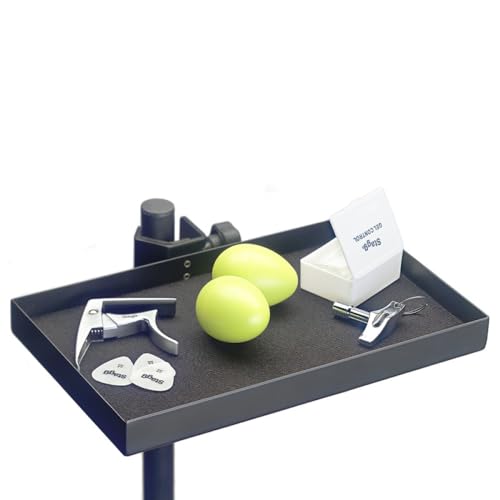
- Useful accessory tray that clamps to stands
The STAGG ACTR-2515 BK Accessory Tray with Clamp offers a much more focused and portable solution compared to full studio desks or workstations. This accessory tray is designed to attach to existing stands (like microphone stands or music stands) to hold small, lightweight items such as capos, picks, small effects pedals, or even a smartphone. While the dbx PB-48 Point Patch Bay is a fixed, rack-mounted solution for extensive audio routing, the Stagg accessory tray addresses immediate, on-the-fly organizational needs for smaller tools and peripherals. It’s less about core signal routing and more about keeping essential small items within arm’s reach during a performance or recording session. For a studio, this tray serves as a practical adjunct, not a replacement, to the core infrastructure provided by a patch bay and a main desk. It highlights the diverse needs within a studio, where both robust, integrated solutions like the dbx PB-48 Point Patch Bay and simple, adaptable accessories find their place.
The Final Word: Is the dbx PB-48 Point Patch Bay the Right Choice for Your Studio?
After extensive testing and consideration of user experiences, we confidently recommend the dbx PB-48 Point Patch Bay as an exceptional value proposition for home and project studios, and even some smaller commercial setups. Its core strengths lie in its reliable 48-point TRS connectivity, noise-free operation, and crucially, its unique and highly flexible adjustable normalling feature. The ability to easily flip modules to reconfigure signal paths is a game-changer for dynamic studio environments, offering a level of customization usually reserved for significantly more expensive units. While its open-back design and reliance on plastic nuts for individual modules might initially raise eyebrows for those expecting a fully enclosed, industrial-grade build, we’ve come to view this as a pragmatic design choice that prioritizes functionality and accessibility over cosmetic overkill, especially given its competitive price point.
The dbx PB-48 Point Patch Bay is an excellent choice for anyone looking to organize their audio cables, protect their expensive gear from wear and tear, and gain swift, precise control over their signal routing. It’s particularly well-suited for studios using primarily line-level, ¼” TRS connections. However, if your setup relies heavily on XLR connections or requires phantom power for condenser microphones, you will need additional dedicated solutions. For those on a budget who prioritize functionality and flexibility, and who are willing to appreciate its unique, albeit unconventional, build, the dbx PB-48 Point Patch Bay stands as a formidable tool. It truly delivers on its promise of making studio life easier and more efficient. Don’t let cable chaos stifle your creativity any longer; take the first step towards a streamlined studio. To explore its features further and check current pricing and availability, click here. Invest in your workflow and the longevity of your gear with the dbx PB-48 Point Patch Bay today, and experience the difference a truly organized studio can make. You won’t regret the clarity and control it brings to your creative process. For an immediate upgrade to your studio organization, secure your dbx PB-48 Point Patch Bay now.
Last update on 2026-09-13 / Affiliate links / Images from Amazon Product Advertising API