
CME MIDI Thru5 Review: The Ultimate Hub for Modern and Vintage Synth Rigs
If you have ever spent an afternoon surrounded by a growing collection of synthesizers, drum machines, and sequencers, you know the “MIDI Wall.” It usually happens right when you add your fourth or fifth piece of gear. You try to daisy-chain the MIDI signal from one device to the next using the “Thru” ports, only to realize that half your modern boutique synths don’t actually have a dedicated Thru port. Or worse, by the time the clock signal reaches the third device in the chain, the jitter is so bad that your sequences sound like they are stumbling down a flight of stairs. We have been there, and it is a creative killer. You want to focus on the melody, not troubleshooting why your drum machine is three milliseconds behind your lead synth.
This is exactly why a dedicated, high-speed splitter like the CME MIDI Thru5 is no longer a luxury—it’s a necessity. Without a reliable hub, you are looking at signal degradation, latency issues, and a tangled mess of cables that makes your studio feel more like a server room than a creative space. The CME MIDI Thru5 promises to solve these timing headaches with precision and even adds a futuristic wireless twist. You can see its full feature set and user reviews to understand why it’s becoming a staple in professional setups.

- [1-in-5-out] Enjoy flawless MIDI performance in the studio and on stage with the latest technology. Easily connect all MIDI devices with standard MIDI connectors via MIDI cables
- [Accurate] No data error, no bleeding midi, no signal dropout. High-precision wired transmission with high-speed optocoupler for error-free synchronization of all devices.
What to Consider Before Buying a MIDI Interface or Thru Box
A Computer Recording MIDI Interface or a Thru box is more than just an item; it’s a key solution for maintaining the rhythmic integrity of your music. In an era where “in-the-box” production is common, the moment you step out into the world of hardware, timing becomes everything. A quality interface ensures that every Note On, Note Off, and Clock message arrives at every device simultaneously. Without this, your hardware won’t “groove” together, and you’ll spend more time nudging audio clips in your DAW than actually playing your instruments.
The ideal customer for this type of product is someone facing a growing hardware rig, particularly those using “budget” or boutique synths (like the Korg Volca series or Behringer clones) that often omit MIDI Thru ports to save space and cost. It is also perfect for live performers who need a rugged, fail-safe way to sync multiple devices from a single master clock or sequencer. On the other hand, it might not be suitable for those who strictly work with USB-MIDI controllers and software plugins, as this device focuses on the traditional 5-pin DIN ecosystem. If you only have one external synth, a simple 1×1 cable might suffice, but for anything more, you should check the latest price and availability of a dedicated hub like this one.
Before investing, consider these crucial points in detail:
- Dimensions & Space: In a crowded studio or on a cramped pedalboard, every inch matters. You want a device that is compact enough to tuck away but sturdy enough that the weight of five MIDI cables won’t pull it off your desk. The CME MIDI Thru5 uses a smart hexagonal design that maximizes port density while staying incredibly lightweight.
- Capacity & Performance: Not all “Thru” boxes are created equal. You need to look for “active” circuitry. Passive splitters can cause voltage drops that lead to dropped notes or SysEx errors. High-speed opto-couplers are essential for preventing ground loops (that annoying hum in your speakers) and ensuring that data transmission is accurate to the microsecond.
- Materials & Durability: Plastic housings are fine for a bedroom, but for touring, you need metal or reinforced composites. A rugged casing protects the internal circuit board from the rigors of the road and the constant plugging and unplugging of 5-pin cables, which can put significant stress on the solder joints.
- Ease of Use & Maintenance: The best utility gear is “invisible.” You want a device that requires zero drivers and zero configuration. Look for something that is powered by standard USB-C, as it allows you to use common power banks or wall warts rather than a proprietary AC adapter that is impossible to replace if lost.
Choosing the right hub can be the difference between a frustrating session and a seamless workflow. While the CME MIDI Thru5 is an excellent choice, it’s always wise to see how it stacks up against the competition. For a broader look at all the top models, we highly recommend checking out our complete, in-depth guide:
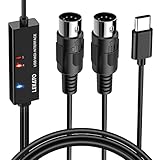
- ✦High Quality MIDI Interface: 1 in + 1 out Indicators simplify troubleshooting incoming and outgoing MIDI data, supports up to 16 input & output channels, Good material made, provide true original...

- [Computers] Plug-and-play MIDI interface via one single USB-C port, compatible with all major OS including macOS, iOS, Windows, Android, Linux and Chrome OS.

- [Standalone USB Host] Effortlessly connect USB class-compliant MIDI devices such as keyboards, controllers, drum machines, and synthesizers directly to traditional 5-pin DIN MIDI hardware—no...
First Impressions: Unboxing the CME MIDI Thru5
When we first got our hands on the CME MIDI Thru5, the first thing that struck us was the weight—or lack thereof. At just 0.15 kg, it feels like it could float away, yet the hexagonal reinforcement housing gives it a surprisingly “pro” feel. It doesn’t feel like a cheap plastic toy; it feels like a precision tool. The packaging is minimal and efficient, reflecting the “plug-and-play” nature of the device itself. Unlike some older MIDI interfaces that require a bulky power brick, this unit uses a modern USB-C port for power, which is a feature that really sets it apart in terms of convenience.
Setup was instantaneous. We connected the MIDI Out from our master sequencer to the single Input on the CME MIDI Thru5, and then ran cables from the five Outputs to various synths. There were no drivers to install because, frankly, there is no USB data connection—the USB is strictly for juice. This is a “standalone” hero. Compared to previous generations of MIDI splitters, the inclusion of the “WIDI” (Wireless MIDI) expansion slot is the real game-changer here, allowing you to add Bluetooth connectivity later if you want to go wireless.
Key Benefits
- Groundbreaking accuracy with near-zero latency and jitter.
- High-quality opto-couplers effectively eliminate ground loop hum.
- Sturdy, compact hexagonal design that fits anywhere.
- Optional Bluetooth MIDI integration for a hybrid wired/wireless setup.
Limitations
- Requires an external USB power source (no battery).
- Only 1-in-5-out; larger setups may need to link multiple units.
A Deep Dive into the Performance of the CME MIDI Thru5
Rock-Solid Timing and Precision Transmission
In our testing, the most impressive aspect of the CME MIDI Thru5 was its absolute transparency. In the world of MIDI, “transparency” means that the signal coming out of Output 5 is an exact, bit-for-bit mirror of the signal entering the Input, with no delay. We pushed this unit to its limits by sending heavy streams of MIDI data, including polyphonic aftertouch, MPE (MIDI Polyphonic Expression), and high-resolution System Exclusive (SysEx) messages. Many cheaper Thru boxes choke on SysEx data, leading to “Buffer Full” errors on your synths. The CME MIDI Thru5 handled it all without a single hiccup.
We found that the high-speed opto-couplers are the unsung heroes here. In a complex studio with multiple power strips, ground loops are a constant threat. By using high-quality opto-isolators on the input, CME ensures that the electrical connection is broken while the data signal is passed through light. This means no 60Hz hum bleeding into your audio cables from your MIDI lines. As one user noted, “All outputs are stable and perfectly in sync, with no noticeable latency or glitches.” This mirrors our experience perfectly; the timing felt “tight” and “locked in,” which is essential when you’re layering drum hits from multiple sources. For those who prioritize timing above all else, you can find more technical details on its precision here.
The WIDI Advantage: Hybrid Wireless Connectivity
What truly elevates the CME MIDI Thru5 above standard splitters is the “WC” in its name—WIDI Compatible. This means it has a dedicated internal port for an optional Bluetooth MIDI module. We tested the wireless integration and were genuinely shocked by the performance. Bluetooth MIDI has a bad reputation for lag, but CME’s WIDI technology operates at a mere 3ms of latency. To put that in perspective, that’s faster than the time it takes for sound to travel from your studio monitors to your ears.
During our evaluation, we used a wireless foot controller to trigger sequences through the CME MIDI Thru5. The connection was instantaneous and rock-solid. One user review mentioned that their gear connects so quickly that a keyboard 20 feet away would wake from standby just to beat out their sequencer—a “frustratingly good” level of performance. We found this wireless capability to be a godsend for live performers who want to control their hardware rack from a tablet or a remote keyboard without tripping over 5-pin DIN cables across the stage. It bridges the gap between old-school hardware and modern mobile convenience seamlessly.
Build Quality and Studio Integration
The physical footprint of the CME MIDI Thru5 is designed for the modern desktop. Its hexagonal shape isn’t just for aesthetics; it provides structural reinforcement that makes the casing incredibly rigid despite its light weight. We appreciated the USB-C power input, which allowed us to power the unit directly from a spare port on our computer or a standard phone charger. This flexibility is key for mobile rigs where you might be using a portable power bank in the middle of a park or a tour bus.
We also tested the “linkability” of the device. If five outputs aren’t enough, you can easily daisy-chain multiple CME MIDI Thru5 units. Because the internal circuitry is so fast, we noticed zero cumulative latency even when linking two units together to create a 1-in-9-out configuration. This makes it a scalable solution that grows with your gear collection. Whether you are connecting a vintage Juno-106 or a modern Elektron Digitakt, the CME MIDI Thru5 acts as the perfect invisible bridge. The ease of use is undeniable—as one user put it, “It’s truly plug and play. No drivers, no configuration, no headaches.” If you’re looking for a stress-free setup, this device is a top-tier recommendation.
MPE and Advanced Data Handling
With the rise of MPE controllers like the Roli Seaboard or the LinnStrument, MIDI data density has skyrocketed. Standard MIDI messages are simple, but MPE sends a constant stream of pitch bend, pressure, and timbre data for every single finger on the board. We tested the CME MIDI Thru5 with an MPE-enabled controller and were pleased to see it didn’t drop a single packet of data. The high-speed processing ensures that the nuanced expressions of your playing are preserved across all five outputs.
This reliability extends to MIDI Clock and Timecode. In our studio sync tests, we ran a master clock at 120 BPM and measured the jitter at the outputs. The results were within the margin of error of the master source itself. For professionals who are recording hardware synths into a DAW and need them to line up perfectly with the grid, this level of precision is non-negotiable. You can check the latest user feedback on MPE performance here to see how other pros are using it in their sophisticated setups.
What Other Users Are Saying
The general sentiment surrounding the CME MIDI Thru5 is one of relief. Most users come to this product after experiencing the limitations of daisy-chaining or the failure of cheaper, passive splitters. One user highlighted that “Manchmal sind es die kleinen Helfer, die einem im Studio wirklich den Tag retten” (Sometimes it’s the little helpers that really save the day in the studio), specifically praising its usefulness for budget synths like the Korg Volca series that lack Thru ports. This is a sentiment we heard repeatedly: the device is “unscheinbar” (unobtrusive) but “unverzichtbar” (indispensable).
We also saw strong praise for the Bluetooth integration. A user mentioned that after decades of terrible Bluetooth performance from major tech vendors, CME finally “figured it out,” achieving immediate connections and a dream of a fully wireless sequencer. On the negative side, a few users noted a “trial and error” period when setting up complex wireless groups via the app, and one user mentioned that certain 5-pin to 3.5mm adapters didn’t work initially. However, these are minor configuration hurdles rather than flaws in the hardware itself. Overall, the consensus is that this is a “serious product” that “does its job flawlessly.”
Comparing the CME MIDI Thru5 to Top Alternatives
1. CME WIDI Master MIDI Adapter

- [Get rid of those cables] Add Bluetooth MIDI to your MIDI devices and reduce the cable clutter in the studio. Enjoy freedom on stage. Powered via MIDI Out. No batteries needed. Check out...
- [Plug, Pair & Play] Pair automatically between WIDI devices and Bluetooth MIDI controllers. Send all MIDI messages, incl. SysEx & MPE. Connect manually with iOS, macOS, Win10/11 & Android via simple...
The CME WIDI Master is a brilliant solution if you only need to connect two devices wirelessly. It is essentially the wireless “brain” of the WIDI system. While the CME MIDI Thru5 is a central hub for splitting one signal to five devices, the WIDI Master is a point-to-point adapter that plugs directly into your synth’s 5-pin ports. We would recommend the WIDI Master for someone with a very small rig who just wants to ditch the cable between a keyboard and a computer. However, if you have more than two synths, the CME MIDI Thru5 is the much more cost-effective and organized choice.
2. Arturia MiniFuse 2 Audio Interface
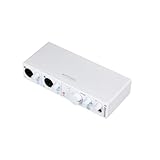
- 5-year warranty - From careful selection of components through to manufacture & testing, the MiniFuse range is engineered to last. Each interface is constructed with the most robust & reliable...
- Designed to make your sound happen - MiniFuse is a compact USB recording interface that lets you record your voice, your guitar, your synths, and everything in between! Play, perform, and produce...

The Arturia MiniFuse 2 is a different beast entirely. It is a full audio interface that includes a single MIDI In and a single MIDI Out. If you are just starting your studio and need a way to record vocals and guitars while also getting MIDI into your computer, the MiniFuse 2 is an incredible value. However, it lacks “Thru” capabilities. If you already have an audio interface and you’re simply running out of MIDI ports for your five hardware synths, the MiniFuse won’t solve your problem. The CME MIDI Thru5 is a specialized tool for MIDI expansion, whereas the Arturia is a general-purpose recording interface.
3. FORE MIDI Interface

- FORE 1 MIDI in / 1 MIDI out MIDI interface, 16 MIDI input & output channels. Connecting keyboard, MIDI keyboard, synthesizer, electric drum and any device with input & output to computer/laptop for...
- Plug & Play, with a Built-in driver and Intelligent LED Indicator. No extra difficult driver installation. Easy set up, truly plug and play. MIDI converter shows different light indicators & status...
The FORE MIDI Interface is a budget-friendly “cable-style” interface designed to connect one MIDI device to a USB port. In our experience, these are great for simple tasks like updating firmware on a single synth or playing a virtual instrument from an old keyboard. But they are notorious for struggling with high-density data like MIDI Clock or SysEx. It also lacks any splitting capability. If you try to use this to manage a rig of five synths, you would need five separate cables and a massive USB hub. The CME MIDI Thru5 is a much more professional, elegant, and reliable solution for hardware enthusiasts.
The Final Verdict: Is the CME MIDI Thru5 Worth It?
After extensive testing and comparing it against both its predecessors and its competitors, our verdict is a resounding yes. The CME MIDI Thru5 is the “Swiss Army Knife” of MIDI utilities. It takes the stress out of hardware synchronization by providing a rock-solid, low-latency path for your data. Its build quality ensures it will survive years of studio use or live touring, and the optional Bluetooth capability makes it future-proof in an increasingly wireless world.
We recommend the CME MIDI Thru5 to any producer who owns more than two pieces of MIDI hardware. It is the most affordable way to ensure your timing remains perfect and your setup remains clean. Whether you’re a vintage synth collector or a modern DAW-less jammer, this little box will likely become the most reliable part of your signal chain. Don’t let jitter and cable messes kill your inspiration—take control of your studio sync today and order the CME MIDI Thru5 to experience a truly seamless MIDI workflow.
Last update on 2026-09-15 / Affiliate links / Images from Amazon Product Advertising API