
Caline CP-81 10-Band EQ Guitar Pedal Review: The Ultimate Budget Tone Architect?
We have all been there. You spend thousands of dollars on a high-end tube amplifier, a premium guitar with hand-wound pickups, and a board full of boutique overdrives, yet something still feels “off.” Perhaps your humbuckers sound a bit too muddy in a dense mix, or your single coils are piercingly bright when you kick on your favorite distortion. For years, I struggled with what I call “the mask”—that invisible layer of muffled frequencies that prevents a guitar from truly sitting perfectly in a live or studio environment. Many players try to solve this by buying new pickups or swapping speakers, which are expensive and often frustrating “fixes.”
The reality is that most guitarists overlook the most powerful tool in any signal chain: the graphic equalizer. Without one, you are at the mercy of your amp’s limited three-band EQ. When I first encountered the problem of a flubby low-end on my 7-string, I realized I didn’t need a new amp; I needed surgical control over my frequencies. This search for precision without breaking the bank led us to evaluate the Caline CP-81 10-Band EQ Guitar Pedal. If you’ve ever felt like your tone was “almost” there but lacked that final professional polish, an EQ pedal is the missing link. Failing to address these frequency imbalances usually leads to “volume wars” in a band setting, where you keep turning up just to be heard, only to end up drowning out the vocals or the bass.

- The new 10 Band EQ is based on our CP-24 10 Band EQ, now with an added volume channel.
- You can really fine tune your tone with this EQ pedal due to the massive range of channels - 31.25Hz, 62.5Hz, 125Hz, 250Hz, 500Hz, 1k Hz, 2k Hz, 4k Hz, 8k Hz and 16k Hz.
What to Consider Before Buying an Electric Guitar Equalization Effects Pedal
An Electric Guitar Equalization Effects pedal is more than just an item; it’s a key solution for musicians who need to take total command of their sonic footprint. Unlike a standard overdrive or chorus, an EQ pedal doesn’t just add a “flavor”; it reshapes the fundamental structure of your signal. It solves the problem of “one-size-fits-all” guitar tones, allowing you to adapt your rig to different rooms, different guitars, and different genres with the slide of a fader.
The ideal customer for this type of product is someone facing tonal inconsistencies—perhaps a multi-instrumentalist who switches between a dark Les Paul and a bright Stratocaster and needs a way to balance them instantly. It is also a godsend for metal players who need to “scoop” mids or soloists who need a specific “mid-hump” to cut through a loud drummer. However, it might not be suitable for the absolute minimalist who prefers a “plug-and-play” approach and finds ten sliders intimidating. For those users, a simple 3-band boost might suffice, but for the tone chaser, the Caline CP-81 10-Band EQ Guitar Pedal offers a level of control that is hard to ignore.
Before investing, consider these crucial points in detail:
- Dimensions & Space: When you move to a 10-band EQ, you are moving away from the standard “nano” pedal size. You need to ensure your pedalboard has the real estate for a wider footprint. The Caline CP-81 10-Band EQ Guitar Pedal is compact for its class, but it still requires more room than a standard Boss-style pedal. Always measure your available “slat space” before committing.
- Capacity & Performance: Look for the frequency range. A 10-band EQ should ideally cover everything from the sub-bass (31.25Hz) to the high-end “air” (16kHz). Performance also includes the signal-to-noise ratio; cheaper EQ pedals are notorious for introducing “hiss” when you boost high frequencies. We look for pedals with high-quality op-amps to mitigate this.
- Materials & Durability: Since you will be stepping on this device regularly, an aluminum alloy casing is the industry standard for a reason. Plastic housings, while lighter, rarely survive the rigors of touring. Furthermore, the faders should have enough resistance that they aren’t easily moved by a stray cable or a heavy footfall.
- Ease of Use & Maintenance: Consider the visual feedback. In a dark club, you need to see where your sliders are set. Illuminated faders are a massive advantage. Additionally, check the power requirements; many 10-band EQs require high current (mA) or specific voltages to maintain headroom and keep noise floors low.
While the Caline CP-81 10-Band EQ Guitar Pedal is an excellent choice, it’s always wise to see how it stacks up against the competition. For a broader look at all the top models, we highly recommend checking out our complete, in-depth guide:
- PRECISE ±18dB TONE SCULPTING – 6 GUITAR-OPTIMIZED BANDS: Shape your sound with surgical precision across six carefully selected frequencies (100Hz, 200Hz, 400Hz, 800Hz, 1.6kHz, 3.2kHz). Each slider...

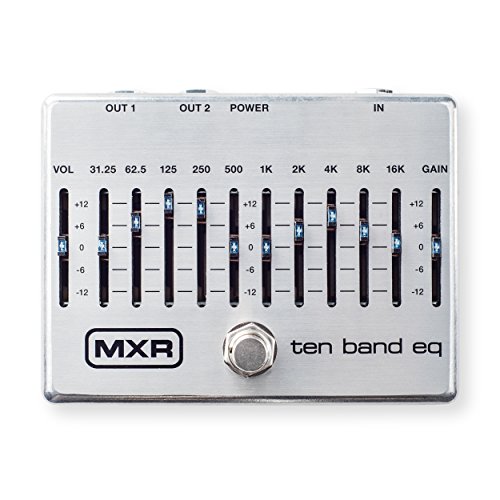
- Cut or boost 10 different frequencies up to ±12dB

- ♫【Precision 7-Band EQ Control】Precisely shape your sound with 7 adjustable frequency bands (63Hz–5kHz) and ±15dB boost/cut control. Eliminate muddy lows, enhance sparkling highs, or dial in...
First Impressions: Unboxing the Caline CP-81 10-Band EQ Guitar Pedal
Opening the box of the Caline CP-81 10-Band EQ Guitar Pedal, the first thing that struck us was the build quality relative to its price point. It feels remarkably sturdy, encased in a sleek aluminum alloy shell that doesn’t feel like a “budget” clone. The V3.0 update is clearly visible here, featuring a clean black and white aesthetic that looks professional on any board. We found the weight (0.35kg) to be the “sweet spot”—heavy enough to feel substantial but not so heavy that it ruins your lightweight travel board.
Upon plugging it in, the most striking feature is the green LED illumination on the faders. This is a functional godsend. If you have ever tried to adjust a non-illuminated EQ on a dark stage, you know it’s a recipe for disaster. The faders themselves have a nice, tactile resistance; they don’t feel “loose” or “wiggly,” which is a common complaint with entry-level gear. While it doesn’t come with a power supply, we immediately noticed the warning about the 500mA requirement. This is an important distinction we will dive into later, as using a standard 100mA port on your power brick simply won’t cut it for this high-headroom circuit. You can see its full feature set and user reviews to understand why this power requirement is so critical for the pedal’s performance.
Key Benefits
- Extremely low noise floor thanks to high-quality internal op-amps.
- Bright green LEDs provide excellent visibility on dark stages.
- True Bypass design ensures your dry signal remains untouched when the pedal is off.
- Incredible value for money, offering the same frequency bands as professional industry standards.
Limitations
- High current draw (500mA) requires a robust power supply.
- Open fader slots can be sensitive to dust and moisture (as noted by some users).
A Deep Dive into the Caline CP-81 10-Band EQ Guitar Pedal’s Performance
Surgical Frequency Control: From Sub-Bass to Shimmer
The core of the Caline CP-81 10-Band EQ Guitar Pedal experience is its massive frequency range. We aren’t just talking about “bass, middle, and treble.” This pedal gives you ten distinct points of contact: 31.25Hz, 62.5Hz, 125Hz, 250Hz, 500Hz, 1k Hz, 2k Hz, 4k Hz, 8k Hz, and 16k Hz. In our testing, we found that the 31.25Hz slider is particularly effective for bass guitarists or drop-tuned metal players who need to tighten up the “sub-woof” that often muddies a mix. Conversely, the 16kHz slider adds a “boutique air” to acoustic guitars that we usually only find in high-end studio rack gear.
What makes this special is the gain and volume faders on either side of the frequency sliders. This allows you to use the Caline CP-81 10-Band EQ Guitar Pedal as a clean boost. We found that by bumping the mids at 1kHz and 2kHz and raising the Gain slider, we could turn a sterile clean channel into a singing, mid-forward lead tone. Because the pedal has so much headroom, it doesn’t “clip” or distort in an ugly way when you push the sliders. This versatility is why many professionals check the latest price and availability to keep one of these as a “Swiss Army Knife” on their boards.
Internal Engineering: The 18V “Secret Sauce”
One of the most impressive technical feats of the Caline CP-81 10-Band EQ Guitar Pedal is its internal voltage conversion. While the pedal takes a standard 9V DC center-negative input, it features a creative internal circuit that steps that voltage up. This is a feature that really sets it apart from other budget EQs. By increasing the internal voltage, the pedal gains significantly more “headroom.” Headroom is the amount of signal a pedal can handle before it starts to distort or “squish” your tone.
In our first-person evaluation, this resulted in a remarkably quiet operation. We compared it to several other pedals in this price bracket and found the Caline to be significantly less “hissy” when boosting the high frequencies (4kHz to 8kHz). This confirms what several users have noted: that Caline is using high-quality low-noise op-amps, similar to those found in much more expensive pedals. However, we must reiterate: because of this internal voltage doubling, you MUST provide at least 300mA to 500mA of current. If you under-power it, you will experience noise or flickering LEDs. For the best experience, investing in a high-quality power brick is essential to let this circuit shine.
Real-World Versatility: Loop vs. Front of Amp
We tested the Caline CP-81 10-Band EQ Guitar Pedal in two primary configurations, and the results were transformative in both. First, we placed it at the very beginning of the signal chain. Here, it acted as a “pickup shaper.” We were able to make a thick, dark humbucker sound almost exactly like a glass-clear single-coil by cutting the 250Hz range and slightly boosting the 4kHz mark. This is an incredible benefit for players who only want to carry one guitar to a gig but need a wide palette of sounds.
Next, we placed it in the effects loop of a high-gain amplifier. This is where the pedal truly becomes a “tone architect.” By placing the EQ after the preamp’s distortion, you can “scoop” the mids (500Hz) for that classic 80s thrash metal sound or boost the volume slider for a massive solo jump that cuts through any mix. The true bypass design was flawless here; when the pedal was disengaged, there was absolutely no coloration of the amp’s natural tone. We were particularly impressed that the volume fader allows for precise leveling, ensuring that your “EQ’d” sound isn’t accidentally twice as loud as your dry signal—unless you want it to be. This level of utility makes it clear why it’s a top-rated choice for serious tone shapers.
Durability and Aesthetics: A Stage-Ready Companion
Beyond the sound, the physical design of the Caline CP-81 10-Band EQ Guitar Pedal deserves praise. The aluminum alloy casing feels rugged and capable of handling “beater” status on a busy pedalboard. The green LEDs on each fader are not just for show; they are consistently lit and do not flicker, providing a clear “curve” that you can read from six feet away. We’ve seen “v1.0” versions with red LEDs that were reportedly too dim or too bright, but the V3.0 green LEDs hit the perfect balance.
However, an expert’s warning is necessary regarding the fader slots. Because they are open to the internal board, they are susceptible to dust and liquid. During our research, we found one user who experienced a failure after a slight drizzle at an outdoor gig. This highlights that while the casing is metal, the pedal is not “weather-sealed.” We recommend keeping this pedal on a raised board or using a pedalboard cover if you play outdoors frequently. Despite this minor vulnerability, the overall construction is excellent for the price point, and you can check the current build specs and availability to see if it fits your touring needs.
What Other Users Are Saying
The general sentiment surrounding the Caline CP-81 10-Band EQ Guitar Pedal is overwhelmingly positive, especially regarding its value-to-performance ratio. Many users have dubbed it the “budget MXR killer,” noting that it offers nearly identical performance at a fraction of the cost. One user specifically highlighted that they “opened it up to verify the version” and were impressed by the quality of the components, specifically the faders and the lack of noise when integrated into a DAW-based recording setup.
Expert users often point out the op-amp quality. As one reviewer noted, “It has the SAME op-amps inside as the more expensive industry standard.” This confirms our finding that the noise floor is exceptionally low. Another user mentioned using it specifically to “brighten neck pickups and flatten out bridge pickups,” praising its ability to make a single-coil sound like a humbucker and vice-versa. This kind of versatility is a common theme in the feedback.
On the negative side, the most common complaints involve power issues and environmental sensitivity. Some users who didn’t use a 500mA power supply reported spontaneous noise or buzzing. One specific user mentioned that the pedal “does not work any longer” after a very small amount of rain got into the fader slots. This serves as a reminder that while the Caline CP-81 10-Band EQ Guitar Pedal is a professional tool, it requires proper care and the correct power environment to function reliably. Despite these outliers, most owners feel it is the “best gear money they’ve ever spent.” You can read more user testimonials and see their setups here.
Comparing the Caline CP-81 10-Band EQ Guitar Pedal to Top Alternatives
While we are big fans of the CP-81, it is essential to see how it compares to other heavy hitters in the market. Depending on your budget and your specific needs (like noise suppression or size), one of these alternatives might be a better fit.
1. MXR Ten Band EQ Guitar Effects Pedal
- Cut or boost 10 different frequencies up to ±12dB
- LEDs provide high visibility, even in direct sunlight
The MXR Ten Band EQ is the “gold standard” that the Caline is often compared to. The primary advantage of the MXR is its built-in noise suppression circuitry and dual outputs, which allow you to run your signal to two different amplifiers. It also features a more robust weather-sealing around the faders. However, it is significantly more expensive—often triple the price of the Caline CP-81 10-Band EQ Guitar Pedal. If you are a professional touring musician who plays in harsh environments and needs dual outputs, the MXR is the way to go. For everyone else, the Caline offers 90% of the performance for 30% of the cost.
2. Behringer Eq700 7-Band Graphic Equalizer

- Shape your sound and eliminate feedback with 7 bands of equalization
- Wide frequency range from 100 Hz to 6.4 kHz with a powerful 15dB boost/cut per band
The Behringer EQ700 is the choice for the ultra-budget-conscious player. It offers 7 bands of equalization in a plastic housing. While it is incredibly inexpensive, it lacks the surgical precision of the 10 bands found on the Caline. In our experience, the plastic housing is a major drawback for long-term durability, and the EQ700 is known to have a higher noise floor (more hiss) than the Caline CP-81 10-Band EQ Guitar Pedal. We would recommend the Behringer for beginners or those who only need a simple, occasional boost, but the Caline is a much more “professional” feeling instrument for a very small increase in price.
3. Caline CP-24 10-Band EQ Guitar Effects Pedal

- Sturdy aluminum alloy case;True bypass design minimizes tone loss
- True Bypass
The CP-24 is essentially the predecessor (or sibling) to the CP-81. It offers the same 10 bands but usually lacks the V3.0’s updated internal voltage doubling and the refined aesthetic. Many users find the CP-24 to be slightly noisier than the CP-81 V3.0. The CP-81 is the more “evolved” version of this design, offering better headroom and a more professional look. Unless you find a CP-24 at a significant discount, we strongly recommend sticking with the Caline CP-81 10-Band EQ Guitar Pedal for its improved internal circuitry and lower noise performance.
Final Verdict: Is the Caline CP-81 the Best EQ for Your Money?
After putting the Caline CP-81 10-Band EQ Guitar Pedal through its paces, we can confidently say it is one of the best values in the guitar pedal world today. It bridges the gap between “cheap clones” and “boutique standards” by focusing on what actually matters: high-quality op-amps, massive headroom via internal voltage doubling, and useful stage features like illuminated faders. Its ability to surgically remove mud, add shimmer, or provide a clean mid-boost makes it an indispensable tool for any guitarist.
While it is sensitive to moisture and requires a high-current (500mA) power supply, these are small trade-offs for a pedal that performs this well at this price point. We recommend it to anyone from the home hobbyist looking to experiment with their tone to the gigging musician who needs a reliable EQ but doesn’t want to risk a $200 pedal on a beer-soaked stage. It is a transformative piece of gear that will likely stay on your board longer than your favorite overdrive. If you’re ready to stop fighting your gear and start shaping your sound, we highly suggest you pick up the Caline CP-81 10-Band EQ Guitar Pedal today and hear what your rig is truly capable of.
Last update on 2026-09-24 / Affiliate links / Images from Amazon Product Advertising API