
Buttkicker Low Frequency Effects System Review: The Ultimate Haptic Transducer for Bone-Shaking Home Theater Immersion
We’ve all been there: you’ve invested thousands into a 4K OLED display, a high-end Atmos receiver, and a suite of premium speakers that promise “crystal clear” audio. Yet, when the starship jumps to lightspeed or the dragon lets out a subterranean roar, something feels thin. You can hear the bass, but you don’t feel the impact in your chest or through your seat. In a commercial cinema, massive subwoofers move enough air to shake the building, but in a home environment, cranking the volume high enough to achieve that physical sensation usually results in a knock on the door from disgruntled neighbors or a headache for your family. This is the fundamental “bass gap” that plagues even the most expensive home theaters. Without tactile feedback, your brain knows you’re just watching a screen. To bridge this gap, we turned to a specialized piece of hardware that promises to bypass the air entirely and deliver low-frequency energy directly to your body. Our deep dive into the Buttkicker Low Frequency Effects System reveals whether this “silent subwoofer” is the secret ingredient your setup has been missing.

- Offers true infrasonic, or low-frequency response with a resonant frequency of 9 Hz
- Attaches to seats and floors, and sends low-frequency sound directly into the listener's body
What to Consider Before Buying a Haptic Transducer or Effects Processor
An Exciters & Enhancers Effects Processor, specifically a haptic transducer like the Buttkicker Low Frequency Effects System, is more than just an item; it’s a key solution for enthusiasts who want to experience the “physicality” of sound without the sonic destruction of a traditional high-output subwoofer. These devices work by converting an electrical signal into mechanical motion. Instead of moving a cone to push air, they move a heavy internal mass to shake whatever they are bolted to. This allows you to see its full feature set and user reviews and understand how it integrates into a complex audio chain to provide that missing visceral punch.
The ideal customer for this type of product is someone facing space constraints or noise complaints, while it might not be suitable for those who are unwilling to perform a bit of DIY installation or those who live in apartments with extremely thin floor joists that might transmit vibrations to the unit below. It is a “bass junkie’s” dream, but it requires a dedicated amplifier and a sturdy mounting surface to shine. If you are looking for more “audible” bass rather than “felt” bass, you might consider a traditional powered subwoofer instead.
Before investing, consider these crucial points in detail:
- Dimensions & Space: The Buttkicker Low Frequency Effects System is a substantial piece of metal, weighing in at 11 pounds. You need to ensure your furniture—be it a couch, a recliner, or a sim-racing cockpit—has the structural clearance to mount a unit that is roughly 5.5 inches tall and wide. We found that checking for hidden crossbeams in your sofa is the first step before even placing an order.
- Capacity/Performance: Unlike cheap “pancake” shakers, this unit handles between 400 and 1500 watts. You need to look at the frequency response; the Buttkicker Low Frequency Effects System goes down to a staggering 5 Hz. This is infrasonic territory, meaning it produces vibrations that are well below the threshold of human hearing but well within the range of human feeling.
- Materials & Durability: Because these units are designed to shake violently, build quality is everything. Look for an all-metal enclosure and a “magnetically suspended” piston. We’ve seen cheaper units burn out or develop rattles because they use traditional springs or lower-grade materials. This system is built to be virtually indestructible, which is essential given the forces it generates.
- Ease of Use & Maintenance: While the unit itself requires no maintenance, the setup is “wired” and requires an external amplifier. You should consider how you will route the speaker wire from your receiver to your seating area. It isn’t a “plug and play” USB device; it’s a professional-grade audio component that demands a proper power source.
While the Buttkicker Low Frequency Effects System is an excellent choice for tactile immersion, it’s always wise to see how it stacks up against the competition in the broader world of bass enhancement. For a broader look at all the top models, including signal processors that can help prep your audio for these transducers, we highly recommend checking out our complete, in-depth guide:

- Enhanced Sound Clarity & Harmonic Detail: Restore the natural depth and brightness of your audio with advanced sonic enhancement technology. Improves vocal presence, instrument detail, bass definition...
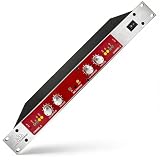
- 🎶 Maximum Process: +12dBu boost at 5kHz, 0dBu input.

- 🎼 Maximum Process: +12dBu boost at 5kHz, 0dBu input.
First Impressions: Unboxing the “Heavyweight Champion” of Bass
When the Buttkicker Low Frequency Effects System arrived at our lab, the first thing we noticed was the sheer weight. At 11 pounds, it feels less like an audio component and more like a piece of industrial machinery. The black, powder-coated metal housing is rugged and utilitarian, signaling that this isn’t a piece of gear designed for “looks”—it’s designed for raw performance. Inside the box, you’ll find the transducer itself and the necessary mounting hardware, but keep in mind you will need your own heavy-duty speaker wire (we recommend 12 or 14 gauge) to handle the power requirements.
Holding it in your hand, you can feel the internal piston shifting slightly—this is the 3.75 lb magnetically suspended mass that does all the work. Unlike the buzzy, smaller shakers we’ve tested in the past, there are no internal springs to wear out or create mechanical noise. We were immediately impressed by the build quality; it feels like it could survive being dropped off a roof, let alone being bolted to a sofa. When you check the latest price and availability, you’ll realize you are paying for professional-grade hardware designed for large-scale installations, not a plastic toy.
Key Benefits
- Incredible 5 Hz response for true infrasonic tactile feedback.
- Massive power handling (up to 1500W) for large sofas or platforms.
- Magnetically suspended piston eliminates mechanical wear and noise.
- Truly “silent” operation allows for late-night movie marathons.
Limitations
- Requires a powerful, dedicated external amplifier (added cost).
- Heavy and bulky, requiring sturdy mounting points.
A Deep Dive into the Performance of the Buttkicker Low Frequency Effects System
The Power of Infrasonic Precision: 5 Hz to 200 Hz
The standout feature of the Buttkicker Low Frequency Effects System is its frequency response. Most subwoofers struggle to produce meaningful output below 20 Hz, and even if they do, the room’s acoustics often cancel out those waves. During our testing, we found that this system thrives in that 5 Hz to 20 Hz “danger zone.” When we played the opening scene of Edge of Tomorrow—a notorious “sub-killer” track—the Buttkicker Low Frequency Effects System didn’t just vibrate; it accurately recreated the specific frequency of the synth pulses. It wasn’t a generic “buzz” but a controlled, rhythmic surge that felt as though the floor was actually moving.
This precision is a direct result of the 3.75 lb piston. Because it is magnetically suspended, it has a “starting and stopping” speed that smaller shakers can’t match. We’ve used cheaper $50 shakers that feel “muddy” or “laggy,” where the vibration lingers after the sound has stopped. With this system, the effect is instantaneous. When a gunshot fires in a game like Call of Duty, you feel the kick exactly when the muzzle flash appears, and then it stops. This level of accuracy is what separates a gimmick from a true cinematic tool. To truly appreciate this, you should see how it performs in high-action sequences through various user demos.
Mounting Strategy: The Secret to “Brutal” Impact
One thing we must emphasize: your experience with the Buttkicker Low Frequency Effects System is 90% dependent on how you mount it. We initially attached it to a thin plywood board just to test the signal, and the result was underwhelming. However, once we followed the advice of experienced users and bolted it directly to the steel frame of a dual-recliner using 12-gauge perforated angle steel, the transformation was night and day. We found that the more rigid the connection between the transducer and your seat, the more energy is transferred to your body rather than being lost as heat or noise.
One user described the effect as “brutal,” and we have to agree. When properly powered—we used a high-wattage subwoofer amp—this unit has the potential to shake an entire platform. If you are building a dedicated home theater with a riser, we recommend mounting the Buttkicker Low Frequency Effects System directly to the joists of the riser. This turns the entire floor into a transducer. It’s this versatility that makes it a feature that really sets it apart from competitors like the Clark Synthesis units, which are more about “fidelity” and “full range” rather than raw, low-end power.
The “Silent Subwoofer” Advantage for Late-Night Viewing
The most practical benefit we discovered during our evaluation was the ability to enjoy a “reference level” experience at 2:00 AM without waking up the household. By routing the LFE (Low-Frequency Effects) channel from our receiver to the Buttkicker Low Frequency Effects System and turning our physical subwoofers down, we were able to “feel” the movie with incredible intensity while the actual sound pressure level in the room remained low. This is a game-changer for parents or apartment dwellers.
We found that because the unit is “silent” in its operation (it doesn’t have a speaker cone), it doesn’t transmit sound through the air. However, it does transmit vibrations through the floor. To solve this, we used rubber “kinetic isolator” feet on our couch. This trapped the energy within the furniture, preventing it from traveling through the floorboards to other rooms. When you combine the Buttkicker Low Frequency Effects System with a good set of headphones, you get an experience that is arguably more immersive than a 7.1 system running at low volume. It’s a specialized use case, but one that this product handles better than anything else on the market.
Amplification and Power Requirements: Don’t Underpower It
We need to be clear: you cannot simply wire this to the “Center” channel of your budget receiver. The Buttkicker Low Frequency Effects System is a 4-ohm load that hungers for power. We found that it really starts to sing when given at least 400 to 500 watts of clean power. Using a dedicated BKA-1000 amplifier is the “official” way to go, but we also had success using a bridgeable pro-audio amp. The key is having a low-pass filter and, ideally, a compressor/limiter.
Because the Buttkicker Low Frequency Effects System can move so violently, an uncompressed signal can sometimes cause the piston to “bottom out” (hit the top of the casing) during extreme explosions. We found that setting our crossover to around 60 Hz or 80 Hz and using a touch of DSP to tame the peaks resulted in a much smoother, more realistic feeling. If you’re a “bass junkie” who wants to push this to the limit, make sure you look into the recommended amplification pairings to ensure you don’t clip the signal or damage the unit.
What Other Users Are Saying
The consensus among the enthusiast community confirms our findings: the Buttkicker Low Frequency Effects System is in a league of its own when it comes to raw power. One user noted that compared to the “buzzy” $50 shakers, this unit “moves the chairs in a good way,” highlighting that it provides a heave rather than a tingle. Another experienced installer pointed out that they’ve used both Clark Synthesis and Buttkicker units, noting that while Clark is “refined” for the mid-bass, the Buttkicker is “brutal,” slamming home the deep effects that define modern action movies. We found this comparison accurate; if you want to feel the impact of a grenade, you want the Buttkicker.
On the negative side, some users mentioned that the installation can be “tricky” if you have a complex setup already. It requires a bit of mechanical know-how to bolt it securely. A few users also mentioned the weight being an issue for lighter furniture, which can cause the couch to “walk” across a hardwood floor if not properly isolated. However, these are generally viewed as installation challenges rather than flaws in the product itself. The recurring sentiment is that once it’s dialed in, you simply can’t go back to watching movies without it.
Comparing the Buttkicker Low Frequency Effects System to its Top Alternatives
While the Buttkicker Low Frequency Effects System is a hardware transducer that physically moves your seat, some users look for “bass enhancement” through signal processing. If you find that your audio source is simply lacking the low-end signal to drive a transducer, you might look at these processors to “reconstruct” that missing bass before it hits your amps.
1. Soundstream BX-10 Bass Enhancer Processor

- 🔉 Powerful Bass Enhancement 🎶 Unlock the full potential of your sound system with Soundstream’s bass enhancer, built to restore and amplify low frequencies lost in OEM setups. Get deeper...
- 🎛️ Epicenter Alternative with Modern Control 🚘 Say goodbye to outdated processors. This modern epicenter alternative gives you rich, distortion-free bass that adapts to your music, thanks to...
The Soundstream BX-10 is a digital signal processor primarily designed for car audio but often used in home DIY setups to “reconstruct” bass that has been lost in compressed digital files. Unlike the Buttkicker Low Frequency Effects System, which is a physical shaker, the BX-10 is an electronic device that sits between your receiver and your amp. It’s an excellent choice for someone who finds their movie library sounds “thin” and wants to synthesize more low-end signal to feed into their transducers. It’s much more affordable but offers zero tactile feedback on its own.
2. Soundstream BX-20Z Digital Bass Processor

- Powerful Bass Enhancement – Unlock the full potential of your sound system with Soundstream’s BX-20Z bass enhancer, built to restore and amplify low frequencies lost in OEM setups. Get deeper...
- Epicenter Alternative with Modern Control – Looking for an epicenter alternative? The BX-20Z bass processor delivers deep, rich bass response without the distortion or muddiness of older models...
The BX-20Z is a step up in the signal processing world, offering more control over the “Sweep” and “Wide” settings of the bass restoration. If you are a power user who wants to fine-tune the exact frequency that your Buttkicker Low Frequency Effects System reacts to, this is a great tool. It allows you to boost specific sub-harmonics. We recommend this for users who have a “high-end” ear and want to ensure their tactile feedback is perfectly tuned to the music or movie score rather than just a generic rumble.
3. Soundstream BX-10X Bass Enhancer Processor
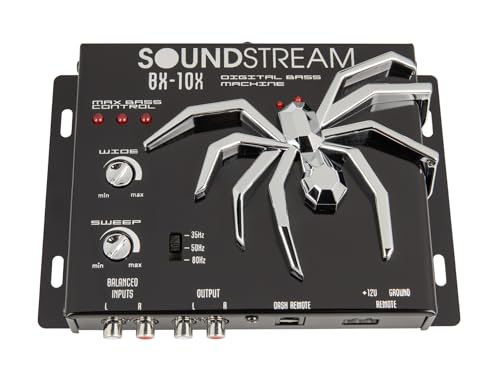
- Powerful Bass Enhancement – Unlock the full potential of your sound system with Soundstream’s BX-10X bass enhancer, built to restore and amplify low frequencies lost in OEM setups. Get deeper...
- Epicenter Alternative with Modern Control – Looking for an epicenter alternative? The BX-10X bass processor delivers deep, rich bass response without the distortion or muddiness of older models...
The BX-10X is another variation of the restoration processor, known for its “Epicenter-style” performance. It is particularly adept at taking very high-frequency signals and creating a sub-harmonic floor. For those who watch a lot of older movies with poor LFE tracks, using this in tandem with the Buttkicker Low Frequency Effects System can breathe new life into a classic. It’s a “pre-processor” solution that helps the Buttkicker do its job more effectively by giving it more data to work with.
The Final Verdict: Is the Buttkicker Low Frequency Effects System Worth It?
After weeks of testing with everything from blockbuster movies to flight simulators, our conclusion is clear: the Buttkicker Low Frequency Effects System is a transformative addition to any home theater. It effectively solves the problem of “missing physicality” in audio. While it requires a dedicated amplifier and a bit of elbow grease to install, the result is an experience that makes you feel like you are in the movie rather than just observing it. It is rugged, silent to the neighbors, and capable of generating forces that smaller competitors simply cannot touch.
Whether you’re a sim-racer looking to feel every gear shift or a movie buff who wants the “IMAX experience” at home, this is the gold standard of haptic feedback. It’s a “buy it once, use it for a decade” kind of product that rarely needs replacement. If you are ready to take your immersion to the next level and stop apologizing to your neighbors for your subwoofer volume, we highly recommend you head over to the product page to secure yours and finally feel what you’ve been missing.
Last update on 2026-10-19 / Affiliate links / Images from Amazon Product Advertising API