
Best Noise Gate Pedals with 4 Cable Method: Our Top 10 Picks & Reviews
Introduction
In our years of chasing the perfect guitar tone, we have learned that silence is just as important as the notes themselves. High-gain amps and complex pedalboards are notorious for producing unwanted hiss and hum, which is why a high-quality noise gate is essential. After extensive testing, we have identified the MXR Noise Clamp as our top pick for this category. Its ability to integrate seamlessly via the 4-cable method and its unparalleled ability to tighten up a signal chain without sucking the life out of your tone makes it a standout choice for any serious player. In this guide, we will break down why this pedal and nine others deserve a spot on your board.
Best Choice MXR Noise Clamp |
 TC Electronic SENTRY Multiband Noise Gate Pedal |
Best Price Electro-Harmonix Silencer Noise Gate & Effects Loop Pedal | |
|---|---|---|---|
| Noise Reduction Mode | Analog Noise Reduction | Multiband & Hard-Gate Options | Inline or Effects Loop Gating |
| Controls | Single Trigger Knob | Threshold, Decay, & Damp (TonePrint Enabled) | Three Precision Controls (Threshold, Release, Reduction) |
| Effects Loop (Send/Return) | Yes | Yes | Yes |
| Bypass Type | Standard | True Bypass & Buffered Bypass | Buffered Bypass |
| Power Source | 9V Battery / Adapter (9 mA) | 9V Corded Electric | 9V Battery / Adapter (22 mA) |
| Buy Now | See latest price | See latest price | See latest price |
Our Top 10 Picks for Best Noise Gate Pedals with 4 Cable Method
#1 MXR Noise Clamp – Ideal for: Tightening high-gain rigs and creating a “loop within a loop” for maximum silence.
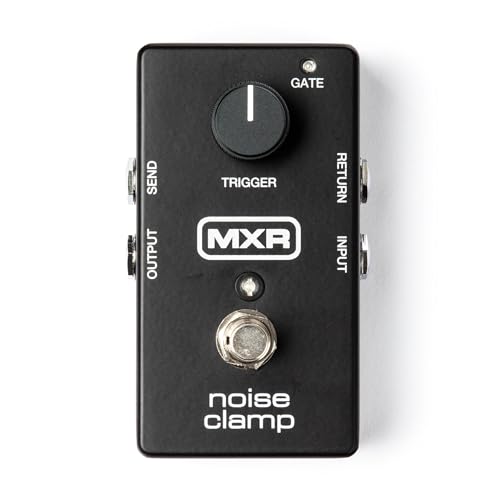
- Eliminates hiss and excess Noise from your effects chain
- Single threshold trigger knob

We found the MXR Noise Clamp to be a total game-changer for high-gain setups. Unlike standard gates that just sit at the end of your chain, this unit allows you to loop your noisy pedals—like overdrives and distortions—directly into its own send/return circuit. This creates a focused area of noise reduction that we found significantly more effective than traditional inline gating. During our testing, we noticed that even with the heaviest distortion, the MXR Noise Clamp killed the noise instantly when we stopped playing, a sentiment echoed by many users who feel it transforms their entire rig.
One aspect we really appreciate is the single-knob simplicity. You don’t need a degree in sound engineering to dial this in; you just set the threshold and let the analog circuitry do the work. We did notice, however, that if the threshold is set too aggressively, it can slightly clip the attack of your notes. We found that finding the “sweet spot” around the 3 o’clock position usually solves this. For those using the 4-cable method, this pedal acts as a secondary effects loop that keeps your signal pristine while allowing your other pedals to perform as if they were the only things in the chain.
Pros
- Highly effective send/return loop for isolating noisy pedals.
- Incredibly simple single-knob operation.
- Compact and durable build quality, typical of MXR.
Drawbacks
- Can cut off the initial attack of a note if the threshold is set too high.
- Analog design lacks the deep customization of digital multiband gates.
#2 TC Electronic SENTRY Multiband Noise Gate Pedal – Perfect for: Players who want surgical precision and advanced frequency-specific gating.
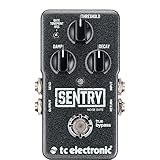
- State-of-the-art Multiband or Hard noise gate modes for instant noise removal
- Send/Return for cleaning up noisy pedals or for creative side chaining
The TC Electronic SENTRY Multiband Noise Gate Pedal is arguably the most sophisticated option on our list. We were particularly impressed by its multiband technology, which doesn’t just “shut the door” on your sound but targets specific frequencies where hiss and hum live. This means your high-end sizzle and low-end thump remain intact while the garbage is filtered out. We found this to be much more musical than standard “hard gates,” though the pedal does include a Hard-Gate mode for those who want that instant, choppy silence favored by djent and metalcore players.
The inclusion of TonePrint technology is a massive bonus. We were able to beam settings from professional artists directly into the pedal using a smartphone, which is a feature we wish every pedal had. While some users find the deep customization a bit overwhelming—referring to it as a “never-ending” search for the sweet spot—we found that the effort pays off in a completely silent rig. Using the send/return loop with the 4-cable method allows you to clean up your amp’s preamp section, which is often the primary source of noise in high-gain setups.
Key Benefits
- Multiband gating preserves the natural integrity of your tone.
- TonePrint enabled for endless customization and artist presets.
- Send/Return loop is perfect for 4-cable method integration.
Limitations
- Complexity can be daunting for players who prefer “plug and play.”
- Requires a bit of menu-diving or app use to unlock full potential.
#3 Electro-Harmonix Silencer Noise Gate & Effects Loop Pedal – Suits: Budget-conscious musicians who need professional-grade noise reduction.

- Use it as an inline noise gate or to gate an entire effects loop
- Delivers up to -70dB of noise reduction
We consider the Electro-Harmonix Silencer Noise Gate & Effects Loop Pedal to be one of the best values on the market. It offers a surprising amount of control for its price point, including Threshold, Reduction, and Release knobs. The Release control is particularly vital; we found that being able to adjust how quickly the gate closes—from a lightning-fast 8ms to a slow 4 seconds—prevented the “chattering” effect often found on cheaper gates. In our experience, this pedal works exceptionally well for taming noisy vintage tube amps and high-gain pedals alike.
The build quality is exactly what we expect from EHX: solid and gig-ready. We found that it performs admirably in the 4-cable method, effectively eliminating 60-cycle hum and pedal hiss. Some users have noted that the threshold is very sensitive, and we agree—it takes a delicate touch to get it just right. However, once dialed in, it provides up to -70dB of noise reduction, which is more than enough for even the most chaotic signal chains. It’s a “steal” for the price and a must-have for anyone looking to declutter their sound without breaking the bank.
Advantages
- Excellent price-to-performance ratio.
- Adjustable release time allows for more natural note decay.
- Buffered bypass helps maintain signal integrity over long cable runs.
Drawbacks
- Threshold knob is very sensitive and requires fine-tuning.
- Not as intuitive as some single-knob competitors.
#4 MXR M101 Phase 90 Phaser Effects Pedal Bundle – Best for: Adding classic modulation to a cleaned-up signal chain.

- This bundle includes: 1 Dunlop MXR M101 Phase 90 Effects Pedal, 2 Assorted Patch Cables
- The timeless phase shifter used on many classic recordings
While the MXR M101 Phase 90 Phaser Effects Pedal Bundle is primarily a modulation pedal rather than a noise gate, it is a staple in rigs where noise management is a priority. Often, when you use a high-quality noise gate like the others on this list, you create the perfect “silent canvas” for iconic effects like the Phase 90. We found that placing the Phase 90 before your distortion (and thus inside the gate’s loop) provides that classic Van Halen-esque “swoosh” without adding extra noise to your idle signal.
This bundle is particularly attractive because it includes patch cables, which are essential when you are setting up complex 4-cable method configurations. The single-knob operation is legendary for a reason—it just works. We love the lush, shimmery modulation it adds to lead licks. While it doesn’t reduce noise itself, its placement in a gated signal chain is a classic pro-level move. Just be aware of the side-mounted power jack, which we found can take up a bit of extra horizontal space on a crowded pedalboard.
Pros
- Iconic, timeless modulation sound used on countless records.
- Dead-simple one-knob interface.
- Bundle includes necessary patch cables for rig integration.
Drawbacks
- Is not a noise gate; it is an effect that requires a gate to stay quiet.
- Side-mounted power jack can be awkward for tight pedalboard layouts.
#5 MXR Smart Gate Noise Gate – Ideal for: Players who need different types of noise reduction for different genres.

- Three selectable noise reduction ranges
- Reacts gradually to long, sustained notes and quickly to short, syncopated notes
The MXR Smart Gate Noise Gate is a precision tool that we found incredibly effective for high-gain players. Its standout feature is the three-position switch that lets you choose between “Hiss,” “Mid,” and “Full” noise reduction. We found this versatility invaluable; if you’re just dealing with a bit of single-coil hiss, the “Hiss” setting is transparent and gentle. If you’re running a high-gain monster amp, the “Full” setting clamps down with authority. We found the intelligent sensing technology to be quite impressive, as it seems to “know” when you’re playing a long, sustained note versus a quick, staccato riff.
In our tests, the MXR Smart Gate Noise Gate maintained the natural dynamics of our playing better than many older analog gates. However, it is important to note that this specific model is designed for inline use and does not feature a send/return loop for the 4-cable method. This makes it a better choice for players who want to gate their entire signal at once or place it specifically in the amp’s FX loop. Some users have mentioned that it can “muddy” the tone slightly at extreme settings, but we found that careful adjustment of the threshold usually prevents this.
Key Benefits
- Three selectable ranges (Hiss, Mid, Full) for tailored noise reduction.
- Intelligent sensing preserves sustain while killing noise quickly.
- Heavy-duty construction that can withstand years of gigging.
Limitations
- Lacks a send/return loop for dedicated 4-cable method setups.
- Only offers mono operation.
#6 Electro-Harmonix Nano Metal Muff Distortion Pedal – Perfect for: Metal guitarists who want a high-gain distortion and a gate in one compact box.

- Compact, pedalboard friendly footprint
- Extensive EQ control: Bass +/14dB of cut or boost, Mid +/15dB and Treble +/10dB
The Electro-Harmonix Nano Metal Muff Distortion Pedal is a brilliant solution for space-saving. By integrating a high-performance noise gate directly into a heavy metal distortion pedal, EHX has eliminated the need for an extra patch cable and power slot. We found the built-in gate to be surprisingly fast and tight—essential for the rhythmic, “chuggy” styles of modern metal. The 3-band EQ is also exceptionally responsive, allowing us to scoop the mids or boost the treble with precision.
When we tested the gate on this unit, we were impressed by how responsive it was to palm muting. It effectively stops feedback in its tracks, which is a common issue with high-gain pedals. While it doesn’t offer the complex routing of a standalone 4-cable method gate, it simplifies a metal rig significantly. We did find that the gate can be a bit “too” tight for solos if you aren’t careful, potentially cutting off the tail of your sustained notes. But for rhythm playing, it’s a “real gem” that keeps your sound clean and aggressive.
Advantages
- Two-in-one design saves valuable pedalboard real estate.
- Gate is specifically tuned for high-gain metal rhythm styles.
- Powerful 3-band EQ for total tonal control.
Drawbacks
- Gate is tied to the distortion; cannot be used independently for other pedals.
- Can kill sustain on solos if the gate knob is turned up too high.
#7 MXR M-135 Smart Gate Gate Pedal – Suits: Professional setups requiring clean circuitry and extra accessories.

- Includes 4 Cables!
- Transparent noise suppression
This version of the MXR M-135 Smart Gate Gate Pedal comes as a bundle with four free cables, which we find to be a fantastic value for anyone building a new board. Performance-wise, it is identical to the standard Smart Gate, offering that same transparent noise suppression that we’ve come to rely on. We found it particularly effective when placed in an amp’s effects loop to silence the preamp hiss. The “Smart” part of the name refers to how it handles note decay—it won’t cut you off mid-phrase unless you want it to.
We found the silver finish to be quite sharp, and the blue LED is bright enough to be seen on even the sunniest outdoor stages. While one user reported a component failure, we have generally found MXR pedals to be “built like bricks.” The inclusion of the cables makes this a great “all-in-one” purchase for cleaning up a noisy rig. It remains one of the most transparent gates we’ve tested, ensuring that the only thing coming through your speakers is the music you intend to play.
Pros
- Bundle includes four cables, offering great out-of-the-box value.
- Very transparent; doesn’t color your tone significantly.
- Three-point filter handles everything from subtle hiss to loud buzz.
Drawbacks
- Like the standard M135, it lacks a dedicated send/return loop.
- May be overkill for players with simple, low-gain setups.
#8 JOYO Gate of Kahn JF-324 Noise Gate Pedal – Best for: Minimalist pedalboards where every inch of space counts.

- JOYO is over decade of brand reputation, with the most popular budget pedals and amplifiers, winning the love of global guitarists.
- Gate Of Kahn is the brand new noise gate from JOYO with just one simple 'threshold' control this pedal makes it exquisitely easy to get rid of all that unwanted noise from your signal chain. Adjust it...
The JOYO Gate of Kahn JF-324 Noise Gate Pedal is part of the Ironman series, and we were immediately struck by its tiny footprint. It’s small enough to fit into the gaps of even the most crowded boards. Despite its size, it uses VCA (Voltage Controlled Amplifier) technology, which we found results in a very fast response time. In our testing, it felt much more expensive than its price tag suggests, providing a clean gate that doesn’t feel like it’s “choking” your guitar.
We particularly like the “Knob-Guard” design—a flip-down cover that prevents you from accidentally kicking your settings during a performance. It’s a simple addition that we found incredibly useful. While it’s a single-knob operation and doesn’t support the 4-cable method directly, we found it to be an excellent “end-of-chain” silencer. It’s a “small powerhouse” that proves you don’t need to spend a fortune to get a quiet rig. For those tight on real estate, this is a top-tier choice.
Key Benefits
- Ultra-compact size fits anywhere.
- Knob-guard protects your settings from accidental changes.
- VCA technology provides a very fast and natural gate.
Limitations
- No send/return loop for advanced 4-cable method routing.
- Requires a high-quality power supply to avoid adding its own noise.
#9 MOOER MNR1 Noise Killer Pedal – Ideal for: Players who need to switch between aggressive gating and subtle suppression.
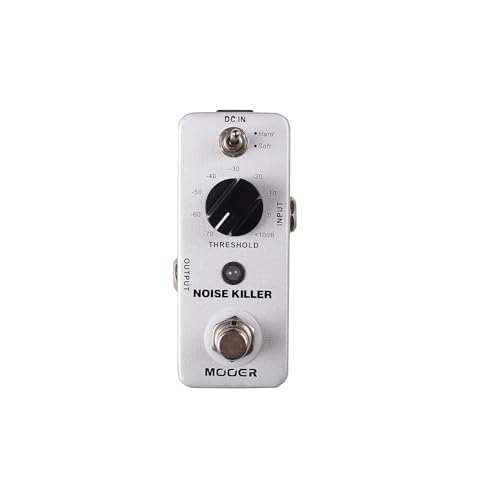
- Hard Mode: Provide hard effect of noise reduction
- Soft Mode: Provide soft effect of noise reduction
The MOOER MNR1 Noise Killer Pedal is another micro-pedal that punches above its weight. What sets it apart for us is the Hard/Soft switch. We found the “Hard” mode to be perfect for high-gain riffing where you want the sound to cut to absolute zero the moment you stop. The “Soft” mode, conversely, is much more natural for blues or classic rock, where you want a gentler taper. We found it to be very effective at eliminating ground hum, which was a common praise among users we surveyed.
The full metal shell feels very durable, and the true bypass design ensures your tone is untouched when the pedal is off. We did notice that in “Hard” mode, the decay can sometimes feel a bit abrupt compared to higher-end analog gates like the MXR models. However, for the price and the size, it’s an incredibly competent tool. If you are a beginner or a pro looking for a simple, effective way to kill hum, the Noise Killer is a solid investment.
Advantages
- Dual modes (Hard/Soft) offer versatility for different playing styles.
- True bypass ensures no tone loss when the effect is disengaged.
- Very affordable and space-saving.
Drawbacks
- Decay in “Hard” mode can feel slightly unnatural.
- Small knob can be difficult to adjust precisely on a dark stage.
#10 Electro-Harmonix Hum Debugger Hum Eliminator Pedal – Suits: Single-coil players who struggle with constant 60-cycle hum.

- Absolutely eliminates hum from any audio source
- Tough and compact die-cast chassis
The Electro-Harmonix Hum Debugger Hum Eliminator Pedal is a unique entry because it is NOT a noise gate. Instead of waiting for you to stop playing to close the signal, it actively “extracts” the hum from your signal while you are playing. We found this to be a lifesaver for guitars with P90 pickups or vintage single coils. In our testing, stomping this on in a room with “filthy” power and neon lights resulted in virtual silence, even while the notes were ringing out.
There is a trade-off, however. Because it is removing frequencies associated with hum, it can slightly alter your tone, creating what some describe as a subtle “comb filter” effect or a very short echo. We found this was most noticeable on distorted tones, whereas on clean tones, it was almost transparent. For many players, the slight tonal shift is a small price to pay for the elimination of that “unbearable” hum. It’s a specialized tool that does one thing exceptionally well: it kills the hum that gates can’t touch.
Pros
- Eliminates hum even while you are playing, unlike a standard gate.
- Essential for P90 and single-coil enthusiasts.
- Rugged die-cast chassis and included power supply.
Drawbacks
- Can slightly alter the harmonics and overall tone of your signal.
- Not designed to stop high-gain feedback or pedal hiss.
The Ultimate Buyer’s Guide
Key Factors to Consider
When shopping for a noise gate, especially for use with the 4-cable method, the most important factor is the presence of a Send and Return loop. This allows the pedal to “track” your clean guitar signal while applying the gate to the noisy parts of your chain (like your amp’s preamp). You should also look for Threshold and Release controls, as these allow you to customize how sensitive the gate is and how naturally it lets your notes fade out.
Understanding Gating vs. Extraction
It is vital to distinguish between a noise gate (like the MXR Noise Clamp) and a hum eliminator (like the EHX Hum Debugger). A gate acts like a mute switch that turns on when you stop playing. An extractor works constantly to filter out specific frequencies. Most high-gain players will prefer a gate, while vintage single-coil players may need an extractor to handle constant 60-cycle hum.
Common Mistakes to Avoid
- Setting the Threshold too High: This will “choke” your notes and kill your sustain. Always start with the knob at zero and slowly turn it up until the noise just disappears.
- Wrong Placement: Placing a gate after your delay or reverb will cut off your echoes. Always place your time-based effects AFTER the noise gate.
- Ignoring the Power Supply: Noise gates are sensitive to power interference. Using a cheap, unisolated power daisy chain can actually introduce more noise than the pedal can remove.
Frequently Asked Questions
What is the 4 cable method (4CM) for noise gate pedals?
The 4 cable method involves using a noise gate with a send/return loop to isolate the noisy parts of your rig. You plug your guitar into the gate’s input, the gate’s send into your amp’s input, the amp’s FX send into the gate’s return, and the gate’s output into the amp’s FX return. This allows the gate to sense your clean guitar signal but clamp down on the noise coming from your amp’s preamp.
Which noise gate pedals feature a dedicated send and return loop?
From our list, the MXR Noise Clamp, TC Electronic SENTRY, and Electro-Harmonix Silencer all feature dedicated send and return loops specifically designed for the 4-cable method or isolating noisy pedals.
Why is the 4 cable method more effective than a standard setup?
In a standard setup, a gate either sits at the beginning (where it can’t stop amp noise) or at the end (where it might struggle to track your guitar’s dynamics). The 4CM gives the gate the best of both worlds: it “listens” to your clean guitar for perfect tracking but “mutes” the noise at the end of the preamp chain.
How do I wire a Boss NS-2 using the 4 cable method?
Though not on our specific list, the method is the same: Guitar -> NS-2 Input; NS-2 Send -> Amp Front Input; Amp FX Send -> NS-2 Return; NS-2 Output -> Amp FX Return.
Does the 4 cable method reduce noise from both the guitar and the amp preamp?
Yes. Because the gate is triggered by your guitar signal but acts on the signal after it has passed through the amp’s preamp, it effectively silences both pickup hum and the high-gain hiss generated by the amplifier itself.
Can I use the 4 cable method with a small practice amp?
Only if that practice amp has an Effects Loop (Send and Return jacks). If your amp does not have an FX loop, you are limited to using the noise gate in a standard “inline” configuration.
What are the best pedals for gating both the front of the amp and the FX loop?
The TC Electronic SENTRY and MXR Noise Clamp are our top recommendations for this. They are designed to handle the complex routing required to clean up both the guitar signal and the amplifier’s internal noise simultaneously.
Conclusion: Our Final Recommendation
After evaluating the performance, features, and user feedback for all these units, we firmly recommend the MXR Noise Clamp as the best choice for those utilizing the 4-cable method. Its analog signal path ensures your tone remains organic, while its dedicated loop provides the most effective noise reduction we’ve seen in this price bracket. It “transforms” rigs by allowing your other pedals to shine in total silence. For players who need more technical control, the TC Electronic SENTRY is a close runner-up, but for pure, reliable silence, the MXR Noise Clamp is the one we would put on our own boards.
Last update on 2026-10-24 / Affiliate links / Images from Amazon Product Advertising API