
Behringer X-Touch Compact Review: The Ultimate Tactile Solution for Modern Producers?
If you have spent any significant amount of time inside a Digital Audio Workstation (DAW), you know the “mixing fatigue” that comes from staring at a screen for ten hours straight. There is a specific kind of frustration that occurs when you are trying to automate a delicate vocal swell or balance a complex drum bus using nothing but a plastic mouse and a tiny cursor. I have been there—hunched over a desk, squinting at automation lanes, wishing I could just reach out and grab the sound. This disconnect between our creative ears and our physical hands is one of the biggest hurdles in modern music production. Without a physical interface, the process feels more like data entry than art. This is why we eventually decided to integrate the Behringer X-Touch Compact into our studio setup, seeking a bridge between the digital and physical worlds.
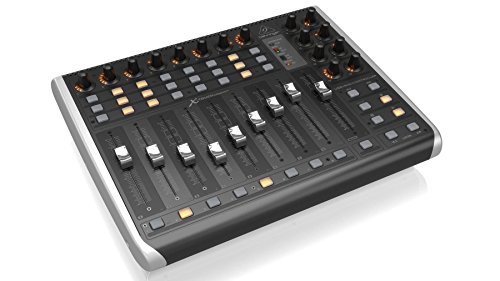
- USB/MIDI Controller with 9 Touch-sensitive Motor Faders
- 39 Illuminated Buttons
What to Consider Before Buying a Digital Audio Workstation Controller
A Digital Audio Workstation Controller is more than just an item; it’s a key solution for breaking the barrier between your computer and your creativity. These devices serve as the “nerve center” of your studio, allowing you to manipulate software parameters with the same fluidity you would find on a multi-million dollar vintage console. By offloading tasks from your computer screen to a physical surface, you reduce cognitive load, improve your mixing accuracy, and—most importantly—speed up your workflow significantly. When you can move four faders at once to find the perfect balance between your kick, snare, and bass, you are making musical decisions rather than mathematical ones.
The ideal customer for this type of product is the home studio owner, the professional mix engineer, or even a live sound technician who needs physical faders to manage software-based mixers. It is perfect for those who feel “stuck in the box” and want to bring a hands-on feel back to their music. On the other hand, it might not be suitable for producers who work exclusively on the go with just a laptop and a pair of headphones, where portability is the absolute priority, or for those who strictly produce loop-based electronic music and prefer grid-based controllers like the Ableton Push. If you belong to the latter group, you might consider different styles of MIDI interfaces.
Before investing, consider these crucial points in detail:
- Dimensions & Space: Consider your desk “real estate.” A controller like the Behringer X-Touch Compact is built to be a centerpiece, so you need to ensure you have enough width to accommodate the fader bank without blocking your keyboard or mouse. Measure your workspace before you check the latest price and availability to ensure a proper fit.
- Capacity & Performance: Look for the number of faders and whether they are motorized. Motorized faders are essential because they automatically jump to the correct position when you switch tracks or open a new project. A non-motorized fader can lead to “parameter jumping,” which can ruin a mix.
- Materials & Durability: Since you will be touching these controls thousands of times, the build quality matters. Stainless steel chassis options are far superior to all-plastic designs, as they provide the weight necessary to keep the unit from sliding around during aggressive mixing sessions.
- Ease of Use & Maintenance: Compatibility is king. Ensure the controller supports the Mackie Control or HUI protocols, which are the industry standards for DAW communication. This ensures that you won’t have to spend hours manually mapping every single button before you can start making music.
While the Behringer X-Touch Compact is an excellent choice, it’s always wise to see how it stacks up against the competition. For a broader look at all the top models, we highly recommend checking out our complete, in-depth guide:

- Tactile Control, Visual Feedback: LCD keys, touch strip, and dials for audio, video, lighting, and more. Know that your command has been executed.


- Complete Command of Ableton Live - Seamlessly integrates with Ableton Live (V9.1.3+), providing hands-on control of Ableton's clip matrix, mixer parameters, virtual instruments, effects, and more

- 8 touch-sensitive, 100 mm long-throw, motorized faders
First Impressions: Unboxing the Behringer X-Touch Compact
When we first pulled the Behringer X-Touch Compact out of its box, the immediate takeaway was its surprising heft. Weighing in at over 10 pounds, it doesn’t feel like a toy. The stainless steel construction gives it a professional, “studio-grade” vibe that we’ve often found lacking in other mid-priced controllers. The black finish is sleek, and the illuminated buttons provide a clear visual indicator of the unit’s status even in a dimly lit control room. Setting it up was a matter of connecting a single USB cable; the unit was recognized instantly by our Windows 10 and Mac test machines. Compared to the original, larger X-Touch, the Behringer X-Touch Compact feels more focused. It strips away the jog wheel and the dedicated timecode display to provide a more streamlined, fader-centric experience that fits comfortably on a standard workstation desk. It feels like a tool designed by people who actually spend time mixing.
Key Benefits
- Nine touch-sensitive motorized faders that are remarkably responsive and quiet.
- 16 rotary encoders with LED collars for 360-degree visual feedback on parameter values.
- Built-in Mackie Control mode ensures near-universal compatibility with DAWs like Ableton, Logic, and Cubase.
- Dual-Layer mode allows for quick switching between DAW control and MIDI CC mapping.
Limitations
- Lacks a dedicated LCD scribble strip, requiring you to look at your monitor to see track names.
- The “Global Setup” mode can be a bit cryptic without consulting the manual.
Deep Dive: Putting the Behringer X-Touch Compact to the Test
The Power of Motorized, Touch-Sensitive Faders
The heart of any serious DAW controller is the fader bank, and we found that the Behringer X-Touch Compact punches well above its weight class in this department. It features nine 100mm motorized faders. In our testing, the “touch-sensitive” aspect was the real game-changer. As soon as your finger makes contact with the fader cap, the DAW recognizes that you are taking control. This prevents the motor from fighting against your movements when you’re writing automation. We tested this extensively in Logic Pro and Ableton Live; the faders tracked our movements with incredible precision. When we switched between “Banks” (sets of 8 tracks), the faders snapped into their new positions almost instantly. While some entry-level motorized faders can be noisy and distracting, the ones on the Behringer X-Touch Compact maintain a relatively low profile, allowing you to focus on the nuances of your audio. For anyone moving from a mouse to this, the ability to experience this level of tactile control is a revelation for the mixing process.
Rotary Encoders and Visual Feedback
Beyond the faders, the Behringer X-Touch Compact is equipped with 16 rotary encoders. Each encoder is surrounded by an LED collar, which is a feature we found indispensable. When you turn a knob to adjust a pan pot or an EQ frequency, the LEDs light up to show you the current value. This means you don’t have to keep glancing back at your computer screen to see where your settings are. In our “Standard Mode,” these encoders controlled panning for the selected eight tracks. However, the real power lies in the “Dual Layer” mode. We were able to switch the unit into a MIDI CC mode where the encoders mapped perfectly to our favorite virtual instruments. Adjusting the cutoff frequency on a software synth felt organic and musical, rather than mechanical. The encoders have a stepped feel to them, which provides great tactile resistance for making small, incremental changes. This level of detail is exactly why we believe the Behringer X-Touch Compact is a feature that really sets it apart from simpler, button-heavy controllers.
Seamless Integration and the Mackie Control Protocol
One of our biggest concerns with MIDI controllers is the “setup headache”—that hour spent trying to get the software to talk to the hardware. We were pleased to find that the Behringer X-Touch Compact uses the Mackie Control protocol. This is essentially a “universal language” for music software. We simply selected “Mackie Control” in our DAW’s preferences, and the Behringer X-Touch Compact came to life. The transport controls (Play, Stop, Record, etc.) worked immediately. The 39 illuminated buttons are pre-configured for tasks like Mute, Solo, and Record Arm. We found the “Compact” name to be a bit of a misnomer in terms of functionality; it doesn’t feel limited. It provides all the essential tools you need to stay away from the mouse. We also experimented with the Behringer Editor software, which allowed us to customize every button and fader for specific MIDI tasks. While some users might find the initial configuration of specialized MIDI CCs a bit technical, the “plug and play” nature of the Mackie mode covers 90% of what most producers need. If you want to see how this fits into a professional workflow, you can see its full feature set and user reviews to understand the depth of its integration.
Durability and Long-Term Studio Utility
In a busy studio environment, gear gets bumped, spilled on, and used for hours on end. The Behringer X-Touch Compact feels built for the long haul. The stainless steel top plate doesn’t just look good; it provides a rigid surface that doesn’t flex under pressure. During our three-week evaluation period, the unit remained stable on the desk, even during fast fader movements. The buttons have a clicky, positive engagement that feels reliable. We also appreciated the inclusion of two USB ports on the back, which act as a hub. This allowed us to plug in our license dongles or a secondary MIDI keyboard without taking up another port on our computer—a small but thoughtful touch for anyone with a limited number of inputs. While the lack of a scribble strip (the little screens that show track names) means you still have to look at your monitor to know which track is “Bass” and which is “Lead Vocal,” the ergonomic layout of the Behringer X-Touch Compact quickly becomes muscle memory. For the price point, the build quality is significantly higher than most competitors in the “compact” category. We recommend you check the latest pricing to see how it compares to the plastic alternatives.
What Other Users Are Saying
The general sentiment among users is overwhelmingly positive, with a few specific caveats regarding niche use cases. One user noted that it “Works exactly as advertised. No complaints. Read the manual, do some research and this product should work for your application.” This aligns with our experience; the Behringer X-Touch Compact is a powerful tool, but it rewards those who take ten minutes to understand its different modes. On the other hand, a user mentioned that it “Does not sync with Xair without cabling. Useless.” This is a relevant point for live sound engineers: while the larger X-Touch has an Ethernet port for direct connection to Behringer’s X-Air mixers, the Compact version relies on USB or traditional 5-pin MIDI. This means if you want to use it with an X-Air mixer, you need a computer in the middle or specific MIDI cabling. For studio use, this isn’t an issue, but it’s a vital distinction for live performers. Most users agree that for the price, the motorized faders are the best in the business, and the ability to customize the unit via software makes it a “Swiss Army knife” for any production style.
Comparing the Behringer X-Touch Compact to the Competition
1. Novation Launchkey 61 MK4 MIDI Keyboard Controller

- The Creative Controller: Launchkey is an all-in-one DAW controller with premium hardware, 16 velocity-sensitive pads, and more
- Seamless DAW integration: Work intuitively in Ableton Live, Logic, Cubase, Reason, FL Studio, and Ardour
The Novation Launchkey 61 MK4 is a different beast entirely. While the Behringer X-Touch Compact is a dedicated mixing surface, the Launchkey is first and foremost a keyboard. It features 61 semi-weighted keys and drum pads, making it the better choice for producers who need to play in melodies and beats. However, its faders are not motorized. If your primary goal is mixing and automation, the Launchkey will feel limiting, as the faders won’t “snap” to your project’s levels. We recommend the Launchkey for composers who need an all-in-one performance tool, but for pure mixing, the Behringer wins hands down.
2. Akai Professional APC40 MKII USB MIDI Controller with Clip Launch Matrix
- Complete Command of Ableton Live - Seamlessly integrates with Ableton Live (V9.1.3+), providing hands-on control of Ableton's clip matrix, mixer parameters, virtual instruments, effects, and more
- Create, Jam, Produce - Trigger clips, loops and samples using a 5X8 clip-launch matrix with RGB feedback for clip status and color coding
The Akai APC40 MKII is the gold standard for Ableton Live users who perform live. Its 5×8 clip launch matrix is iconic and offers a level of session-view control that the Behringer X-Touch Compact cannot match. However, like the Launchkey, the APC40 lacks motorized faders. When you switch between tracks or scenes, the physical faders on the Akai stay put while the software values change, leading to “jumps” in volume when you move them. For studio-based mixing and precise automation, we still prefer the tactile feedback and motorized recall of the Behringer.
3. Elgato Stream Deck + Studio Controller
- Tactile Control, Visual Feedback: LCD keys, touch strip, and dials for audio, video, lighting, and more. Know that your command has been executed.
- Fully Customizable: Use as an audio mixer, studio controller, production console, etc.
The Elgato Stream Deck + is a modern alternative that focuses on customizable LCD keys and touch strips. It is incredibly versatile for content creators and streamers who need to trigger macros or adjust volume on the fly. It is much smaller than the Behringer X-Touch Compact and fits into tight spaces. However, it lacks long-throw faders entirely. If you are trying to do a “pro” mix with fine-tuned level adjustments, the Stream Deck + will feel cramped. It’s an excellent secondary controller for workflow shortcuts, but it doesn’t replace the traditional console feel of the Behringer.
Final Verdict: Is the Behringer X-Touch Compact Right for You?
After weeks of testing, our conclusion is clear: the Behringer X-Touch Compact is one of the most cost-effective ways to get professional-grade motorized faders into your studio. Its strengths lie in its rugged build quality, its responsive touch-sensitive controls, and its near-universal compatibility through the Mackie Control protocol. While the lack of scribble strips is a minor inconvenience, the sheer tactile joy of mixing with physical faders far outweighs the need to occasionally glance at your computer monitor. It transforms the mixing process from a chore into a performance.
We recommend the Behringer X-Touch Compact to any producer who is tired of mixing with a mouse and wants to take their workflow to the next level without spending thousands of dollars. It is a reliable, heavy-duty tool that does exactly what it promises. If you are ready to reclaim your creative flow and stop “painting” automation with a cursor, we highly suggest you grab the Behringer X-Touch Compact today and feel the difference for yourself.
Last update on 2026-10-16 / Affiliate links / Images from Amazon Product Advertising API