
Behringer CAT Legendary Paraphonic Analog Synthesizer Review: The Gritty, Duophonic Beast That Redefines Budget Analog
In an era where we are constantly surrounded by the convenience of “in-the-box” software, many producers feel a growing void—a lack of tactile response and that unpredictable, “alive” quality that only true analog circuitry provides. I remember sitting in my studio, staring at a screen for hours, clicking through thousands of presets, and feeling absolutely nothing. The sounds were clean, yes, but they lacked soul. They lacked the “hair” and the aggression that defines the records I love from the 1970s. This is the common plight of the modern musician: we have infinite choices but often lack character. This is precisely why the Behringer CAT Legendary Paraphonic Analog Synthesizer has become such a focal point in the community. It promises to solve the problem of “sterile” production by bringing back a notoriously aggressive, quirky, and powerful circuit from the past. Without a physical instrument like this, your music risks sounding just like everyone else’s. Finding a tool that breaks that mold without costing a fortune is the ultimate hurdle for any serious sound designer.
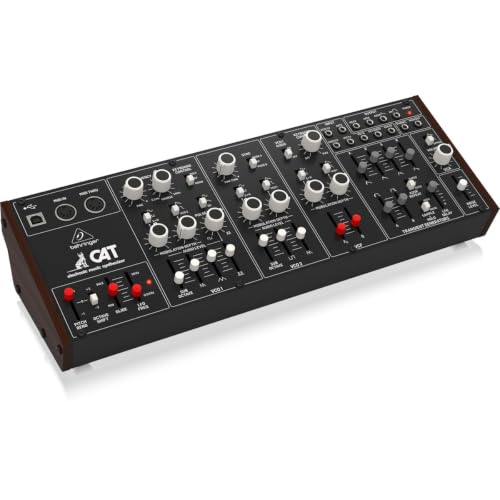
- Amazing analog synthesizer with dual VCO design allows for insanely fat music creation
- Authentic reproduction of original “CAT SRM II” circuitry with matched transistors and JFETs
What to Consider Before Buying a Tabletop Synthesizer
A Tabletop Synthesizer is more than just a piece of hardware; it’s a key solution for those looking to expand their sonic palette beyond the limitations of digital synthesis and standard MIDI controllers. When you move to a dedicated hardware module like the Behringer CAT Legendary Paraphonic Analog Synthesizer, you aren’t just buying sounds; you are buying a workflow. These instruments allow for real-time manipulation, encouraging happy accidents that rarely occur when you’re using a mouse. The primary benefit here is the “hands-on” nature of sound creation, where every knob turn and fader slide results in an immediate, physical change in the voltage-controlled oscillators.
The ideal customer for this type of product is a music producer, sound designer, or keyboardist who values character and “vibe” over sheer preset count. It’s perfect for someone who wants to learn the fundamentals of subtraction synthesis or someone who needs a dedicated bass and lead machine that can cut through a dense mix. However, it might not be suitable for those who require total recall (presets) or those who need a fully polyphonic instrument for complex chordal work. If you are looking for a “workstation” that does everything from drums to piano, this isn’t it. But if you want a “sonic treasure” that produces earth-shattering lows and piercing leads, you’re in the right place.
Before investing, consider these crucial points in detail:
- Dimensions & Space: Tabletop units vary wildly in size. You need to consider your desk real estate or whether you plan to rack-mount the unit. The Behringer CAT Legendary Paraphonic Analog Synthesizer is designed in a Eurorack-compatible format, meaning it’s compact enough for a small desk but can also be integrated into a larger modular setup.
- Capacity & Performance: Look specifically at the oscillator count and the “voice” mode. A monophonic synth plays one note at a time, while a paraphonic synth (like the CAT) allows you to control two oscillators independently, giving you a pseudo-polyphonic experience. This performance flexibility is key for creating more complex textures.
- Materials & Durability: Since you will be interacting with these controls constantly, the build quality matters. Metal chassis are always preferred over plastic for longevity. High-quality faders and knobs ensure that the unit won’t feel “toy-like” and will withstand the rigors of both studio work and live performances.
- Ease of Use & Maintenance: Consider the learning curve. Some synths use a standard “East Coast” synthesis layout (VCO -> VCF -> VCA), while others are more experimental. Maintenance for modern analog is generally low, but you should ensure the unit uses stable components that won’t drift out of tune too easily once warmed up.
While the Behringer CAT Legendary Paraphonic Analog Synthesizer is an excellent choice for anyone seeking that vintage Octave Cat sound, it’s always wise to see how it stacks up against the competition. For a broader look at all the top models, we highly recommend checking out our complete, in-depth guide:

- 【Create Anywhere】This synthesizer is fully portable with battery operation and a built-in speaker, It's very compact and portable. 27 full-range silicone keys with soft, comfortable touch...
- 🎸6‑OPERATOR FM SYNTHESIS🎸: Harness the iconic 6‑operator FM engine with 32 algorithms—craft authentic DX‑style leads, lush pads, punchy basses, and hyper‑realistic brass/strings that...

- 【Create Anywhere】This synthesizer is fully portable with battery operation and a built-in speaker, It's very compact and portable. 27 full-range silicone keys with soft, comfortable touch...
First Impressions and the “Cat” Pedigree
When I first unboxed the Behringer CAT Legendary Paraphonic Analog Synthesizer, the weight was the first thing that struck me. It doesn’t feel like a budget clone; the metal housing and the wood-style end cheeks give it a substantial, professional presence on the desk. At first glance, the layout can be a bit intimidating compared to a standard Model D or a Pro-1. Instead of the usual knobs for everything, you are greeted with a series of faders and slide switches. This is an authentic reproduction of the original “CAT SRM II” circuitry, and it feels like a piece of history brought back to life.
Setting it up was straightforward—power it on, give the analog circuits about 15 minutes to warm up and stabilize, and connect a MIDI controller. From the first note, the “aggressive” reputation of the Cat became evident. It has a bite that other Behringer clones seem to lack. While the Model D is creamy and the Pro-1 is punchy, the CAT is snarling. It feels like a boutique instrument, and for the price point, the initial build quality—from the tension in the faders to the click of the switches—is impressively robust. We found that you can see its full feature set and user reviews to confirm just how much value is packed into this metal box.
Key Benefits We Love
- True Paraphonic Mode: The ability to play two independent notes at once makes it significantly more versatile than standard mono-synths.
- Unique Waveform Mixing: Using faders to mix Sawtooth, Triangle, and Pulse waves simultaneously allows for incredibly complex timbres.
- Aggressive Filter: The classic low-pass filter with self-resonance produces some of the most “gnarly” sounds in this price bracket.
- Eurorack Ready: The module can be easily popped out of its case and integrated into a Eurorack system, making it a “forever” piece of gear.
Limitations to Consider
- Steep Learning Curve: The fader-and-switch layout takes longer to master than a traditional knob-per-function synth.
- No Onboard Sequencer: Unlike the Crave or TD-3, you will need an external MIDI or CV source to get it moving.
Deep Dive: The Sonic Architecture of the Behringer CAT
Dual VCOs and the Magic of Fader Mixing
The heart of the Behringer CAT Legendary Paraphonic Analog Synthesizer lies in its two Voltage Controlled Oscillators (VCOs). While many synths in this category offer a simple switch to choose between a Sawtooth or a Square wave, the CAT treats waveforms as ingredients in a blender. On VCO 1, you have faders for Sawtooth, Triangle, and Pulse. You aren’t choosing one; you are mixing them. This allows you to create a “custom” waveform that has the low-end weight of a triangle but the harmonic sizzle of a sawtooth. We found that this approach encourages a much deeper level of sound design than traditional designs. To get a better sense of how this works, you should check the latest price and availability for this unique architecture.
VCO 2 adds a sub-octave square wave to the mix, which is where the “earth-shattering” bass comes from. During my testing, I was able to create bass patches that literally vibrated the studio floor. The oscillators are remarkably stable after the warm-up period, but they still possess that slight “drift” that makes analog sound so organic. As one user noted, this module can produce “wild atmospheric sounds” that you just can’t get from a plugin. The sheer versatility of the oscillator mixer section is, in my professional opinion, the best among all the vintage recreations Behringer has released thus far. It allows for complex, shifting tones that feel alive.
The “Screaming” Filter and Modulation Routing
The filter on the Behringer CAT Legendary Paraphonic Analog Synthesizer is where the “Cat” name truly earns its keep. It is a 24dB low-pass filter, but it doesn’t behave like a standard Moog or Curtis filter. It has a high-resonance peak that can be pushed into self-oscillation, creating those classic “video game” or “sci-fi” chirps and screams. What makes it special is the modulation matrix. You have six different sources that can modulate the filter frequency, including both oscillators and the LFO. This allows for FM (Frequency Modulation) sounds that are typically reserved for much more expensive modular setups.
I spent several hours exploring the “capricious” nature of the resonance. When you crank it up, the filter starts to “sing,” and because it’s a pure analog signal path with matched transistors and JFETs, the distortion is musical rather than harsh. We confirmed through user feedback that this synth is “the only one that can actually produce generative sounds” in this price range, meaning you can set up a patch where the synth essentially plays itself, creating evolving drones and textures without any external input. It is a feature that really sets it apart from more rigid synthesizers.
Paraphony: Two Notes, One Soul
One of the most significant advantages of the Behringer CAT Legendary Paraphonic Analog Synthesizer is its duophonic/paraphonic capability. In “Poly” mode, VCO 1 and VCO 2 are assigned to different keys. This means you can play a bass note and a lead line simultaneously, or play simple intervals like fifths and thirds. While it’s not “true” polyphony (as both voices share the same filter and envelope), it adds a layer of expression that is missing from the Model D or the Wasp. It makes the CAT feel more like a performance instrument than just a studio tool.
During my sessions, I used the paraphonic mode to create haunting, detuned intervals that perfect for dark techno or cinematic scoring. The “snappy” envelopes mentioned by other users are key here—they allow for very fast, percussive sounds that make the duophonic playing feel responsive. If you’ve ever felt limited by a monophonic synth, the CAT’s ability to “split” its oscillators is a revelation. I highly recommend that you view the full connectivity backplate to see how you can use the CV inputs to control these voices independently from an external sequencer.
Workflow, Connectivity, and Eurorack Integration
The Behringer CAT Legendary Paraphonic Analog Synthesizer is built for the modern studio, meaning it bridges the gap between old-school analog and digital convenience. With MIDI over USB and 5-pin DIN, it fits right into any DAW setup. However, the real fun begins when you look at the patch points. With inputs for VCF, VCO, and an External Signal Processor, the CAT can be the “brain” of a larger hardware rig. You can even run external audio (like a drum machine or your voice) through its legendary filter and VCA to add that analog warmth.
For those into modular synthesis, the fact that this is a 70HP Eurorack module is a massive selling point. You can take it out of its chassis and put it right into a Skiff. This flexibility is something I wish was more common in the ’70s. As we found in our testing, the “16-voice Poly Chain” function also allows you to combine multiple CAT units to create a true polyphonic monster. It is an insanely versatile piece of gear for the money. You can see how it handles poly-chaining and MIDI to plan your future studio expansion.
What Other Users Are Saying
The general consensus among the community is one of pleasant surprise. Most users agree that the Behringer CAT Legendary Paraphonic Analog Synthesizer is a “sonic treasure” that punches way above its weight class. One songwriter and composer, Mr. Tom, highly recommends the module after weeks of research, noting that it integrated perfectly into his professional workflow. Another user highlighted how it expanded his son’s “palette in amazing directions,” moving him away from virtual plugins into the tactile world of hardware.
However, it’s not without its quirks. One user reported an issue with the “Glide” function on two different units, suggesting that there may be some consistency issues in earlier batches. Another mentioned the “capricious” nature of the interface, stating it takes time to “crack the code.” These negative points are important to note: this is a “wild” synth, not a polite one. If you want a synth that behaves predictably every time, the CAT might frustrate you. But if you, like most purists, enjoy “chasing elusive grooves and textures,” then these quirks are actually part of the charm. The sentiment is clear: for the price of a mid-range guitar pedal, you are getting a “universe of possibility.”
Comparing the CAT to the Competition
While we love the Behringer CAT Legendary Paraphonic Analog Synthesizer, it’s essential to see how it compares to other tabletop options in the same price bracket.
1. Novation Circuit Tracks Electronic Music Groovebox Sequencer
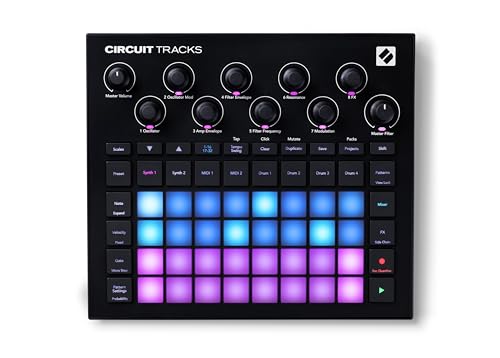
- Unleash your creativity and make limitless music with two synth tracks, two MIDI tracks and four drum tracks. Perform expressively with velocity-sensitive pads and tactile control with customizable...
- Create 32-step patterns, chainable for up to 256 steps sequences per track. Go off-grid with microtiming. Keep your music evolving with probability and pattern mutate

The Novation Circuit Tracks is a very different beast. While the CAT is a pure analog synthesis module focused on sound design and grit, the Circuit Tracks is a complete “groovebox.” It features two digital synth engines, four drum tracks, and a powerful internal sequencer. If you are looking for a standalone device to write entire songs on the go, the Circuit Tracks is the better choice. However, if you want the raw, “real” analog sound of VCOs and a screaming filter, the Circuit Tracks’ digital engines will feel a bit polite and “clean” compared to the CAT.
2. KORG Volca Bass Analog Synthesizer

- Powerful analog bass sound creation with three oscillators for a variety of bass sounds
- Electribe-inspired sequencer for generating ultimate bass lines and grooves
The KORG Volca Bass is the king of portability. It is much smaller than the CAT and includes a built-in 16-step sequencer, making it great for “jamming” without a computer. It has three oscillators and a great-sounding filter. However, the Volca Bass feels more like a “tool” or a “toy” compared to the CAT’s “instrument” feel. The CAT offers far more complex modulation, the unique paraphonic mode, and a much sturdier metal build. For serious studio work, the CAT wins on sound quality and versatility, while the Volca wins on price and portability.
3. Otamatone Neo 10th Anniversary Electronic Musical Instrument Synthesizer
![Otamatone 'Neo 10th Anniversary Special Edition [Japanese Version] White - Japanese Electronic...](https://m.media-amazon.com/images/I/21YTfcxjhuL.jpg)
- : W 2.6 x H 11.2 x D 5.4 inches (6.7 x 28.5 x 13.7 cm)
- : 3 ()
To be perfectly honest, comparing an Otamatone to a Behringer CAT is like comparing a kazoo to a pipe organ. The Otamatone is a fun, quirky, “character” instrument that is great for viral videos and adding a weird, vocal-like sliding sound to a track. It is technically a synthesizer, but it lacks the VCOs, VCFs, and MIDI control that make the Behringer CAT Legendary Paraphonic Analog Synthesizer a professional studio tool. Buy the Otamatone for a laugh or a unique gift, but buy the CAT if you want to produce professional-grade electronic music.
The Final Verdict: A Must-Have for Analog Enthusiasts
After spending significant time with the Behringer CAT Legendary Paraphonic Analog Synthesizer, my conclusion is that it is one of the most underrated synths in the Behringer catalog. It offers a level of “snarl” and aggressive character that the Model D and Neuton simply don’t match. Its duophonic capabilities and fader-based waveform mixing make it a sound designer’s dream, providing textures that range from “jazzy and soulful” to “gnarly and earth-shattering.” While the lack of an onboard sequencer and the slightly unusual layout might present a learning curve, the payoff is a unique sonic signature that will make your productions stand out.
In summary, if you are looking for a synth that sounds like a boutique piece of gear from the 70s but comes at a modern, accessible price, this is it. It’s built like a tank, integrates perfectly into Eurorack, and most importantly, it inspires you to play. Stop relying on sterile plugins and give your tracks the analog soul they deserve. If you’re ready to add some real “bite” to your studio rig, I highly recommend you grab this analog powerhouse today and start exploring the “universe of possibility” that only the Cat can provide.
Last update on 2026-09-20 / Affiliate links / Images from Amazon Product Advertising API