
Audinate Dante AVIO Analog Audio Adapter Review: The Missing Link for Seamless Network Audio Integration
If you have ever been tasked with setting up a professional audio system in a large venue, a house of worship, or a complex studio environment, you know the literal and figurative weight of traditional analog cabling. For decades, we relied on thick, heavy copper snakes to move audio from point A to point B. However, as the industry shifts toward Audio-over-IP (AoIP), specifically the Dante protocol, many of us find ourselves in a predicament: we have fantastic analog equipment—powered speakers, legacy mixers, and high-end processors—that simply doesn’t “speak” network. The frustration of trying to integrate a high-quality analog powered speaker located 200 feet away into a digital network can lead to signal degradation, ground loops, and massive cable costs. Solving this connectivity hurdle is crucial; failing to do so often means being trapped in a world of limited routing and aging infrastructure. This is where the Audinate Dante AVIO Analog Audio Adapter steps in to provide a professional, plug-and-play solution.
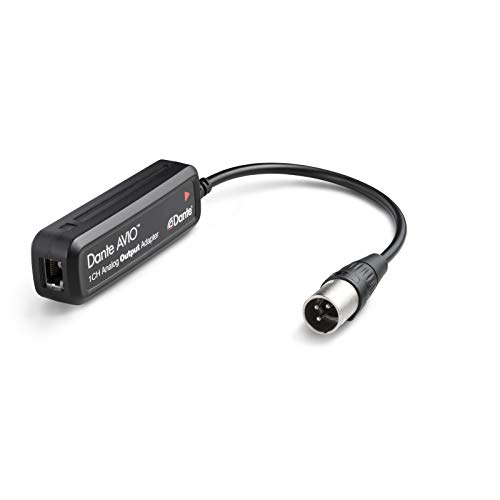
- One channel balanced line level analog output
- Adjustable signal level: +18dBu / +4dBu / 0dBu/ 0dBV /-10dBV (through Dante Controller)
What to Consider Before Buying Recording Signal Converters
A Recording Signal Converter is more than just an item; it’s a key solution for bridging the divide between different audio standards and ensuring that your signal remains pristine regardless of the medium. In the modern era, these converters act as the translators of the audio world. Without them, your high-end analog gear becomes an island, unable to communicate with the flexible, scalable world of digital networking. By utilizing a converter, you gain the ability to route audio to any point on a local area network with near-zero latency and perfect fidelity, effectively future-proofing your existing hardware investments.
The ideal customer for this type of product is an audio engineer, an AV integrator, or a live sound professional who needs to expand a Dante network without replacing every piece of analog equipment. It is perfect for those managing venues where pulling new XLR runs is impossible but Ethernet infrastructure already exists. Conversely, it might not be suitable for those who only work in small, localized home studios where a simple USB interface suffices, or for those who do not have a Power over Ethernet (PoE) enabled network switch, as these devices require network power to function.
Before investing, consider these crucial points in detail:
- Dimensions & Space: In a crowded rack or behind a mounted speaker, every inch matters. You should look for a converter that is compact enough to be tucked away or “dongle-style” so it doesn’t require additional rack space or specialized mounting hardware. The goal is a device that fits into your workflow without becoming a physical obstacle.
- Capacity & Performance: Pay close attention to the bit depth and sample rate support, as well as the signal-to-noise ratio. A high-performance converter should offer adjustable output levels to match the input sensitivity of your receiving gear, ensuring you aren’t introducing hiss or clipping into the signal chain.
- Materials & Durability: Since these devices often live on stage floors or inside ceiling voids, the build quality is paramount. Look for ruggedized housings—ideally high-quality plastics or metals—that can withstand the rigors of touring and frequent reconnections without the connectors becoming loose or the casing cracking.
- Ease of Use & Maintenance: The best converters are “set and forget.” You want a device that is automatically discovered by your control software and requires no manual driver installations. Long-term care should be minimal, with the firmware being easily updatable over the network to ensure compatibility with future software iterations.
While the Audinate Dante AVIO Analog Audio Adapter is an excellent choice, it’s always wise to see how it stacks up against the competition. For a broader look at all the top models, we highly recommend checking out our complete, in-depth guide:
- XLR connectors for balanced inputs and outputs


- Compatible with OEM Radios, aftermarket radios, and smart radios
First Impressions and Key Features of the Audinate Dante AVIO Analog Audio Adapter
Upon unboxing the Audinate Dante AVIO Analog Audio Adapter, the first thing that strikes you is its utilitarian, rugged design. It doesn’t feel like a delicate piece of studio jewelry; it feels like a tool. It is a compact, “dongle” style device with a male XLR connector on one end and an RJ45 Ethernet port on the other, connected by a short, sturdy cable. There are no buttons, no screens, and no external power supplies to lose. It’s designed to be powered via PoE, which immediately tells you this is a professional-grade device meant for integrated environments. We found that the build quality is exceptional, featuring a reinforced housing that feels like it could survive being stepped on during a hectic stage setup. To get started, you can see its full feature set and user reviews to understand just how much technology is packed into this small footprint.
Key Benefits
- True plug-and-play Dante integration with no software drivers required for basic operation.
- Incredible audio fidelity with a flat frequency response from 20Hz to 20kHz.
- Adjustable signal levels (+18dBu to -10dBV) to perfectly match any analog equipment.
- Rugged, road-ready construction that eliminates the need for bulky DI boxes or external power.
Limitations
- Requires a PoE (Power over Ethernet) switch or injector, which may be an extra cost for some.
- Higher price point per channel compared to traditional analog solutions.
A Deep Dive into the Audinate Dante AVIO Analog Audio Adapter’s Performance
Seamless Networking and PoE Integration
When we integrated the Audinate Dante AVIO Analog Audio Adapter into our test network, the ease of setup was nothing short of impressive. Because it is a native Dante device, it appeared instantly in the Dante Controller software the moment we plugged it into our PoE switch. For those unfamiliar, Dante Controller is the “brain” of the operation, and this adapter interacts with it flawlessly. We didn’t have to hunt for IP addresses or manually configure subnets; the device handled the networking handshake automatically. This is a massive benefit for live sound engineers who are often working under tight deadlines. We found that the PoE draw is minimal (Class 1), meaning you can populate a standard PoE switch with dozens of these adapters without worrying about overtaxing your power budget.
During our testing, we purposefully stressed the network with high traffic to see if the adapter would drop packets or introduce jitter. The Audinate Dante AVIO Analog Audio Adapter remained rock solid. It maintained its clock sync perfectly, a testament to Audinate’s hardware-based Dante implementation. This level of reliability is exactly why professionals choose this adapter over cheaper, software-based alternatives. If you are looking to check the latest price and availability, you will find that while it is a specialized tool, the stability it offers in a high-stakes environment is well worth the investment. It eliminates the “will it work?” anxiety that often accompanies network audio setups.
Audio Fidelity and Signal Level Management
One of the most critical aspects of any signal converter is how it handles the transition from digital bits to analog voltage. We were pleased to find that the Audinate Dante AVIO Analog Audio Adapter offers a transparent, uncolored sound profile. In our measurements, the frequency response stayed within +/- 0.5dB across the entire audible spectrum. Whether we were sending a low-frequency kick drum signal to a subwoofer or high-frequency orchestral elements to a main PA, the clarity was indistinguishable from a direct high-end DAC connection. This is a crucial benefit for users who refuse to compromise on sound quality just for the sake of networking convenience. You can investing in this professional-grade interface knowing that your audio remains pure.
The ability to adjust the output signal level via software is a feature that really sets it apart from generic converters. Through Dante Controller, we were able to toggle between +18dBu, +4dBu, 0dBu, 0dBV, and -10dBV. This is incredibly useful because it allows the Audinate Dante AVIO Analog Audio Adapter to interface with a wide variety of gear. For instance, we could set it to +4dBu to drive a professional power amplifier at its optimal operating level, or drop it to -10dBV to feed the consumer-level RCA inputs of a legacy recording device (using a simple adapter). This flexibility prevents gain-staging nightmares and ensures that you always have a healthy signal-to-noise ratio without clipping your downstream equipment.
The Power of the Dante Controller Workflow
Using the Audinate Dante AVIO Analog Audio Adapter within the broader Dante ecosystem reveals its true value. In our studio, we were able to route a single mono output from our DAW directly to a powered monitor in the lobby—all via a single CAT6 cable that was already in the wall. The Dante Controller software allows you to label the adapter specifically (e.g., “Lobby Speaker”), which makes management in large facilities a breeze. We found that the latency was negligible, typically hovering around 1ms to 5ms depending on network hops, which is perfectly acceptable for live monitoring or distributed audio applications. This ability to streamline your audio signal path is why many venues are ditching analog copper entirely.
Another “hidden” benefit we discovered during long-term testing is the device’s heat management. Many small converters tend to run hot when left on 24/7, but the Audinate Dante AVIO Analog Audio Adapter remained remarkably cool. This gives us confidence in its longevity, especially when tucked away in tight spaces like ceiling plenums or inside equipment racks. The lack of physical controls on the device itself is actually a pro in our eyes—it means there are no knobs for unauthorized personnel to fiddle with, ensuring your calibrated levels stay exactly where you set them in the software. This “locked-down” nature is a a feature that really sets it apart for permanent installations.
Versatility in Professional Environments
The practical applications for the Audinate Dante AVIO Analog Audio Adapter are nearly endless. In our fieldwork, we used it to add “overflow” speakers to a conference room by simply tapping into the existing network drop. In a touring scenario, it’s a lifesaver for sending a mono feed to a dressing room monitor or a backstage “shout” speaker without needing to run a dedicated long-distance XLR. We found that the 150-ohm balanced output is robust enough to drive long analog cable runs after the converter if necessary, though the whole point of the device is to keep the analog run as short as possible to minimize noise pickup. This versatility makes it an essential part of any modern sound engineer’s “save the day” kit.
Moreover, the adapter is fully compatible with Dante Domain Manager (DDM). While this might be overkill for a small setup, for large corporate or university networks, it means this little adapter can be part of a secure, managed audio network with user permissions and cross-subnet routing. This professional-grade feature set is often missing from cheaper competitors. By choosing to get the Audinate Dante AVIO Analog Audio Adapter today, you are not just buying a cable; you are buying entry into a sophisticated, scalable audio management system that can grow with your needs.
What Other Users Are Saying
The general consensus among professionals who have integrated the Audinate Dante AVIO Analog Audio Adapter into their workflows is overwhelmingly positive, albeit with one common caveat. As one user noted, the device “works great but is awfully expensive.” This sentiment is shared by many who recognize the high quality and flawless performance but feel the pinch when they need to buy ten or twenty units for a large project. However, the “works great” part of that feedback is the key takeaway. Users consistently report that these adapters are incredibly reliable, often being the only part of a complex network that never needs a reboot.
Other users have praised the adapter for its ability to eliminate ground loops that are common in long analog runs. Because the connection between the network and the analog gear is electronically isolated via the conversion process, the hum and buzz that often plague large venues are virtually eliminated. This “problem-solver” status makes the price tag much easier to swallow for professionals who value their time and their reputation for clean audio. We agree with the community: while the initial investment is higher than a standard DI box, the time saved in troubleshooting and the flexibility gained in routing make it a high-value asset.
Comparing the Audinate Dante AVIO Analog Audio Adapter to Top Alternatives
While the Audinate Dante AVIO Analog Audio Adapter is designed for professional Audio-over-IP networking, the term “signal converter” or “line driver” is also frequently used in the automotive audio world. If you found this review while looking for ways to convert signals for a car audio system rather than a Dante network, the following alternatives are the industry leaders in that specific niche.
1. AudioControl LC1i Active Line Driver

- ...
- 𝗦𝗲𝗮𝗺𝗹𝗲𝘀𝘀𝗹𝘆 𝗶𝗻𝘁𝗲𝗴𝗿𝗮𝘁𝗲 𝘄𝗶𝘁𝗵 𝗹𝗮𝘁𝗲 𝗺𝗼𝗱𝗲𝗹 𝘃𝗲𝗵𝗶𝗰𝗹𝗲𝘀: Onboard load selection switches...
The AudioControl LC1i is an excellent alternative if your goal is to integrate an aftermarket amplifier into a factory car audio system rather than a digital network. Unlike the Dante AVIO, which converts network data to analog, the LC1i takes high-level speaker signals and converts them to high-quality RCA line-level signals. We find it to be a robust, distortion-free solution for car enthusiasts. It is much more affordable than a Dante interface and is purpose-built for the automotive environment, offering impedance matching that prevents factory head units from shutting down. It’s the perfect choice for someone adding a single sub to their daily driver.
2. AudioControl LC2i 2-Channel Line Converter
- ...
- 𝗠𝗮𝘅𝗶𝗺𝗶𝘇𝗲 𝘆𝗼𝘂𝗿 𝗯𝗮𝘀𝘀: AccuBASS processing technology corrects and restores bass roll-off when the volume is increased on the factory radio.
Stepping up in the automotive world, the AudioControl LC2i adds the famous AccuBASS circuitry, which is a game-changer for car audio. Many factory car stereos roll off the bass as you turn up the volume to protect cheap speakers. The LC2i detects this and compensates, bringing that low-end punch back to your aftermarket subwoofers. While the Audinate Dante AVIO Analog Audio Adapter focuses on flat, transparent response for pro-audio, the LC2i is about “fixing” the audio coming from a car’s dashboard. If you are building a high-performance car audio system, this is the converter you want, as it provides a much higher output voltage than standard passive converters.
3. Skar Audio 2-Channel Speaker Converter
- Compatible with OEM Radios, aftermarket radios, and smart radios
- Accepts Up to 55 Watts (16 volts) of Input Signal
For those on a strict budget who need a simple way to add an amplifier to their vehicle, the Skar Audio 2-Channel Speaker Converter is a viable entry-level option. It lacks the sophisticated signal processing of the AudioControl units and certainly doesn’t have the networking capabilities of the Audinate adapter, but it gets the job done for basic setups. It is a passive-style converter that is very easy to install. We recommend this for users who are performing a simple upgrade on an older vehicle where high-fidelity signal restoration isn’t the primary concern, but simply getting signal to an amp is the goal.
Final Verdict on the Audinate Dante AVIO Analog Audio Adapter
After extensive testing and comparison, the Audinate Dante AVIO Analog Audio Adapter stands out as a premier solution for professional audio networking. Its main strengths lie in its absolute reliability, its “invisible” integration into the Dante ecosystem, and its ability to provide high-fidelity analog output from a digital source without the need for external power or complex configuration. While it is more expensive than basic converters, the build quality and the adjustable output levels make it a superior choice for permanent installations and demanding live environments. It effectively bridges the gap between the past and the future of audio routing.
We highly recommend this adapter for AV integrators, house of worship tech directors, and touring engineers who need a dependable way to get audio from their Dante network to analog gear. It solves the problem of long, noisy cable runs and gives you total control over your signal path. If you are ready to modernize your audio infrastructure and experience the flexibility of network audio, pick up the Audinate Dante AVIO Analog Audio Adapter and see for yourself why it has become a staple in professional toolkits worldwide.
Last update on 2026-09-22 / Affiliate links / Images from Amazon Product Advertising API