
ART DualZDirect Passive Direct Box Review: A Versatile Workhorse for Studio and Stage
If you have ever spent a frantic thirty minutes before a live set trying to track down a persistent buzz in the PA system, you know exactly why we value a high-quality direct box. Whether it is a laptop power supply introducing a ground loop, an acoustic guitar sounding “thin” through a long cable run, or a keyboard signal that is simply too hot for the mixer’s preamp, the challenges of signal management are endless. We have found that many musicians and engineers try to skip this step, only to realize that their audio lacks the “body” and “clarity” of a professional production. The ART DualZDirect Passive Direct Box was designed to solve these exact headaches, providing a transparent bridge between unbalanced gear and balanced professional inputs. Without a reliable DI, you are essentially gambling with your tone every time you plug into a new venue’s sound system.
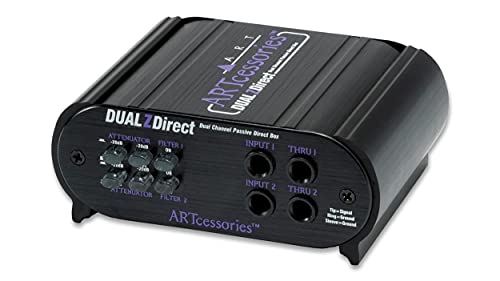
- Fully passive, high performance transformer design. No battery required.
- Converts 50k ohm inputs into 600 ohm balanced outputs
Choosing the Right Recording Signal Direct Boxes: A Comprehensive Buyer’s Guide
A Recording Signal Direct Boxes is more than just an item; it’s a key solution for any musician who needs to convert a high-impedance, unbalanced signal (like that from a guitar or keyboard) into a low-impedance, balanced signal suitable for a mixing console. This conversion is vital for preventing signal loss over long cable runs and for protecting your audio from electromagnetic interference. When we evaluate these units, we aren’t just looking for a simple pass-through; we are looking for how the internal transformer handles the nuances of your instrument’s frequency response. A high-quality DI box ensures that the “soul” of your instrument makes it to the speakers without being colored or degraded by cheap components.
The ideal customer for this type of product is someone facing diverse routing challenges—the gigging keyboardist, the home studio owner recording bass, or the AV professional running audio from a laptop to a powered speaker. While it might not be suitable for those who require active circuitry to boost extremely weak signals (like some vintage passive pickups), it is a “must-have” for anyone who needs a reliable, “no-power-needed” solution that can live at the bottom of a gig bag and work every time it’s called upon. If you find yourself frequently switching between instruments or dealing with “dirty” power in older venues, a passive DI like this is your first line of defense.
Before investing, consider these crucial points in detail:
- Dimensions & Space: In a crowded pedalboard or a dense studio rack, every inch matters. You want a unit that is rugged enough to be stepped on but compact enough to fit into a backpack side pocket or tucked under a riser. Look for an enclosure that protects the switches from being accidentally toggled during transport.
- Capacity & Performance: This refers to the transformer’s ability to handle high signal levels without saturating or distorting. For line-level gear like keyboards or DJ mixers, the input attenuation (pad) is critical. A good DI should offer at least 20dB of attenuation to handle “hot” signals without clipping the mixer’s input.
- Materials & Durability: Plastic housings are a recipe for disaster on the road. We always recommend extruded aluminum or heavy-duty steel. Not only does this protect the internal components, but metal enclosures also provide better shielding against RF interference and hum.
- Ease of Use & Maintenance: Passive units are generally maintenance-free because they require no batteries or phantom power. However, the quality of the switches and jacks is paramount. You want “clicky” buttons that feel substantial and jacks that grip your cables tightly, ensuring a solid connection through years of use.
While the ART DualZDirect Passive Direct Box is an excellent choice, it’s always wise to see how it stacks up against the competition. For a broader look at all the top models, we highly recommend checking out our complete, in-depth guide:
FULL ANALYSIS
Our Expert Guide to the Best 2-Channel Direct Boxes for Modern Keyboard Rigs

- Passive Stereo DI with Isolation Transformer

- DEVICE CONNECTOR: Provides a variety of DI solutions with its inch device connector live sound recording applications. It allows you to easily connect keyboards, guitars & outboard signal processors


- Passive Mono Direct Box with Custom Transfmer Rugged I-beam Construction
First Impressions: Unboxing the ART DualZDirect Passive Direct Box
When we first pulled the ART DualZDirect Passive Direct Box out of its packaging, the first thing that struck us was the weight. At roughly 15.5 ounces, it feels incredibly solid—more like a piece of industrial equipment than a budget audio accessory. The extruded aluminum chassis has a matte finish that looks professional and feels like it could survive a drop off a tall stage without much more than a cosmetic scratch. The layout is intuitive: two independent channels with 1/4″ inputs and thru-jacks on one side, and balanced XLR outputs on the other.
What really sets this apart during the initial inspection is the sheer number of control options. You don’t just get a ground lift; you get input attenuation, a low-pass filter, and a phase invert switch. For a unit at this price point, seeing such a feature-rich interface is impressive. While some might find the number of buttons overwhelming at first, we immediately saw the potential for this unit to solve a variety of complex audio problems that simpler DI boxes just can’t touch. It is a compact, “swiss-army-knife” tool for the modern musician.
Key Benefits
- Two completely independent channels in one compact enclosure.
- Fully passive design requires no batteries or phantom power.
- Extremely versatile feature set (Pad, Phase, Filter, Ground Lift).
- Excellent price-to-performance ratio for a dual-channel unit.
Limitations
- Passive design leads to significant signal level drop (typical of DIs).
- Tiny buttons can be accidentally pressed if not handled carefully.
A Deep Dive into the Performance of the ART DualZDirect Passive Direct Box
Pristine Audio Fidelity and Transformer Performance
In our testing, the core of any DI box’s value lies in its transparency. We ran several sources through the ART DualZDirect Passive Direct Box—ranging from a high-output active bass to a stereo laptop feed—and the results were consistently impressive. One user described the experience as “taking a blanket off” their acoustic guitar, and we have to agree. There is a noticeable clarity in the high-mid frequencies that often gets lost when using cheaper, generic DI boxes. This is largely due to the high-quality transformers ART has utilized, which manage to keep the signal clean and articulate without introducing the “mushiness” sometimes found in budget passive components.
We found that when used with keyboards, the signal remained flat and responsive across the entire frequency spectrum. Some users have noted that there is no “audible difference” on keyboards compared to cheaper units, but we would argue that the benefit here is actually in the lack of coloring. You want your keyboard samples to sound exactly as they were programmed, and this DI delivers that neutrality. To get the best results, you can check the latest price and availability to see how this fits into your current gear budget, but from a purely sonic standpoint, it punch way above its weight class.
Unrivaled Versatility and Problem-Solving Features
The “Z” in DualZDirect stands for impedance, and this box is a master at managing it. Most DI boxes offer a simple ground lift, but the ART DualZDirect Passive Direct Box goes much further. The switchable low-pass filter is a lifesaver in environments with high-frequency interference (like rooms with old neon lighting or heavy Wi-Fi traffic). During our evaluation, engaging this filter helped smooth out some harsh digital “fizz” from a laptop output without sacrificing the core of the audio signal. Furthermore, the phase invert switch is an underrated addition. If you are miking a cabinet and also taking a DI signal, being able to flip the phase at the source can solve cancellation issues before they ever reach the mixing board.
Another standout feature is the multi-stage attenuation. With 0, -20, and -40 dB settings, we were able to take everything from a quiet piezo pickup to a blistering-hot line-level signal from a DJ mixer and bring it down to a level that wouldn’t clip our microphone preamps. We found this especially useful in “small church” or “amateur home studio” settings where the mixing console might not have the most robust input pads. This level of control makes it much more than just a converter—it’s a signal management station.
Rugged Construction for the Road and the Studio
Durability is where the ART DualZDirect Passive Direct Box really shines. We’ve seen many DI boxes with plastic switches that snap off after a few months of gigging, but ART has opted for a design where the switches are slightly recessed or protected by the overhanging aluminum chassis. One user mentioned that it “fitted perfectly under my mini Pedalboard for my HX Stomp outs,” and we can confirm that its low profile is a major asset for musicians with complex floor setups. The extruded aluminum isn’t just for show; it acts as a shield against the electromagnetic interference often found on stages crowded with power cables and amplifiers.
The dual-channel nature of the unit means you are essentially getting two DI boxes in the space of one-and-a-half. This makes for a much neater setup. Instead of having two separate boxes sliding around the floor, you have one stable unit. We also appreciated the rubber feet on the bottom, which provide enough grip to keep the unit from sliding around on a slick stage or the top of an amp. For those looking to streamline their mobile recording rig, this is a feature that really sets it apart from single-channel competitors.
Understanding the Passive Level Drop
It is important to address a common point of confusion among users: signal level. Because the ART DualZDirect Passive Direct Box is a passive unit, it uses a transformer to convert impedance. This naturally results in a drop in signal level (voltage). One user mentioned they couldn’t drive a powered speaker directly from the output of this box, which is a common misunderstanding of how DI boxes work. A DI box converts your signal to “Mic Level,” which then requires a microphone preamp (usually found in a mixer) to bring it back up to “Line Level.”
In our expert view, this level drop is a sign that the transformer is doing its job correctly. It provides the necessary isolation to break ground loops and the correct impedance for your mixer’s XLR inputs. If you need a unit that boosts the signal, you would need an active DI, but you would then lose the isolation and “plug-and-play” simplicity that makes this ART unit so valuable. Once you understand that this box is designed to go into a mixer’s XLR input, the performance is flawless. To see how others have integrated this into their setups, you can see its full feature set and user reviews.
What Other Users Are Saying
The general consensus among the audio community is that the ART DualZDirect Passive Direct Box is one of the best “bang-for-your-buck” investments you can make. Most users praise its sturdy build and clean signal path. One user noted that for acoustic guitar, the DI sounds “louder in a pleasant way,” providing much more “detail, clarity, fullness, and tone” compared to cheaper alternatives. This aligns with our findings that the internal transformers are of a higher grade than what you typically find in budget gear.
However, no product is without its critics. A common minor complaint is the “abundance of buttons.” One user remarked that they “always find this with a button erroneously pressed” when someone else picks it up. While the buttons provide great versatility, you do need to be diligent about checking your settings before every performance. Another user was disappointed by the signal level drop, but as we discussed, this is a characteristic of passive DI design rather than a defect. Overall, the sentiment is overwhelmingly positive, with many professionals keeping two or three of these in their work kits for emergencies.
Comparing the ART DualZDirect Passive Direct Box to the Competition
1. Radial Engineering Pro DI Passive Direct Box
- Passive Mono Direct Box with Custom Transfmer Rugged I-beam Construction
The Radial Pro DI is often considered the industry standard for passive direct boxes. It features a custom-made transformer that offers incredible headroom and virtually zero phase distortion. While the ART DualZDirect Passive Direct Box is more versatile due to its dual-channel design and extra filters, the Radial is built like a tank and is practically indestructible. If you only need a single channel and your budget allows for a “buy it for life” piece of gear, the Radial is a fantastic choice. However, for those who need to handle stereo signals or two instruments at once, the ART provides significantly better value without a massive sacrifice in audio quality.
2. Pyle Premium DI Box with Input Attenuator & XLR Connector

- ¼ “ DEVICE CONNECTOR: Provides a variety of DI solutions with its ¼ inch device connector and detachable AC power cord for live sound recording applications. It allows you to easily connect...
- PROVIDES CLEAN AUDIO: Useful for connecting unbalanced signals from sources submixers, effects processors & keyboards to a main PA or recording mixer. This impedance transformer also has buzz & hum...
The Pyle Premium DI is a budget-friendly alternative for hobbyists and home recordists on a strict budget. It provides the basic functionality of a DI box and includes an attenuator. In our comparison, however, the ART DualZDirect Passive Direct Box feels much more substantial and offers better shielding. The Pyle unit is prone to more noise in high-interference environments and doesn’t have the phase invert or low-pass filter options found on the ART. We recommend the Pyle for occasional home use, but for anyone gigging regularly, the ART is worth the extra investment for the peace of mind and the added features.
3. Pyle Compact Hum Eliminator & Noise Filter Box

- REMOVES AC NOISE: The Pyle Hum Eliminator removes 60Hz AC hum caused by ground loops that act like radio antennae (loop antenna). It breaks the ground loop safely making it impossible for the signal...
- PASSIVE DEVICE: The noise isolator is a passive device that does not require power to operate. Equipped w/ ¼” TRS phone and XLR inputs and outputs on 2 channels. Automatically converts...
This Pyle unit is specifically designed as a hum eliminator using a 1:1 isolation transformer. While it can solve ground loop issues, it lacks the impedance-matching capabilities and the extensive control set of the ART DualZDirect Passive Direct Box. The ART box is a true DI, meaning it changes the signal type to be compatible with mixer inputs, whereas this Pyle unit is more of a “fix-it” tool for existing line-level loops. If you need a versatile tool to connect instruments to a PA, the ART is the correct choice. The Pyle is better suited for specialized noise-reduction tasks between two pieces of line-level gear.
Final Verdict: Is the ART DualZDirect Passive Direct Box a Solid Investment?
After putting the ART DualZDirect Passive Direct Box through its paces, we can confidently say it is one of the most useful tools any musician or sound engineer can own. Its combination of dual-channel independence, rugged aluminum construction, and an exhaustive list of features—including the rare-for-this-price phase invert and low-pass filter—makes it a standout performer. While you have to be careful not to accidentally knock the buttons, the sonic benefits and the ability to solve almost any signal-related problem on the fly are invaluable. It provides a clean, transparent signal that respects the original tone of your instrument while protecting it from the harsh realities of live sound environments.
Whether you are a bass player looking for a clean path to the PA, a keyboardist managing a stereo rig, or a videographer needing to interface a mixer with a camera, this DI box is up to the task. It is sturdy, roadworthy, and offers professional performance at a price that is hard to beat. We highly recommend adding at least one of these to your toolkit to ensure you are never caught off guard by a noisy stage or an incompatible signal. To get started with a cleaner, more professional sound, order your ART DualZDirect Passive Direct Box today and experience the difference that a high-quality transformer can make.
Last update on 2026-10-16 / Affiliate links / Images from Amazon Product Advertising API