
Ampeg Scrambler Bass Overdrive Pedal Review: Pure Tube-Style SVT Grit in a Compact Stompbox
Every bassist who has ever stepped onto a stage or plugged into a studio console knows the undeniable power of an all-tube Ampeg SVT stack pushed to the absolute brink. That distinct, warm, growling saturation—where the low end remains thick and authoritative while the upper harmonics sizzle with rich overdrive—is the golden standard of bass tone across rock, funk, blues, and modern metal. However, hauling a 90-pound tube head and an 8×10 speaker cabinet to every club gig or rehearsal is simply not realistic for most working musicians. For years, I searched for a compact effect pedal that could replicate that genuine power-section tube “sag” and dynamic grind without turning my core low-end signal into a muddy, thin mess. Many overdrive pedals on the market cut essential bass frequencies, leaving the mix sounding hollow as soon as you step on the footswitch. When we put the Ampeg Scrambler Bass Overdrive Pedal through its paces on our workbench and in live stage tests, we wanted to see if this pure analog design could truly bring that iconic SVT character to any rig setup.
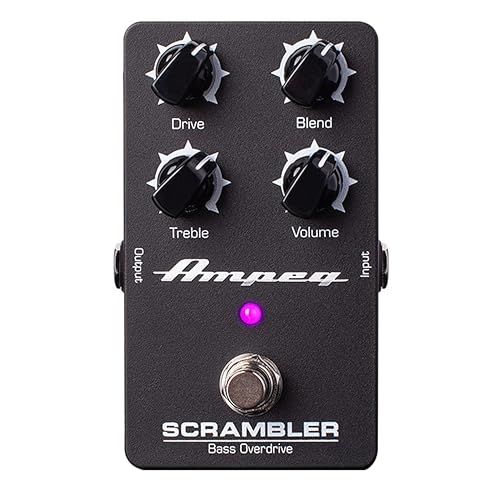
- Demo Scrambler Bass Overdrive Pedal
- Delivers classic Ampeg grit, grind, and sag

What to Consider Before Buying a Bass Distortion & Overdrive Pedal
A Bass Distortion & Overdrive Effects is more than just an item; it’s a key solution for bridging the gap between clean, dry direct signals and the expressive, rich harmonic breakup associated with high-end tube amplification. Unlike electric guitar overdrive pedals, which primarily focus on boosting midrange frequencies to cut through a mix, a dedicated bass overdrive must maintain ultra-clean low-frequency clarity while simultaneously adding harmonic drive to the mids and highs. Without proper signal routing and frequency tailoring, adding distortion to a bass guitar frequently results in lost dynamic punch, low-end dissipation, and harsh digital artifacts that clash with the kick drum.
The ideal customer for this type of pedal is a bassist looking to inject authentic amp-like warmth, harmonic grit, and dynamic compression into their signal chain—whether playing through a solid-state amplifier, direct into a PA via a DI box, or recording straight into an audio interface. It is particularly well-suited for players who prefer traditional, organic overdrive textures over hyper-compressed, high-gain fuzz. Conversely, it might not be suitable for modern metal performers seeking extreme, razor-sharp digital distortion or those using high-output active basses who require massive headroom without input clipping, unless they plan to carefully manage their instrument’s output gain.
Before investing, consider these crucial points in detail:
- Dimensions & Space: Consider your pedalboard footprint, input/output jack placement, and top-panel clearance. A standard compact pedal shape like the Ampeg Scrambler Bass Overdrive Pedal measures 6.04 x 3.46 x 2.91 inches and weighs roughly 11.6 ounces, making it easy to fit into tight pedalboard layouts without requiring custom angled patch cables or non-standard power routing solutions.
- Capacity/Performance & Circuitry: Pay close attention to whether the pedal utilizes pure analog circuitry or digital processing, as well as the presence of a dedicated Wet/Dry Blend control. Pure analog architecture offers immediate dynamic response, zero latency, and natural power-tube emulation, while a clean blend control ensures your fundamental sub-bass frequencies pass through completely unmolested by distortion.
- Materials & Durability: Gigging musicians put their stompboxes through harsh environments, including heavy foot pressure, transport shocks, and accidental spills. Look for an all-metal enclosure, heavy-duty tactile footswitches, firmly anchored potentiometers, and recessed control knobs that won’t shear off inside a gig bag during transit.
- Ease of Use & Maintenance: The control layout should be intuitive enough to make quick on-stage adjustments under dim lighting. Ensure the pedal operates on standard 9V DC power (center-negative) with minimal current draw (such as 20 mA), allowing for effortless integration with universal pedalboard power supplies or standard 9-volt batteries.
Understanding these critical features ensures you choose a stompbox that elevates your tone rather than compromising your rig’s foundation.
While the Ampeg Scrambler Bass Overdrive Pedal is an excellent choice, it’s always wise to see how it stacks up against the competition. For a broader look at all the top models, we highly recommend checking out our complete, in-depth guide:

- BLEND CONTROL — RETAIN LOW-END PUNCH WHILE ADDING GRIT: The DOUBLE THRUSTER features a dedicated Blend knob that mixes your clean bass signal with the overdriven signal. Dial it back to retain full...


- Based on a classic distortion circuit famous for its nasty sound
First Impressions and Key Features of the Ampeg Scrambler Bass Overdrive Pedal
Unboxing the Ampeg Scrambler Bass Overdrive Pedal immediately inspires confidence in its build quality. Encased in a sleek, roadworthy black all-metal chassis adorned with classic silver graphics, it feels remarkably solid in the hand. Weighing in at 11.6 ounces, the weight reflects heavy-duty internal componentry rather than cheap plastic framing. The physical design pays direct homage to legendary vintage gear while maintaining a footprint that effortlessly slots into modern board layouts. You can easily check its current price and availability online to see how competitively priced it is for an all-metal chassis construction.
The control panel features four simple, highly functional control knobs: Drive, Highs, Blend, and Volume. Removing the bottom plate reveals clean internal soldering and easy access to the 9V battery compartment, though most players will opt to power it via the standard 9V DC side jack drawing a modest 20mA. Plugging in for the first time, the footswitch engages with a satisfying mechanical click. When bypassed, the pure analog circuit keeps your dry signal pristine without any top-end tone suck or added noise floor. It becomes instantly clear that this stompbox was engineered specifically by bass specialists for bass players who value organic tone above all else.
Key Advantages
- Authentic analog SVT-style tube grit, warmth, and dynamic sag.
- Dedicated wet/dry Blend knob preserves critical low-end fundamentals.
- Ultra-durable, roadworthy all-metal chassis engineered for touring.
- Low 20mA power draw operates seamlessly on battery or standard 9V supply.
Considerations
- High-output active pickups may push the input gain into premature clipping.
- Treble frequencies can become slightly sizzly if the Highs knob is dimed.
Deep Dive Performance Analysis: Real-World Hands-On Evaluation
Pure Analog Tone Architecture and Authentic SVT Sag
When testing drive pedals built for bass, the first hurdle is always tone fidelity. Digital modelers often struggle to capture the non-linear compression and touch-sensitive feel of vacuum tubes working under load. During our extended testing phase with the Ampeg Scrambler Bass Overdrive Pedal, the pure analog signal path immediately proved its worth. Pushing the Drive knob past 11 o’clock produces a gorgeous, subtle harmonic saturation that mirrors an all-tube power amp section starting to warm up. Rather than layering a harsh, buzzy distortion mask over your tone, the pedal responds dynamically to your picking strength and finger-style touch nuances.
If you play lightly with the pad of your thumb or fingers, the signal remains warm, round, and clear with just a hint of vintage fur around the edges. Dig in hard with a heavy plectrum, and the pedal reacts with that unmistakable Ampeg “sag”—a subtle dynamic compression where the initial transient pick attack gives way to a grinding, thick sustain. This analog responsiveness makes the pedal feel like a natural extension of your amplifier rather than an external effect box added after the fact. To evaluate how this distinct tone response can integrate into your rig, you can see its full technical feature set and gain settings.
Furthermore, the range of the Drive control is exceptionally smooth. At minimum settings, it acts almost as a subtle harmonic enhancer, adding body to sterile direct-box signals. As you sweep past 2 o’clock, the character shifts into aggressive, grinding overdrive perfect for classic rock, punk, and hard-hitting alternative lines. Because the distortion harmonics are tuned specifically to bass frequencies, the pedal avoids the boxy midrange honk that ruins standard guitar overdrive circuits applied to bass instruments.
The Critical Role of the Parallel Wet/Dry Blend Control
In any professional bass rig, maintaining low-end punch is non-negotiable. The moment a drive pedal removes sub-bass frequencies below 100 Hz, the bass guitar loses its authority in a live room mix, forcing the sound engineer to fight to bring the bass back up in the main speakers. The Ampeg Scrambler Bass Overdrive Pedal solves this age-old problem by incorporating a dedicated parallel Blend control, which serves as a feature that really sets it apart from competing stompboxes in this price bracket.
The Blend knob allows you to mix your completely clean, uncompressed dry instrument signal with the fully overdriven analog circuit. During our studio testing, setting the Blend control right at 50/50 (12 o’clock) provided the ultimate sweet spot for dense rock mixes. The clean side of the path keeps the low-frequency fundamental rock-solid and articulate, driving the subwoofer cabinets with absolute authority. Simultaneously, the wet side of the path sits directly on top, delivering edge, teeth, and midrange presence that helps your bass lines cut effortlessly through dense wall-of-sound guitar textures.
This parallel processing capability means you can dial in an intensely aggressive, screaming drive sound on the wet circuit without worrying about losing your low-end weight. If you need maximum distortion for an extreme solo section, dialing the Blend control further clockwise emphasizes the grittier harmonics. If you simply want a subtle touch of warmth for jazz-fusion or vintage Motown lines, backing the Blend knob down to 25% adds just enough harmonic character while leaving your tone fundamentally untouched and completely clean.
Highs Frequency Shaping and EQ Dynamic Response
The Highs control on the Ampeg Scrambler Bass Overdrive Pedal plays an essential role in dictating the overall attitude of your overdriven tone. Unlike broad-stroke treble controls found on basic budget distortion boxes, this high-frequency EQ circuit is voiced specifically to control top-end sheen and pick attack click. Sweeping the Highs control from its minimum setting to maximum alters the personality of the overdrive dramatically.
When set around 9 o’clock to 10 o’clock, the Highs knob rolls off aggressive high-frequency sizzle, creating a dark, velvety, tubey grind reminiscent of early 1970s rock recordings. This setting excels when paired with flatwound strings or passive Precision-style basses, producing a smooth overdrive that blends seamlessly behind heavy rhythm guitars. Moving the Highs control up toward 2 o’clock introduces sharp top-end bite and glassiness, bringing out string clack, pick attack, and finger harmonics—ideal for aggressive slap bass techniques or fast, complex metal fingerpicking where every note definition must remain crystal clear.
We found that keeping the Highs knob between 11 o’clock and 1 o’clock offered the most balanced frequency response, maintaining clarity without introducing unwanted treble harshness. It gives you the power to compensate for dark amp speaker cabinets or bright tweeter-equipped 4×10 rigs effortlessly, guaranteeing consistent performance across different stage amplification setups. You can test drive this legendary analog grit for yourself to discover how effectively it cuts through your specific band mix.
Pickup Headroom, Active Signal Matching, and Guitar Crossover Potential
A crucial factor when evaluating any bass dirt box is how it handles different instrument output levels. During our hands-on testing, we paired the Ampeg Scrambler Bass Overdrive Pedal with traditional passive single-coil and split-coil basses, as well as modern active basses equipped with high-output 18-volt onboard preamps. With passive instruments like a classic Fender Precision or Jazz Bass, the pedal operates in its absolute comfort zone. The input impedance perfectly complements passive pickups, offering full dynamic range, clean tracking, and smooth control roll-off directly from your instrument’s volume knob.
However, when plugging in high-output active basses with boosted onboard EQ controls, the pedal’s analog input stage can be pushed hard. Because the internal headroom is optimized for vintage-style signal levels, ultra-hot active signals may trigger subtle input clipping before the Drive circuit even engages. To achieve optimal performance with active electronics, we recommend slightly backing off your instrument’s master output volume or keeping the onboard preamp EQ flat. This simple adjustment ensures the pedal clips smoothly through its designed overdrive circuit rather than overloading the front end.
In a surprising and welcome experiment, we also tested the Ampeg Scrambler Bass Overdrive Pedal with six-string electric guitars plugged into a high-gain tube amplifier setup. Because the pedal’s frequency curve is designed to maintain lower midrange integrity without losing bottom end, it functions as a phenomenally rich, warm overdrive for electric guitarists. It delivers full-bodied blues crunch and thick rhythm textures that sound shockingly close to boutique guitar overdrive units, adding immense cross-instrument value for multi-instrumentalists and studio producers alike.
What Other Users Are Saying: Real-World Bassist Insights
To provide a complete, well-rounded perspective, we synthesized user feedback from bassists across various musical backgrounds who have gigged and recorded extensively with the Ampeg Scrambler Bass Overdrive Pedal. The overwhelming consensus aligns directly with our hands-on test findings: musicians love the pedal’s simplicity, authentic tone, and rugged reliability.
Many owners frequently praise how simple it is to dial in usable tones within seconds of plugging in. Musicians across diverse genres—from classic rock and indie pop to church worship teams—report that the pedal seamlessly integrates into any rig setup. Numerous users specifically highlight the reasonable price point for an authentic Ampeg product, with several mentioning that they purchased the Scrambler after having great long-term success with Ampeg’s analog optical compressor and analog chorus pedals. A significant number of guitar players who borrowed the pedal also stepped forward to praise its warmth when applied to electric guitar, reinforcing our studio findings.
On the flip side, critical feedback comes almost exclusively from players who exclusively use high-output active basses. A few users reported returning the pedal because the hot preamp output of their active instruments created unwanted input saturation that felt overly compressed for their tastes. Additionally, international buyers noted that while logistics or customs clearance can occasionally present minor hurdles depending on regional shipping sellers, dedicated customer support teams quickly and satisfactorily resolve those rare administrative issues. Overall, the vast majority of players agree that for passive bass setups and classic rock tone shaping, it is an outstanding piece of gear. Feel free to read thousands of hands-on user ratings online to verify these real-world experiences.
How the Ampeg Scrambler Bass Overdrive Pedal Compares to Top Alternatives
1. SMD Distortion Detector DD-1

- Distortion detector/analyzer (dd1)
- Distortion detector's circuitry is 100% analog
The SMD Distortion Detector DD-1 is not an musical tone effect pedal; rather, it is a specialized audio diagnostic instrument designed to detect signal clipping and harmonic distortion in high-end car audio and professional sound system installations. While both devices deal with distortion, their purposes are entirely different. You would buy the SMD DD-1 if you are an audio technician, system installer, or sound engineer needing to calibrate amplifier gain structure precisely without damaging speakers. However, if you are a performing musician seeking to create warm, overdrive tone textures for your bass guitar, the Ampeg Scrambler Bass Overdrive Pedal is the dedicated effect pedal designed specifically for artistic tone production.
2. Behringer Bod400 Tube-Sound Bass Overdrive Pedal

- Get tube-like distortion, smooth sustain and super-fat tone
- Unique Balance control to blend between overdriven and dry bass sound for maximum punch
The Behringer Bod400 Tube-Sound Bass Overdrive Pedal represents an ultra-budget entry in the bass dirt category. It offers basic gain, EQ, and dry blend functionality aimed at beginner players or those working on extremely strict budgets. While the Bod400 delivers acceptable overdrive sounds for home practice, its lightweight plastic casing, cheaper footswitch construction, and higher self-noise floor leave it vulnerable on gigging stages. By contrast, the Ampeg Scrambler Bass Overdrive Pedal features superior pure analog audio path design, significantly better build quality with its roadworthy all-metal chassis, and a far more authentic SVT-style tube sag. You can explore current pricing options for this rugged unit to evaluate the long-term investment value.
3. Electro-Harmonix Bass Big Muff Pi Fuzz Pedal

- Tailor your drive/distortion sound with sustain, tone and volume knobs
- A dry switch that mixes your dry bass with the Bass Big Muff Pi's distortion
The Electro-Harmonix Bass Big Muff Pi Fuzz Pedal is an absolute icon in the world of heavy bass distortion, famous for producing thick, saturated, wall-of-fuzz sustain. The key distinction lies in the tonal character: the Bass Big Muff Pi delivers dense, scoop-heavy, aggressive fuzz ideal for stoner rock, shoegaze, and heavy doom metal where extreme sustain is required. The Ampeg Scrambler Bass Overdrive Pedal, on the other hand, provides smooth, dynamic, tube-style overdrive and subtle grind that keeps your natural bass voice completely intact. If you want extreme, saturated fuzz, choose the Muff; if you want touch-sensitive amp warmth, dynamic crunch, and vintage SVT punch, the Scrambler is the vastly superior choice.
Final Verdict: Is the Ampeg Scrambler Bass Overdrive Pedal Worth a Spot on Your Board?
After putting the Ampeg Scrambler Bass Overdrive Pedal through rigorous testing, we can confidently state that it delivers on its promise: delivering genuine, tube-style Ampeg grit, grind, and sag in a highly portable, tank-like stompbox. Its pure analog architecture captures the organic compression and harmonic richness of a cranked SVT amplifier, while the intuitive four-knob control layout makes dialing in incredible tones effortless. The standout inclusion of a dedicated wet/dry Blend control guarantees that your fundamental low-end punch remains intact, avoiding the thin, washed-out low end that plagues inferior drive circuits.
While players who exclusively use high-output 18-volt active basses should take care to manage their instrument’s output gain to prevent unwanted input clipping, passive bass players and vintage tone enthusiasts will find a reliable partner in this pedal. Furthermore, its surprising versatility when paired with electric guitars makes it a valuable secret weapon in any home or professional recording studio setup. Considering its durable all-metal construction, low power consumption, and highly accessible price point, this pedal earns a enthusiastic recommendation for any bassist wanting authentic tube character without breaking their back or their bank account. Don’t let weak direct tone hold your performance back—add authentic Ampeg grit to your pedalboard today and elevate your bass sound to the next level.
Last update on 2026-10-23 / Affiliate links / Images from Amazon Product Advertising API